
Warehousing is one of the harder industries to place with a PEO. You’re dealing with high workers’ comp exposure, OSHA obligations, a workforce that can double in size during peak season, and often multiple facilities across different states. Most generic PEO lists don’t account for any of that — they rank by brand name or surface-level price.
This list is built differently. Every provider here was evaluated on what actually matters for warehouse and distribution operations: how they handle workers’ comp, whether their safety programs are real or just a checkbox, multi-state payroll capability, and whether the pricing model makes sense for an hourly workforce. Use this as a starting point for your evaluation, not a final answer.
1. PEO Metrics
Best for: Warehouse businesses comparing multiple PEO providers before committing to a contract.
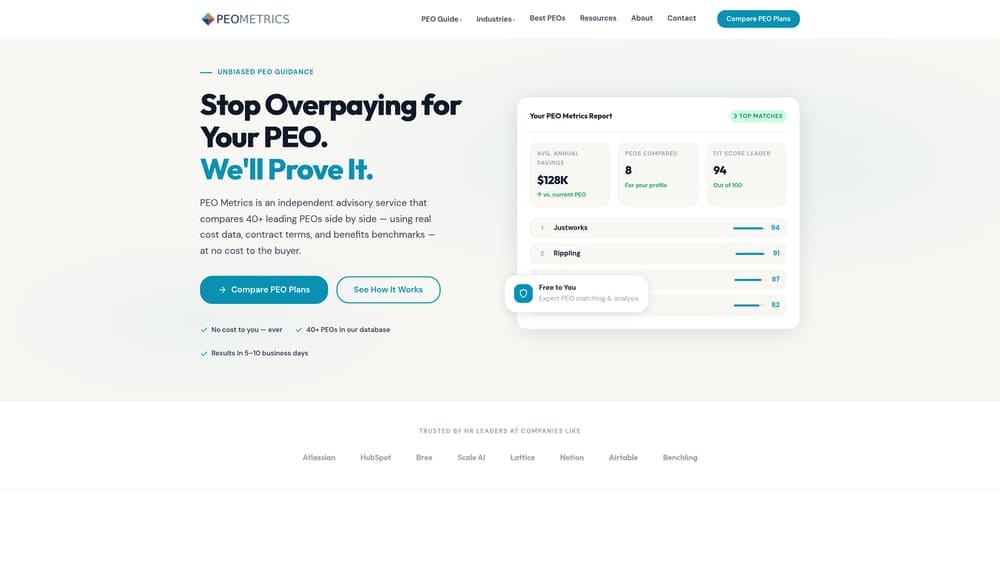
PEO Metrics is an independent PEO comparison service that helps warehouse and distribution businesses evaluate providers side-by-side — covering pricing models, workers’ comp handling, safety program support, and contract terms — without the sales pressure of going directly to a PEO.
Where This Tool Shines
The biggest mistake warehouse operators make when shopping for a PEO is evaluating providers in isolation. You get a pitch from one, a quote from another, and no real way to compare apples to apples. PEO Metrics exists to fix that. It gives you a structured, side-by-side view of what providers actually charge and what they actually offer for your specific headcount and risk profile.
For warehousing specifically, this matters more than in most industries. Workers’ comp pricing, safety program depth, and contract flexibility vary significantly across providers — and those differences have real dollar consequences. Knowing which PEOs have loss control services built in versus which ones treat safety as an afterthought is the kind of detail that’s hard to surface when you’re talking to sales reps.
Key Features
Side-by-Side Comparisons: Detailed pricing and capability data across multiple PEO providers in a single view.
Unbiased Guidance: Not affiliated with any single PEO — assessments aren’t shaped by referral incentives from one provider.
Workers’ Comp Evaluation: Specifically assesses how each PEO handles risk management and safety programs relevant to high-risk industries like warehousing.
Pricing Model Analysis: Helps identify whether a percentage-of-payroll or PEPM model makes more financial sense for your hourly workforce.
Contract Term Review: Surfaces flexibility clauses, exit terms, and minimum commitment structures before you sign.
Best For
Any warehouse or distribution business that’s evaluating PEOs for the first time or considering switching providers. Particularly useful if you’re unsure whether your current pricing model is the right fit for your headcount structure, or if you want to pressure-test a quote you’ve already received.
Pricing
Free to use. Revenue comes from provider relationships, not client fees — so there’s no cost to get a comparison done.
2. TriNet
Best for: Warehouse operators where benefits quality is a primary retention lever.
TriNet is a large, publicly traded PEO with strong benefits access and industry-specific service tracks, suited for warehouse operators where competitive benefits are a meaningful differentiator in a tight labor market.
Where This Tool Shines
Warehousing competes for labor against large fulfillment operators who offer robust benefits packages. TriNet’s access to large-group health, dental, vision, and retirement plans can help smaller warehouse businesses punch above their weight in that competition. If turnover is your primary problem and you’re losing workers to better benefits elsewhere, this is where TriNet earns its keep.
That said, TriNet is less specialized in blue-collar safety programs than some alternatives on this list. It’s a strong HR and benefits platform — but if workers’ comp cost reduction and OSHA program support are your top priorities, you’ll want to weigh that honestly.
Key Features
Large-Group Benefits Access: Health, dental, vision, and 401(k) plans typically unavailable to smaller employers on their own.
Industry-Specific HR Tracks: Service structures tailored to different business types, though not warehouse-specific by default.
Multi-State Payroll: Handles payroll and compliance across multiple states — relevant for distributed warehouse networks.
HR Technology Platform: Integrated payroll, time tracking, and HR management tools.
CPEO Certified: Provides federal tax liability protections for co-employed workers.
Best For
Warehouse businesses where labor retention is the primary challenge and competitive benefits are the solution. Less ideal if your main concern is workers’ comp cost control or OSHA compliance support.
Pricing
Custom pricing, typically quoted on a per-employee-per-month basis. Requires a direct quote from TriNet’s sales team.
3. Insperity
Best for: Mid-sized warehouse operations that need both HR depth and active risk management support.
Insperity is one of the largest full-service PEOs in the U.S., with dedicated HR specialists and risk management consulting that goes meaningfully beyond standard compliance — a real advantage for warehouse environments with OSHA exposure and elevated workers’ comp risk.
Where This Tool Shines
Insperity’s safety and risk management services are a genuine differentiator, not a marketing bullet point. For warehouse operators dealing with forklift operations, hazardous materials handling, or a history of workplace incidents, having access to dedicated safety consulting alongside standard HR administration is a different value proposition than most PEOs offer.
The dedicated HR specialist model also matters in warehousing, where workforce issues — attendance, turnover, disciplinary processes — tend to be more frequent and operationally disruptive than in office environments. Having a real person assigned to your account, not just a help desk, changes how quickly those situations get resolved.
Key Features
Dedicated HR Specialists: Assigned HR professionals per client account, not a shared service center.
Risk Management and Safety Consulting: Active safety program support, not just compliance documentation.
Comprehensive Benefits: Competitive health, dental, vision, and retirement plan access.
Multi-State Compliance: Handles regulatory requirements across multiple states for distributed operations.
Performance Management Tools: HR technology platform for employee management and documentation.
Best For
Warehouse businesses with 50 or more employees that need a full-service PEO with real safety consulting capability. Pricing tends to be at the higher end of the market, so it makes more sense at scale.
Pricing
Higher-end pricing; custom quotes required. Generally better value at 50+ employees where the dedicated service model justifies the cost.
4. ADP TotalSource
Best for: Larger warehouse and distribution operations with complex, multi-location payroll needs.
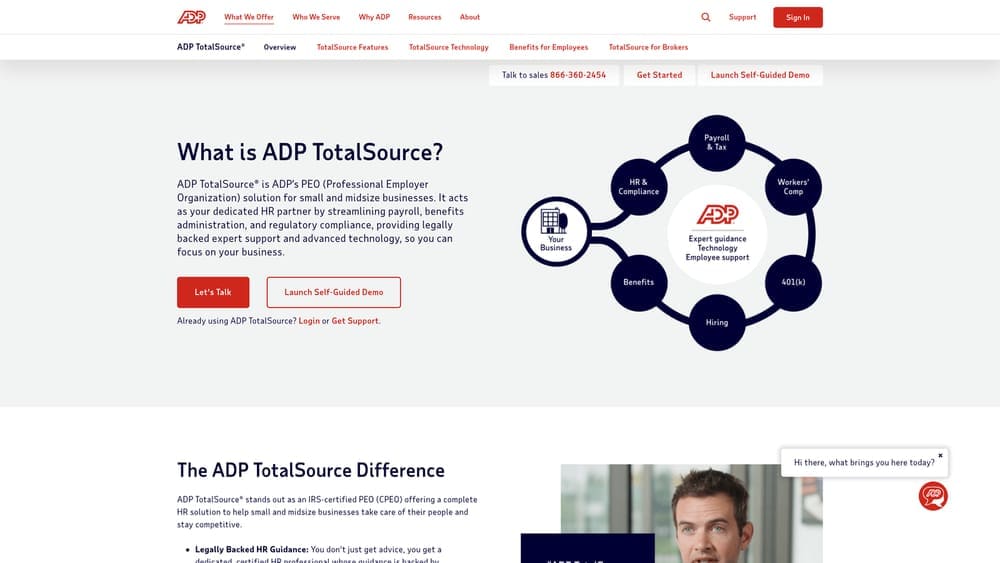
ADP TotalSource is ADP’s full-service PEO offering, built on deep payroll infrastructure and multi-state compliance capability — the right fit for warehouse operations where payroll complexity, not safety consulting, is the primary operational challenge.
Where This Tool Shines
If you’re running distribution centers across five states with different payroll cadences, varying state unemployment tax structures, and workers’ comp classifications that differ by location, ADP TotalSource’s infrastructure handles that without breaking a sweat. For companies already running ADP payroll, the integration is seamless — no data migration, no parallel systems, no transition headaches.
The CPEO certification also matters here. For larger operations, the federal tax liability protections that come with CPEO status can represent real financial value, particularly around employment tax responsibilities during the co-employment period.
Key Features
Multi-State Payroll Processing: Broad state coverage with deep compliance infrastructure for distributed operations.
ADP Integration: Seamless connection with existing ADP payroll systems for businesses already on the platform.
Workers’ Comp Administration: Administration and safety resources, though not as specialized as some alternatives.
Scalable Platform: Built to grow with distribution operations as headcount and locations expand.
Best For
Larger warehouse and distribution businesses with multi-state payroll complexity, particularly those already using ADP’s payroll infrastructure. Less differentiated for smaller operations or those prioritizing safety program depth.
Pricing
Custom pricing available as percentage of payroll or PEPM depending on structure. Requires a direct quote; pricing tends to be competitive at larger headcounts.
5. Justworks
Best for: Smaller warehouse businesses that need cost predictability and transparent pricing.
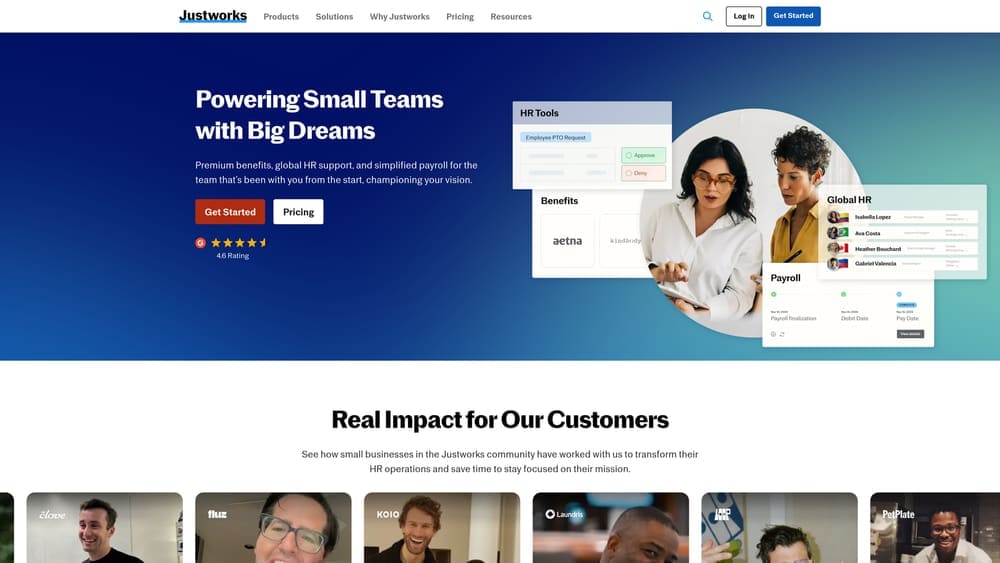
Justworks is a tech-forward PEO known for flat-rate per-employee pricing — a practical choice for smaller warehouse operations that need to know exactly what they’re paying each month without decoding a complex contract.
Where This Tool Shines
Pricing transparency is genuinely rare in the PEO market. Most providers require a custom quote, and the final number often includes bundled fees and administrative markups that aren’t immediately obvious. Justworks publishes its pricing tiers, which makes budgeting straightforward and removes a lot of the friction from the evaluation process.
For a small warehouse operation — say, under 50 employees — where the priority is getting payroll, benefits, and basic HR compliance handled without a complex setup, Justworks delivers that cleanly. It’s not the deepest platform for safety consulting or workers’ comp loss control, but it’s not trying to be.
Key Features
Transparent Flat-Rate Pricing: Published per-employee-per-month tiers with no hidden fees.
Benefits Access: Competitive health benefits and 401(k) options for smaller employers.
CPEO Certified: Federal tax protections for co-employed workers.
User-Friendly Platform: Clean HR and payroll interface that doesn’t require heavy training to use.
Multi-State Payroll: Handles payroll across multiple states for operations that cross state lines.
Best For
Small warehouse businesses under 50 employees where pricing clarity and ease of use matter more than specialized safety consulting or complex workers’ comp management.
Pricing
Published tiered pricing starting around $59–$99 per employee per month depending on plan — one of the most transparent pricing structures in the PEO market.
6. Paychex PEO
Best for: Multi-location warehouse businesses that want relationship-based service with local support.
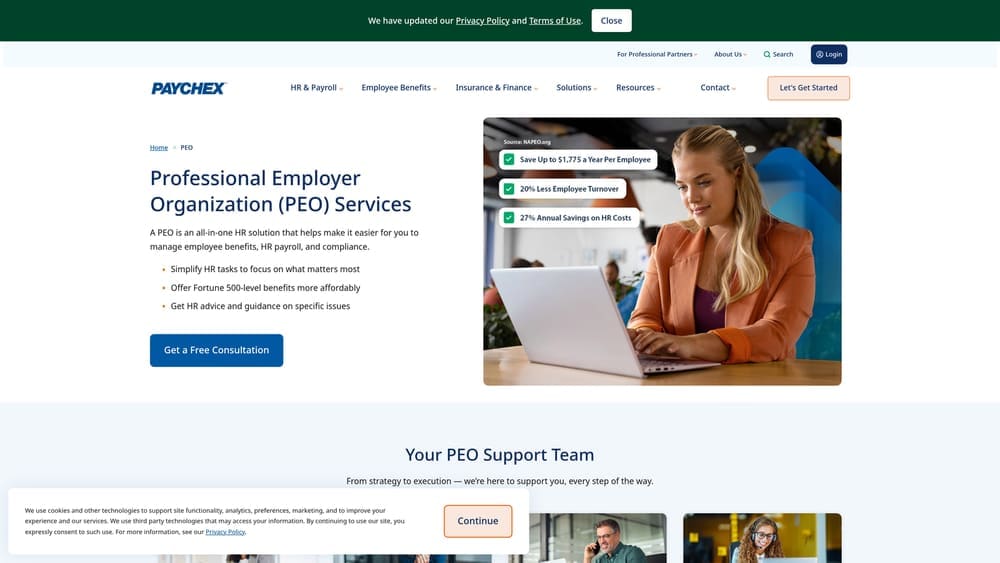
Paychex PEO is a national PEO backed by Paychex’s payroll infrastructure, with an extensive local representative network that makes it practical for warehouse operators managing multiple facilities who want in-person service rather than a remote help desk.
Where This Tool Shines
The local representative network is Paychex’s most distinctive operational advantage. For a warehouse operator running three distribution centers in different cities, having a local Paychex rep who knows your account and can show up in person is a different service experience than most national PEOs offer. That relationship model matters when you’re dealing with time-sensitive compliance issues or workforce situations that need human judgment, not a ticket queue.
Paychex also offers flexibility between full PEO co-employment and HRO (HR outsourcing) arrangements, which can be useful if you want some services without full co-employment. That optionality is worth understanding before you commit to a structure.
Key Features
Local Representative Network: Extensive in-person coverage across the U.S. for relationship-based service.
Multi-State Compliance: Broad state coverage for distributed warehouse and distribution networks.
Workers’ Comp Administration: Administration and safety resources for higher-risk classifications.
Flexible Service Models: PEO or HRO options depending on how much co-employment you want.
HR Technology: Integrated payroll and time tracking platform.
Best For
Multi-location warehouse operations that value in-person service relationships and want flexibility in how they structure HR outsourcing. Pricing is typically negotiable based on headcount and services selected.
Pricing
Custom pricing, negotiable based on headcount and services. Requires a direct quote from a Paychex representative.
7. Oasis (a Paychex Company)
Best for: Warehouse operators with elevated workers’ comp risk profiles and loss control needs.
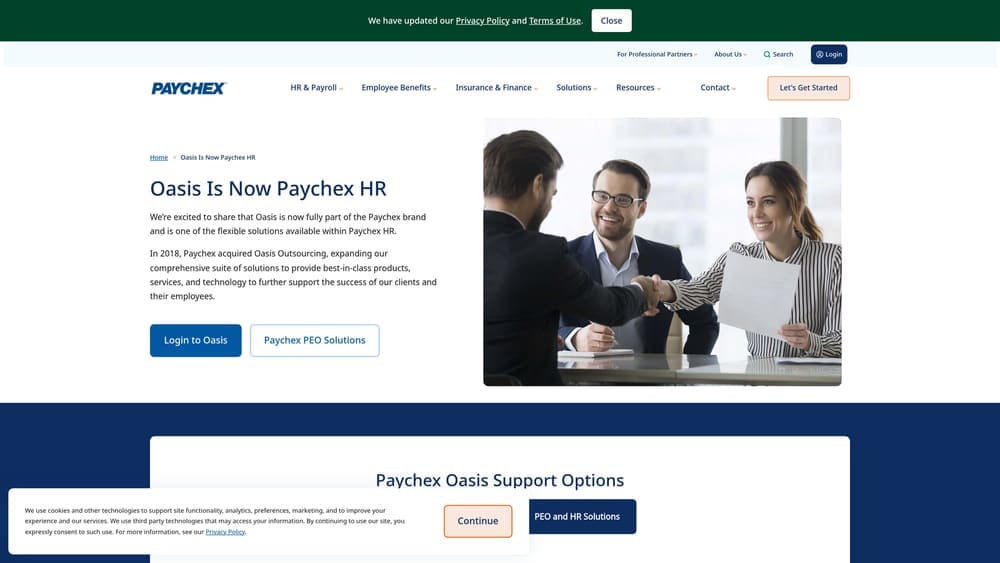
Oasis operates within the Paychex family but has historically maintained distinct program characteristics — particularly around workers’ comp and loss control services that are directly relevant to high-risk warehouse classifications.
Where This Tool Shines
Workers’ comp is where Oasis earns its place on this list. For warehouse operations with elevated NCCI classification codes and a history of claims, a PEO with active loss control support — not just claims administration — can have a real impact on mod rate trajectory over time. Oasis has built programs around this kind of risk profile, which makes it a more targeted fit than a generalist PEO for operations where workers’ comp cost is the primary financial concern.
Because it operates within the Paychex ecosystem, you also get access to broader HR and benefits infrastructure without starting from scratch with an unfamiliar platform. It’s worth comparing directly against Paychex PEO to understand where the program differences actually sit for your specific risk classification.
Key Features
Workers’ Comp Programs with Loss Control: Active safety and loss control support for high-risk industry classifications.
HR Administration and Compliance: Standard HR services including payroll and tax administration.
Benefits Access: Health and retirement benefits through the Paychex ecosystem.
Payroll Processing: Integrated payroll and tax administration.
High-Risk Industry Experience: Relevant experience with elevated workers’ comp classifications common in warehousing.
Best For
Warehouse businesses where workers’ comp cost management and mod rate reduction are the primary drivers for choosing a PEO. Worth comparing directly against G&A Partners if this is your main concern.
Pricing
Custom pricing within the Paychex pricing ecosystem. Requires a direct quote; pricing structure may differ from standard Paychex PEO.
8. Employer Flexible
Best for: Warehouse and distribution operations in Texas and the broader Sun Belt region.
Employer Flexible is a regional PEO with deep compliance expertise in Texas and surrounding Sun Belt states — a practical option for warehouse operators in those markets where state-specific regulatory nuances make local knowledge genuinely valuable.
Where This Tool Shines
Texas has its own workers’ comp framework — it’s a non-subscriber state, which means the standard workers’ comp rules that apply in most of the country don’t automatically apply here. That creates real compliance complexity for warehouse operators, and a PEO with deep Texas-specific experience handles that differently than a national provider who treats Texas as just another state in the system.
The Sun Belt logistics corridor — Texas, Oklahoma, Louisiana, and surrounding states — has seen significant warehouse and distribution growth, and Employer Flexible’s regional focus means they understand the specific labor market and regulatory environment those operations are navigating. If your facilities are concentrated in this region, a regional PEO can often outperform a national one on service quality and local responsiveness.
Key Features
Regional Compliance Expertise: Deep knowledge of Texas and Southeast market regulatory requirements.
Workers’ Comp Administration: Safety support with awareness of Texas non-subscriber framework complexities.
Relationship-Based Service: Regional focus typically translates to more accessible, personalized service.
HR and Payroll Services: Core HR administration tailored to regional business needs.
Sun Belt Market Focus: Relevant for warehouse operators in high-growth logistics corridors across the region.
Best For
Warehouse and distribution businesses with primary operations in Texas or surrounding Sun Belt states. Not the right fit if your facilities are spread across the Northeast, Midwest, or West Coast — the regional focus is the value, not a limitation to work around.
Pricing
Custom pricing as a regional PEO. Requires a direct quote; pricing may be competitive relative to national providers for in-region operations.
9. G&A Partners
Best for: Warehouse operators with active OSHA exposure or high mod rates who need real safety consulting, not just HR administration.
G&A Partners is a Texas-based PEO with national reach that includes dedicated safety consulting as a core service — built into the offering, not sold as an add-on — making it a strong fit for warehouse operators actively trying to reduce incident rates and experience modification scores.
Where This Tool Shines
Most PEOs offer “safety resources” — which in practice often means access to a document library or a hotline. G&A Partners treats safety consulting as a core deliverable, not a marketing feature. For a warehouse operation with a history of OSHA citations, elevated mod rates, or ongoing forklift and materials handling risk, that distinction matters in ways that show up in actual cost over time.
Mod rate reduction is a long game. It requires consistent safety program implementation, incident documentation, and claims management — not just a checklist at onboarding. G&A Partners’ approach is oriented toward that kind of sustained engagement, which is why it belongs on a warehousing-specific list even though it’s less well-known than some of the national brands above.
Key Features
Dedicated Safety Consulting: Built-in safety program support, not an optional add-on.
Workers’ Comp with Active Loss Control: Claims management and incident reduction support for high-risk classifications.
HR Compliance and Payroll: Full HR administration including payroll processing and tax compliance.
Benefits Access: Health and retirement plan options for co-employed workers.
National Coverage: Despite regional roots, serves businesses across the country.
Best For
Warehouse operators with OSHA history, elevated mod rates, or a genuine commitment to reducing workplace incidents over time. The safety consulting depth makes this more valuable for higher-risk operations than for businesses where workers’ comp is a minor cost factor.
Pricing
Custom pricing; requires a direct quote. National coverage despite Texas-based roots, so don’t assume it’s limited to the Sun Belt.
Which PEO Actually Fits Your Warehouse Operation
Picking a PEO for a warehousing operation isn’t the same as picking one for a software company. Workers’ comp rates, OSHA compliance, seasonal headcount swings, and multi-state payroll complexity all push you toward providers with specific capabilities — not just the biggest brand names or the most recognizable logo.
Here’s a quick way to think about it. If workers’ comp cost is your primary concern, look hard at Oasis and G&A Partners — both are built around loss control and risk management in ways that generalist PEOs aren’t. If benefits quality is driving turnover and you need to compete for hourly labor, TriNet and Insperity are worth a serious look. If you’re small and need pricing clarity before anything else, Justworks is the most transparent option in the market. And if you’re running multi-state distribution with complex payroll, ADP TotalSource or Paychex PEO will have the infrastructure to handle it without friction.
For warehouse operators in Texas and the Sun Belt specifically, Employer Flexible’s regional depth is worth considering before defaulting to a national provider. Regional expertise in a non-subscriber workers’ comp state isn’t a small thing.
If you’re still early in the process, start with PEO Metrics to get a side-by-side comparison of what these providers actually charge and offer for your specific headcount and risk profile. It removes the sales pressure from the evaluation and surfaces the details — pricing model structure, contract flexibility, workers’ comp handling — that matter most for a warehousing operation.
One rule that applies regardless of where you are in the process: don’t evaluate fewer than three providers, and don’t sign without understanding the exit terms. The pricing variance between providers for the same headcount can be significant, and contracts designed around minimum commitments can be costly if your headcount shifts seasonally.
Don’t auto-renew. Make an informed, confident decision.
Before you sign that PEO renewal, make sure you’re not leaving money on the table.
Many businesses unknowingly overpay because of bundled fees, hidden administrative markups, and contracts designed to limit flexibility. We give you a clear, side-by-side breakdown of pricing, services, and contract terms—so you can see exactly what you’re paying for and choose the option that truly fits your business.
