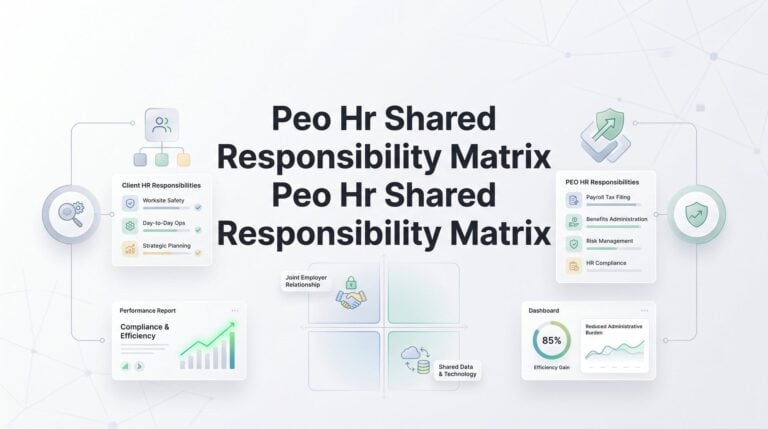
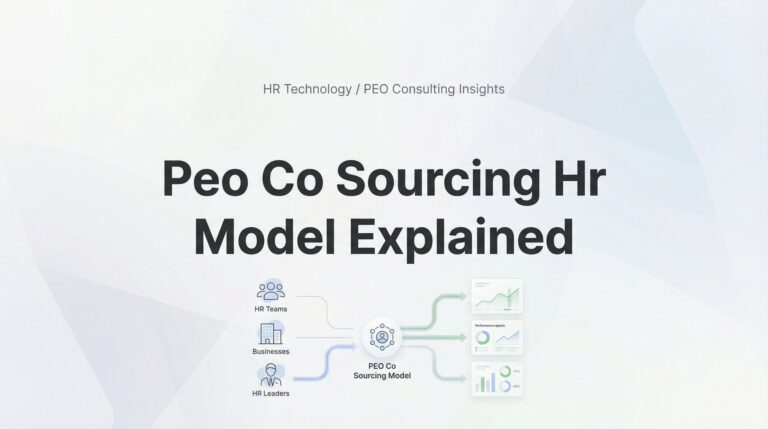
A PEO is the legal employer of record for your employees’ tax, benefits, and workers’ comp purposes. You stay the worksite employer — you hire, fire, manage performance, set culture. The PEO files payroll taxes under its own EIN, provides health insurance under its master plan, and absorbs the administrative weight of being an employer of record across 50 states.
The structure exists because the math works out differently at scale than it does at small-business scale. When 1,500 small employers pool into one PEO’s group health plan, the actuarial risk smooths out. Aetna or UnitedHealthcare sees a 50,000-life book and prices accordingly — typically 15–30% lower than what a 50-person company can negotiate solo, with networks that are 2–3 tiers deeper.
The same logic applies to workers’ compensation. A 75-employee Texas plumbing contractor with a standalone mod of 1.34 might join a PEO whose blended mod is 0.92. That spread, applied to a $400K annual workers’ comp premium, is the difference between profitable and bleeding.
When does a PEO actually make sense? Three triggers, in our experience:
- You’re scaling past 10 employees and your HR is one overworked person + a stack of spreadsheets
- You operate in 3+ states and the compliance complexity is starting to surface real risk (PSD penalties, missed labor-law posters, surprise NJ unemployment audits)
- Your broker can’t get you competitive group health quotes because you’re in the small-group rating tier (typically under 100 employees)
A PEO is usually wrong when: you’re under 5 employees (the math doesn’t pencil), publicly traded (audit complications), have specialty workforce arrangements (heavy 1099 mix, union shops, international employees), or have benefits relationships you can’t replace. We tell roughly 1 in 5 discovery-call prospects that a PEO isn’t the right fit. The honest answer matters — wrong-fit clients are the ones who write the angry Trustpilot reviews 18 months later.