
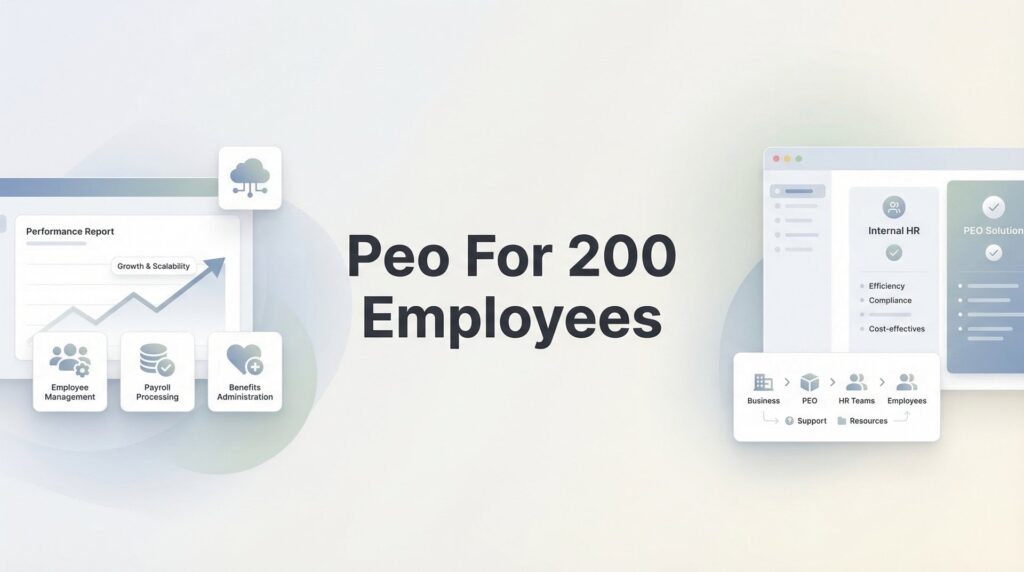
At 200 employees, you’re in a peculiar spot. Too big for the scrappy startup PEO packages, not quite large enough to justify a fully staffed in-house HR department. This headcount tier creates specific challenges—you likely have dedicated HR staff but they’re stretched thin across compliance, benefits administration, and employee relations.
The PEO decision at this size isn’t about whether you need HR help. It’s about optimizing what you’re already spending and filling gaps that are costing you money or exposing you to risk.
These seven strategies address the unique dynamics of evaluating PEO partnerships when you’ve outgrown basic solutions but haven’t reached enterprise scale.
1. Audit Your Current Per-Employee HR Costs Before Shopping
The Challenge It Solves
Most companies at 200 employees know roughly what they spend on HR salaries and benefits administration. What they don’t know is the true all-in cost per employee—including the hidden overhead that PEO proposals will replace.
Without this baseline, you’re comparing PEO quotes against incomplete internal cost data. You might dismiss a $180 PEPM quote as too expensive when your actual current cost is $220 per employee once you account for everything.
The Strategy Explained
Build a comprehensive cost model that captures every dollar currently flowing into HR operations. Start with obvious line items: HR staff salaries, benefits broker fees, payroll processing costs, HRIS subscription fees, workers’ comp premiums, and compliance software.
Then add the hidden costs. Time your finance team spends on payroll tax filings. Legal fees for employment matters. The portion of your insurance broker’s time spent on benefits administration. Technology support for HR systems. Training costs for compliance updates.
Divide this total annual figure by 200 employees, then by 12 months. That’s your true per-employee-per-month baseline. This number tells you what you’re actually spending today—and what a PEO needs to beat or match while adding value. For a detailed framework on running these numbers, see our guide on PEO ROI and cost-benefit analysis.
Implementation Steps
1. Pull 12 months of expenses across HR salaries, benefits administration, payroll processing, HRIS fees, workers’ comp, and compliance tools
2. Add indirect costs: percentage of finance team time on HR tasks, legal fees for employment matters, broker fees, technology support
3. Calculate total annual HR cost divided by 200 employees divided by 12 to get your per-employee-per-month baseline
4. Document what’s included in this baseline so you can compare apples-to-apples against PEO service bundles
Pro Tips
Don’t forget to include the cost of things that aren’t happening but should be—like proactive compliance audits or structured performance management. If a PEO fills those gaps, that’s real value even if it’s not currently in your budget.
2. Negotiate Pricing Structures That Reward Your Scale
The Challenge It Solves
PEO pricing models vary wildly—flat per-employee-per-month fees, percentage of payroll, tiered structures, or hybrid approaches. At 200 employees, you have enough volume to negotiate, but many companies accept the first pricing structure offered without understanding how it scales with their specific compensation profile.
If your average salary is $75,000 and you’re quoted 3% of payroll, you’re paying $187.50 per employee per month. A company with $50,000 average salaries pays $125 PEPM for identical services. That compensation structure difference costs you $150,000 annually.
The Strategy Explained
Start by calculating what different pricing models would actually cost you based on your real payroll data. Run the math on flat PEPM fees, percentage-of-payroll models, and tiered structures. See which model favors your compensation profile.
Then use your 200-employee volume as leverage. You’re large enough to matter to most PEOs but not so large that you’re demanding custom enterprise pricing. This sweet spot gives you negotiating power. Our PEO contract negotiation guide walks through specific tactics for leveraging your scale.
Push for volume discounts, capped per-employee fees, or hybrid models that protect you from percentage-based inflation as you give raises. Ask what happens to your pricing when you hit 250 employees—will you get better rates or stay locked into your initial tier?
Implementation Steps
1. Calculate your total annual payroll and average employee compensation to model different pricing structures accurately
2. Request quotes in multiple formats: flat PEPM, percentage of payroll, and tiered structures to compare total annual cost
3. Negotiate volume discounts or rate locks based on your 200-employee scale and projected growth trajectory
4. Secure written commitments on how pricing adjusts as you scale to 250+ employees to avoid surprise increases
Pro Tips
If you have high-compensation roles (executives, senior engineers, specialized sales), percentage-of-payroll models will hurt you disproportionately. Push for flat PEPM structures or hybrid models with caps on high earners.
3. Evaluate Benefits Buying Power Against Your Current Broker
The Challenge It Solves
The standard PEO pitch emphasizes pooled benefits buying power—access to Fortune 500-level health plans through the PEO’s master policy. At 200 employees, you likely already have decent group rates through your existing broker. The question isn’t whether PEO benefits exist; it’s whether they’re actually better than what you have.
Many companies assume PEO benefits will automatically beat their current plans without running side-by-side comparisons. They discover too late that their existing broker negotiated better rates or that the PEO’s plan design includes higher deductibles that employees hate.
The Strategy Explained
Request detailed benefits proposals from PEOs that mirror your current plan designs as closely as possible. Don’t just compare premium costs—compare deductibles, copays, out-of-pocket maximums, network coverage, and prescription drug formularies.
Calculate total cost of coverage, not just employer premiums. If the PEO plan shifts $2,000 more in deductibles to employees while saving you $1,500 in premiums, that’s not a win—it’s a compensation cut disguised as cost savings. Understanding how PEO benefits administration outsourcing actually works helps you evaluate these tradeoffs.
Talk to your current broker before making any moves. Show them the PEO benefits proposal and ask if they can match or beat it. Brokers often have flexibility to improve rates when they know they’re competing against a PEO transition.
Implementation Steps
1. Document your current benefits plan details including premiums, deductibles, copays, networks, and employer contribution percentages
2. Request PEO benefits proposals that match your current plan design as closely as possible for apples-to-apples comparison
3. Calculate total cost of coverage including employee out-of-pocket exposure, not just employer premium savings
4. Share PEO proposals with your current broker and ask if they can match or improve on pricing before committing
Pro Tips
Pay attention to network coverage if you have multi-state employees. Some PEO health plans use regional networks that may not cover your remote workers as well as your current national plan does.
4. Map Multi-State Complexity Before Assuming You Need It
The Challenge It Solves
PEOs sell multi-state compliance support as a major value driver. For companies with employees across many states, that’s legitimate. But at 200 employees, you might have most people concentrated in 2-3 states with just a handful of remote workers scattered elsewhere.
If you’re paying for comprehensive 50-state compliance infrastructure when you only need deep expertise in three states, you’re subsidizing capabilities you’ll never use. That’s expensive insurance against a problem you don’t actually have.
The Strategy Explained
Map your actual geographic footprint. Count how many employees you have in each state, not just whether you have any presence there. Identify which states drive the bulk of your compliance complexity—California, New York, and a few others have dramatically more regulatory burden than most.
Assess whether your current HR team already handles multi-state payroll compliance adequately for your footprint. If you have 180 employees in two states and 20 remote workers across eight others, you might not need PEO-level multi-state support. You might just need a good employment law hotline and occasional counsel.
If you do have meaningful multi-state complexity, verify that the PEO actually provides state-specific expertise, not just generic compliance templates. Ask about their local HR support in your key states and whether they have experience with your specific regulatory challenges.
Implementation Steps
1. Document employee count by state to identify where your actual compliance exposure lives versus scattered remote workers
2. Assess current compliance gaps or risks in your key states—are these problems your internal team can’t solve?
3. Ask PEOs specifically how they handle compliance in your top 3 states and whether they have local HR support or just centralized resources
4. Compare cost of PEO multi-state support against targeted solutions like employment law hotlines or fractional HR for specific states
Pro Tips
If you’re planning aggressive remote hiring across many states, multi-state PEO support becomes more valuable. But if your footprint is stable, don’t pay for infrastructure you won’t use.
5. Define the HR Support Model You Actually Need
The Challenge It Solves
At 200 employees, you probably have 1-3 people handling HR internally. The question isn’t whether you need HR support—it’s what kind of support fills your actual gaps versus what PEOs want to sell you.
PEO service tiers range from basic administrative support to full-service HR partnership with dedicated account managers. The pricing difference between these tiers is substantial. Many companies buy more service than they need because they don’t clearly define what their internal team can handle versus where they need external expertise.
The Strategy Explained
Start by honestly assessing your internal HR team’s strengths and gaps. Can they handle day-to-day employee relations, or do they need coaching on difficult terminations and performance issues? Do they stay current on compliance changes, or do they need someone watching for regulatory updates?
Map PEO service tiers against your specific gaps. If your HR person is strong on employee relations but weak on benefits administration, you need excellent benefits support and solid compliance backing—not necessarily a dedicated HR business partner who’ll duplicate what you already do well internally. This is the core tradeoff in the PEO vs in-house HR department decision.
Understand the difference between shared support (you’re one of many clients assigned to a representative) versus dedicated support (you have a named person who knows your business). Shared support costs less but means longer response times and less institutional knowledge about your company.
Implementation Steps
1. List your internal HR team’s core strengths and specific knowledge gaps or capacity constraints
2. Map those gaps against PEO service tier descriptions to identify which level of support actually fills your needs
3. Ask PEOs specifically about response times, whether support is shared or dedicated, and how they handle urgent employee relations issues
4. Request references from companies similar to your size and industry to verify service quality matches what’s promised
Pro Tips
The most expensive service tier isn’t always the best fit. If your internal HR team is competent but capacity-constrained, you might need administrative burden reduction more than strategic HR partnership.
6. Stress-Test Technology Integration Requirements
The Challenge It Solves
Moving to a PEO means adopting their technology platform for payroll, benefits administration, time tracking, and HR records. At 200 employees, you likely have established systems that work—even if they’re not perfect.
The technology transition risk isn’t just about whether the PEO’s platform has the features you need. It’s about integration with your existing financial systems, the actual cost of migration, employee disruption during the transition, and whether you’re locked into their platform if you eventually leave.
The Strategy Explained
Request detailed demonstrations of the PEO’s technology platform focused on your specific workflows. Don’t just watch a sales demo—ask to see how your finance team would pull data for month-end close, how managers would approve time off, how employees would update their information. Our breakdown of PEO HR technology platforms covers what to look for in these demos.
Map integration requirements with your existing systems. Does your accounting software connect to their payroll platform? Can you export data in formats your financial systems need? What happens to historical data if you transition away from the PEO later?
Calculate the true cost of migration. This includes data conversion, employee training, IT support during transition, and the productivity loss as people learn new systems. Add this one-time cost to your first-year PEO expense when comparing against keeping your current setup.
Implementation Steps
1. Document your current technology stack including payroll, HRIS, time tracking, benefits administration, and accounting systems
2. Request PEO platform demonstrations focused on your specific workflows and integration requirements with existing systems
3. Ask about data migration process, historical data access, and data portability if you eventually transition away from the PEO
4. Calculate total transition cost including data conversion, training, IT support, and productivity loss during the switch
Pro Tips
Pay special attention to reporting capabilities. If your current systems let you build custom reports and the PEO platform only offers standard templates, that limitation will frustrate your finance team constantly.
7. Build an Exit Strategy Into Your Initial Contract
The Challenge It Solves
Most companies evaluate PEO contracts focused on what they’re getting, not how they’ll get out if things don’t work. At 200 employees, you’re likely to grow—potentially past the point where a PEO makes sense—or your needs may change in ways that make the partnership less valuable.
PEO contracts with long terms, auto-renewal clauses, and expensive exit provisions can trap you in relationships that no longer serve your business. The time to negotiate flexibility is before you sign, not when you’re trying to leave.
The Strategy Explained
Start with contract length. Push for one-year initial terms with annual renewal options rather than multi-year commitments. If the PEO insists on longer terms, negotiate lower rates for the commitment or clear exit provisions.
Understand termination requirements in detail. How much notice do you need to give? Are there termination fees? What happens to your benefits mid-year if you leave? Can you terminate for cause if service quality drops, or are you locked in regardless? Our guide to leaving a PEO covers what you need to know about exit logistics.
Clarify data ownership and portability. When you leave, do you get complete historical data in usable formats? Can you export employee records, payroll history, and benefits information cleanly? Some PEOs make data extraction difficult as a retention tactic.
Implementation Steps
1. Negotiate one-year initial contract terms with annual renewals rather than multi-year commitments that limit flexibility
2. Document termination requirements including notice periods, any termination fees, and provisions for leaving mid-year
3. Secure written commitments on data ownership, export formats, and historical data access after termination
4. Add performance-based termination clauses that let you exit without penalty if service levels drop below agreed standards
Pro Tips
Auto-renewal clauses with long notice periods are common traps. If the contract auto-renews unless you give 90 days notice, set a calendar reminder for 120 days before renewal to evaluate whether you want to continue.
Putting These Strategies to Work
The 200-employee PEO decision isn’t about finding the “best” PEO. It’s about finding the right fit for your specific cost structure, growth trajectory, and operational gaps.
Start with the cost audit to establish your baseline. That number tells you what you’re actually spending today and what a PEO needs to beat or match while adding value. Then use your scale as leverage in negotiations—you’re large enough to matter but not so large that you’re stuck with rigid enterprise pricing.
Don’t assume PEO benefits will beat your current broker without verification. Run side-by-side comparisons that account for total cost of coverage, not just employer premiums. And be honest about your multi-state complexity—if you don’t actually need comprehensive 50-state support, don’t pay for it.
Match PEO service tiers to your internal HR team’s actual gaps. The most expensive service level isn’t always the best fit if your team is already strong in areas the PEO wants to duplicate. And critically, stress-test technology integration requirements before you commit. The platform transition cost and disruption are real expenses that belong in your first-year analysis.
Build in flexibility for what comes next. Whether that’s scaling to 300+ employees or eventually transitioning to a fully in-house model, the contract terms you negotiate today determine your options tomorrow. One-year terms with clear exit provisions protect you far better than multi-year commitments with expensive termination fees. If you’re approaching the next growth tier, our strategies for PEO at 250 employees cover what changes at that scale.
The companies that get this decision right treat it as a strategic partnership evaluation, not a vendor selection. They know their numbers, understand their gaps, and negotiate from a position of clarity about what they actually need.
Before you sign that PEO renewal, make sure you’re not leaving money on the table. Many businesses unknowingly overpay because of bundled fees, hidden administrative markups, and contracts designed to limit flexibility. We give you a clear, side-by-side breakdown of pricing, services, and contract terms—so you can see exactly what you’re paying for and choose the option that truly fits your business. Don’t auto-renew. Make an informed, confident decision.
