
Manufacturing HR isn’t office HR. You’re dealing with multiple workers’ comp class codes on the same floor, OSHA 300 logs, shift differentials, and a labor market where skilled trades workers have real options. The tools that work for a 15-person marketing agency don’t necessarily work for a 75-person machine shop.
The PEO vs. payroll company decision hits differently in manufacturing because the stakes are different. Workers’ comp structure, safety compliance, and benefits competitiveness for trades retention are all in play. Get it wrong and you’re either overpaying for a PEO you don’t need, or underprotected with a payroll platform that can’t touch your actual risk exposure.
Here’s a practical breakdown of the leading options — PEOs and payroll companies — covering what each one actually handles in a manufacturing context, where they fall short, and which type of provider fits which situation.
1. PEO Metrics
Best for: Manufacturers evaluating multiple PEO providers simultaneously without vendor bias
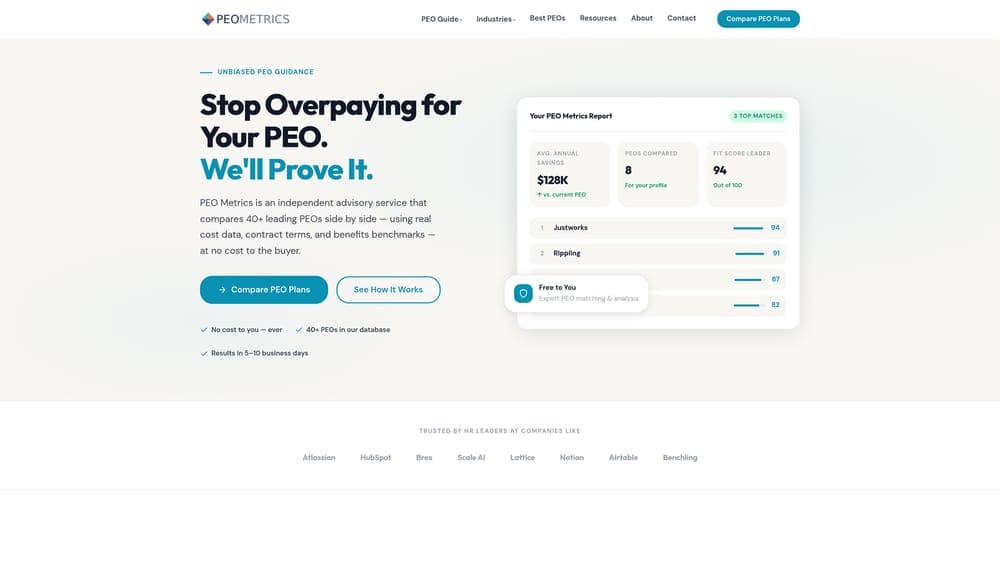
PEO Metrics is an independent comparison platform that helps manufacturers cut through PEO sales noise and evaluate providers on actual pricing, coverage, and fit.
Where This Tool Shines
This isn’t a PEO. It’s a decision tool — and that distinction matters. Most manufacturers shopping for a PEO end up talking to sales reps who have every incentive to close a deal, not help you find the right fit. PEO Metrics sits outside that dynamic entirely. There’s no financial relationship with any PEO provider.
For manufacturers specifically, the platform helps surface which PEOs have real experience with multi-code workers’ comp environments, manufacturing-specific compliance, and the benefits depth needed to retain skilled trades workers. That’s not something a generic Google search or a broker with a preferred vendor list is going to give you cleanly.
Key Features
Side-by-Side PEO Comparisons: Pricing and coverage data presented together so you can see actual differences, not just marketing language.
No Vendor Bias: PEO Metrics has no financial relationship with any PEO provider, so the guidance reflects your needs, not a commission structure.
Industry-Specific Filtering: Helps identify which PEOs have manufacturing experience and appropriate workers’ comp handling for multi-code environments.
Headcount-Calibrated Analysis: Metrics are tailored to your actual employee count, which matters because PEO pricing models shift significantly across headcount tiers.
Free to Use: No subscription, no sales pressure, no upsell.
Best For
Any manufacturer considering a PEO for the first time, or coming up on contract renewal and wondering if they’re getting a fair deal. Particularly valuable if you’re comparing three or more PEOs at once and don’t want to manage that process through competing sales reps.
Pricing
Free to use. No cost to run comparisons or access guidance.
2. Insperity
Best for: Mid-market manufacturers with 50–500 employees who want enterprise-grade benefits and dedicated HR support
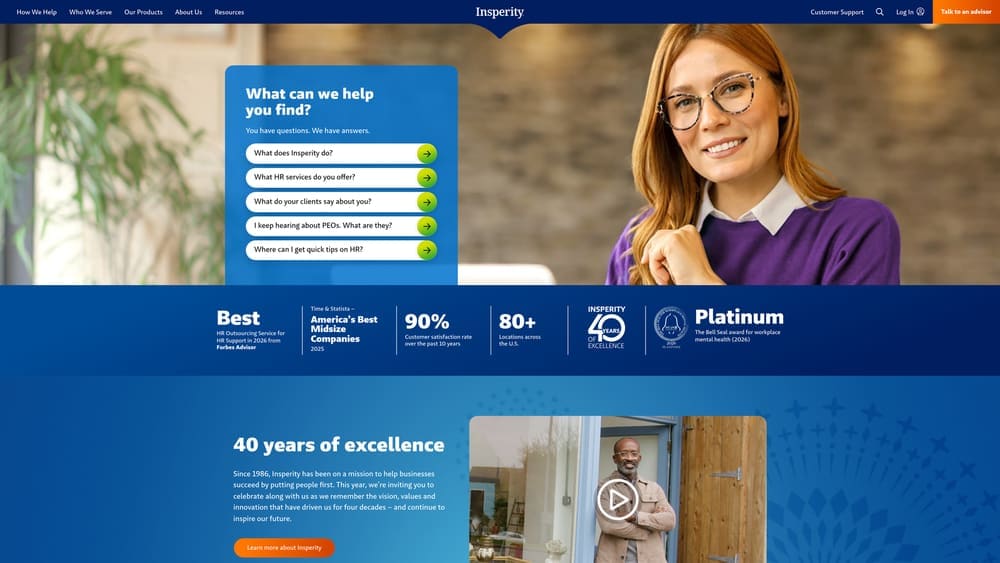
Insperity is a full-service PEO with a strong track record in mid-market manufacturing and a dedicated HR specialist model that goes beyond call center support.
Where This Tool Shines
Insperity’s biggest differentiator for manufacturers is the dedicated HR specialist model. You get an assigned specialist who knows your account, not a rotating support queue. For a plant manager dealing with an OSHA recordable incident or a workers’ comp claim on a forklift operator, having someone who already understands your operations is genuinely valuable.
The benefits access is also legitimately enterprise-grade. If you’re a 75-person manufacturer trying to offer health coverage competitive with a 2,000-person company down the road, Insperity’s pooled purchasing can close that gap in ways a standalone payroll platform simply can’t.
Key Features
Dedicated HR Specialist: A named specialist assigned to your account — not a call center ticket system.
Competitive Benefits Access: Health, dental, vision, and voluntary benefits through large-employer pooling, relevant for skilled trades retention.
Workers’ Comp Administration: Claims management and safety program support, including assistance with manufacturing-specific risk classifications.
OSHA Compliance Assistance: Risk management resources and compliance guidance relevant to manufacturing environments.
Multi-Rate Payroll: Handles shift differentials, overtime, and multiple pay rates common in manufacturing operations.
Best For
Manufacturers in the 50–500 employee range with meaningful workers’ comp exposure and a need for benefits that can compete with larger employers for skilled trades hiring. Less ideal for very small shops where the premium pricing may not pencil out.
Pricing
Custom pricing at the premium tier. Contact Insperity directly for a manufacturing-specific quote. Expect pricing to reflect the depth of service.
3. TriNet
Best for: Smaller or specialty manufacturers that need compliance depth without a large internal HR team
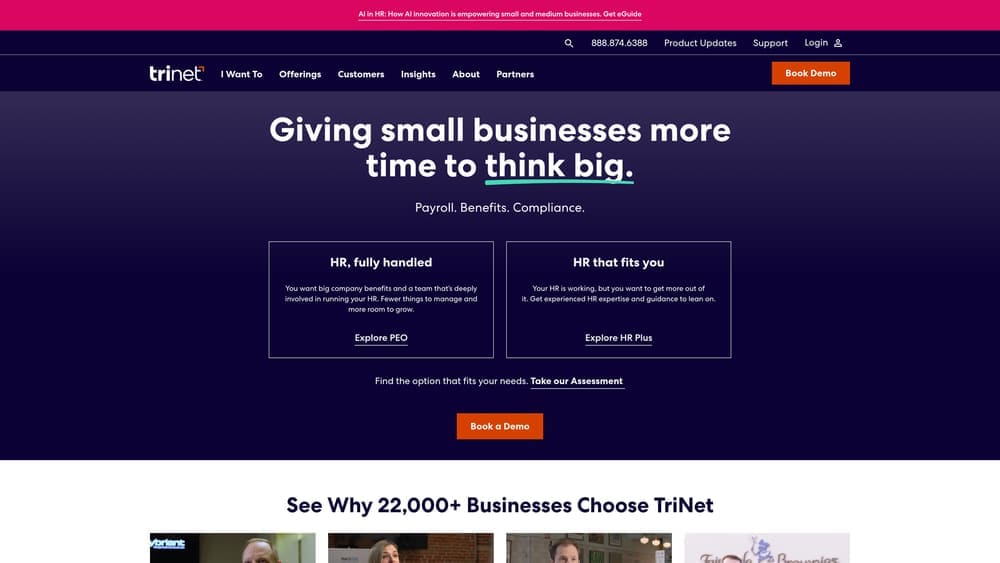
TriNet is a tech-forward PEO with industry-specific HR guidance and a platform built for businesses that want compliance support without hiring a full HR department.
Where This Tool Shines
TriNet’s industry-specific HR guidance is a real differentiator for specialty manufacturers — think precision machining, electronics assembly, or medical device fabrication — where compliance requirements are layered and a generalist PEO might miss nuances. The cloud-based platform with mobile access also works well for floor managers who need to pull information without being tied to a desk.
For multi-state manufacturers or those with satellite locations, TriNet’s compliance handling across jurisdictions is solid. Workers’ comp is included with claims management support, which removes one of the most administratively painful pieces of manufacturing HR.
Key Features
Industry-Specific HR Guidance: Compliance support tailored to your sector, not generic small business advice.
Benefits Pooling: Access to competitive rates through TriNet’s large employer base.
Cloud-Based Platform: Mobile-accessible for floor managers and supervisors, not just office staff.
Workers’ Comp with Claims Management: Included in the PEO structure with active claims support.
Multi-State Payroll and Compliance: Useful for manufacturers with distribution facilities or locations across state lines.
Best For
Specialty or smaller manufacturers in the 15–100 employee range that need compliance depth and benefits access but don’t have internal HR staff. Also a strong fit for multi-state operations where compliance complexity is the primary driver.
Pricing
Per-employee per-month pricing. Contact TriNet for a manufacturing-specific quote, as rates vary by headcount and benefits selection.
4. Paychex PEO
Best for: Manufacturers already on Paychex payroll who want to upgrade to full PEO without switching platforms
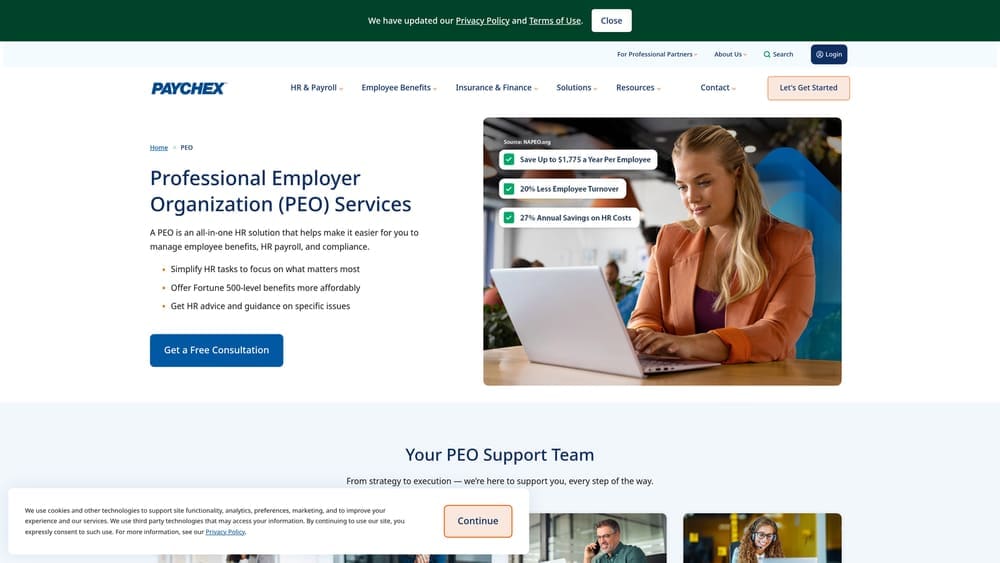
Paychex PEO layers full PEO services on top of Paychex’s existing payroll infrastructure, making it a low-friction upgrade path for current Paychex customers.
Where This Tool Shines
The main advantage here is continuity. If your manufacturing operation is already running payroll through Paychex, migrating to a different PEO means data migration, retraining, and transition risk. Paychex PEO eliminates that friction entirely — your existing payroll data, time and attendance setup, and employee records carry over without disruption.
The time and attendance tools are a genuine asset for shift-based manufacturing. Paychex has invested in floor-level time tracking that integrates directly with payroll, which reduces the manual reconciliation that causes errors in shift differential and overtime calculations.
Key Features
Seamless Paychex Upgrade: No data migration required for existing Paychex payroll customers — a meaningful operational advantage.
Workers’ Comp Administration: Risk management and claims handling included in the PEO structure.
HR Administration Support: Compliance assistance and HR tools layered on top of existing payroll infrastructure.
PEO Benefits Access: Benefits pooling through the co-employment structure for improved rates.
Shift-Ready Time and Attendance: Tools designed for hourly, shift-based workforces common in manufacturing.
Best For
Manufacturers already using Paychex Flex who are growing into workers’ comp complexity or benefits needs that a standalone payroll platform can’t address. Less compelling if you’re not already a Paychex customer, since the primary advantage is continuity.
Pricing
Custom pricing based on employee count. Contact Paychex directly for a quote that reflects your current service tier and upgrade scope.
5. ADP TotalSource
Best for: Larger or multi-location manufacturing operations with complex compliance requirements
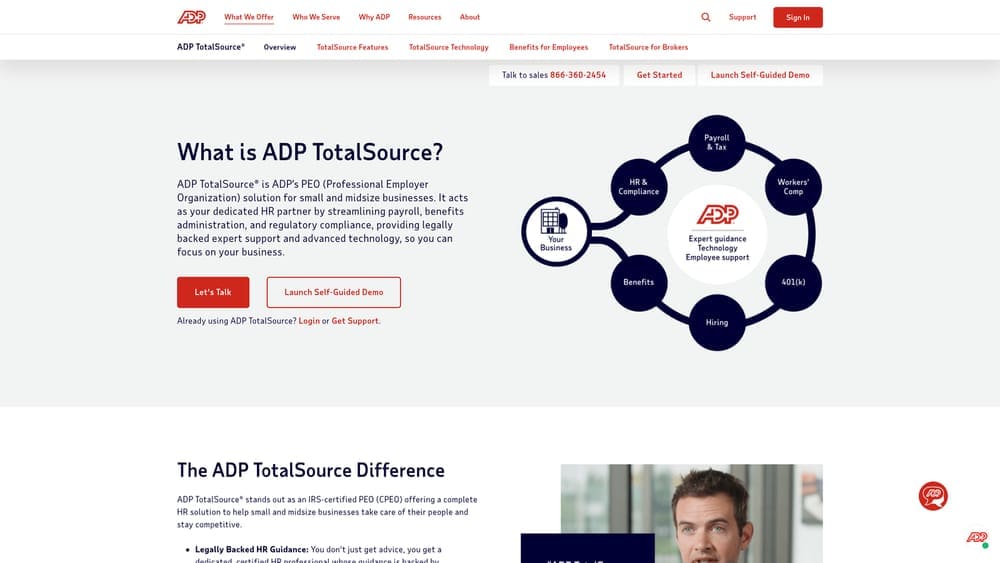
ADP TotalSource is ADP’s enterprise-grade PEO offering, built for organizations that need deep compliance infrastructure and multi-state capabilities at scale.
Where This Tool Shines
For manufacturers with multiple facilities across different states, ADP TotalSource’s compliance infrastructure is hard to match. Multi-state payroll, varying workers’ comp jurisdictions, and OSHA requirements that differ by state are all handled within a single platform backed by ADP’s compliance team. The breadth of that infrastructure is genuinely enterprise-level.
The integration with ADP’s broader HR and time-tracking ecosystem also matters for larger operations. If you’re running 200+ employees across two or three facilities, having payroll, time tracking, benefits, and compliance in one connected system reduces the reconciliation burden significantly.
Key Features
Multi-State Payroll and Compliance: Robust handling of varying state requirements — relevant for manufacturers with distributed operations.
Workers’ Comp with Dedicated Claims Management: Structured claims handling with dedicated support staff.
OSHA and Safety Compliance Support: Resources and guidance for manufacturing-specific safety obligations.
Large-Employer Benefits Access: Enterprise-level benefits purchasing through the PEO structure.
ADP Ecosystem Integration: Connects with ADP’s HR, time, and analytics tools for a unified operational view.
Best For
Multi-location manufacturers or operations above 150 employees where compliance complexity and multi-state exposure justify enterprise-tier PEO pricing. Smaller shops may find ADP TotalSource feels bureaucratic relative to their actual needs.
Pricing
Custom enterprise pricing. Contact ADP directly for a quote. Expect pricing to reflect the depth and scale of the platform.
6. Gusto
Best for: Small manufacturing operations under 25 employees that need clean payroll without co-employment complexity
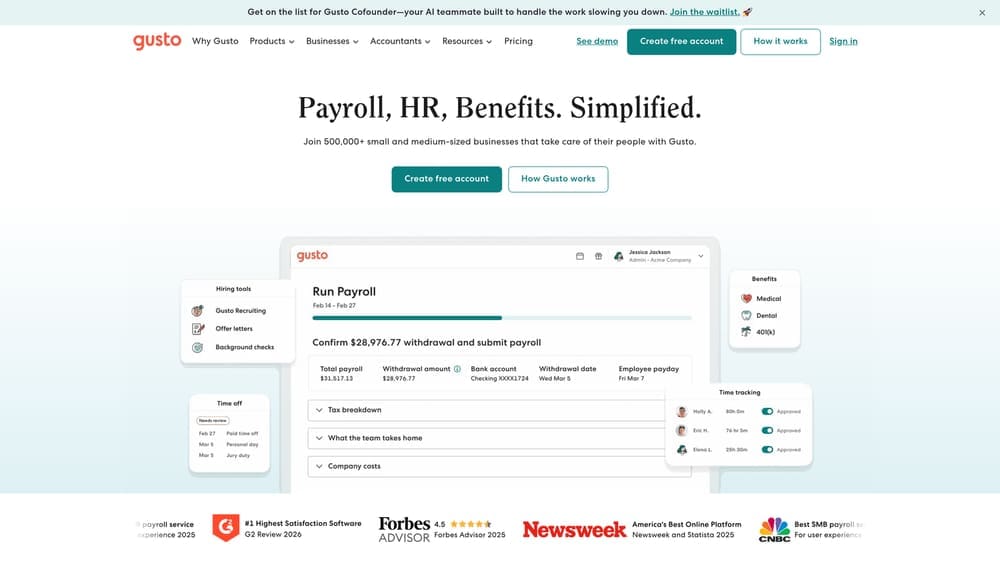
Gusto is a payroll platform — not a PEO — designed for simplicity and ease of use, with a strong fit for small manufacturers who want reliable payroll without the overhead of a co-employment arrangement.
Where This Tool Shines
Gusto does payroll well and keeps it simple. For a 10 or 15-person manufacturing operation where the owner is handling HR alongside everything else, Gusto’s clean interface and automated tax filing remove a meaningful administrative burden without requiring a steep learning curve or a dedicated HR person to manage it.
It’s also worth being direct about what Gusto doesn’t do: it doesn’t touch workers’ comp structure, it doesn’t provide OSHA compliance support, and it doesn’t offer benefits through employer pooling. For small manufacturers with relatively low workers’ comp exposure and stable headcount, that’s an acceptable tradeoff. For anyone scaling past 25 employees or dealing with complex risk classifications, those gaps start to matter.
Key Features
Straightforward Payroll: Automated payroll runs with tax filing and direct deposit handled cleanly.
Basic HR Tools: Onboarding workflows, offer letters, and document storage included.
Benefits Administration Add-On: Optional benefits administration available, though not through PEO pooling.
Time Tracking Integration: Integrates with time tracking tools for hourly workers.
No Co-Employment: You retain full employer status — no shared liability arrangement.
Best For
Small manufacturers under 25 employees with a relatively stable, lower-risk workforce. Also a reasonable fit for manufacturers who have a specific reason to avoid co-employment, such as certain government contracts.
Pricing
Starts at approximately $46/month base plus a per-employee fee. Check Gusto’s website for current pricing tiers, as these change periodically.
7. Paychex Flex
Best for: Manufacturers with internal HR capacity that need reliable, scalable payroll infrastructure
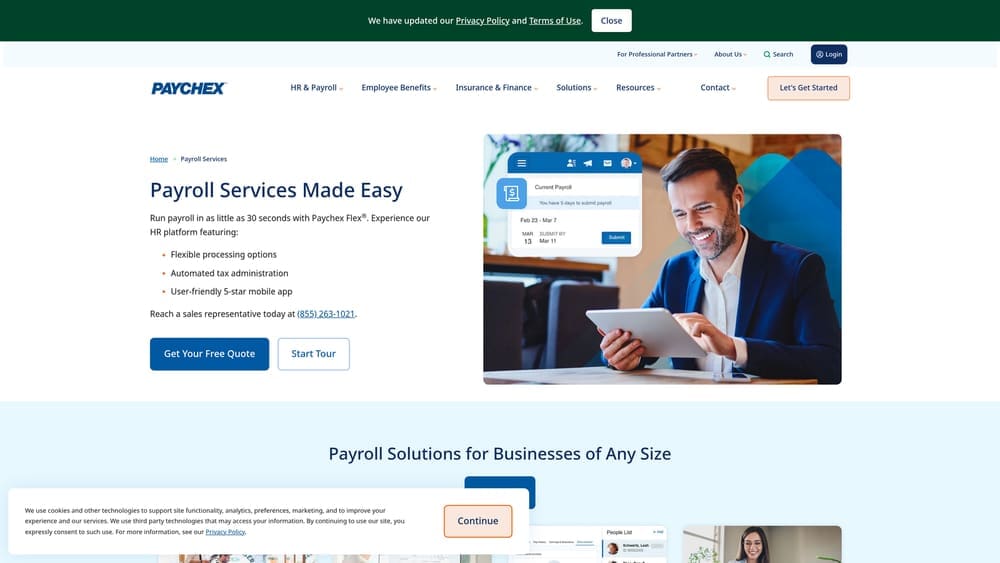
Paychex Flex is Paychex’s standalone payroll platform — separate from their PEO offering — designed for businesses that have HR handled internally and need a solid payroll engine to support it.
Where This Tool Shines
Paychex Flex handles the payroll complexity that manufacturing creates without requiring you to hand over co-employment. Multi-rate payroll, shift differentials, overtime calculations, and time and attendance tracking are all built in and work well in shift-based environments. If you have an HR manager or HR coordinator on staff and just need the payroll infrastructure to be reliable and scalable, Flex delivers that.
The upgrade path to Paychex PEO is also worth noting. If your operation grows and workers’ comp or benefits complexity increases, you can move to the PEO structure without switching platforms or migrating data. That optionality has real value for manufacturers in a growth phase.
Key Features
Multi-Rate Payroll: Handles shift differentials, overtime, and multiple pay rates across job classifications.
Time and Attendance Tools: Floor-level punch-in options and scheduling tools suited for manufacturing environments.
Tax Filing and Compliance Reporting: Automated tax filing with compliance reporting built in.
Scalable Architecture: Designed to grow from small operations to mid-size without a platform change.
PEO Upgrade Path: Direct path to Paychex PEO if your needs evolve — no migration required.
Best For
Manufacturers with 25–200 employees who have internal HR staff and primarily need payroll infrastructure rather than full PEO services. Also a smart starting point for manufacturers who anticipate needing PEO services in the next one to two years.
Pricing
Custom pricing based on employee count and features selected. Contact Paychex for a quote specific to your operation.
8. QuickBooks Payroll
Best for: Very small manufacturing operations already using QuickBooks where the owner manages both financials and payroll
QuickBooks Payroll is a payroll module built directly into the QuickBooks accounting ecosystem, designed for small businesses where financial management and payroll live in the same place.
Where This Tool Shines
The integration with QuickBooks accounting is the core value proposition here. If you’re a small manufacturer already running your books in QuickBooks, adding payroll through the same platform eliminates duplicate data entry and keeps your labor costs directly connected to your financials. For an owner-operator managing a 5 to 20-person shop, that’s a real efficiency gain.
Be realistic about the ceiling, though. QuickBooks Payroll wasn’t built for manufacturing complexity at scale. Multi-code workers’ comp, OSHA compliance, and competitive benefits for skilled trades retention are all outside its scope. It’s a clean solution for a narrow use case, not a platform to grow into as your operation expands.
Key Features
QuickBooks Integration: Direct connection to QuickBooks accounting with no duplicate data entry for labor costs.
Automated Payroll and Tax Filing: Payroll runs and tax filing handled automatically on higher tiers.
Same-Day or Next-Day Direct Deposit: Available on higher pricing tiers for faster payroll processing.
Basic HR Support Tools: Available on premium tiers, though limited in depth.
Workers’ Comp Pay-As-You-Go: Optional pay-as-you-go workers’ comp available through partner integration.
Best For
Very small manufacturing operations — typically under 15 employees — where the owner is managing both accounting and payroll and QuickBooks is already the financial system of record. Not the right fit once manufacturing complexity or headcount increases meaningfully.
Pricing
Starts at approximately $45/month plus a per-employee fee. Check Intuit’s website for current pricing, as tiers and features change periodically.
9. Justworks
Best for: Growing manufacturers who need predictable HR costs as headcount scales
Justworks is a PEO with flat-rate per-employee pricing — a genuine rarity in an industry where pricing opacity is the norm.
Where This Tool Shines
Transparent pricing is the headline differentiator, and it’s meaningful. Most PEO contracts are structured in ways that make true cost comparison difficult — percentage-of-payroll models, bundled fees, and administrative markups that shift over time. Justworks publishes its pricing publicly, which gives manufacturers in a growth phase the ability to model HR costs accurately as they add headcount. For a manufacturer scaling from 30 to 80 employees over two years, that predictability has real budget planning value.
Workers’ comp is included in the PEO structure, and the platform handles payroll, compliance, and HR tools in one place. It’s not the deepest platform for complex multi-location manufacturing, but for a single-site manufacturer in a growth phase, the combination of PEO benefits and pricing transparency is a strong value proposition.
Key Features
Flat Per-Employee Pricing: No percentage-of-payroll surprises — a fixed monthly cost per employee that’s published online.
Benefits Through PEO Pooling: Access to competitive health and benefits packages through the co-employment structure.
Workers’ Comp Included: Workers’ comp administration built into the PEO structure without separate negotiation.
Unified Platform: Payroll, compliance, and HR tools on one platform without separate vendor relationships.
Published Pricing: Pricing tiers available on Justworks’ website — uncommon in the PEO industry.
Best For
Single-site manufacturers in a growth phase — typically 20 to 150 employees — where cost predictability and benefits access are the primary drivers. Also a strong fit for finance-minded operators who want to model HR costs without going through a full sales process first.
Pricing
Flat per-employee per-month pricing published on Justworks’ website. Check directly for current tiers, as pricing is subject to change.
Which Option Actually Fits Your Operation
Here’s the practical cut: if you’re running a manufacturing operation with 25 or more employees and workers’ comp is a meaningful cost line, a PEO almost always delivers more operational value than a standalone payroll company. The workers’ comp pooling, OSHA compliance support, and benefits access for skilled trades retention are things a payroll platform simply doesn’t touch.
But the wrong PEO is worse than no PEO. Multi-year contracts with pricing structures that don’t reflect your actual safety record or experience modification rate can lock you into costs that don’t make sense for your operation. That’s not a hypothetical — it’s a common outcome when manufacturers sign PEO contracts without comparing multiple providers first.
If you’re under 25 employees, or your workforce is relatively stable and lower-risk, a solid payroll platform like Gusto or QuickBooks Payroll is often the leaner, smarter choice. You keep full employer status, you avoid PEO onboarding overhead, and you’re not paying for services you don’t need yet.
For manufacturers evaluating PEOs, the standouts from this list depend on your situation. Insperity is the strongest fit for mid-market manufacturers who want dedicated HR support and enterprise benefits access. ADP TotalSource makes sense for multi-location operations with complex compliance exposure. Justworks is the right call if pricing transparency and predictability matter more than depth of service. And if you’re already on Paychex, the PEO upgrade path is worth a serious look before you start shopping elsewhere.
Before you commit to any PEO contract, run a side-by-side comparison. The differences in pricing structure, workers’ comp handling, and contract terms across providers are significant enough that choosing without comparing is a real financial risk. Don’t auto-renew. Make an informed, confident decision.
Before you sign that PEO renewal, make sure you’re not leaving money on the table.
Many businesses unknowingly overpay because of bundled fees, hidden administrative markups, and contracts designed to limit flexibility. We give you a clear, side-by-side breakdown of pricing, services, and contract terms—so you can see exactly what you’re paying for and choose the option that truly fits your business.
