
Most lists of PEO companies are recycled vendor positioning. They tell buyers that everyone offers payroll, benefits, compliance, and HR support, which is technically true and commercially useless. What they usually skip are the details that change the economics of the deal: how fees are structured, what happens at renewal, who services the account after implementation, and whether the provider fits a company's headcount, footprint, and risk profile.
That gap matters because this is a large, mature market. NAPEO reported that its member firms served about 200,000 client businesses and 4.5 million worksite employees in 2024, and public state directories show a deep bench of national and regional providers competing in major markets such as Florida's licensed PEO market, including TriNet, Justworks Employment Group, Vensure Employer Services, and Paychex-affiliated entities in the Florida PEO directory. A simple ranked list won't help a CFO narrow that field.
This list of PEO companies takes a different approach. It's built as a shortlisting tool for HR leaders, CFOs, and operators who need to get from “we should evaluate a PEO” to three serious finalists.
The focus is practical. Which provider fits a multi-state manufacturer versus a lean SaaS team? Where should a buyer expect stronger benefits value, and where should they press on service structure, implementation scope, and contract language? Those are the questions that affect cash flow, employee experience, and switching risk.
Table of Contents
- 1. ADP TotalSource
- 2. Insperity
- 3. TriNet
- 4. Paychex PEO
- 5. Justworks
- 6. Rippling PEO
- 7. CoAdvantage
- 8. Engage PEO
- 9. ExtensisHR
- 10. G&A Partners
- Top 10 PEO Companies: Side-by-Side Comparison
- Your Next Steps From Shortlist to Signed Agreement
1. ADP TotalSource
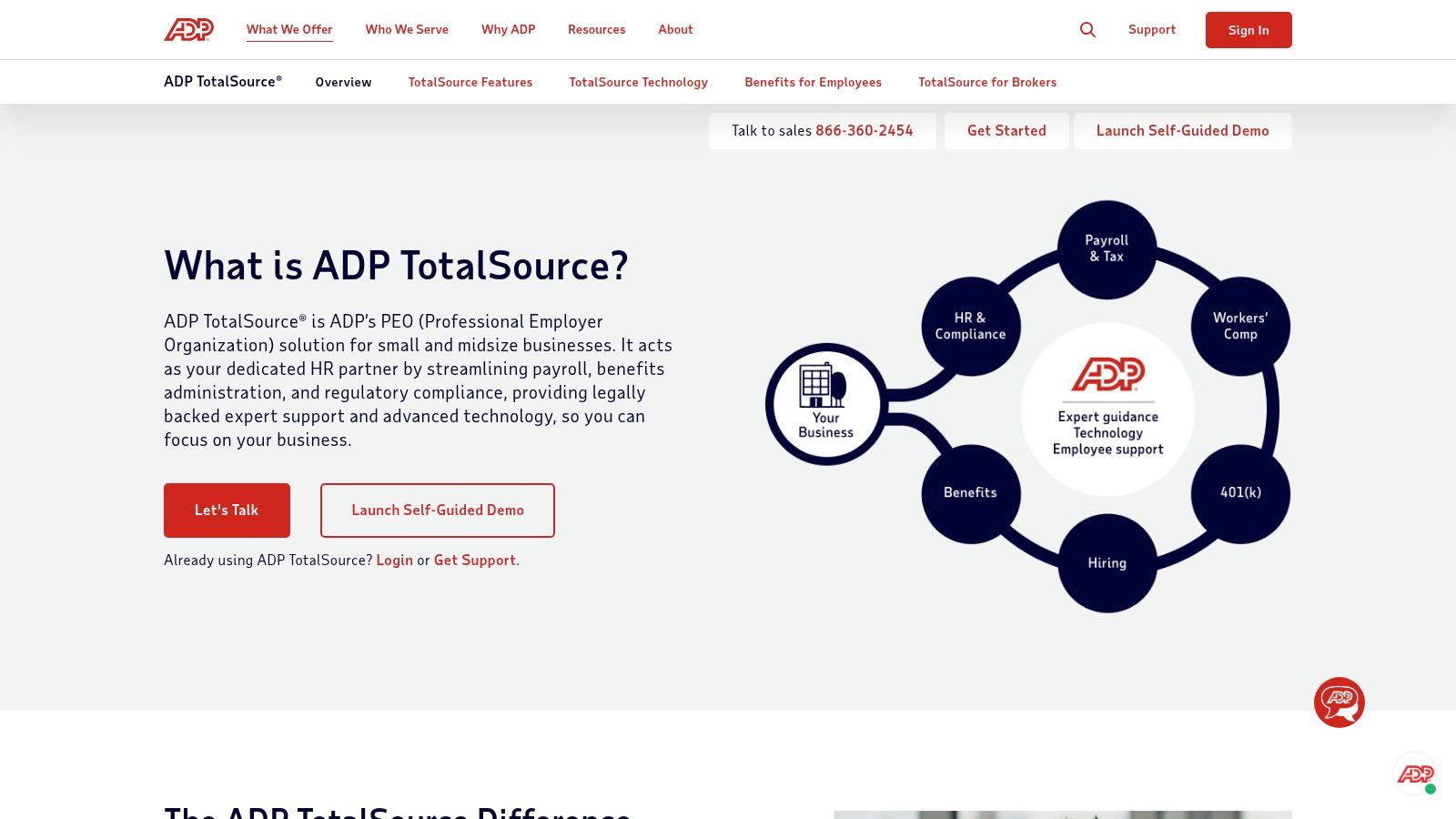
ADP TotalSource belongs on almost any serious list of PEO companies because it pairs a national PEO model with one of the most established payroll infrastructures in the market. For companies with employees across several states, that matters more than flashy software. Clean tax administration, broad HR support, and predictable payroll operations usually beat novelty.
It's a strong fit for employers that want one vendor to handle payroll, tax administration, benefits access, HR support, workers' compensation administration, and risk services. It's especially relevant when leadership wants institutional depth and broad integration options, not a lightweight startup tool.
A buyer that's still sorting out the basics can start with a plain-English overview of what a professional employer organization PEO is, then come back to vendor differences. ADP tends to make the most sense once the company already knows it wants full co-employment, not just payroll software.
Where ADP fits best
ADP TotalSource usually works best in these situations:
- Multi-state operations: Employers need payroll and tax administration that can handle complexity without stitching together several vendors.
- Benefits-driven evaluation: Leadership wants broad carrier access and pooled buying power to improve the quality of the benefits package.
- Finance-led buying: The CFO cares about process discipline, auditability, and integration with the rest of the HR and payroll stack.
The main trade-off is the one buyers already expect from a large vendor. Pricing is quote-based, and the service experience can feel less bespoke than it would with a smaller PEO.
Practical rule: Ask ADP to separate administrative fees, benefits costs, workers' compensation components, and any implementation charges in writing. Large platforms can look competitively priced until bundled charges are unpacked.
Another issue involves renewal negotiating power. Large providers often have strong infrastructure, but that doesn't automatically mean the second-year economics will be as attractive as the first-year proposal. A buyer should treat the initial quote as the start of the negotiation, not the finish.
Website: ADP TotalSource
2. Insperity
Insperity tends to win when the buyer values service depth as much as software. Some PEOs are sold on platform efficiency. Insperity is more often sold on the idea that a dedicated team will help the client run HR well, not just process payroll correctly.
That model appeals to growing SMBs and mid-market firms that have operational complexity but don't yet want to build a large internal HR department. It's also one of the more recognizable names in a market that remains broad and crowded. IBISWorld estimates the U.S. Professional Employer Organizations industry will have 6,675 businesses in 2026 and a market size of $254.8 billion, with Insperity, ADP, and Paychex identified as the largest firms in the IBISWorld industry outlook.
Where Insperity is strongest
Insperity is usually worth a close look when the company needs:
- Dedicated support: Leadership wants named contacts, not a rotating support queue.
- HR advisory depth: Internal managers need help with policy, employee relations, safety, and compliance questions.
- A service-first operating model: The company is willing to pay more if the support layer is materially better.
That service-first posture is also the risk. The buyer isn't just selecting a brand. The buyer is selecting the quality of the assigned team. Two clients can buy the same product and experience it very differently depending on how strong the service bench is in their segment.
A disciplined CFO should ask who will own implementation, who handles escalation after go-live, and how handoffs work if the assigned team changes. Those details matter more than the sales demo.
Better service isn't defined by how many people are on the org chart. It's defined by whether the client knows who to call when payroll is wrong, a claim is disputed, or a manager creates an employment-law issue on a Friday afternoon.
Website: Insperity
3. TriNet
TriNet is one of the few providers in this list of PEO companies that often gets shortlisted because of industry fit, not just scale. That matters for buyers in life sciences, professional services, financial services, technology, and other sectors where generic HR support may not be enough.
The useful part of TriNet's offering is choice. Companies can pursue the full PEO route or use a lighter solution path if they want less outsourcing. That gives finance and HR leaders a way to align the service model with where the company is, rather than overbuying.
Why buyers pick TriNet
Public buyer guides commonly frame TriNet as a strong option for specialized or regulated industries, especially compared with broader one-size-fits-all providers, as summarized in this PEO buyer guide. That doesn't make it automatically better. It does make it worth testing if the company operates in a sector where policy nuance and benefits design matter.
TriNet is often strongest when the client wants:
- Industry alignment: The account team and plan design need to make sense for a specific sector.
- Flexible operating model: The company may want full PEO support now but different outsourcing levels later.
- Recognized compliance posture: The buyer values accreditations and formal operating credentials.
The caution point is contract scrutiny. Sector fit can distract buyers from the less glamorous questions. Renewal language, implementation fees, off-cycle payroll charges, and benefit plan migration details still matter.
A company should also verify whether TriNet's strongest service motion for its target industry lines up with its actual headcount band. Some providers are excellent in a segment but less compelling outside it.
Website: TriNet PEO
4. Paychex PEO
Paychex PEO is often a practical choice for companies that want a familiar payroll brand with a broad add-on ecosystem. It's not always the most talked-about option in polished comparison pages, but it's frequently relevant for employers that want payroll, HR, benefits, and adjacent modules under one roof.
That makes it appealing to companies that may outgrow basic payroll but don't want to rip out the full stack again in a year. A very small employer can start with simpler needs and still have room to expand into a fuller outsourced HR model.
What stands out operationally
Paychex PEO usually gets attention for three reasons:
- Payroll depth: The company already knows payroll and tax administration at scale.
- Technology continuity: Paychex Flex gives buyers a broader system environment than a narrow PEO-only interface.
- Breadth for smaller employers: It can be more approachable for businesses that aren't yet in classic mid-market territory.
The trade-off is that broader product menus can hide total cost. Buyers should be careful with add-on modules, implementation work, and support assumptions. What looks like a consolidated platform can still become expensive if key functions sit outside the base scope.
For finance leaders, the smart move is to ask for the proposal in an operating-budget format. What is fixed, what fluctuates with census, what depends on benefits elections, and what could be charged separately after launch? Those questions usually reveal whether the package is indeed efficient or just neatly bundled.
Website: Paychex PEO
5. Justworks
Justworks is one of the clearest examples of a PEO that wins on usability and pricing transparency. For lean HR teams, founders, and distributed companies that don't want to decode a complicated quote before they even know whether the vendor is in budget, that's a real advantage.
Many traditional vendors lose smaller buyers, as the proposal process can be slow, opaque, and difficult to compare. Justworks usually feels easier to understand upfront.
Best for lean teams that want clarity
Justworks tends to fit companies that want:
- Transparent packaging: Published plan structures make early comparison easier.
- Cleaner user experience: Employees and managers can generally use the system without much training.
- Fast administrative execution: Lean teams want fewer manual workarounds and a straightforward support model.
That doesn't mean it's the best fit for every employer. The buyer should still test whether the benefits offering is competitive in the states where employees sit, and whether advanced time tracking or other capabilities require a higher tier or separate add-ons.
The broader market context matters here. The U.S. Chamber notes that buyers should request cost breakdowns so they can compare carrier rates against administrative markups in its guidance on choosing a PEO for a small business. That advice is especially useful when comparing a transparent vendor like Justworks against a more custom-quoted provider. Transparency is helpful, but it isn't the same thing as lowest total cost.
A clean interface can save administrative frustration. It won't fix a weak contract or an overpriced renewal.
Website: Justworks PEO
6. Rippling PEO
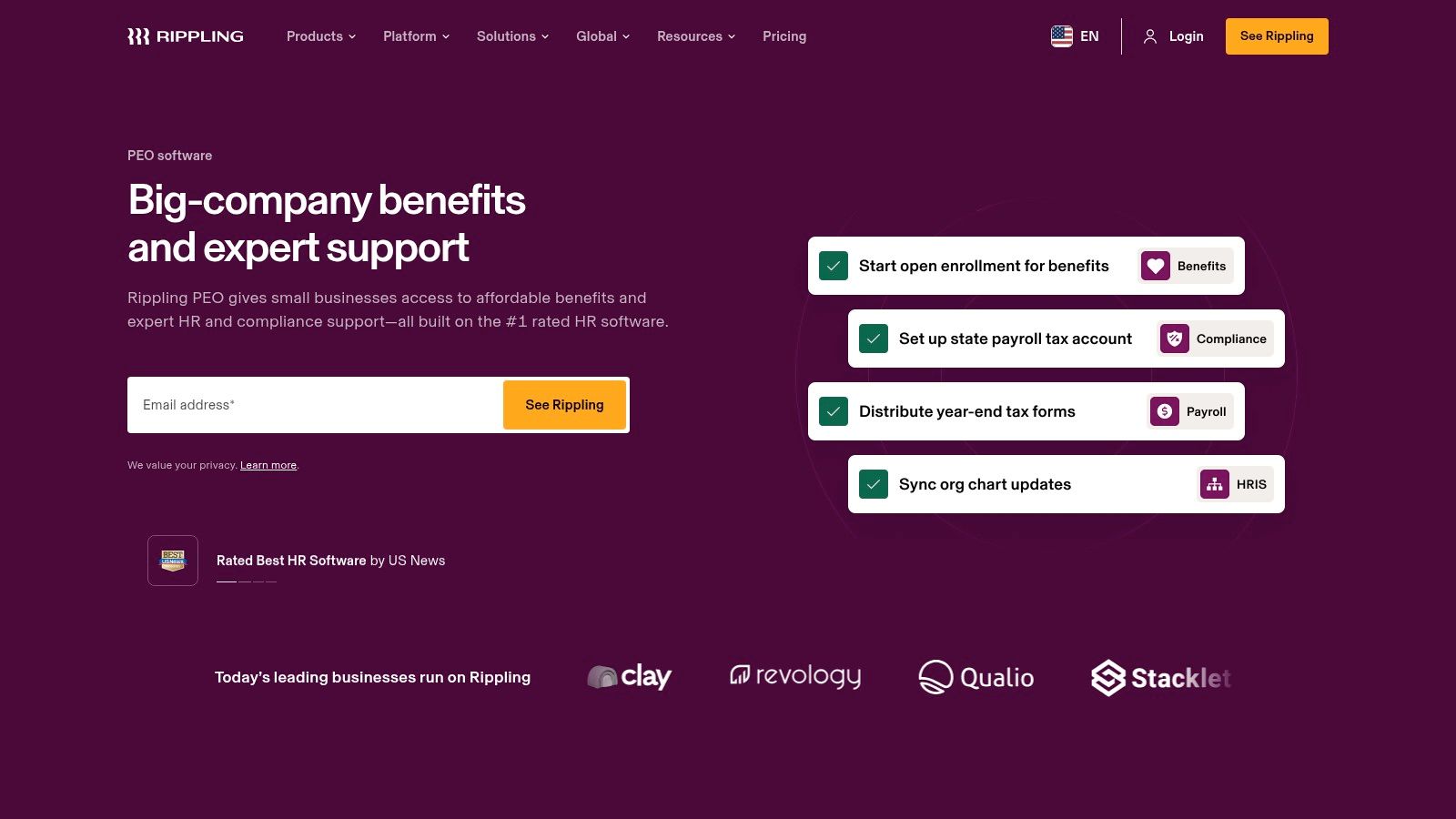
Rippling PEO is the option that usually enters the conversation when the company wants the PEO inside a broader operating system. For tech-forward teams, that can be compelling. HR, payroll, device management, app provisioning, time tracking, and automation can live in one environment.
That flexibility is useful when the company wants the ability to switch between PEO and non-PEO configurations without rebuilding the whole stack. For fast-scaling employers, especially those with distributed teams and a heavy SaaS footprint, that can simplify future transitions.
Where Rippling earns a shortlist spot
Rippling is often strongest when the buyer values:
- Automation: The company wants workflows, permissions, approvals, and reporting in one configurable system.
- Cross-functional control: HR and IT both need a shared operating layer.
- Optionality: Leadership wants a platform that can support a change in outsourcing model later.
The caution is simple. Modular pricing can be efficient, but it can also blur total cost of ownership. A company that adds modules gradually may discover that the platform budget has expanded well beyond the original PEO line item.
The other issue is fit. Rippling is generally most attractive when the organization will use the broader platform. If the company only needs classic PEO support and won't use the automation or IT components, part of the value proposition disappears.
Website: Rippling PEO
7. CoAdvantage
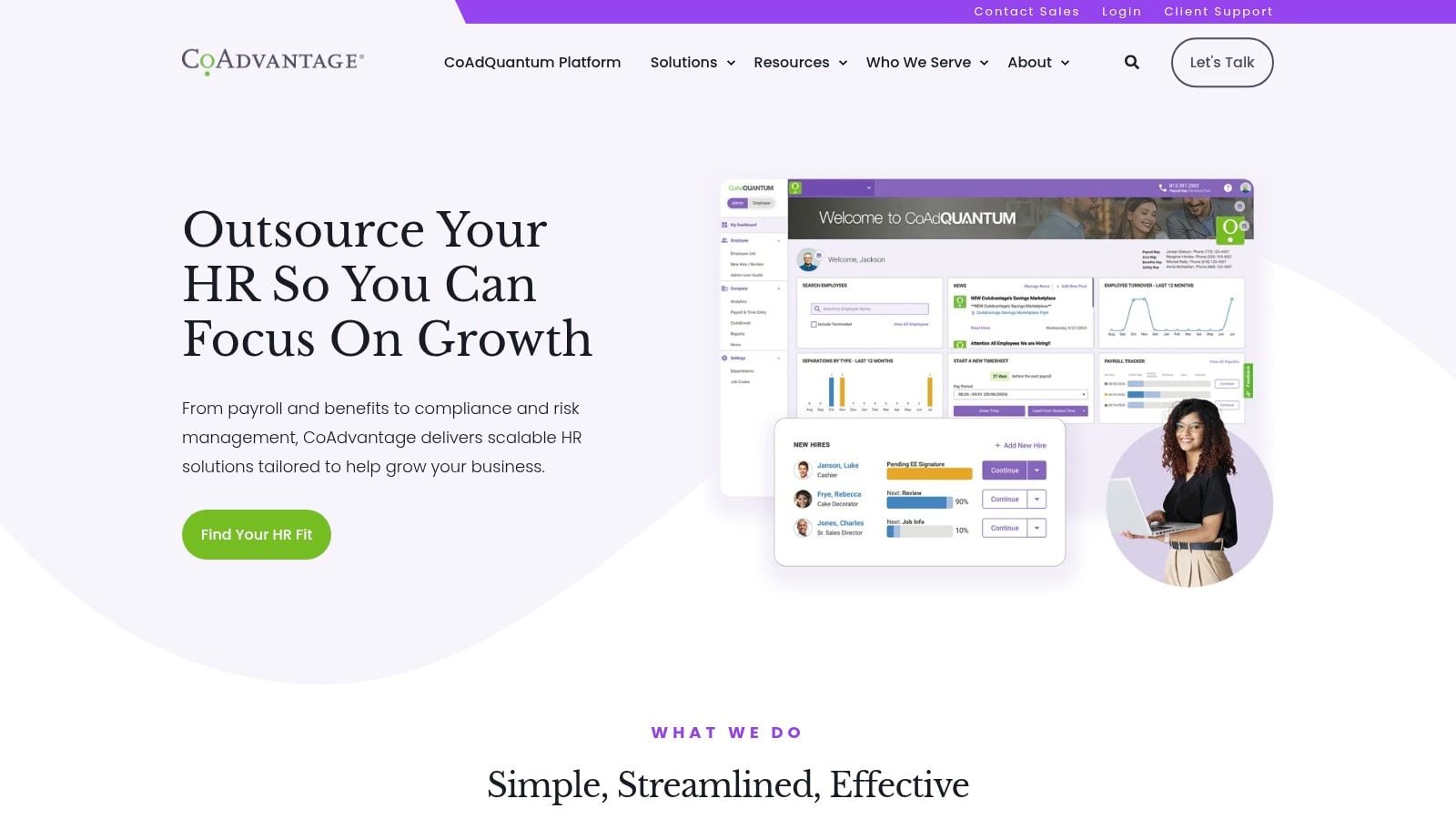
CoAdvantage is often evaluated by buyers who want a dedicated PEO model with national reach but don't necessarily want one of the biggest legacy brands. Its position inside the broader Vensure organization gives it scale, while the CoAdvantage brand still feels more PEO-centered than payroll-platform-first.
That can be attractive for SMBs that want support across payroll, benefits, compliance, onboarding, and workers' compensation administration without moving to a mega-vendor experience.
What to watch during diligence
The appeal here is breadth with a somewhat more focused PEO posture. The risk is organizational complexity inside a larger umbrella.
A buyer should press on these points:
- Service consistency: Ask whether account delivery is standardized across the organization or varies by inherited teams and operating units.
- Pricing mechanics: Confirm how administrative fees, benefits costs, and workers' compensation components are calculated and adjusted.
- Escalation paths: Get clarity on who resolves service issues if implementation or ongoing support falls short.
New York's Department of Labor maintains a public Professional Employer Organization list that includes hundreds of entities and public update dates, which underlines a broader point for buyers. PEOs operate inside formal state-level compliance frameworks, and provider registration status should always be verified during diligence through resources such as the New York Department of Labor PEO list.
That doesn't make CoAdvantage uniquely risky. It means buyers should treat regulatory standing and entity-level documentation as part of normal diligence, especially when a provider sits within a larger corporate family.
Website: CoAdvantage
8. Engage PEO
Engage PEO tends to appeal to buyers who strongly prioritize compliance rigor. That profile is different from a buyer who mainly wants simple payroll outsourcing or a polished self-service interface. Companies with higher sensitivity around employee relations, labor exposure, or multi-state employment questions often value a more compliance-forward operating style.
That orientation can be a strength if the internal HR team is thin or if leadership wants heavier guidance on policy, risk mitigation, and process discipline. It can feel slower or more formal if the company prefers a lighter-touch vendor.
Strong fit for risk-aware employers
Engage PEO is often worth evaluating when the business needs:
- Compliance-first support: Leadership wants strong guidance on employment practices, not just transaction processing.
- Multi-state help: HR needs support across state lines with fewer internal compliance resources.
- Hands-on operating discipline: The buyer wants structure, not just software access.
The natural trade-off is pace and flexibility. Compliance-heavy providers can be more process-oriented, which some clients value and others find cumbersome. That isn't a flaw by itself. It's a fit question.
The right PEO for a regulated or risk-sensitive employer is often the one that says no at the right moment, not the one that says yes fastest.
Another point for CFOs: ask how compliance support is delivered. Is it embedded in the service team, escalated to specialists, or limited to reactive guidance? The answer changes the value of the relationship.
Website: Engage PEO
9. ExtensisHR
ExtensisHR usually enters the shortlist when a buyer wants boutique-style service without giving up national reach. Some employers don't want a giant platform experience, but they also can't afford a purely local provider that may struggle with multi-state growth.
That's where ExtensisHR can make sense. It speaks to buyers who want a more customized relationship and place weight on compliance credentials, risk management posture, and personalized support.
Why some buyers prefer boutique scale
There's a practical reason some finance and HR teams prefer a smaller provider. They want higher visibility into who is handling the account and less fear of being routed through layers of generic support.
ExtensisHR can be attractive for employers that want:
- A service-led relationship: The team values responsiveness and continuity over broad brand recognition.
- Strong documentation: Certifications and formal controls matter in diligence.
- Customized implementation: The company wants a less templated rollout.
The downside is straightforward. Smaller than the mega-PEOs doesn't mean weaker, but it does mean the buyer should verify carrier access, regional plan fit, and support depth in the exact states where employees work. A boutique feel is valuable only if the operational coverage still holds up.
For this type of provider, references matter more than polished marketing. Buyers should ask for clients with a similar headcount, industry, and geographic footprint, then ask narrow questions about renewals, payroll issue resolution, and open enrollment execution.
Website: ExtensisHR
10. G&A Partners
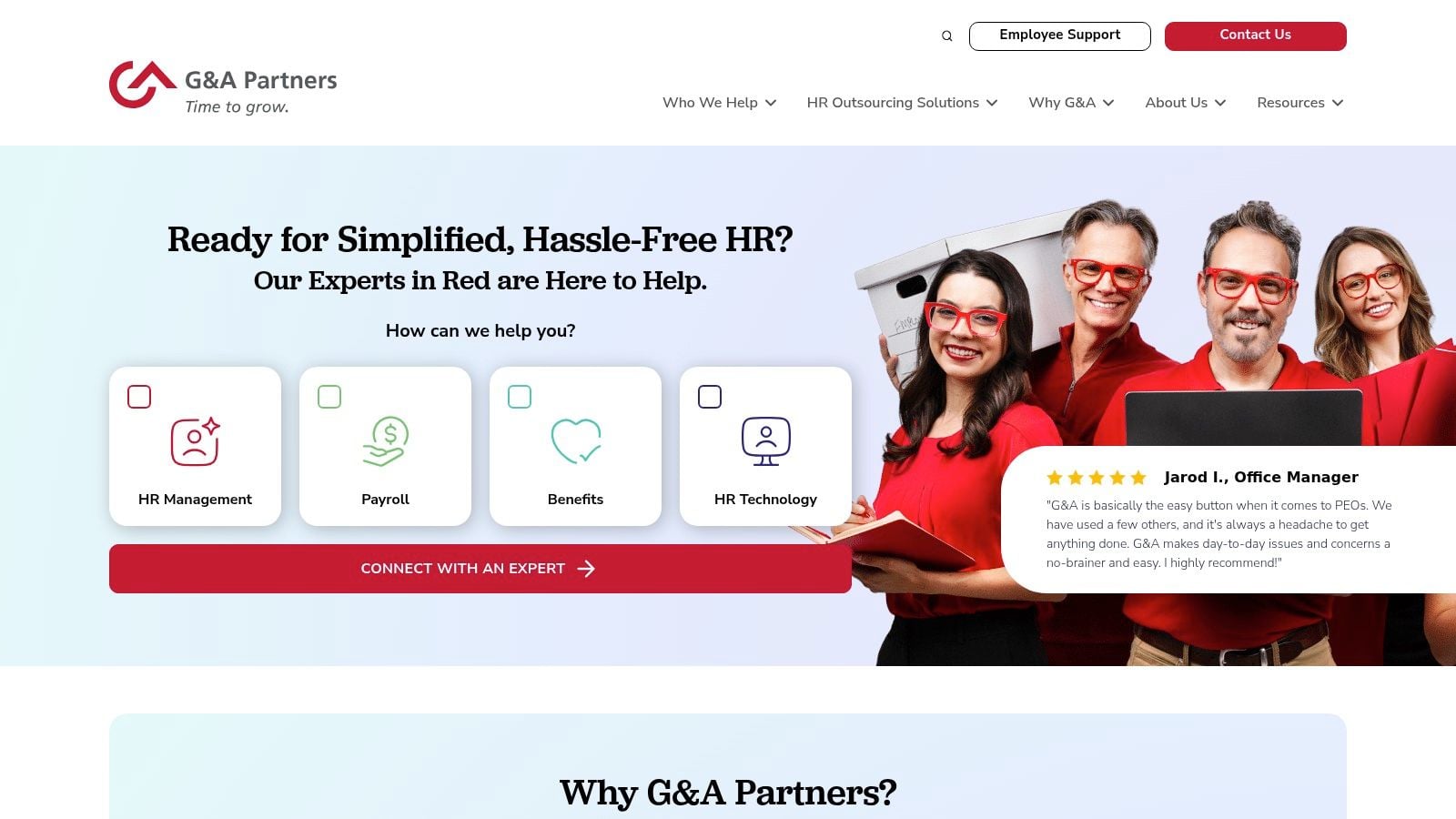
G&A Partners is often shortlisted by buyers who want national coverage and a high-touch service reputation without defaulting to the most obvious household names. It tends to resonate with SMB and mid-market employers that want dedicated HR support and enough structure to handle growth, compliance, and payroll administration in one relationship.
That can be particularly relevant for companies in regulated or operationally complex environments where responsiveness matters as much as software.
Best for service-sensitive buyers
G&A Partners generally makes sense when the buyer wants:
- Dedicated HR support: The company expects direct access to people, not just a platform.
- National footprint: Employees are spread across multiple states and need consistent support.
- Formal standing: The buyer values documented accreditation and certification posture.
The market backdrop reinforces why provider fit matters more than broad brand recognition. One market analysis values the U.S. PEO services market at USD 174.70 million in 2024 and identifies major participants including ADP, Insperity, TriNet, Paychex, Justworks, Deel, and Papaya Global in the Credence Research market report. For buyers, that mix of established PEO brands and adjacent workforce platforms is a reminder to separate true co-employment needs from general HR tech shopping.
G&A's main diligence issue is the same one that applies to many service-led providers. Buyers need detailed proposals to compare total cost and should verify plan availability by market, not by headline description.
Website: G&A Partners
Top 10 PEO Companies: Side-by-Side Comparison
| Provider | Core features | Best fit / Target | Service & UX | Value / USP | Pricing & contract notes |
|---|---|---|---|---|---|
| ADP TotalSource (ADP) | Pooled benefits; end-to-end payroll & tax; HRIS & integrations; risk/WC admin | Multi-state SMBs & mid-market seeking scale | Mature technology; nationwide support; less personalized for some SMBs | Fortune 500–level benefits buying power; robust payroll rails | Quote-based pricing; watch renewals and fee increases |
| Insperity | Dedicated service teams; benefits & retirement; safety & compliance; CPEO emphasis | Growing SMBs/mid-market wanting high-touch service | High-touch advisory; compliance-focused; experience varies by team | Established operator with strong compliance resources | No public pricing; often perceived as premium |
| TriNet | Industry-specific benefits & compliance; payroll/tax; HRIS; two solution tracks | SMBs–mid-market needing sector-tailored solutions | Accredited sources cited; service varies by segment | Choice of full PEO or lighter "HR Plus"; industry expertise | Quote-based; scrutinize renewal terms and fees |
| Paychex PEO | Paychex Flex stack; dedicated HRBP & payroll specialists; time/hiring modules | Employers wanting single-vendor payroll+HR across small→large SMBs | Deep payroll expertise; broad toolset; possible inconsistency at scale | Scales widely; strong payroll and add-on modules | Quote-based; evaluate total cost and module add-ons |
| Justworks | Clear plan tiers (Basic/Plus); payroll, benefits, compliance; modern UX | Distributed teams and lean SMBs seeking simplicity | Transparent plans; strong UX; 24/7 support | Published tiers and easy comparison; low admin overhead | Published tiered pricing; higher tiers/add-ons for advanced features |
| Rippling PEO | Unified HR, payroll, time + IT/device/app provisioning; automation | Tech-forward, fast-scaling orgs wanting modular stack | Highly configurable; strong automation & reporting | Unified HR + IT platform; switch PEO on/off | Quote-based; modular pricing can increase TCO |
| CoAdvantage (Vensure) | Payroll & benefits admin; risk & WC; centralized HR platform | SMBs seeking dedicated PEO with umbrella-scale | Multi-state capability; flexible program design | Backed by Vensure resources; broad service menu | Quote-based; review admin fees and benefit load factors |
| Engage PEO | Compliance-first model with legal oversight; benefits & COBRA; multi-state payroll | Employers prioritizing ER/HR legal guidance and compliance | Compliance-rigorous; process-driven support | Attorney-founded compliance emphasis; competitive benefits | Quote-based; confirm admin fees and renewal mechanics |
| ExtensisHR | Tailored HR & benefits admin; risk management; certifications (ESAC/CPEO/SOC1) | SMBs wanting boutique service with national reach | Personalized service ethos; strong compliance documentation | Boutique-style service + formal certifications | Quote-based; verify carrier networks and fee structure |
| G&A Partners | Full HR, payroll/tax, benefits; dedicated HR teams; ESAC accreditation | SMBs/mid-market across 50 states, regulated industries | High-touch client service; nationally resourced | ESAC accreditation; responsive, flexible configurations | Quote-based; requires detailed proposals to compare total cost |
Your Next Steps From Shortlist to Signed Agreement
A long PEO shortlist usually signals a weak buying process. By this stage, the job is not to collect more demos. It is to pressure-test the few providers that fit your headcount, state footprint, benefits goals, and tolerance for contract lock-in.
Cut the list to three, maybe five if the use case is complicated. Anything beyond that tends to reward polished sales teams, not better economics or better service.
Use a scorecard built around the three areas that change the outcome after signature: total cost, contract terms, and operating model. Total cost means the full employer spend, not just the admin fee quoted on the first call. Review benefit premiums, payroll and tax scope, workers' compensation structure, implementation fees, off-cycle charges, year-two renewal mechanics, and any PEPM or percentage-based pricing that can drift as payroll grows. A lower quote often loses once those items are examined side by side.
Contract review deserves the same weight as pricing. CFOs should push for specific language on renewal notice periods, fee increase limits, termination rights, data access, runout support, and liability allocation for tax filings, claims handling, and compliance mistakes. Sales language does not govern the relationship. The service agreement does. If a provider describes a clause as standard, that is the point to read it carefully and mark it up.
Service quality is where buyers get surprised. The demo usually shows the ideal version of the account team. The pertinent question is how support works in month six, during open enrollment, or after a payroll error. Confirm who runs implementation, whether support is pooled or dedicated, how escalations work, what response times are committed in writing, and what happens if the named team changes after go-live.
Renewal buyers should treat the incumbent the same way. Familiarity has value, but it should not excuse weak terms or creeping cost. A credible comparison can improve pricing, tighten contract language, or expose service gaps before another annual term locks in.
Some companies also bring in an independent advisor for side-by-side review of pricing, benefits, contract terms, service structure, and fit. PEO Metrics is one option for buyers that want outside help before signing or renewing.
The right choice is the provider that fits the company you run. That includes the cash flow profile, hiring plan, compliance burden, and appetite for switching risk.
PEO Metrics helps companies compare, select, and negotiate the right PEO by narrowing the market to the strongest-fit options, benchmarking pricing and benefits, and flagging contract terms that can create cost or switching risk later.
