
Most HR consulting rates land between $75 and $350 per hour, and retainer-style support can quickly move into the low thousands per month. Those numbers are useful, but they're also misleading unless the buyer translates them into total cost by scope, duration, and what would otherwise be bundled inside a PEO or ASO relationship.
That's the budgeting problem many HR directors and CFOs are dealing with right now. One consultant quotes an hourly rate. Another proposes a fixed-fee handbook rewrite. A third offers a monthly retainer with “strategic support” included. On paper, the cheapest option often looks obvious. In practice, it often isn't.
The issue isn't finding a market rate. It's figuring out what the company will spend for the result it needs. A handbook update, a multi-state compliance review, manager training, policy rollout support, and ongoing employee relations guidance are not the same purchase, even if they all sit under “HR consulting.”
The better approach is to treat HR consulting rates like any other operating cost. Break the quote into units, assumptions, exclusions, and likely add-ons. Then compare that structure against alternatives such as a bundled HR service model. For buyers reviewing options like HR consulting solutions, that shift from sticker price to total cost of ownership is what makes quotes comparable.
Table of Contents
- Why HR Consulting Rates Are So Hard to Compare
- The Four Common HR Consulting Pricing Models
- Decoding HR Consultant Rate Tiers by Experience
- Key Factors That Drive Your Total Cost
- Sample Calculation Comparing Two HR Projects
- HR Consultant vs PEO Which Model Is More Cost-Effective
- How to Get Accurate Quotes and Negotiate Terms
Why HR Consulting Rates Are So Hard to Compare
Most buyers start with the wrong question. They ask, “What's the hourly rate?” when the more useful question is, “What problem is this quote designed to solve?”
That matters because the HR consulting market is large and crowded. In the U.S., the industry is projected at $29.0 billion in 2026 with 51,209 businesses, according to IBISWorld's HR consulting industry data. In a market with that many firms, pricing gets fragmented fast. Some providers price for transactional support. Others price for legal-risk reduction, executive guidance, or implementation capacity.
Different quotes hide different assumptions
A quote for “HR support” might mean any of these:
- Basic advice on demand for employee relations questions
- A defined project such as handbook revision or policy drafting
- Ongoing access to a consultant who joins recurring leadership calls
- Part-time executive support for compensation, org design, or compliance oversight
Those are different products wearing the same label.
A CFO comparing only the visible rate can miss what isn't included. An hourly quote may exclude implementation. A project fee may exclude revision rounds. A monthly retainer may include access, but not execution.
Practical rule: If two vendors describe the work differently, their rates aren't comparable yet.
The wrong comparison creates false savings
A lower hourly rate can still produce a higher total spend if the scope is vague, revisions pile up, or the company has to buy additional services after the initial work is done.
By contrast, a more expensive-looking quote can be the cheaper decision if it includes clearer deliverables, faster turnaround, and fewer handoffs to internal staff. That distinction becomes even sharper in multi-state settings, where policy work, payroll alignment, and compliance review often overlap.
The useful benchmark isn't “What does HR consulting cost?” It's “What does this operating model cost over the life of the issue?”
The Four Common HR Consulting Pricing Models
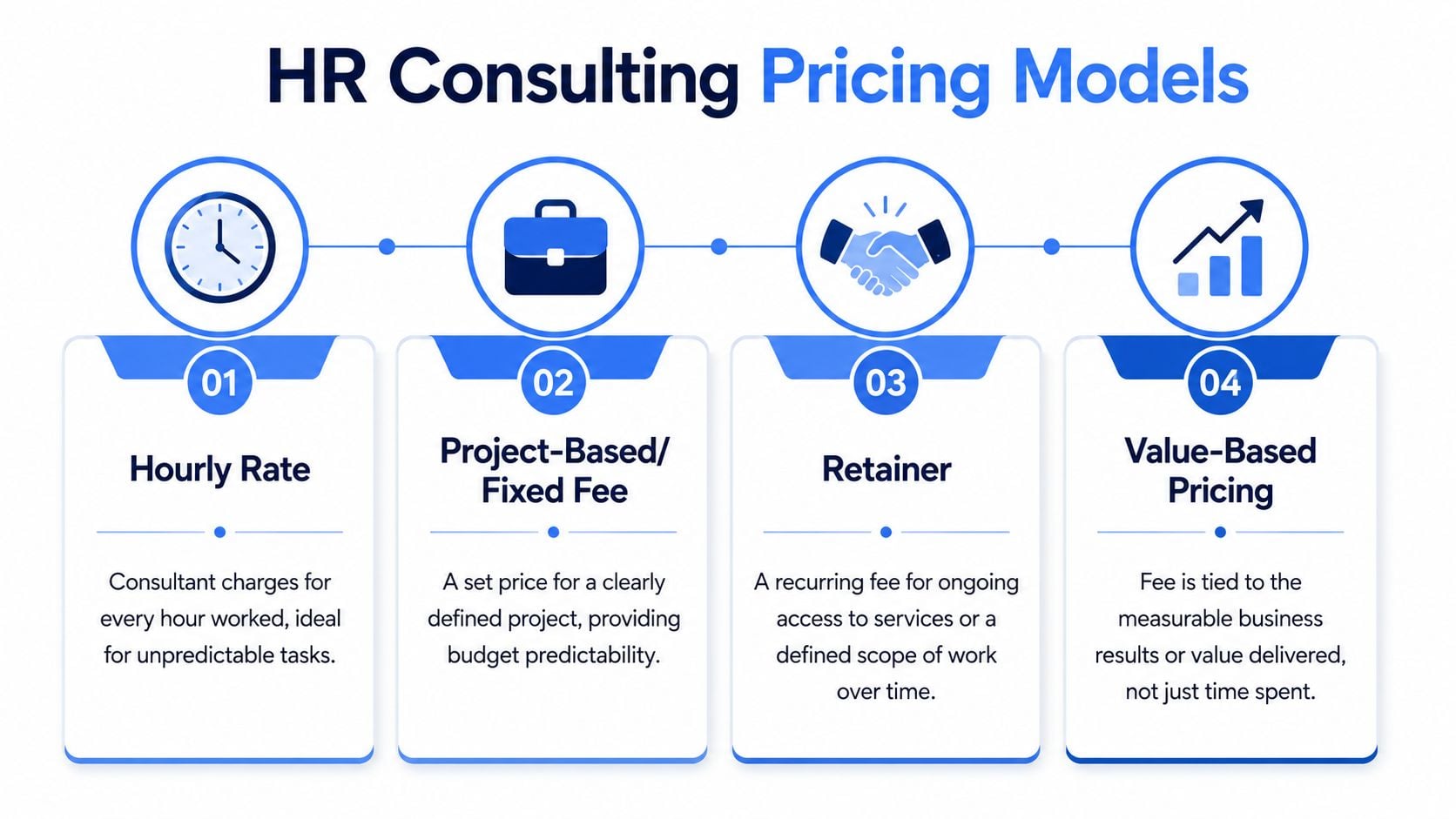
Most HR consulting rates fall into four billing structures. Once the buyer identifies the model, the quote gets easier to evaluate.
For teams that already compare outsourced providers more broadly, this is similar to how buyers review a HR services provider. The label matters less than the billing logic underneath it.
Hourly billing
Hourly billing is the simplest model. The consultant charges for time worked.
This works best when the company needs flexible support and can't define the exact scope in advance. Common examples include employee relations questions, intermittent compliance issues, or leadership coaching tied to specific incidents.
It's similar to hiring outside counsel for a narrow issue. The company pays for access and judgment, but the final invoice depends on how much time the issue consumes.
What works
- Unclear scope: Useful when the company can't predict how much help it will need
- Short-term questions: Good for policy interpretation, investigations, or manager guidance
- Vendor testing: A low-commitment way to assess fit before a larger engagement
What doesn't
- Loose internal ownership: Costs drift when nobody approves hours tightly
- Budget-sensitive projects: Finance teams struggle when there's no ceiling
- Multi-step implementation: Drafting, training, revisions, and rollout can sprawl
Monthly retainer
A retainer is recurring access for a fixed monthly fee, usually tied to a general scope, response window, or hour allocation.
This resembles a subscription model. The company isn't buying one project. It's buying availability. For buyers used to software contracts, the logic isn't far from Voice AI pricing: the invoice structure depends not just on the product, but on access level, usage assumptions, and support depth.
Retainers often make sense for companies that need regular HR help but don't want a full in-house senior hire.
Project-based pricing
Project fees work best when the deliverable is concrete. Handbook revision, compensation framework design, policy drafting, manager training rollout, and audit support often fit this model.
This is usually the easiest structure for a CFO to approve because the spend is bounded. If the scope is tight, the company gets budget predictability.
The risk is change orders. If the project starts as “update the handbook” and turns into state-specific rewrites, legal review coordination, manager FAQs, and employee communications, the fixed fee can stop being fixed.
Fractional leadership support
Fractional support sits between consulting and executive staffing. The company brings in a senior HR leader, often to guide strategy, build systems, or manage a transition.
This isn't administrative HR. It's leadership capacity on a part-time basis. It's often the right answer when a company needs senior judgment but doesn't want a full-time executive yet.
A useful filter is simple. If the company needs advice, hourly may work. If it needs a deliverable, project pricing fits. If it needs recurring access, a retainer fits. If it needs leadership, fractional support is the cleaner model.
Decoding HR Consultant Rate Tiers by Experience
The same pricing model can still produce wildly different quotes because experience changes what the consultant can handle independently.
In the U.S. market, independent HR consultants are commonly benchmarked at about $75 to $325 per hour overall, with early-career practitioners around $75 to $130, mid-level consultants around $130 to $200, and senior specialists or fractional CHROs around $200 to $350 per hour, based on Consulting Success benchmarks for HR consultants.
A simple benchmark table
| Experience tier | Typical hourly range | Best fit |
|---|---|---|
| Early-career practitioner | $75 to $130/hour | Administrative support, routine policy work, basic process cleanup |
| Mid-level consultant | $130 to $200/hour | Multi-step projects, manager support, broader compliance work |
| Senior specialist or fractional CHRO | $200 to $350/hour | Executive guidance, complex risk, organization design, sensitive compliance decisions |
That table is useful only if the buyer connects the rate to the work. A lower-cost consultant may be perfectly appropriate for handbook formatting, document cleanup, or basic onboarding workflows. The same consultant may not be the right choice for a reduction in force, executive coaching during a misconduct investigation, or multi-state classification issues.
What the higher rate is actually buying
Senior HR consulting rates aren't higher just because of title inflation. They're higher because the company is paying for fewer mistakes, faster judgment, and less internal rework.
Consider the difference in decision load:
- Entry-level support often needs tighter direction, templates, and review
- Mid-level support can usually manage a defined workstream with moderate oversight
- Senior support can spot second-order issues early, shape executive decisions, and own ambiguity
That distinction matters more than buyers expect. A cheaper consultant who needs repeated guidance from legal, finance, and internal HR can cost more in staff time than a more expensive specialist who closes the issue quickly.
Higher rates make the most sense when the work touches legal exposure, executive communication, compensation structure, or multi-state policy consistency.
Another practical point gets missed in a lot of quote comparisons. Companies often buy too much seniority for routine work and too little seniority for high-risk work. Both are expensive mistakes. Paying senior rates to reformat a handbook is wasteful. Using a low-cost generalist to handle a sensitive classification issue is usually false economy.
Key Factors That Drive Your Total Cost
The advertised rate is often the least important number in the proposal.
A company might approve an hourly quote because it seems reasonable, then discover that onboarding, audits, training, and implementation support weren't included. That's where HR consulting rates turn into actual budget overruns.
According to Search Solution Group's review of HR consulting costs, 60 to 70 percent of clients incur additional fees for onboarding, compliance audits, or leadership training, and those charges can add $5,000 to $25,000 per project. That's the part many buyers miss when they focus only on rate cards. It's also why finance teams often compare these quotes against broader bundled models such as a PEO cost framework.
The rate is only the starting point
Three cost drivers usually matter most.
First, scope ambiguity. “Review our handbook” sounds contained, but the actual work may include state addenda, manager guidance, revision meetings, employee-facing summaries, and coordination with payroll or counsel.
Second, implementation depth. Some consultants stop at recommendations. Others stay involved through rollout, training, and exception handling. The second quote will look more expensive because it includes more labor.
Third, organizational complexity. A single-state employer with straightforward policies is easier to support than a distributed employer with varying leave rules, compensation practices, and internal stakeholders.
Questions that expose the true budget
A finance-minded buyer should push every proposal through this checklist:
- What's excluded: Ask whether the quote excludes training, revisions, meetings, legal coordination, or implementation support.
- How changes are billed: Clarify what counts as out-of-scope work and whether that work reverts to hourly billing.
- Who does the work: Determine whether the senior person in the pitch deck is also the person who will draft, review, and present.
- What internal time is required: Some lower-fee engagements push heavy project management back onto HR, payroll, or operations.
- What happens after delivery: A clean final document has limited value if no one helps managers apply it correctly.
A practical budget model should include consultant fees and internal labor burden. If HR has to spend weeks coordinating drafts, collecting state-level feedback, and translating recommendations into payroll or handbook changes, the company is still paying. It's just paying in a different line item.
Sample Calculation Comparing Two HR Projects
A side-by-side example shows why pricing structure matters more than the headline rate.
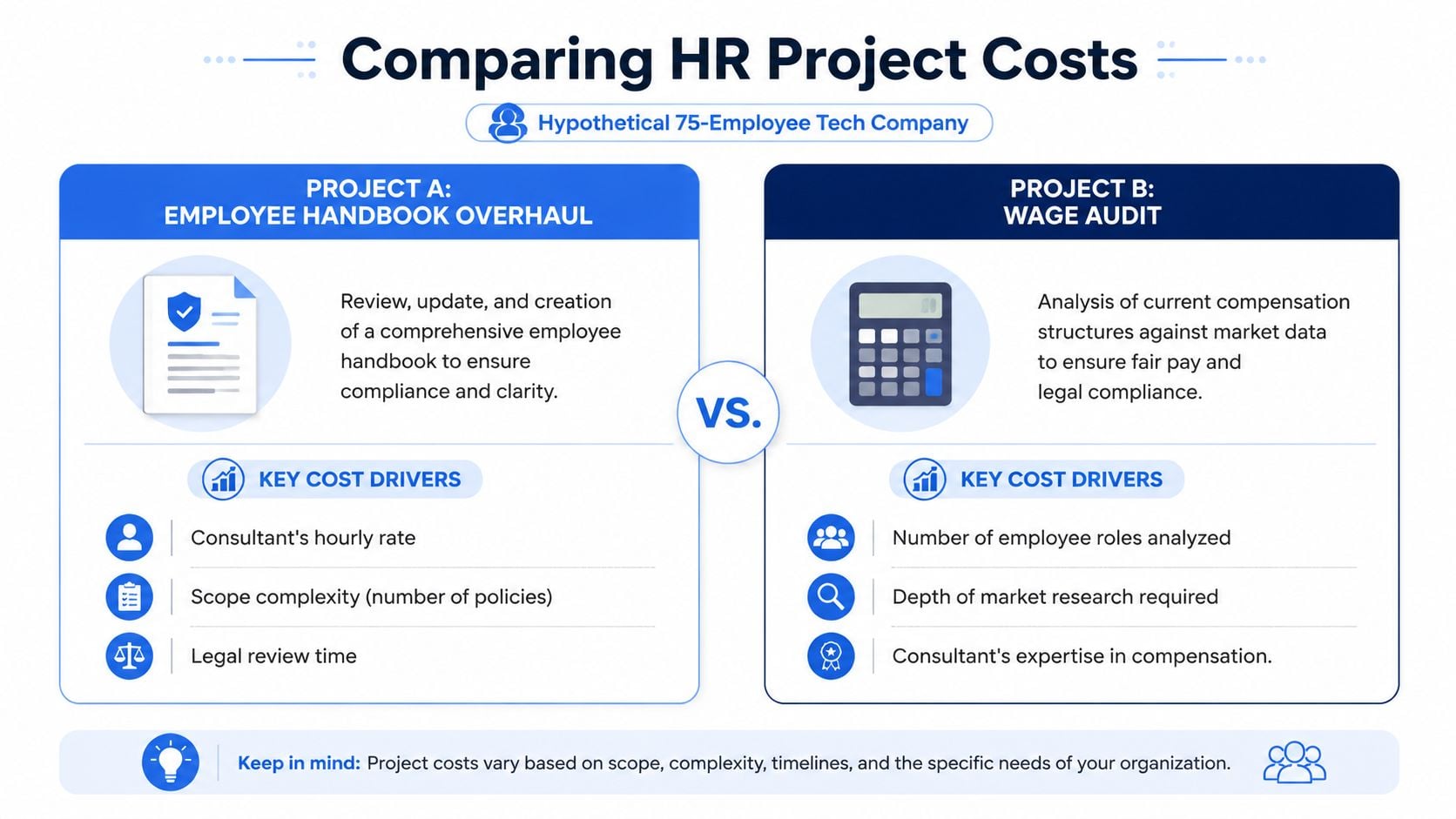
Assume a 75-employee technology company needs two things at the same time: an employee handbook overhaul and a wage-and-hour compliance review across three states. Those are common enough needs, and they sit right in the gray area where buyers struggle to compare project fees with hourly consulting.
A company can model this in a spreadsheet, but tools built for PEO cost per employee modeling are often useful because they force the buyer to separate one-time work from recurring support.
Scenario one fixed-fee boutique firm
The boutique firm proposes:
- A fixed project fee for the handbook rewrite
- A second project fee for the wage-and-hour review
- Separate implementation support if managers need training or payroll practices need adjustment
This structure gives the CFO a clearer approval path. The buyer knows the deliverables up front and can line them up to a timeline such as discovery, draft delivery, revision rounds, and final rollout.
What works here is budget visibility. What often fails is assuming the project ends at document delivery. If managers need live support after release, or if payroll and legal review uncover issues that require another pass, the company can still end up back on hourly billing.
Scenario two senior independent consultant
The independent consultant prices the same work on an hourly basis, using a rate within the senior specialist range covered earlier.
The value proposition is different. The company gets one experienced person who can likely handle discovery calls, policy analysis, draft revisions, and executive discussion without much layering. That can reduce coordination friction.
But the total cost now depends on time spent across several workstreams:
- Discovery and fact gathering
- Policy and handbook review
- State-by-state wage and hour analysis
- Revision meetings with leadership
- Implementation support and follow-up questions
If the scope stays disciplined, this can be efficient. If stakeholders keep expanding the ask, the invoice grows with each addition.
For this kind of work, the cleanest comparison is not project fee versus hourly rate. It's total expected spend for discovery, draft work, revisions, training, and post-delivery support.
The budgeting lesson
For a company of this size, the right choice often comes down to internal capacity.
If the HR lead can tightly define scope, enforce timelines, and manage implementation, project pricing often creates cleaner financial control. If the company needs one senior operator to manage uncertainty and handle executive-level decisions in real time, the hourly senior consultant may be the better buy despite the higher visible rate.
Neither is automatically cheaper. The better model is the one that matches how much management the company can provide internally.
HR Consultant vs PEO Which Model Is More Cost-Effective
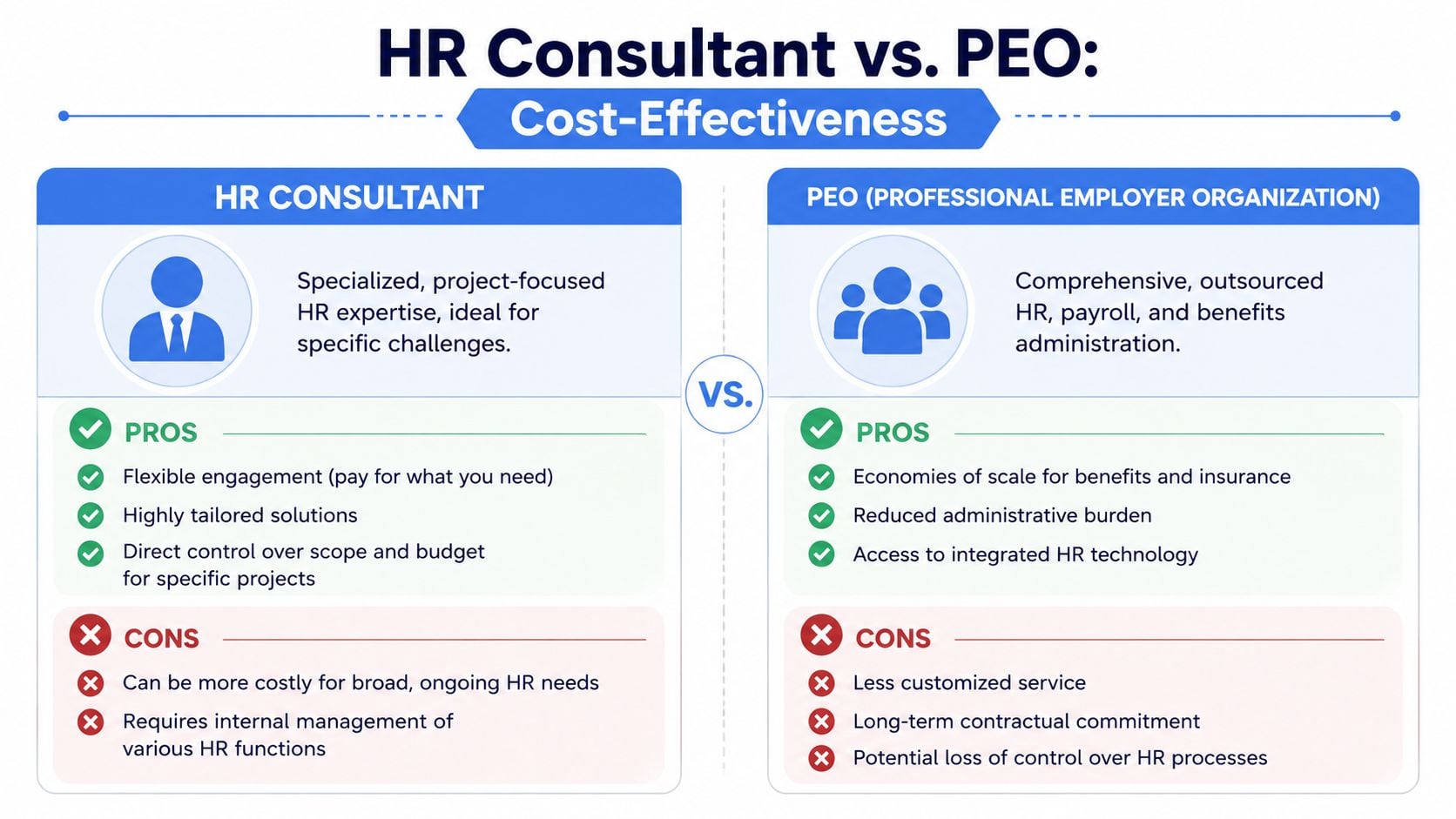
Many comparisons break down. A consultant's proposal usually arrives as an hourly rate, monthly retainer, or project fee. A PEO or ASO proposal usually arrives as a bundled per-employee monthly cost. Those structures don't line up naturally.
That gap is real. Buyers often lack a clean way to convert consultant pricing into a bundled service comparison. As noted in Paradigm's analysis of HR consultant rates and PEO pricing, consultant hourly rates for fractional support commonly sit around $150 to $300 per hour, while full-service PEO pricing models often fall around $60 to $120 per employee per month. Without a conversion framework, companies can't tell which option is more cost-effective. That's especially true for firms trying to compare consulting spend with integrated support around PEO payroll services.
When a consultant usually wins
A consultant is often more cost-effective when the company needs targeted expertise rather than an operating system.
Examples include:
- Defined one-time projects: Handbook overhaul, compensation design, investigation support, policy cleanup
- Short bursts of senior judgment: A financing event, leadership transition, or urgent compliance issue
- Internal HR team already exists: The company has execution capacity and only needs specialist input
In these cases, bundled per-employee pricing can be excessive if most of the included services won't be used.
When a PEO or ASO usually wins
A bundled model often becomes more economical when HR needs are continuous, broad, and operationally linked.
That tends to happen when the company needs:
- Recurring compliance support across multiple states
- Payroll, benefits, and HR administration working in one system
- Ongoing manager and employee support instead of isolated advice
- Predictable budgeting tied to headcount rather than issue volume
A consultant can solve specific problems well. A PEO or ASO can reduce the number of separate vendors, handoffs, and invoices the company has to manage.
A practical apples-to-apples framework
To compare the two, buyers should convert both models into annual operating cost categories:
| Cost category | Consultant model | PEO or ASO model |
|---|---|---|
| Strategic HR guidance | Hourly, retainer, or fractional | Usually bundled |
| Compliance review | Project fee or hourly add-on | Often bundled or partially bundled |
| Payroll coordination | Usually separate vendor or internal | Often integrated |
| Manager support | Billed as used or retained | Often included within service model |
| Implementation work | Frequently separate | May be included, limited, or one-time |
The goal isn't to force exact equivalence. It's to expose what the company is paying for twice, what's missing, and what internal work still sits outside the vendor relationship.
For a business with limited HR infrastructure, a PEO can be more efficient even if the visible monthly fee looks higher than a consultant's retainer. For a company with strong internal HR and payroll operations, a consultant may be the cheaper and cleaner answer for specialized work.
How to Get Accurate Quotes and Negotiate Terms
The strongest buyers ask for fewer slogans and more line items.
Start with a written scope that names the deliverables, who owns implementation, how revisions are handled, and what triggers out-of-scope billing. If a proposal says “ongoing support,” that should be translated into response times, included services, and whether meetings, training, and policy updates are part of the monthly fee.
Questions worth asking before signing
- What is included in the base fee: Ask whether discovery, document drafting, training, and revisions are all covered.
- What is billed separately: Require a list of implementation charges, audit fees, or post-project support.
- Who will do the work: Confirm whether the senior seller stays involved after kickoff.
- How price changes work: Ask for rate locks, notice periods, and approval requirements for expanded scope.
- What the agreement says: Buyers that want a stronger handle on contract language can review these contract insights for new businesses before finalizing service terms.
Ask vendors to price the same scope two ways: fixed fee and hourly with a not-to-exceed cap. That single move often exposes where risk is sitting.
Negotiation usually works best when the company asks for a cap on overages, a defined revision limit, and written pricing for optional add-ons before work starts. If the provider won't define exclusions clearly, the rate probably isn't the actual price.
PEO buyers that want an independent view of pricing, contract terms, implementation costs, and provider trade-offs can use PEO Metrics to compare options side by side and negotiate more effectively before signing.
