
You signed the PEO agreement because you wanted to offload employment headaches. Payroll taxes, workers’ comp, benefits administration—all handled. Then your HR manager gets hit with a discrimination lawsuit, or an OSHA inspector shows up at your warehouse, and you discover something uncomfortable: you’re still the defendant. The PEO isn’t stepping in to cover this one.
This catches business owners off guard constantly. The assumption is that “shared liability” means the PEO takes the big risks while you focus on running the business. But shared liability doesn’t work that way. It’s not a 50/50 split or a blanket transfer of exposure. It’s a specific, contractual division of who owns what—and if you don’t understand where those lines fall, you’re likely underinsuring, over-relying on the PEO’s protections, or both.
This breakdown walks through exactly which liabilities move to the PEO, which stay squarely with you, and which live in a gray zone that depends entirely on your contract language and how you actually operate. This isn’t legal advice. It’s a decision-making framework so you know where your risk actually sits before something goes wrong.
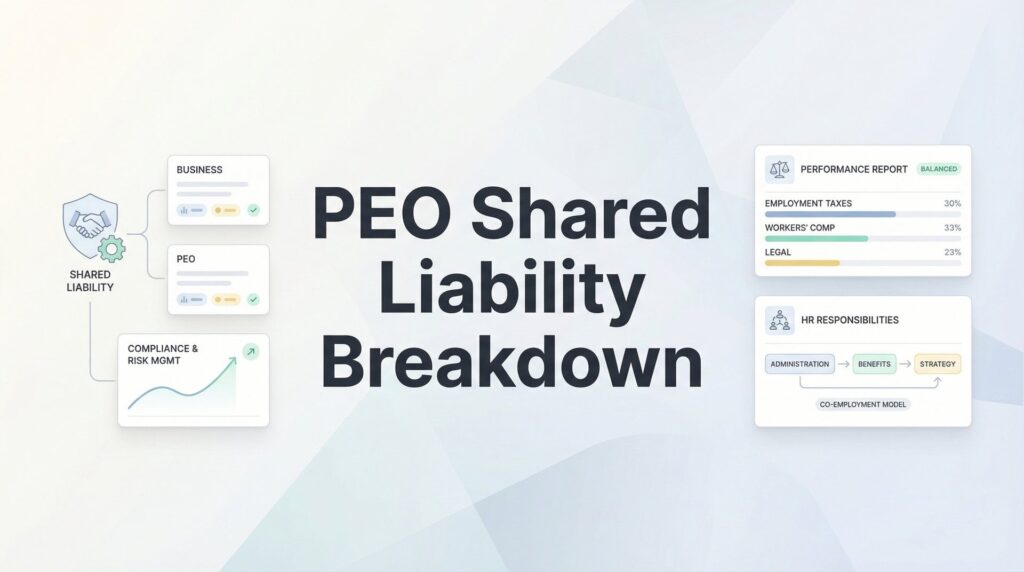
The Co-Employment Split: How Liability Actually Divides
Co-employment means you and the PEO are both considered employers of your workforce—but for different purposes. The PEO typically becomes the employer of record for tax filings and benefits administration. They issue W-2s under their EIN in many arrangements. They manage payroll tax deposits and remittances. They hold the master health insurance policy and handle ERISA compliance for benefits.
You remain the employer for everything operational. You hire. You fire. You set schedules, assign tasks, manage performance, and control the day-to-day work environment. Your managers supervise employees. Your policies govern workplace behavior. Your decisions determine who gets promoted, disciplined, or terminated.
This creates a fundamental split in liability exposure. The PEO owns risks tied to their administrative functions. You own risks tied to your operational control. And some risks—like wage and hour compliance or handbook enforcement—sit in the middle, where both parties have responsibilities and the contract determines who bears primary exposure if something fails. Understanding how a PEO works at a fundamental level helps clarify these boundaries.
Here’s what trips people up: “shared liability” doesn’t mean both parties are equally liable for everything. It means different parties own different categories of risk entirely. The PEO isn’t your insurance policy. They’re your administrative partner with specific contractual duties. When those duties are clear and well-executed, liability transfers cleanly. When they’re vague or poorly managed, you end up in disputes about who should have done what.
Think of it in three buckets. PEO-owned liability covers their administrative and compliance functions—payroll taxes, benefits fiduciary duties, workers’ comp administration. Client-owned liability covers your operational decisions—hiring, firing, workplace safety, day-to-day supervision. Jointly-held exposure covers areas where both parties have roles and the facts of the situation determine who’s actually at fault.
The contract defines the boundaries, but real-world execution determines whether those boundaries hold up when tested. If the PEO provides you with compliant overtime policies but you don’t follow them, that exposure flows back to you. If you rely on the PEO’s harassment training but your managers ignore complaints, you own that liability regardless of what the PEO did administratively.
Understanding this split isn’t about finding loopholes. It’s about knowing where you need your own protections, where you can genuinely rely on the PEO, and where you need to actively manage the handoff between their responsibilities and yours.
Liabilities the PEO Typically Assumes
The PEO’s core value proposition is taking over specific administrative burdens that carry compliance risk. When they execute these functions properly, the liability transfers cleanly. When they fail, they own the consequences—assuming your contract is written correctly.
Payroll tax compliance is the big one. The PEO handles federal and state payroll tax calculations, deposits, and filings. If they miss a deposit deadline or miscalculate withholding, the penalties fall on them, not you. This is especially true if you’re working with a Certified Professional Employer Organization (CPEO). CPEO certification means the IRS holds the PEO solely responsible for federal employment tax obligations. If a CPEO fails to remit taxes, you’re not on the hook. That’s a significant protection standard PEOs don’t provide.
Workers’ compensation administration also transfers. The PEO manages claims, coordinates with the carrier, handles state reporting, and ensures coverage stays active. If a claim gets mishandled or coverage lapses due to PEO error, that’s their exposure. You’re still paying the premiums—they flow through your invoice as a pass-through cost—but the administrative liability for proper management sits with the PEO.
That said, workplace safety itself stays with you. The PEO isn’t responsible for making sure your warehouse has proper guardrails or that your drivers follow safety protocols. They’re responsible for ensuring the workers’ comp policy is in place and claims get processed. The underlying safety compliance is still yours.
Benefits administration compliance is another major transfer. The PEO acts as the plan sponsor for health insurance and other benefits under their master policy. They hold ERISA fiduciary duties for plan administration, including timely enrollment, accurate record-keeping, and regulatory filings like Form 5500. If the plan fails an ERISA audit because of administrative errors, that’s the PEO’s problem.
You’re still making decisions about which benefits to offer and how much to contribute, but the legal and regulatory compliance around plan administration transfers to the PEO. This is valuable because ERISA violations carry steep penalties and the compliance burden is complex.
The pattern here is clear: administrative execution and regulatory filings are PEO territory. Operational decisions and workplace management are yours. The liability follows the function.
Liabilities That Stay Squarely With You
Employment decisions are yours. All of them. Hiring, firing, promotions, demotions, disciplinary actions—every decision that affects an employee’s job status originates with you and carries your liability.
This means discrimination claims, wrongful termination lawsuits, retaliation allegations, and harassment complaints almost always name you as the defendant, not the PEO. The PEO may provide HR guidance, template policies, and training resources, but they don’t make the actual decisions. Your managers do. Your supervisors do. You do.
If your regional manager fires someone in a way that looks retaliatory, you own that exposure. If your hiring process results in a pattern that suggests age discrimination, that’s your liability. The PEO can help you create compliant processes, but they can’t prevent you from making bad decisions or protect you from the consequences when you do. Understanding PEO risk management and liability support helps clarify what’s actually covered.
Workplace safety and OSHA compliance stay entirely with you. You control the physical work environment. You set safety protocols. You provide equipment and training. You determine how work gets done. If an OSHA inspector finds violations, the citations and fines come to you, not the PEO.
The PEO may offer safety training programs or help you develop written safety plans, but implementation and enforcement are your responsibility. If your warehouse has blocked exits or your construction crews aren’t using fall protection, that’s on you. The PEO doesn’t visit your job sites or monitor your compliance.
Day-to-day supervision and performance management also remain your domain. How your managers treat employees, how performance issues get addressed, how workplace conflicts get resolved—all of this creates potential liability that sits with you. The PEO can provide manager training and policy templates, but they’re not in your break room or on your shop floor managing interactions.
This is where many business owners underestimate their exposure. They assume the PEO’s HR support means they’re covered for employment practices liability. It doesn’t. The PEO can help you avoid mistakes, but they can’t shield you from claims arising from your operational decisions.
You need your own Employment Practices Liability Insurance (EPLI) coverage. The PEO may carry EPLI for their own exposure, and some PEOs offer EPLI as an add-on for clients, but relying solely on the PEO’s coverage without understanding the policy limits, exclusions, and who’s actually named as the insured is a mistake.
The Gray Zone: Shared Exposure That Depends on Your Contract
Some liabilities don’t fit neatly into PEO-owned or client-owned buckets. They depend on how responsibilities are divided in your specific contract and how well both parties execute their roles. This is where disputes happen when things go wrong.
Wage and hour compliance is the biggest gray area. The PEO typically handles payroll processing, which includes calculating overtime, applying exemptions, and ensuring accurate pay. But you control employee classifications, work schedules, and timekeeping systems. If employees are misclassified as exempt when they should be non-exempt, or if overtime isn’t being tracked properly, who’s liable?
It depends. If the PEO provided you with compliant classification guidance and you ignored it, that’s your exposure. If the PEO processed payroll based on incorrect information you provided, that’s also likely yours. But if the PEO failed to flag obvious compliance issues or gave you bad advice that you relied on, they may share or own the liability. This is why understanding misclassification liability exposure matters before problems arise.
Contract language around wage and hour compliance varies significantly between PEOs. Some contracts clearly state that classification decisions are the client’s responsibility and the PEO processes payroll based on client direction. Others include language where the PEO agrees to provide compliance guidance and may assume partial responsibility for failures. Read this section carefully.
Employee handbook policies create similar ambiguity. Many PEOs provide template handbooks or policy libraries. Some even customize them for your business. But who’s responsible if the handbook includes an illegal policy or if you fail to follow your own stated procedures?
If the PEO drafted the handbook and included a problematic policy, they may share liability for providing defective guidance. But if you modified their template, added your own policies, or simply failed to enforce what’s written, that’s your problem. Implementation and enforcement always fall on you, even if the PEO provided the documents.
Indemnification clauses are where risk gets contractually shifted. These clauses specify which party agrees to defend and cover the other if certain types of claims arise. A mutual indemnification clause means both parties protect each other for their respective screw-ups. A one-sided clause means you’re agreeing to cover the PEO even if they’re partially at fault.
Look for carve-outs for gross negligence or willful misconduct. A well-negotiated contract won’t require you to indemnify the PEO if they completely fail to perform their duties. But many standard PEO contracts include broad indemnification language that shifts significant risk back to you.
This gray zone is where your contract quality matters most. Vague language about “shared responsibilities” or “collaborative compliance” sounds nice but creates ambiguity when determining who pays for a lawsuit. Clear definitions of who does what, who owns which decisions, and who bears liability for specific failure scenarios protect both parties and reduce disputes.
Reading Your Contract: Key Clauses That Define Your Exposure
Your PEO contract isn’t just a service agreement. It’s a liability allocation document. Understanding a few key sections tells you where your actual risk sits.
Start with the indemnification clauses. These specify who agrees to defend and cover the other party if claims arise. Mutual indemnification is standard—you cover the PEO for your operational screw-ups, they cover you for their administrative failures. But read the details.
Look for whether indemnification is limited to the indemnifying party’s negligence or extends to joint liability scenarios. Some contracts require you to indemnify the PEO even in situations where both parties contributed to the problem. Others include carve-outs that eliminate your indemnification duty if the PEO was grossly negligent or violated the contract. Knowing the common PEO contract liability risks helps you spot problematic language.
Check whether indemnification includes defense costs or just damages. Defending an employment lawsuit can cost as much as settling it. If you’re required to cover the PEO’s defense costs in addition to any settlement or judgment, that’s a bigger exposure than just covering damages.
The scope of services section defines what the PEO is actually responsible for. Vague language like “HR support” or “compliance assistance” doesn’t tell you much. Specific language like “classification audits,” “policy development,” or “manager training” creates clearer expectations and clearer liability boundaries.
If the contract says the PEO will provide wage and hour compliance guidance, does that mean they’ll proactively audit your practices or just answer questions when you ask? The difference matters. Proactive obligations create stronger PEO liability if they miss something. Reactive support puts more responsibility on you to identify issues and seek help.
Insurance requirements are another critical section. The contract should specify what insurance the PEO carries and what insurance you’re required to maintain. Many PEO contracts require you to carry your own general liability, professional liability, or EPLI coverage even though the PEO also has policies.
This isn’t duplication. It’s layered protection. The PEO’s insurance covers their exposure. Your insurance covers yours. In gray zone scenarios, both policies may respond, or the contracts may specify a primary and secondary carrier. But if your contract requires you to maintain coverage and you don’t, you’re in breach and potentially uninsured for major risks.
Pay attention to termination clauses and tail coverage requirements. Some contracts require you to purchase extended reporting coverage (tail coverage) for claims that arise after you leave the PEO but relate to the co-employment period. This can be expensive and is often buried in the fine print. A solid PEO contract negotiation guide can help you address these terms before signing.
Finally, look for dispute resolution and governing law provisions. These determine where and how disputes get resolved if you and the PEO disagree about who’s liable for something. Mandatory arbitration clauses can limit your options. Governing law provisions may require disputes to be handled in the PEO’s home state rather than yours.
Practical Steps to Minimize Your Retained Liability
Understanding where liability falls is step one. Managing it effectively is step two. You can’t eliminate your exposure, but you can reduce it significantly with the right practices.
Use the PEO’s compliance resources proactively, and document that you did. If the PEO offers manager training, make sure your managers attend and keep records. If they provide policy templates, implement them and document the rollout. If they offer classification reviews or handbook audits, take advantage of them and keep the reports.
This creates a paper trail showing you relied on the PEO’s guidance and followed their recommendations. If a claim arises later, this documentation supports shifting liability to the PEO if their guidance was defective or supports your defense if you followed best practices. Leveraging PEO HR compliance protection effectively requires this kind of active engagement.
Maintain your own EPLI coverage even when the PEO has policies in place. The PEO’s EPLI covers their exposure, not necessarily yours. Your own policy ensures you have defense coverage and limits for claims arising from your employment decisions. This is especially important for businesses with significant employee counts or industries with high employment litigation risk.
Create clear internal processes for escalating employment decisions to the PEO’s HR support before acting. Terminations, disciplinary actions, leave requests, accommodation discussions—anything that could generate a claim should get reviewed by the PEO’s HR team before you pull the trigger.
This doesn’t mean the PEO makes the decision. You still own it. But getting their input, documenting their guidance, and following compliant procedures reduces your risk of making a costly mistake. It also creates a record that you sought expert advice before acting.
Review your contract annually, especially before renewal. PEO contracts often auto-renew, and terms can change. Make sure you understand any updates to indemnification language, service scope, or insurance requirements. If your business has grown or your risk profile has changed, renegotiate terms that no longer fit. If you’re considering a change, understanding how to leave your PEO gives you leverage in negotiations.
Finally, don’t assume silence means coverage. If you’re unsure whether a particular situation is the PEO’s responsibility or yours, ask explicitly and get the answer in writing. Assumptions about who owns what create gaps that become expensive when tested.
Putting It All Together
Shared liability is a feature of co-employment, not a bug. The PEO handles administrative functions and owns the compliance risks tied to those functions. You handle operational decisions and own the risks tied to how you manage your business and your people. Some risks sit in the middle, and your contract determines how they split.
The mistake is assuming the PEO is a liability shield that protects you from all employment risk. It’s not. It’s a partnership where both parties have distinct responsibilities and distinct exposures. Understanding exactly where those lines fall is essential before you sign and essential for managing your business while you’re in the relationship.
Review your specific contract language with this framework in mind. Ask pointed questions during PEO evaluations about how liability splits in real scenarios—wage and hour violations, discrimination claims, OSHA citations, benefits administration failures. How different PEOs structure their liability assumptions can reveal significant differences in your actual risk exposure.
And don’t assume all PEOs operate the same way. Contract terms vary. Service quality varies. How proactive they are about compliance support varies. Comparing your options with a clear understanding of liability allocation helps you choose a partner that actually reduces your risk rather than just shifting paperwork.
Before you sign that PEO renewal, make sure you’re not leaving money on the table. Many businesses unknowingly overpay because of bundled fees, hidden administrative markups, and contracts designed to limit flexibility. We give you a clear, side-by-side breakdown of pricing, services, and contract terms—so you can see exactly what you’re paying for and choose the option that truly fits your business. Don’t auto-renew. Make an informed, confident decision.
