
Most advice on HR outsourcing near me starts with the wrong filter. It assumes the closest provider is the safest choice.
That used to make more sense when service depended on onsite visits, paper-heavy workflows, and local account teams. Today, many firms deliver payroll, benefits administration, compliance support, onboarding, and employee help desks remotely across wide service areas. The stronger question isn't “Who has an office nearby?” It's “Which model fits the business, the risk profile, and the internal team?”
That distinction matters because this isn't a niche purchase anymore. One industry roundup projected the global HR outsourcing market at $291.59 billion in 2026 and $423.61 billion by 2032, while also reporting 191% average ROI and a 24% drop in audit findings tied to outsourced compliance platforms, which frames outsourcing as both an operating and risk decision, not just admin relief (Insignia Resource HR outsourcing statistics).
Table of Contents
- Why 'Near Me' Is The Wrong First Question
- Decoding Your Options PEO vs ASO vs Broker
- Building Your Search Defining Scope and Finding Contenders
- The Vetting Process Questions That Reveal True Value
- PEO Contract Red Flags and Powerful Negotiation Levers
- Making the Final Decision and Planning Next Steps
Why 'Near Me' Is The Wrong First Question
A Charlotte company may end up with the right partner in Florida, Texas, or somewhere else entirely. Geography often matters less than whether the provider can support the actual workload. That includes payroll accuracy, benefits administration, leave tracking, handbook support, training, and day-to-day compliance handling.

Local presence matters less than service scope
The core issue with most “near me” searches is that they confuse proximity with fit. As noted by Catapult, many firms now offer remote-first delivery without a local office, and the key decision is scope, especially whether a provider handles payroll, benefits, compliance, and training or only transactional work (Catapult on HR outsourcing service scope).
For some companies, local support still matters. A manufacturer with sensitive employee relations issues, a field workforce, or frequent onsite training needs may want periodic in-person access. But that should be a defined buying criterion, not an assumption.
Practical rule: If a provider's only clear advantage is that their office is nearby, that's a weak buying case.
A similar mistake shows up in marketing decisions. Companies that need local customer visibility still benefit from clear location strategy, and Bare Digital's essential local SEO guide is useful for that purpose. HR outsourcing is different. Employee support, payroll workflows, and compliance escalation usually depend more on platform quality and operating process than office distance.
What to ask before geography
A smarter first pass is to answer four questions:
- Employer model: Does the company want a co-employment arrangement, or does it want to stay in full employer-of-record control?
- Risk concentration: Which functions create the most exposure today. Payroll, leave administration, handbook updates, onboarding, multi-state compliance, workers' compensation coordination?
- Service intensity: Do employees need a help desk, manager coaching, open enrollment support, or only back-office processing?
- System fit: Will the provider's platform work with the current finance, timekeeping, and reporting environment?
Those questions do more for decision quality than a map pin. Buyers who want a broader market read can review recent HR outsourcing trends to understand how service delivery and buyer expectations have shifted.
Decoding Your Options PEO vs ASO vs Broker
The biggest mistake in this market isn't choosing the wrong provider first. It's choosing the wrong structure.
A company that needs enhanced benefits, payroll administration, and bundled compliance support may do well in a PEO. A business with a capable internal HR lead and a strong benefits setup may prefer an ASO. A company that doesn't yet know what it needs may benefit from an independent broker or consultant who narrows the field.
The model changes the deal
A PEO typically operates through co-employment. That affects how payroll, benefits, certain compliance tasks, and workers' compensation are handled. For a growing employer that wants a more turnkey arrangement, that can be useful. It can also create confusion if leaders assume “full service” means every people problem is now off the internal team's plate.
An ASO is usually a cleaner fit for employers that want support without co-employment. The company keeps more direct control while outsourcing selected administrative functions. This is often the better answer when the business already has leadership ownership of culture, performance management, and employee relations.
An HR broker or consultant doesn't replace operations. The role is to assess needs, compare market options, and help the buyer avoid bad fit. That can be valuable when pricing, service bundles, and contract terms are hard to compare.
PEO vs. ASO vs. HR Broker At a Glance
| Feature | PEO (Professional Employer Organization) | ASO (Administrative Services Organization) | HR Broker/Consultant |
|---|---|---|---|
| Employer structure | Co-employment model | Client retains employer-of-record role | Advises on options, doesn't operate HR delivery |
| Best for | Companies wanting bundled HR administration and benefits support | Companies wanting a la carte admin support with more retained control | Buyers comparing providers or renegotiating |
| Benefits approach | Often bundled with broader service package | May support administration without the same structure as a PEO | Helps evaluate market options |
| Compliance support | Usually broad on transactional HR and admin compliance | Can be targeted by function | Helps assess provider capability and risk |
| Strategic HR depth | Often uneven | Depends on scope purchased | Depends on advisor capability |
| Typical buyer concern | Liability, exit terms, pricing mechanics | Internal bandwidth and role clarity | Objectivity and market coverage |
Where buyers get tripped up
Payroll is the most commonly outsourced function, and PEOs tend to be strong on transactional work like payroll and benefits administration. They are often weaker on strategic work such as talent management and employee development, which is why some buyers pay for a “full-service” bundle and still need separate support for higher-level people strategy (J.M. Cope outsourced HR guide).
That trade-off shows up fast in practice:
- A 40-person services firm may want a PEO because leadership is buried in payroll questions, onboarding, and benefit administration.
- A 300-person multi-state company may prefer an ASO because it already has an HR director and only wants better process support.
- A founder-led business may need a broker or consultant first because it doesn't yet understand the contract and pricing differences well enough to buy directly.
Misclassification risk also belongs in the model discussion, especially when providers speak loosely about exempt and nonexempt roles. Buyers that want a quick legal primer can review Coto & Waddington's FLSA insights. For a broader evaluation of service models and support structures, this overview of HR consulting solutions is a useful companion.
Building Your Search Defining Scope and Finding Contenders
Local proximity is a weak filter for HR outsourcing. Service model, industry fit, and system fit matter more.
A Charlotte company can end up with a better PEO in Florida or a stronger ASO partner in Texas because the core work happens through payroll platforms, case management queues, benefits systems, and scheduled service calls. An office ten minutes away does not help if the implementation team is thin, the reporting is poor, or the contract does not match how the business operates.
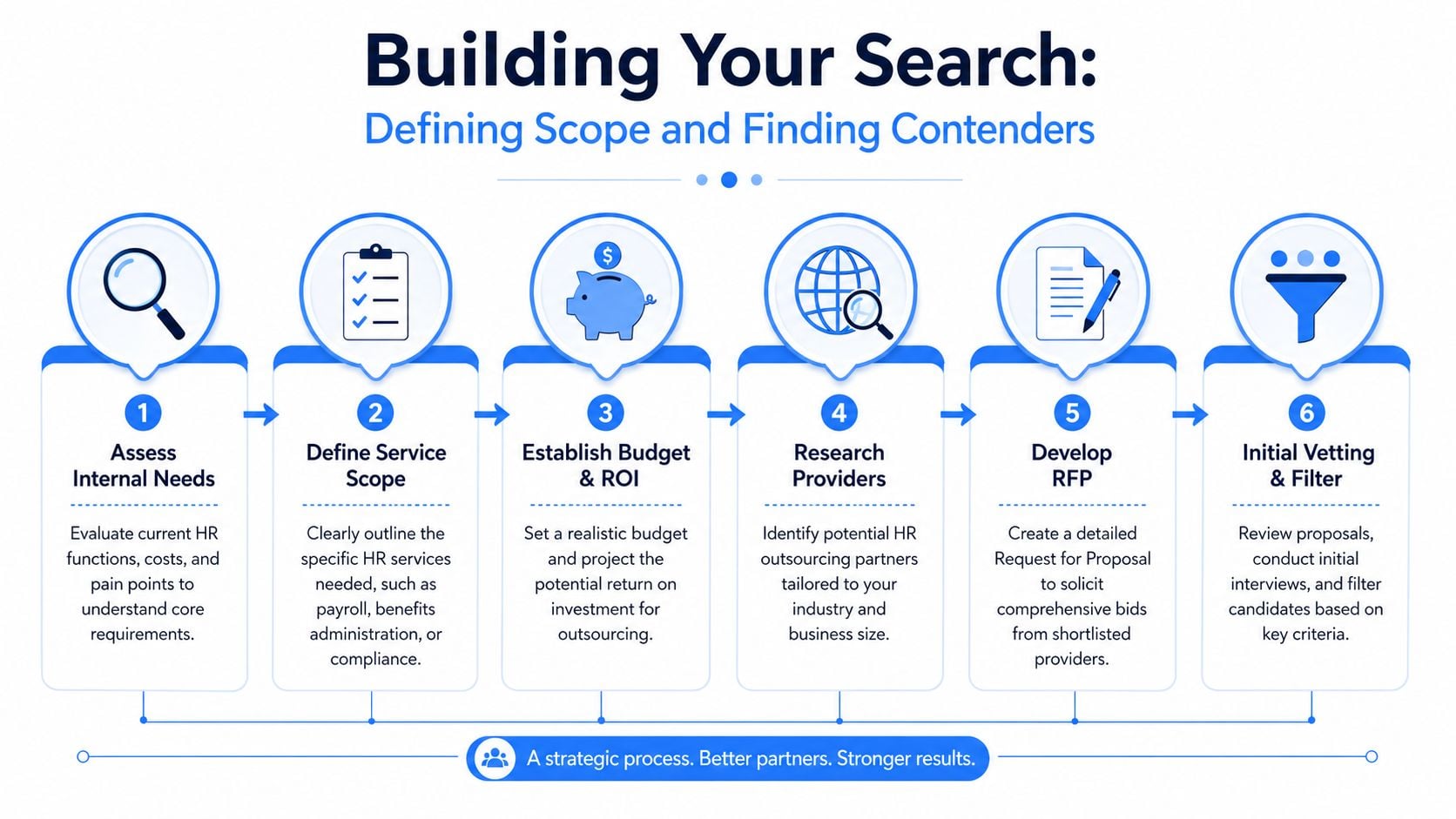
Define scope before you contact vendors
Start with failure points, not features.
Look at the last 12 months and identify where internal time or money is leaking. Payroll corrections. Open enrollment confusion. Leave tracking mistakes. Workers' comp administration. Weak manager documentation. Multi-state registration gaps. Manual onboarding. Benefits invoices that finance cannot reconcile.
Then separate the work into three buckets:
- Keep in-house. Strategic HR decisions, employee relations, executive hiring, culture work, manager coaching.
- Outsource immediately. Repeatable admin work that creates drag or compliance risk.
- Buy support only where needed. Areas where the company has partial coverage but weak backup, such as handbook updates or leave administration.
This exercise changes the search fast. A company that mainly needs payroll, benefits administration, and compliance support may fit a PEO. A company with an internal HR lead and a preferred benefits structure may need an ASO or point solution stack instead. Geography does not answer that question.
Build a longlist that reflects actual fit
The first pass should be broad enough to show the market, but narrow enough to avoid junk leads.
Use four filters.
- Industry pattern match. A light industrial employer with injury exposure, shift work, and hiring spikes needs different support than a 60-person software firm.
- Employee count and growth path. A provider that works well at 35 employees may start to break at 150 if reporting, integrations, or service staffing are thin.
- Coverage map. If the company hires in multiple states, confirm the provider supports those states operationally, not just in sales language.
- Technology compatibility. Check payroll platform, benefits administration tools, API options, and finance reporting before you spend time on demos.
For a broad market scan, this list of PEO companies is a useful starting point. It helps teams identify national firms, regional specialists, and providers they would not find by searching "near me."
Peer referrals still matter. Ask controllers, CFOs, HR directors, employment counsel, and benefits advisors who they have implemented, not just who they know. The best referral is from a company with similar headcount, state footprint, turnover pattern, and claim history.
That last point matters more than buyers expect. If workers' comp pain is part of the reason for outsourcing, ask whether the provider has a process for injury reporting, return-to-work coordination, and manager training. Basic prevention work still sits with the employer, and these actionable steps to cut claims costs are worth reviewing before you assume outsourcing will fix claim frequency by itself.
Cut the longlist with hard screens
Do not schedule six polished demos. Cut fast.
A provider belongs on the shortlist only if it can answer a few operational questions clearly on the first call:
- Who is your best-fit client? Vague answers usually signal weak specialization.
- What systems do you use? If the payroll engine, reporting structure, or benefits workflow is a black box, expect friction later.
- How do you price the account? Percentage-of-payroll pricing, PEPM fees, setup fees, benefit administration charges, and off-cycle payroll fees should be easy to explain.
- Who handles implementation? Sales should not be guessing here.
- What breaks most often for new clients? Good operators answer this directly.
A serious shortlist is usually three to five contenders. More than that means the scope is still fuzzy or the team is avoiding trade-offs.
The goal is not to find the closest vendor. The goal is to find the provider whose service model, operating discipline, and technology stack fit the business you have now and the one you expect to have in two years.
The Vetting Process Questions That Reveal True Value
Once the shortlist is built, polished presentations become a distraction. The actual work is operational due diligence.
Buyers need line-item clarity, implementation detail, and evidence that the provider can support the business after the sales rep disappears.
Ask for operating proof, not marketing language
A solid outsourcing process includes internal assessment, an RFP, reference checks, and benchmarking around HR time, compliance risk, and implementation fees. The same guidance notes that outsourcing costs can range from about $50 per employee per month for basic support to $1,500+ for full-service HR, which is exactly why vague proposals are dangerous (Business.com on HR outsourcing vetting and cost range).
That spread is wide enough to hide bad fit in either direction. A low fee can mean thin support. A high fee can mean bundled services the company won't use.
Questions that surface hidden cost and service risk
Use direct questions. Short ones. Then stay quiet.
- Pricing transparency: Ask for a mock invoice that shows every line item, every pass-through, and every nonstandard fee.
- Implementation ownership: Ask who runs implementation, how issues are escalated, and what data the client must provide.
- Service response: Ask what happens when a manager has a payroll error, leave question, or termination issue late in the day.
- Technology limits: Ask which tasks still require manual workarounds, spreadsheets, or support tickets.
- Client references: Ask for references that match industry, headcount range, and state footprint.
- Workers' compensation support: If claims management matters, compare their process against practical prevention steps such as these actionable steps to cut claims costs.
A provider that won't show invoice mechanics before signature usually creates billing surprises after go-live.
What strong answers sound like
Good answers are specific. The provider explains the implementation sequence, names the client-side responsibilities, and shows how service issues move through the team. Weak answers rely on adjectives like “dedicated,” or “high touch” without any process behind them.
Reference calls matter more than most buyers think. The right question isn't “Do you like them?” It's “What broke during the first ninety days, and how did they respond?” Another strong question is “Which promises from the sales process did not hold up after launch?”
For teams that want a structured buying checklist, this PEO due diligence checklist for buyers is a practical tool.
PEO Contract Red Flags and Powerful Negotiation Levers
Most mistakes in HR outsourcing don't happen in the demo. They happen in the contract.
A service team can be decent and the deal can still be bad because the agreement leaves too much room for price movement, weak service accountability, and a painful exit.
Contract terms that deserve scrutiny
One market summary says HR outsourcing administration fees have fallen 21% over the last five years, and North America is expected to contribute 44% of global HRO market growth from 2025 to 2029, which points to a mature, competitive market where buyers have more room to negotiate than many assume (High5Test HR outsourcing market summary).
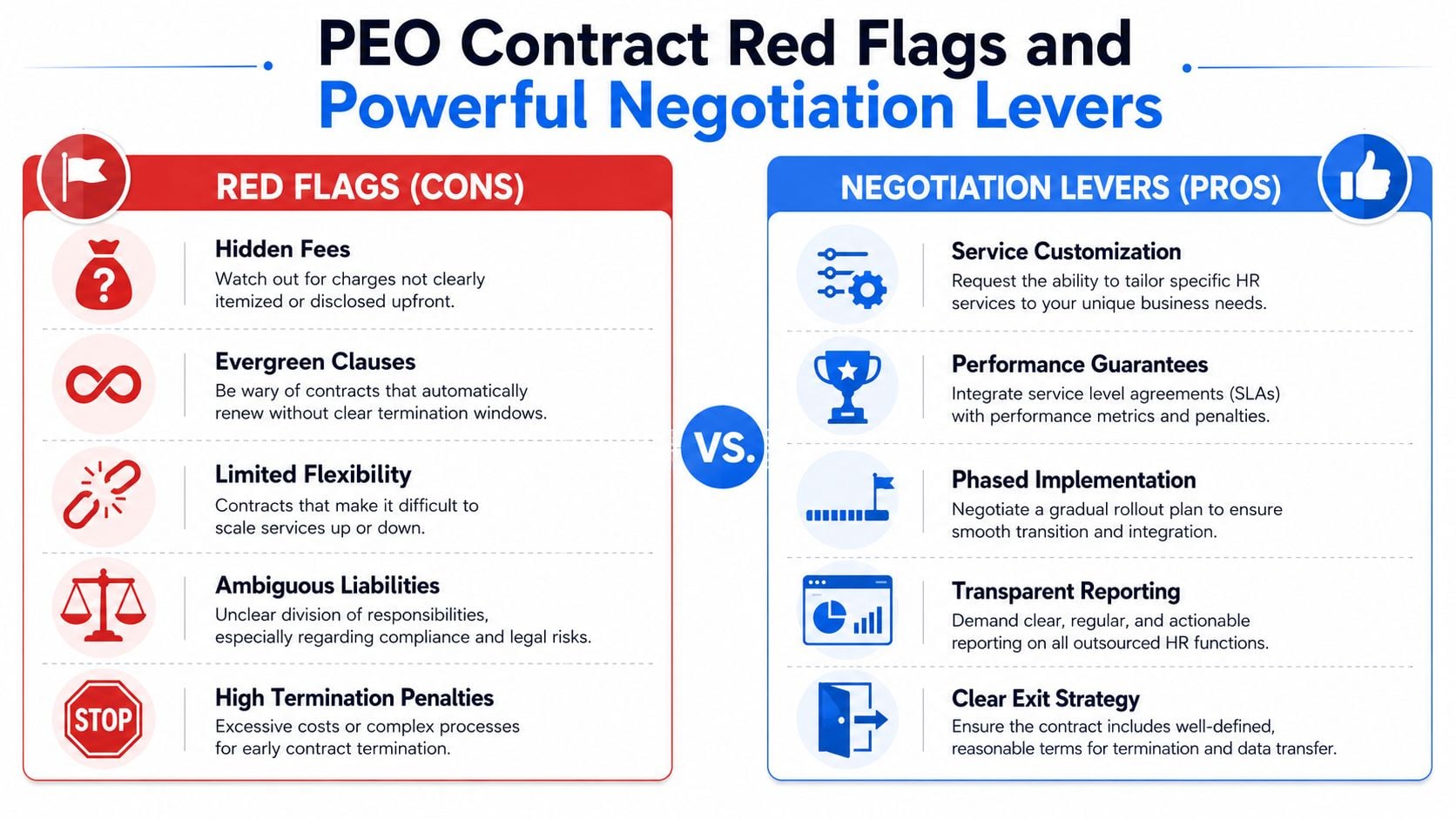
That matters because many contracts still arrive with seller-friendly terms. Watch for these:
- Evergreen renewals: Automatic renewal language paired with narrow notice windows.
- Murky fee escalation: Admin fees that can increase without a defined cap or formula.
- Implementation charges: Setup fees that aren't tied to clear deliverables.
- Unclear liability language: Compliance support described broadly while responsibility stays vague.
- Bad exit mechanics: Delayed data release, extra termination charges, or unclear transition support.
Buyers should treat the contract like an operating document, not legal cleanup.
Negotiation levers buyers should actually use
The strongest influence usually comes before verbal commitment. Once the provider thinks the deal is done, flexibility shrinks.
Push on terms that matter over the life of the relationship:
Fee protection
Ask for capped increases or a fixed admin fee period. If the provider won't hold price, ask what conditions trigger adjustments.Implementation relief
Request waived or reduced setup fees, especially if the company is moving on a defined timeline and bringing a clean employee census.Service levels
Get response expectations, escalation paths, and reporting commitments into writing.Termination clarity
Shorten notice periods where possible and define post-termination data transfer support.Scope precision
Write down what is included, what requires added fees, and what stays with the client.
An independent comparison can be beneficial. Some buyers use firms such as PEO Metrics to compare projected cost, contract terms, and provider trade-offs side by side before signing. For a deeper list of terms worth challenging, review these PEO contract negotiation red flags.
Making the Final Decision and Planning Next Steps
The final decision should not go to the lowest quote by default. It should go to the provider whose model, contract, support structure, and technology fit the actual business.
A cheap deal can become expensive if payroll corrections pile up, managers wait days for answers, or the contract makes exit difficult. A pricier deal can still be the wrong one if the company buys a broad bundle but still needs separate help for strategic HR work.
Choose on fit, not presentation quality
A useful decision matrix usually weighs five things:
- Service model fit: PEO, ASO, or advisory support.
- Operational coverage: What the provider will own day to day.
- Contract risk: Renewal language, fee movement, implementation terms, and exit conditions.
- Technology usability: Payroll workflow, employee self-service, reporting access, and manager tools.
- Reference quality: Feedback from companies with comparable complexity.
Research on outsourcing barriers points to weak governance, limited prior experience, trouble finding trustworthy suppliers, uncertainty around cost-effectiveness, and lack of management commitment as recurring causes of failure. The same review notes that strong contract controls, measurable KPIs, and regular service review matter more than treating outsourcing as a simple handoff (PMC review of HR outsourcing barriers and governance).
Plan implementation before signature day
The provider decision is only half the work. The company also needs an internal owner, a data collection plan, a manager communication schedule, and a list of policies or workflows that need revision before launch.
A clean handoff usually depends on three internal moves:
- Assign one accountable lead: Finance, HR, or operations should own the implementation calendar.
- Set early review points: Check payroll accuracy, employee issue routing, and reporting access quickly after launch.
- Keep governance active: Quarterly reviews, open issues logs, and KPI tracking prevent drift.
The companies that get value from outsourcing don't “set it and forget it.” They manage the relationship.
If the company is comparing PEOs, switching providers, or renegotiating an existing agreement, PEO Metrics provides an independent side-by-side analysis of pricing, benefits, contract terms, service model, and provider fit so decision-makers can make a cleaner apples-to-apples choice before signing.
