
Running a moving company means managing a workforce that’s physically demanding, seasonally unpredictable, and exposed to real injury risk. Workers’ comp alone can eat a significant chunk of your margins if you’re not with the right PEO — and picking the wrong one can cost you more than going it alone.
That’s why comparison matters before you sign anything. This guide covers the tools that actually help moving company owners evaluate PEO options side-by-side, understand what they’re paying for, and avoid the pricing traps that catch a lot of operators off guard.
If you’re already familiar with what a PEO does and just need help comparing providers for your moving business, you’re in the right place. We’ve kept this list short on purpose. Only tools that genuinely serve this decision are included.
1. PEO Metrics
Best for: Moving companies that need workers’ comp cost modeling and unbiased, side-by-side PEO provider comparisons.
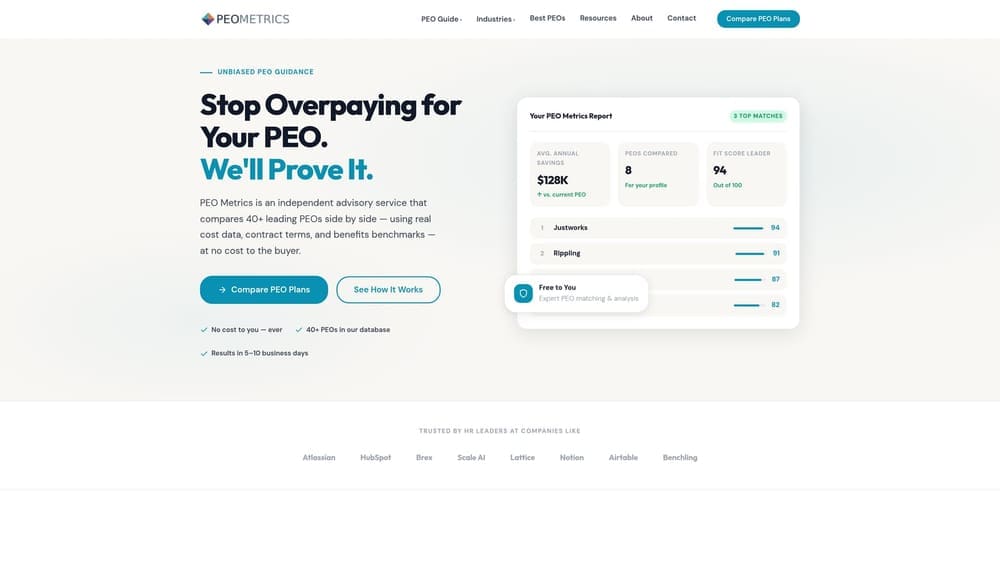
PEO Metrics is a purpose-built comparison platform designed for businesses in labor-intensive, high-risk industries where workers’ comp rates and class code structuring are the real cost drivers — not just the admin fee line item.
Where This Tool Shines
Most PEO comparison tools are built for generic office-based businesses. Moving companies aren’t that. Your workforce carries high-risk NCCI class codes, your headcount fluctuates with the season, and your injury exposure is real. A comparison tool that doesn’t surface workers’ comp rate differences across providers is essentially useless for your situation.
PEO Metrics is built around the assumption that pricing structure matters as much as the price itself. The platform helps you model the difference between percentage-of-payroll pricing and flat per-employee-per-month structures — which hits very differently at the hourly wage levels typical in moving operations, especially during peak season when overtime is common.
Key Features
Side-by-Side Provider Comparisons: Detailed pricing metrics across multiple PEO providers so you can see actual differences, not just marketing language.
Workers’ Comp Class Code Analysis: Surfaces how providers handle high-risk labor classifications, which is the most consequential cost variable for moving companies evaluating PEOs.
Pricing Structure Modeling: Helps you compare percentage-of-payroll vs. flat-fee PEO structures and understand the dollar implications at your actual payroll levels.
Unbiased Guidance: Not a lead-gen referral engine. PEO Metrics doesn’t get paid to steer you toward a specific provider, which matters when you’re making a decision this consequential.
Built for SMBs in Complex Risk Profiles: The platform is designed for businesses where risk classification, claims management, and return-to-work programs are material factors — not afterthoughts.
Best For
Moving company owners who are actively evaluating PEO providers and want to understand the real cost differences before signing. Particularly useful if you’ve received quotes that look similar on the surface but feel off when you try to compare them directly. Also valuable if you’re approaching a PEO renewal and want to pressure-test whether your current provider is still the right fit.
Pricing
Free to use for comparison. Advisory service pricing is available on the site for businesses that want more hands-on support through the evaluation process.
2. PEOcompare
Best for: Early-stage market mapping and getting a broad sense of which PEO providers are out there before narrowing your list.
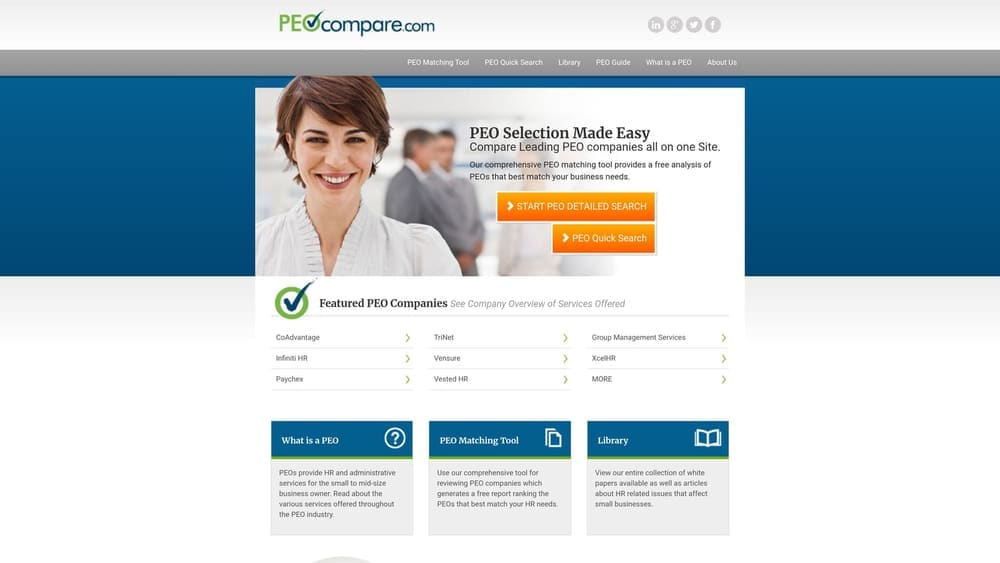
PEOcompare is an aggregator platform that catalogs PEO providers and allows general side-by-side comparisons across a wide range of business types and industries.
Where This Tool Shines
If you’re at the beginning of your PEO research and don’t yet have a shortlist, PEOcompare is a reasonable starting point. It gives you a broad directory view of the market in one place, which saves time compared to searching for providers individually and piecing together their offerings from marketing pages.
For moving companies specifically, the value is mostly in the top-of-funnel phase. You can use it to identify which providers operate in your region and cover labor-intensive industries before moving to a more specialized comparison tool for the actual cost analysis. Think of it as the first filter, not the final one.
Key Features
Broad Provider Directory: Catalogs a wide range of PEO providers in one searchable place, useful for building an initial shortlist.
General Comparison Functionality: Side-by-side provider profiles that cover basic service offerings and characteristics.
Industry Coverage: Includes labor-intensive and physically demanding business types, not just white-collar industries.
Market Overview: Helpful for operators who are new to PEOs and want to understand the landscape before getting into detailed pricing conversations.
Best For
Moving company owners who are early in their research and want a quick lay of the land before committing time to detailed provider evaluations. Less useful once you’re past the initial discovery phase and need to compare actual pricing structures or workers’ comp handling across your shortlisted providers.
Pricing
Free to use.
3. HR Guide
Best for: Understanding compliance obligations, employment law basics, and PEO evaluation frameworks before you start comparing specific providers.
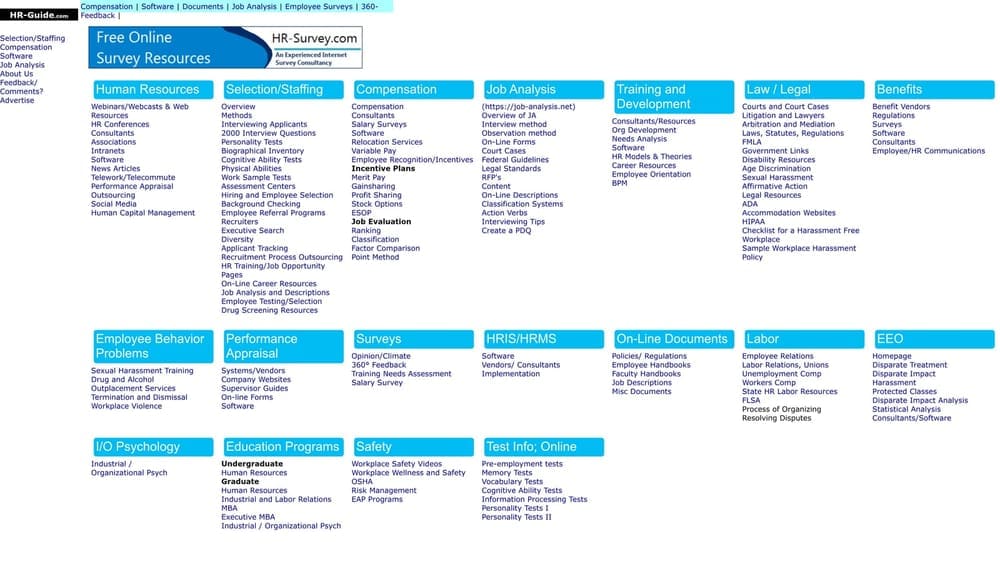
HR Guide is a long-standing HR information resource covering PEO topics, employment law, compliance, and HR best practices across a broad range of industries, including those with physical labor workforces.
Where This Tool Shines
HR Guide isn’t a comparison tool in the traditional sense. It’s more of an educational resource — and for moving company owners who want to understand what they’re actually buying before they start talking to PEO sales reps, that has real value.
Moving companies have compliance obligations that go beyond standard employment law. If you’re operating interstate, FMCSA regulations apply. Workers’ comp requirements vary by state and by class code. Wage and hour rules around overtime and piece-rate pay can be complicated when you’re scaling up a seasonal crew. HR Guide helps you build the foundational knowledge to ask better questions when you do start evaluating providers — and to recognize when a PEO’s answer to a compliance question is incomplete.
Key Features
PEO Explanations and Evaluation Frameworks: Covers what PEOs do, how co-employment works, and what to look for when evaluating providers — useful context before you start comparing quotes.
Employment Law and Compliance Coverage: Broad content on wage and hour law, workers’ comp obligations, and regulatory requirements relevant to labor-intensive industries.
HR Best Practices: Practical guidance on workforce management topics that apply to physically demanding work environments.
Reference Depth: Long-form content that goes deeper than most aggregator platforms on the regulatory and compliance side of running a workforce.
Best For
Moving company owners who want to get educated on PEO fundamentals and compliance obligations before entering provider conversations. Also useful as a reference resource during the evaluation process when a PEO rep mentions a compliance benefit and you want to verify what that actually means in practice. Not a substitute for specialized PEO comparison tools once you’re ready to evaluate pricing and contract terms.
Pricing
Free to access.
Key PEO Tools Moving Companies Actually Use
Beyond the comparison platforms covered above, moving company owners often ask which tools — payroll systems, HR portals, claims management — they should expect their PEO to bring to the relationship. The answer varies by provider, but here are the functional categories that matter most for moving operations and what to look for in each.
Payroll and Tax Filing
Every PEO runs payroll, but not all payroll engines handle the complexity common in moving operations. Look for platforms that can manage multiple pay types in a single pay run: hourly wages, piece-rate pay for specific jobs, overtime during peak season, and tip reporting if applicable. Your PEO’s payroll system should also handle multi-state tax filing without manual intervention if you run crews across state lines. Rippling and ADP TotalSource are frequently cited by moving operators for this reason — Rippling for its automation and integration depth, ADP for its compliance coverage across states with complex wage and hour rules.
Workers’ Comp and Claims Management
This is where PEO tooling has the most direct financial impact for moving companies. A PEO with solid claims management infrastructure — dedicated adjusters, return-to-work programs, and proactive loss control support — can meaningfully reduce the long-term cost of your workers’ comp program. Tools to ask about: online injury reporting portals (speed matters after an incident), experience modification rate (EMR) tracking, and whether the PEO offers safety training resources tailored to physical labor environments. Insperity and ADP TotalSource both invest heavily in this area, which is one reason they remain competitive for labor-intensive industries despite higher admin fees in some cases.
Employee Onboarding and I-9 Compliance
Seasonal hiring spikes create onboarding bottlenecks fast. A PEO with digital onboarding — electronic I-9 completion, direct deposit setup, and benefits enrollment in a single workflow — saves real time during your busy hiring windows. Given that E-Verify is required for some DOT-regulated employers and is good practice regardless, confirm whether your PEO’s onboarding tool supports E-Verify integration directly or routes it through a third-party portal.
HR Compliance Alerts and Policy Templates
Moving companies that operate across state lines face an ongoing challenge: employment law changes state by state, and keeping your employee handbook and policies current is a real operational burden. Most mid-tier and enterprise PEOs provide compliance alert services — notifications when state or federal law changes affect your obligations — along with updated policy templates. This is a meaningful time-saver for owners who are managing HR alongside sales and operations.
Benefit Administration Portals
Your drivers and movers need to access their benefits without calling your office. Look for PEO platforms where employees can view their coverage, update dependents, and request documentation through a mobile-accessible portal. This reduces HR administrative burden during peak season when your team has no time to hand-hold enrollment questions.
The most effective way to evaluate whether a specific PEO’s toolset fits your moving operation is to request a live demo that walks through payroll processing for a week with overtime, an injury claim workflow, and a seasonal onboarding run — not just the marketing overview. PEO Metrics can help you structure those conversations and compare how different providers’ tools actually hold up for labor-intensive operations before you commit.
Which Tool Is Right for Your Moving Business
The honest answer depends on where you are in the process.
If you’re just starting to think about PEOs and want to understand the landscape, PEOcompare gives you a broad market view and HR Guide helps you build the foundational knowledge to evaluate providers intelligently. Both are free and useful at the research stage.
But if you’re past that point — if you’ve already got quotes in hand, you’re approaching a renewal, or you’re trying to figure out why two PEO proposals look different on paper — PEO Metrics is where you actually get the analysis that matters. The workers’ comp class code modeling and pricing structure comparison are specifically relevant to moving operations, where those variables have real dollar consequences that generic tools don’t surface.
A few things worth keeping in mind before you decide:
Don’t evaluate PEOs on admin fees alone. For moving companies, the workers’ comp component of your PEO arrangement often matters more than the per-employee admin cost. A PEO with a lower admin fee but unfavorable class code pooling can end up costing you significantly more.
Seasonal headcount flexibility matters. If your crew doubles in summer and shrinks in winter, make sure you understand how your PEO’s pricing model handles that — before you sign a contract that assumes a stable headcount.
DOT compliance support is a real filter criterion. Not every PEO has experience supporting FMCSA-regulated employers. If you run interstate operations, this is worth asking about directly.
Before you sign that PEO renewal, make sure you’re not leaving money on the table. Many moving companies unknowingly overpay because of bundled fees, hidden administrative markups, and contracts designed to limit flexibility. Don’t auto-renew. Make an informed, confident decision.
Before you sign that PEO renewal, make sure you’re not leaving money on the table.
Many businesses unknowingly overpay because of bundled fees, hidden administrative markups, and contracts designed to limit flexibility. We give you a clear, side-by-side breakdown of pricing, services, and contract terms—so you can see exactly what you’re paying for and choose the option that truly fits your business.
