

Your renewal quote came back higher than last year. No one explained why. Or you’re running a 200-person distribution operation across three states, your workers’ comp mod is climbing, and the payroll company you’ve been using since you had 40 employees has no real answer for any of it.
The choice between a PEO and a standalone payroll company is not a software decision. It’s a structural decision about who carries your employment risk, who negotiates your benefits, and who picks up the phone when OSHA shows up at your dock. For distribution companies specifically, that distinction matters more than it does for most industries. You have warehouse pickers, forklift operators, CDL drivers, and office staff, often across multiple states, all with different workers’ comp class codes and very different risk profiles.
Generic HR content skips all of that. This guide doesn’t. Below are the tools and services worth considering for distribution operations, starting with how to compare them before you commit to any of them.
1. PEO Metrics
Best for: Distribution companies that want an unbiased, benchmarked comparison before signing a PEO contract.
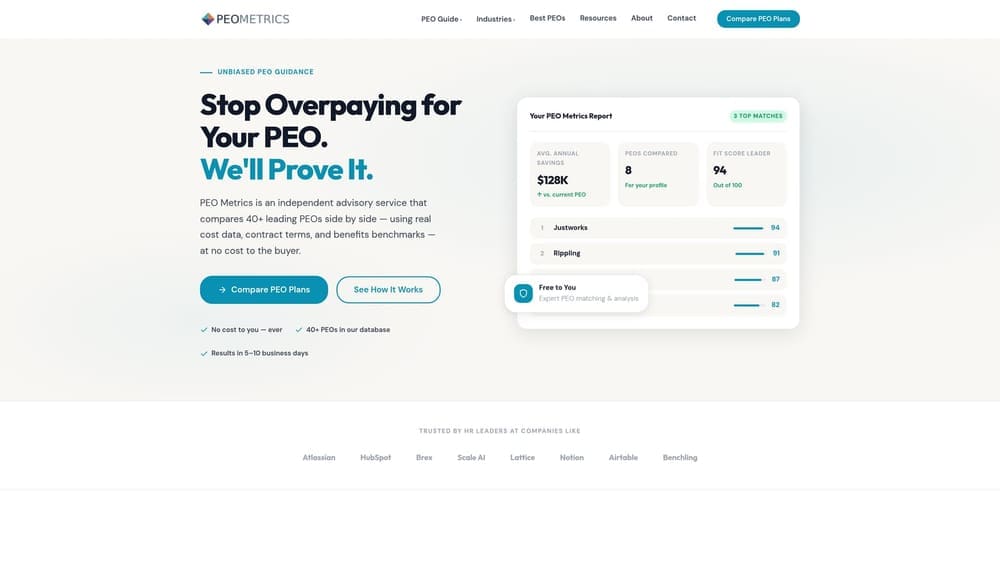
PEO Metrics is an independent advisory service that compares 40+ PEOs side by side on cost data, contract terms, and benefits benchmarks, always free to the buyer.
Where This Tool Shines
Most distribution companies sign a PEO contract without knowing whether the rate they were quoted is competitive. PEO Metrics exists to fix that. The service benchmarks your situation against $2.1 billion in PEO spend across 850+ companies matched since 2019, then delivers a side-by-side comparison across 40+ providers using a 12-dimension methodology that covers pricing structure, contract terms, workers’ comp approach, benefits quality, and exit provisions.
For distribution buyers specifically, this matters because workers’ comp class codes (8018 for warehouse, 7380 for drivers, 8810 for clerical) dramatically affect what a PEO will actually charge you. Not every PEO courts high-mod distribution clients. PEO Metrics tells you which ones do, what their comp rates look like for your profile, and where the fee escalators are buried in the contract before you sign anything.
Key Features
12-Dimension Methodology: Covers cost, contract terms, benefits benchmarks, workers’ comp approach, service model, and more across 40+ tracked PEOs.
$2.1B Benchmarked: Your quote gets compared against real spend data from 850+ companies matched since 2019.
Unbiased Guidance: PEO Metrics is never paid by vendors to steer recommendations. The comparison reflects your profile, not a referral arrangement.
Fast Turnaround: The intake takes about 8 minutes. Your benchmarked report arrives in 5-10 business days.
Contract Risk Review: Flags fee escalators, exit clauses, and workers’ comp carve-outs that distribution buyers frequently miss.
Best For
Any distribution company evaluating a PEO for the first time, questioning a renewal quote, or switching providers. Particularly valuable for operations with high-hazard class codes or multi-state footprints where PEO pricing varies most. Serves companies with 10 to 2,000 employees.
Pricing
100% free to the buyer. PEO Metrics does not charge you at any stage of the process.
2. ADP TotalSource
Best for: Mid-to-large distribution companies that need national scale and established workers’ comp infrastructure.
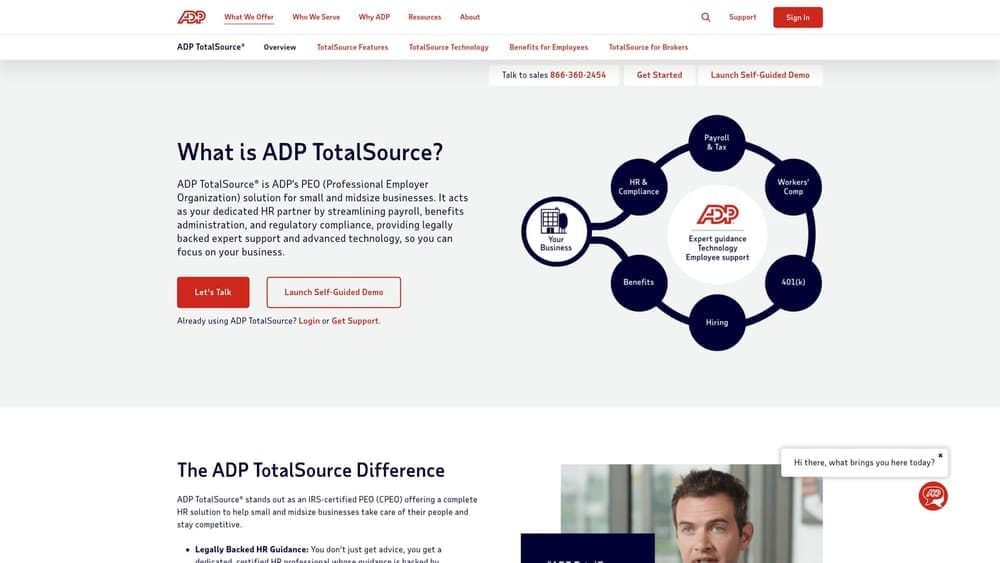
ADP TotalSource is one of the largest PEOs in the US, with broad industry coverage and multi-state payroll capability built for complex operations.
Where This Tool Shines
ADP TotalSource’s group workers’ comp program is one of its strongest assets for distribution buyers. The program covers a wide range of industry class codes, including warehouse and logistics profiles that smaller PEOs sometimes decline. If you’re running a high-mod operation and need a PEO that won’t flinch at your loss history, ADP TotalSource is worth putting in the comparison.
The limitation is pricing transparency. ADP TotalSource does not publish rates, and buyers who don’t benchmark before signing frequently overpay. The first quote is rarely the best quote. Get a benchmark before you accept their proposal.
Key Features
Group Workers’ Comp: Broad coverage including distribution and logistics class codes, with risk pooled across ADP’s large client base.
Multi-State Infrastructure: Payroll and compliance across all 50 states, including SUTA management and new-state registration.
Large-Group Benefits: Access to health plans through ADP’s buying pool, which can be competitive for smaller distribution companies.
HR Business Partner Model: Dedicated HR support assigned to your account.
Integrated Technology: ADP’s HR platform connects payroll, benefits, and compliance in one system.
Best For
Distribution operations with 50 or more employees, multi-state presence, and workers’ comp class codes that require a large, established PEO program. Companies that want a nationally recognized provider with deep infrastructure.
Pricing
Custom pricing, not published. Quoted as a percentage of payroll or PEPM depending on your profile. Benchmark against other PEOs before accepting any quote.
3. Insperity
Best for: Distribution companies with 50 or more employees that prioritize benefits quality and hands-on HR service.
Insperity is a full-service PEO recognized for above-average benefit plan quality and a service model that gives clients a dedicated HR specialist.
Where This Tool Shines
If attracting and retaining warehouse supervisors, logistics coordinators, and skilled CDL drivers is a real challenge for your operation, Insperity’s benefit plans are worth the conversation. Their group health options typically include plans that smaller employers cannot access on their own, which can matter in competitive labor markets.
The honest limitation is cost. Insperity tends toward the higher end of the PEO market, and they prefer clients with 50 or more employees. If your distribution operation is smaller or your priority is minimizing PEO spend rather than maximizing benefits quality, other options will likely fit better. Also worth noting: their workers’ comp program is solid but they are less aggressive than ADP TotalSource in courting high-hazard or high-mod profiles.
Key Features
Premium Benefits Access: Group health plans typically available only to large employers, competitive for retention in tight labor markets.
Dedicated HR Specialist: Each client gets a named HR specialist, not a call center rotation.
Workers’ Comp Coverage: Included in the PEO program with compliance and claims support.
Payroll and Compliance: Full payroll processing, tax filing, and multi-state compliance support.
HR Technology: Performance management tools and an HR platform for employee self-service.
Best For
Distribution companies with 50 or more employees where benefits competitiveness drives retention decisions. Less suited to high-mod operations focused primarily on reducing workers’ comp costs.
Pricing
Custom pricing, not published. Tends toward the higher end of the PEO market. Minimum headcount requirements apply. Request a benchmark before signing.
4. TriNet
Best for: Distribution companies expanding into new states that need multi-state compliance support quickly.
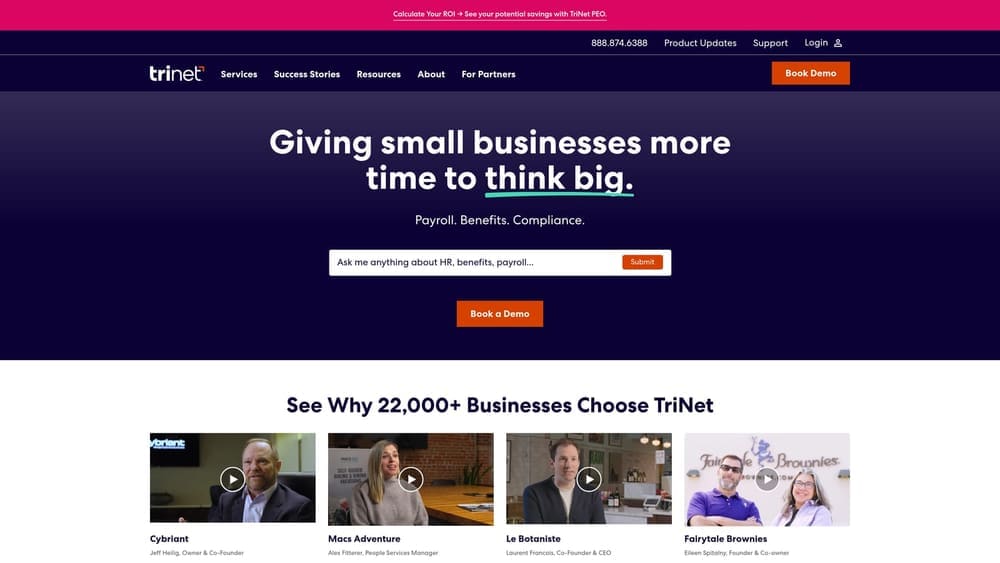
TriNet is a PEO with strong multi-state compliance infrastructure and industry-specific HR packages that can accelerate new-state setup.
Where This Tool Shines
When a distribution company opens a new distribution center in a state where they have no existing payroll registration, workers’ comp policy, or unemployment account, the setup timeline can slow operations. TriNet’s multi-state compliance infrastructure handles that registration and compliance work, which is a real operational advantage for growing distributors.
The limitation to know: TriNet is less experienced with high-hazard workers’ comp profiles than ADP TotalSource or Paychex PEO. If your operation has a meaningful number of forklift operators or CDL drivers with a history of claims, TriNet may not be the strongest fit for the comp piece specifically. Their strength is compliance breadth, not high-hazard risk pooling.
Key Features
Multi-State Compliance: Payroll, tax registration, and compliance handling across states, including new-state setup.
Industry-Specific HR Packages: Tailored HR support for different business types and workforce profiles.
Group Benefits and 401(k): Health, dental, vision, and retirement plan administration.
Online HR Platform: Employee self-service for onboarding, pay stubs, and benefits enrollment.
Employment Practices Liability Support: Risk mitigation tools and EPLI coverage options.
Best For
Distribution companies in active geographic expansion who need compliance infrastructure in new states fast. Less ideal for high-mod operations where workers’ comp rate is the primary cost driver.
Pricing
Custom pricing, not published. Quoted per employee per month. Request a benchmark before committing to any proposal.
5. Rippling
Best for: Distribution operators who want consolidated HR and payroll software without co-employment or shared workers’ comp risk.
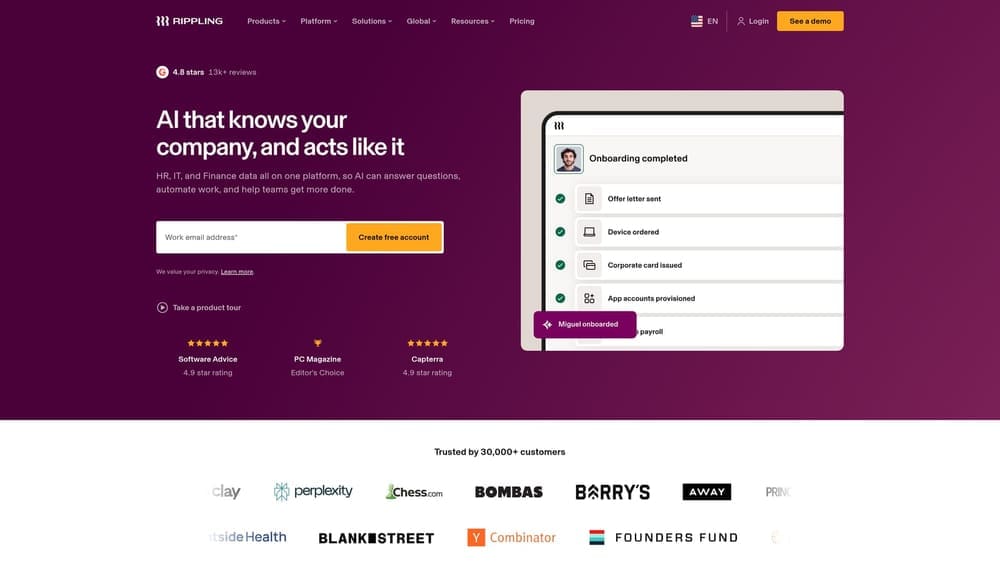
Rippling is a technology-forward payroll and HR platform with strong automation and integrations, but it is not a PEO.
Where This Tool Shines
If you’ve already solved your workers’ comp situation through a standalone policy, your mod is under control, and what you actually need is better payroll automation and integrations with your time-tracking and scheduling systems, Rippling is genuinely strong. Its modular architecture means you can add HR, IT management, and finance tools without switching platforms. For distribution operators who run multiple software systems that don’t talk to each other, that consolidation has real value.
The critical distinction for distribution buyers: Rippling does not provide co-employment. You remain the employer of record. You carry your own workers’ comp policy. You manage your own SUTA rate. If your reason for exploring this decision is to reduce comp costs or access large-group benefits, Rippling does not solve that problem. It is a payroll and HRIS platform, not a risk-sharing arrangement.
Key Features
Automated Payroll: Handles hourly and salaried payroll with direct deposit, tax filing, and multi-state compliance without co-employment.
Strong Integrations: Connects with time-tracking, scheduling, and ERP tools common in distribution environments.
Modular Platform: HR, IT, and finance management in one system; pay for the modules you use.
Multi-State Payroll Compliance: Handles registration and tax compliance across states without a PEO structure.
Scalable Architecture: Grows with your operation without requiring a new vendor relationship.
Best For
Distribution companies with manageable workers’ comp exposure and a low mod that need better HR technology, not co-employment. Not appropriate for high-hazard operations looking to reduce comp costs through risk pooling.
Pricing
Starts at approximately $8 per employee per month for core payroll. Full platform pricing is custom based on the modules selected.
6. Justworks
Best for: Smaller distribution operations under 50 employees that want predictable PEO costs and basic benefits access.
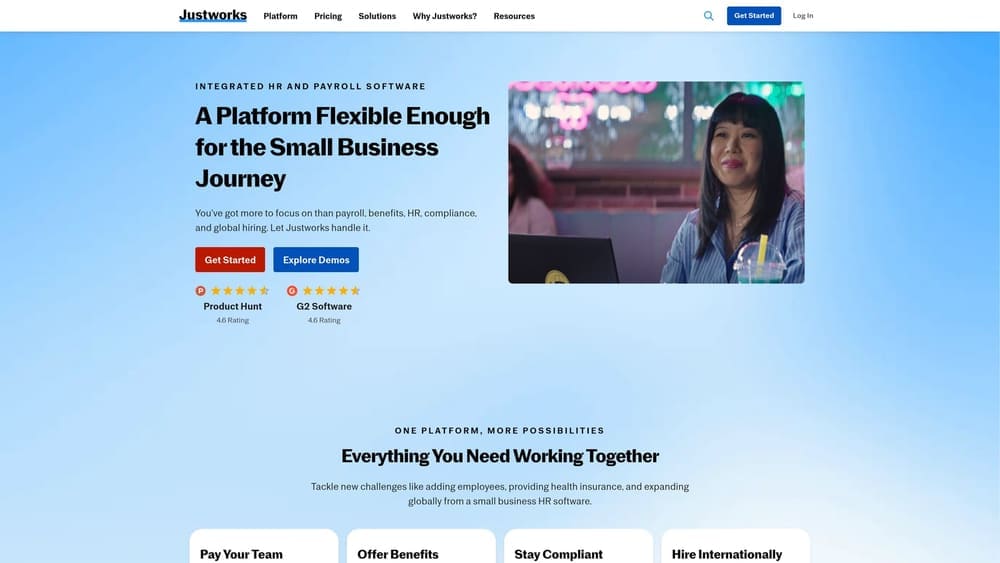
Justworks is a PEO with transparent per-employee pricing and a straightforward onboarding process that removes most of the contract complexity common in larger PEOs.
Where This Tool Shines
Justworks publishes its pricing, which is genuinely unusual in the PEO market. For a smaller distribution company that wants to understand exactly what they’re paying before they sign anything, that transparency has real value. The onboarding process is simpler than most enterprise PEOs, and the platform is clean enough that a small HR team or office manager can run it without dedicated training.
The limitation for distribution buyers is workers’ comp depth. Justworks includes workers’ comp coverage in its PEO program, but it is not the strongest option for high-hazard profiles with multiple class codes and a history of claims. If your operation has a meaningful workers’ comp exposure, you’ll want to ask Justworks directly whether they accept your specific class codes and what the effective rate will be. Don’t assume it’s competitive until you see the number.
Key Features
Transparent Pricing: PEPM rates published on their website, which is rare in the PEO industry.
Benefits Access: Group health, dental, vision, and 401(k) administration included.
Workers’ Comp Coverage: Included in the PEO program, though depth varies for high-hazard profiles.
Payroll and Tax Filing: Full payroll processing with automated tax deposits and filings.
24/7 Support: Around-the-clock access to support, which matters for operations running overnight shifts.
Best For
Distribution operations under 50 employees with moderate workers’ comp exposure that want simple, predictable PEO pricing. Not the best fit for high-mod or high-hazard operations.
Pricing
Published pricing starts at $59 per employee per month for the basic plan. Higher tiers available with additional features.
7. Gusto
Best for: Very small distribution operations with low workers’ comp exposure that need affordable payroll without co-employment complexity.
Gusto is a payroll-first platform designed for small businesses. It is not a PEO, and that distinction matters for most distribution buyers.
Where This Tool Shines
Gusto is genuinely good at what it does: clean payroll automation, benefits administration, and onboarding for small teams. If you’re running a small distribution or last-mile delivery operation with mostly office and light warehouse staff, a low workers’ comp exposure, and no multi-state complexity, Gusto will handle your payroll reliably at a price that’s hard to argue with.
For most distribution companies, though, Gusto is the wrong answer to the wrong question. It does not provide co-employment. It does not pool your workers’ comp risk. It does not give you access to large-group benefits. If your workforce includes forklift operators, CDL drivers, or warehouse pickers with any meaningful claims history, Gusto is not equipped to address the structural risk that a PEO is designed to solve. It’s a payroll tool, not an employment risk solution.
Key Features
Automated Payroll: Direct deposit, tax filing, and year-end W-2 processing handled automatically.
Benefits Administration: Health, dental, and vision benefits for small teams.
Time Tracking and PTO: Built-in tools for tracking hours and managing time-off policies.
New Hire Onboarding: Digital onboarding with I-9 management and document collection.
Accounting Integrations: Connects with QuickBooks, Xero, and other common small-business accounting tools.
Best For
Very small distribution or light logistics operations with fewer than 25 employees, low workers’ comp class codes, and no multi-state payroll complexity. Not appropriate for high-hazard or high-mod operations.
Pricing
Starts at $46 per month plus $6 per employee per month for the Simple plan.
8. Paychex PEO
Best for: Distribution operators who want a large, established PEO with local service representatives and broad industry coverage.
Paychex PEO is an established co-employment provider with local reps in many markets and a track record across distribution and logistics clients.
Where This Tool Shines
Paychex PEO’s local service model is a genuine differentiator for distribution operators who prefer in-person support over a fully remote relationship. If you’re running a regional distribution network and you want a rep who can actually visit your facility, Paychex is one of the few PEOs that still invests in that model. Their workers’ comp program covers distribution and logistics class codes, making them a viable option for operations that have been turned away by smaller or more selective PEOs.
The limitation worth flagging: service quality at Paychex PEO varies by region. The experience in one market can be meaningfully different from another, depending on the local team assigned to your account. Pricing is also opaque and negotiable, which means buyers who don’t benchmark before signing often leave money on the table. The first quote is not the final offer.
Key Features
Co-Employment with Workers’ Comp Coverage: PEO structure includes workers’ comp for distribution and logistics class codes.
Multi-State Payroll and Compliance: Payroll processing and tax compliance across states, including SUTA management.
Group Benefits and Retirement: Health benefits and 401(k) administration through the PEO’s buying pool.
Local HR Representatives: In-person support available in many markets, which is rare among national PEOs.
HR Technology Platform: Employee self-service, onboarding, and HR management tools included.
Best For
Distribution companies that want a nationally recognized PEO with local service capability and broad workers’ comp coverage. Particularly relevant for regional operators who value in-person support alongside the co-employment structure.
Pricing
Custom pricing, not published. Pricing is negotiable. Benchmark against at least two other PEOs before accepting any proposal from Paychex.
Before you sign anything, it’s worth getting a side-by-side comparison across the PEOs relevant to your profile. Compare PEO Plans through PEO Metrics and see where your current quote actually lands relative to the market.
Which Option Fits Your Distribution Operation
The right answer depends on your headcount, your workers’ comp profile, and what problem you’re actually trying to solve. Here’s how to think through it by situation.
Small single-state shop under 25 employees with low comp exposure: A payroll platform like Gusto or Rippling is probably enough. You don’t need co-employment, and the PEO overhead isn’t justified at this size unless you’re trying to offer competitive benefits to attract better candidates.
Mid-size multi-state distributor with 50 to 200 employees: This is where a PEO earns its cost. ADP TotalSource and Paychex PEO both have the multi-state infrastructure and workers’ comp programs to handle your profile. Insperity is worth considering if benefits quality is a retention lever for you. Get a benchmark before you sign any of them.
High-mod warehouse operation where workers’ comp is the primary cost driver: ADP TotalSource and Paychex PEO are the most experienced at accepting and managing high-hazard distribution profiles. Ask any PEO candidate directly whether they accept your specific class codes (8018, 7380) and what the effective comp rate will be under their program versus your current experience-rated policy. That number is the decision.
Company evaluating its first PEO: Start with PEO Metrics before you talk to any vendor. The intake takes about 8 minutes. You’ll get a benchmarked comparison across 40+ providers in 5-10 business days, covering cost, contract terms, workers’ comp approach, and exit provisions for your specific profile. It’s free, and it puts you in the room with actual data instead of a sales pitch.
Distribution is not a generic HR environment, and the PEO-vs-payroll decision is not a generic HR decision. The workers’ comp class codes, the multi-state SUTA exposure, the hourly turnover volume, and the contract terms that govern your exit all matter in ways that most general comparisons skip entirely.
Don’t auto-renew. Make an informed, confident decision.
Before you sign that PEO renewal, make sure you’re not leaving money on the table.
Many businesses unknowingly overpay because of bundled fees, hidden administrative markups, and contracts designed to limit flexibility. We give you a clear, side-by-side breakdown of pricing, services, and contract terms—so you can see exactly what you’re paying for and choose the option that truly fits your business.
