

Your workers’ comp renewal just came back higher than last year. Or you expanded into a second state and suddenly realized you have no idea how to handle SUTA registration there. Or you’re losing hourly workers to a competitor down the road who somehow offers better benefits despite being roughly the same size. Any of these sound familiar?
The warehousing and distribution industry has a specific HR cost structure that generic PEO-versus-payroll content almost never addresses: elevated workers’ comp exposure from forklift and material handling operations, turnover rates that create constant administrative drag, and multi-state compliance complexity that multiplies fast as you open new distribution centers. The decision between a PEO and a standalone payroll company is not just about convenience. It changes who carries your workers’ comp risk, what benefits rates you can access, and how much you pay in SUTA when your workforce churns.
This guide covers the leading PEO providers and payroll platforms warehousing operators actually evaluate, explains the workers’ comp math that most vendor comparisons skip, and tells you when a PEO is the right call versus when a payroll processor is all you need. The comparisons here draw on PEO Metrics’ work benchmarking over $2.1 billion in PEO spend across 40+ providers, not vendor marketing materials.
The Workers’ Comp Question That Changes Everything
Before you evaluate any specific vendor, you need to answer one question: what are your workers’ comp class codes, and what is your experience modification rate?
Warehousing operations typically run under codes like 8100 (warehouse, not otherwise classified), 8291 (cold storage), or similar material handling classifications. Forklift-heavy operations carry elevated rates. If your e-mod is above 1.0, meaning your claims history is worse than average for your class, a PEO’s master policy can absorb that risk across thousands of co-employees and potentially bring your effective rate down. If your e-mod is below 1.0, you may actually be subsidizing other clients inside the PEO pool.
There’s a second factor most content ignores: SUTA. When you join a PEO, your employees remap to the PEO’s state unemployment account. If your warehouse has high turnover and a high SUTA rate, that remapping can be a meaningful savings driver. But if you’ve built a low-turnover workforce and earned a favorable SUTA rate, you may lose that advantage inside the PEO. Ask every PEO you evaluate exactly how SUTA is handled before you sign. For a deeper look at how class codes shift under co-employment, see workers’ comp class code restructuring under a PEO.
With that framework in place, here are the tools worth evaluating.
1. PEO Metrics
Best for: Warehousing operators who want an unbiased comparison before committing to any PEO.
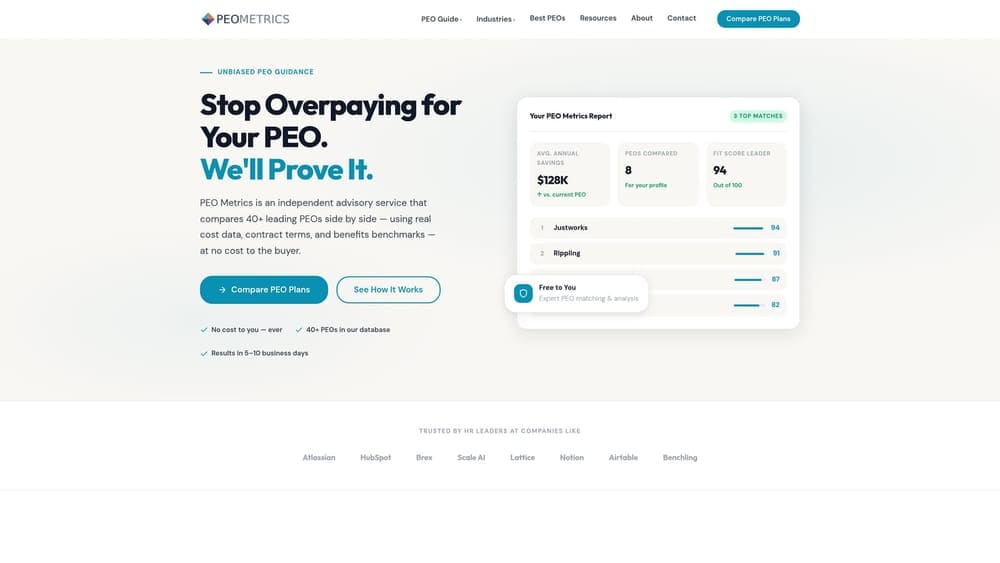
PEO Metrics is an independent advisory service that compares 40+ PEOs side by side on cost data, contract terms, and benefits benchmarks, at no cost to the buyer.
Where This Tool Shines
For a warehousing operator, the value here is specificity. Generic PEO comparison tools show you features and logos. PEO Metrics runs your actual profile, including your workers’ comp class codes, headcount, states of operation, and turnover rate, against 40+ providers to show you which ones are actually equipped for your risk profile and which ones will either decline you or price your comp coverage uncompetitively.
That matters because several well-known PEOs are quietly cautious about high-hazard workers’ comp classes. You can spend weeks in a sales process before finding out the PEO can’t accommodate your forklift operators at a competitive rate. PEO Metrics surfaces that before you invest the time.
Key Features
12-Dimension Comparison Methodology: Evaluates each PEO across cost, contract terms, benefits quality, workers’ comp handling, technology, and more, not just a feature checklist.
$2.1B Benchmarked: Cost comparisons draw on real contract and pricing data from 850+ company matches since 2019, so you’re seeing what operators like yours actually paid, not published list rates.
Workers’ Comp and High-Hazard Expertise: Specifically useful for warehousing profiles where comp class codes and e-mod rates determine whether a PEO saves or costs money.
Fast Turnaround: An approximately 8-minute intake form generates a report within 5-10 business days. No long consulting engagement required.
No Vendor Alignment: PEO Metrics is not paid by any PEO. Recommendations are based on fit, not referral fees.
Best For
Any warehousing operator with 10 to 2,000 employees who is evaluating a PEO for the first time, renegotiating a renewal, or switching after a cost surprise. Particularly valuable if you operate in multiple states or have a workers’ comp history that makes standard PEO pricing unpredictable.
Pricing
100% free to the buyer. PEO Metrics is compensated by PEOs only when a match is made, and only after the client confirms the fit. No cost, no obligation to the operator.
2. ADP TotalSource
Best for: Mid-to-large warehousing operations that need mature workers’ comp infrastructure and multi-state compliance depth.
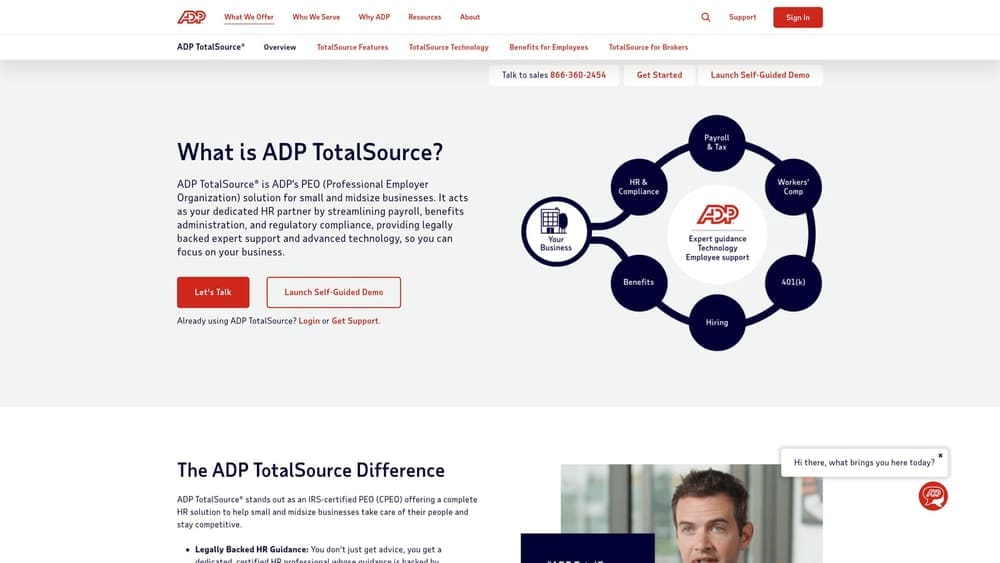
ADP TotalSource is one of the largest full-service PEOs in the US, with risk management resources built for industrial and high-hazard employer profiles.
Where This Tool Shines
For warehousing, the genuine differentiator is risk management depth. ADP TotalSource brings safety consulting resources, OSHA compliance support, and workers’ comp infrastructure that smaller PEOs simply cannot match. If your facility has active OSHA exposure around powered industrial trucks, high-bay racking, or ergonomics, having a PEO that can put a safety consultant on-site has real operational value beyond the insurance savings.
Their multi-state payroll and compliance infrastructure is also mature. As you open new distribution centers across state lines, the administrative burden of SUTA registration, state-specific leave law compliance, and workers’ comp rate filings compounds quickly. ADP TotalSource handles that at scale.
Key Features
CPEO Certification: IRS-certified PEO status provides federal tax liability protection under co-employment, which matters for warehousing operators with complex payroll tax exposure.
Workers’ Comp and Safety Consulting: Active safety resources relevant to OSHA-intensive warehouse environments, not just insurance coverage.
Multi-State Compliance Infrastructure: Handles SUTA registration, state leave law compliance, and workers’ comp rate filings across multiple states.
Large Group Benefits Buying Power: Access to group health rates that most standalone warehousing operators cannot reach on their own.
Scalable Service Tiers: HR support scales with headcount, though service depth varies by contract tier.
Best For
Warehousing and distribution operations with 50 or more employees, particularly those with active OSHA compliance needs, multi-state footprints, or workers’ comp class codes in higher-risk categories. Less suited to operators under 25 employees, where the pricing structure becomes less favorable.
Pricing
Custom pricing, not published publicly. Typically quoted as a percentage of payroll or a per-employee-per-month fee. Multi-year contracts have been reported to include fee escalator clauses. Ask specifically about escalators before signing anything.
3. Insperity
Best for: Warehousing operators competing for hourly talent through better benefits, where retention ROI justifies a premium PEO.
Insperity is a full-service CPEO-certified PEO known for high-quality benefits packages and a dedicated HR specialist model rather than call-center support.

Where This Tool Shines
The honest case for Insperity in warehousing is this: if your turnover problem is driven by benefits quality, not just wage competition, Insperity gives you access to health and ancillary benefits packages that can genuinely shift hourly worker retention. Their dedicated HR specialist model also means you have a named person who knows your account, not a ticket queue.
That said, Insperity’s model is built for operators who value HR depth and benefits quality over pure cost minimization. If your primary goal is the lowest possible administrative fee, Insperity is probably not your answer. Their pricing reflects the service level.
Key Features
CPEO Certification: Federal tax liability protection under co-employment, same as ADP TotalSource.
Dedicated HR Specialist Model: A named HR specialist assigned to your account, not a shared service center rotation.
Benefits Quality for Hourly Workforce Retention: Health and ancillary benefits packages designed to help operators compete for hourly labor in tight markets.
Workers’ Comp Coverage: Included in the PEO arrangement with risk management support.
Multi-State Compliance Support: Handles state-specific leave laws, SUTA, and payroll tax compliance as you expand.
Best For
Warehousing operators with 50 or more employees where benefits-driven retention has a measurable cost impact, and where HR support depth matters more than getting the lowest possible PEPM. If you’re in a tight labor market for hourly workers, Insperity’s benefits access is worth pricing out.
Pricing
Custom pricing, generally positioned at a premium compared to mid-market PEOs. No published rates. Best evaluated after getting a comparison benchmark from an independent advisor so you know what “premium” actually means in dollar terms for your headcount.
4. TriNet
Best for: Mixed-workforce warehousing operations where the office and management population is as large as the hourly floor workforce.
TriNet is an industry-packaged PEO with a strong technology platform and solid benefits access, though its core competency sits closer to professional services than heavy industrial.
Where This Tool Shines
TriNet’s platform is genuinely clean and modern. For warehousing operations that have a meaningful salaried or professional workforce alongside hourly floor workers, the self-service tools and HR technology reduce administrative load for the management layer. Their industry-specific HR packages also bring some useful structure to compliance documentation.
The limitation to name directly: TriNet’s historical client base skews toward professional services and technology companies. High-hazard workers’ comp classes, the kind common in forklift-heavy or cold storage environments, are not their core competency. Some operators have reported difficulty getting competitive workers’ comp rates through TriNet for heavy industrial profiles. If your comp class codes are in elevated-rate territory, price TriNet’s workers’ comp coverage carefully before committing.
Key Features
Industry-Specific HR Packages: Pre-built HR frameworks by industry, which can reduce setup time for compliance documentation.
Modern HR Technology Platform: Self-service tools for employees and managers, with clean payroll reporting.
Large Group Health Insurance Access: Competitive benefits for mixed workforces.
Multi-State Payroll and Compliance: Handles multi-state payroll tax filings and compliance requirements.
Dedicated Support Team: Account-based support, though service model varies by contract tier.
Best For
Warehousing or 3PL operations with a significant professional or administrative workforce alongside hourly workers, particularly where platform usability and HR technology matter to the management team. Less suited to pure high-hazard industrial profiles.
Pricing
PEPM pricing varies by industry package and headcount. Not publicly listed. Request a quote alongside at least one other PEO to benchmark the number.
5. Justworks
Best for: Small warehousing or light-duty fulfillment operations with low workers’ comp exposure that want pricing transparency and simple onboarding.
Justworks is a flat-rate PEPM PEO with published pricing and a clean platform, built for straightforward small-business HR rather than high-hazard industrial profiles.
Where This Tool Shines
Justworks’ genuine strength is pricing clarity. In a market where most PEOs will not quote you a number until you’ve been through a full sales cycle, Justworks publishes its PEPM rates. For a small warehousing or e-commerce fulfillment operation with low physical risk, that transparency is valuable. Onboarding is also genuinely fast and self-directed.
The limitation is real and worth stating plainly: Justworks has historically been cautious about high-hazard workers’ comp classes. If your operation involves forklifts, heavy material handling, or elevated injury risk, Justworks may be unable to accommodate you, or may price your workers’ comp coverage uncompetitively. This is not a knock on the platform. It’s a function of their client mix and risk pooling model. Verify your comp class code eligibility before investing time in their onboarding process.
Key Features
Transparent Published PEPM Pricing: Rates are available on their website, which is genuinely unusual in the PEO market.
Clean, User-Friendly Platform: Payroll, benefits administration, and compliance tools in a straightforward interface.
Large Group Health Benefits Access: Competitive health insurance rates through the PEO’s group buying pool.
Multi-State Payroll Processing: Handles payroll across multiple states.
24/7 Support: Around-the-clock customer support, which matters during payroll runs that fall outside business hours.
Best For
Small warehousing, e-commerce fulfillment, or light assembly operations with 10 to 50 employees, low physical risk, and a need for straightforward payroll and benefits without a complex sales process. Not the right fit for forklift-heavy or cold storage environments.
Pricing
Published PEPM pricing available at justworks.com. Check the current rates directly, as tiers are updated periodically.
6. Rippling
Best for: Tech-forward warehouse operators who prioritize platform automation and HR-IT integration over deep workers’ comp expertise.
Rippling is an HR and IT platform that offers PEO services as part of a modular product suite, with best-in-class automation for onboarding, offboarding, and workforce management.
Where This Tool Shines
If your warehousing operation has high turnover, the administrative cost of onboarding and offboarding dozens of employees each month is real. Rippling’s automated workflows handle device provisioning, system access, payroll setup, and benefits enrollment in a single flow. For a distribution center that processes 20 or 30 new hires a month, that automation reduces HR staff time meaningfully.
The honest limitation: Rippling’s PEO offering is newer and less proven in high-risk industrial environments than ADP TotalSource or Insperity. Their value proposition is platform efficiency and integration depth, not workers’ comp risk pooling or OSHA safety consulting. If your primary decision driver is managing elevated comp class codes or e-mod rates, Rippling is not the right starting point.
Key Features
HR and IT Integration: Unique capability to manage device provisioning, app access, and HR data in one system, relevant for warehouses with WMS or logistics software.
Automated Onboarding and Offboarding: Workflow automation that reduces administrative time for high-turnover environments.
PEO and Employer-of-Record Options: Flexibility to choose co-employment or EOR depending on your structure.
Modern Payroll with Strong Reporting: Clean payroll processing with reporting tools useful for labor cost analysis.
Modular Platform: Pay for the services you need rather than a bundled package.
Best For
Warehousing operators with strong technology infrastructure, moderate workers’ comp exposure, and a management team that values platform automation over deep HR specialist support. Better suited to tech-enabled 3PLs or e-commerce fulfillment centers than traditional heavy industrial warehousing.
Pricing
Modular pricing based on core platform plus add-on services. PEO-specific pricing requires a direct quote from Rippling. Contact them for current rates.
7. Gusto
Best for: Very small warehousing or light fulfillment operations that need clean, affordable payroll without co-employment complexity.
Gusto is a payroll-first platform with no co-employment relationship, suited to small operations that want straightforward payroll processing and basic HR tools at a predictable cost.
Where This Tool Shines
Gusto is genuinely good at what it does: clean payroll, automated tax filings, and a user-friendly interface that does not require an HR background to operate. For a small warehousing operation that does not need workers’ comp risk pooling, PEO benefits buying power, or multi-state compliance support, Gusto handles the payroll function efficiently and affordably.
The structural limitation is important to understand: Gusto is not a PEO. There is no co-employment relationship. Your business retains full employer liability, carries its own workers’ comp policy, and negotiates benefits independently. For a small operation with low physical risk and a simple single-state footprint, that is fine. For a warehouse with elevated comp exposure or multi-state complexity, you are managing those risks entirely on your own.
Key Features
Affordable Tiered Payroll Pricing: No long-term contracts, with published pricing tiers for different service levels.
Automated Tax Filings: Federal, state, and local payroll tax filings handled automatically.
Basic HR Tools: Onboarding checklists, document storage, and offer letter templates included.
Health Benefits Administration: Benefits enrollment available as an add-on, though without PEO group buying power.
No Co-Employment: Full employer liability stays with your business, which is a feature for some operators and a gap for others.
Best For
Warehousing or light fulfillment operations with under 25 employees, single-state operations, and low workers’ comp exposure. If you need payroll processing and basic HR tools without the complexity or cost of a PEO relationship, Gusto is a sensible starting point.
Pricing
Published monthly base fee plus a per-employee charge. Check gusto.com for current pricing tiers, as they are updated periodically.
8. Paychex
Best for: Warehousing operators who want to start with payroll processing and have the option to layer in full PEO services later without switching vendors.
Paychex offers both a standalone payroll platform (Paychex Flex) and a separate full PEO service, giving operators a rare ability to scale their HR infrastructure within one vendor relationship.
Where This Tool Shines
The modular structure is the genuine differentiator here. Most vendors force a binary choice: you’re either a PEO client or you’re not. Paychex lets you start with Paychex Flex for payroll processing, then transition to Paychex PEO when your headcount, risk profile, or multi-state complexity justifies co-employment, without rebuilding your HR infrastructure on a new platform. For a growing warehousing operation that is not sure it needs a PEO yet, that optionality has real value.
The honest limitation: Paychex PEO is less frequently cited as a top-tier option for complex multi-state warehousing compared to ADP TotalSource or Insperity. Their HR specialist support depth is generally considered lighter than Insperity’s, and their workers’ comp and safety consulting resources are less developed than ADP TotalSource’s. If your primary driver is industrial risk management, Paychex PEO is not the strongest choice.
Key Features
Modular Payroll-to-PEO Pathway: Start with Paychex Flex and transition to full PEO without switching systems or re-entering employee data.
Multi-State Payroll and Tax Compliance: Handles payroll tax filings across multiple states, relevant for operators expanding their DC footprint.
Workers’ Comp Pay-As-You-Go Option: Pay-as-you-go workers’ comp eliminates large upfront deposits, which helps cash flow for seasonal warehousing operations.
HR Generalist Support with PEO Tier: Access to HR generalist support when you upgrade to the PEO service level.
Broad Industry Coverage: Long-established vendor with experience across a wide range of industries including warehousing and distribution.
Best For
Growing warehousing operations that currently need payroll processing but anticipate needing full PEO services as they scale, and want to avoid a platform migration later. Also useful for operators who want pay-as-you-go workers’ comp to manage seasonal cash flow.
Pricing
Paychex Flex pricing is partially published and varies by service tier and headcount. Paychex PEO pricing is custom. Contact Paychex directly for a PEO quote.
Before you sign that PEO renewal, make sure you’re not leaving money on the table. Compare PEO Plans with PEO Metrics to see a side-by-side breakdown of what 40+ providers would actually charge your operation.
Which Option Fits Your Warehousing Profile
The PEO-versus-payroll decision in warehousing comes down to three factors: your workers’ comp class code exposure, whether you operate across multiple states, and how competitive your benefits need to be to retain hourly workers. Get those three things right and the vendor choice becomes much clearer.
If your operation has elevated workers’ comp exposure, forklift operations, cold storage, or a claims history that has pushed your e-mod above 1.0, a PEO with mature risk pooling and safety consulting is worth serious evaluation. ADP TotalSource is the strongest fit for that profile. Insperity is the right call when benefits quality is the retention lever and you want dedicated HR support. For a quick, unbiased read on which one actually fits your specific class codes and headcount, that is exactly what PEO Metrics was built to answer.
If your operation is smaller, lower-risk, or single-state, a standalone payroll platform may be all you need right now. Gusto handles clean payroll for light-duty operations. Paychex gives you a path to scale into co-employment later without rebuilding your HR stack. Justworks works well for small, low-hazard fulfillment operations that want pricing transparency.
For mixed-workforce operations with a meaningful professional or tech-forward management layer, TriNet and Rippling are worth evaluating, with the caveat that neither is optimized for heavy industrial workers’ comp profiles.
One thing to check regardless of which direction you go: if you are in a PEO now, confirm how your SUTA rate is being handled and whether your current workers’ comp class codes were correctly mapped when you enrolled. Both are common sources of overpayment that operators do not discover until renewal. For a deeper look at the compliance side of this decision, the workforce compliance strategy for logistics companies and the workers’ comp class code cost modeling approach are worth reading before your next renewal conversation.
You’re good at running a warehouse. Evaluating PEO contracts and benchmarking PEPM rates against 40+ providers is a different skill, and it is not one you should have to develop from scratch. PEO Metrics has benchmarked over $2.1 billion in PEO spend across 850+ company matches since 2019, and the service is completely free to the buyer. Don’t auto-renew. Make an informed, confident decision.
Before you sign that PEO renewal, make sure you’re not leaving money on the table.
Many businesses unknowingly overpay because of bundled fees, hidden administrative markups, and contracts designed to limit flexibility. We give you a clear, side-by-side breakdown of pricing, services, and contract terms—so you can see exactly what you’re paying for and choose the option that truly fits your business.
