

Running a grease trap pumping operation means you’re already juggling more compliance obligations than most small business owners. Your crews are doing confined space entry work covered under OSHA 29 CFR 1910.146. You’re dealing with DOT transport requirements. Workers’ comp class code placement is a real cost driver, not a line item you can ignore. And if your experience modification rate has been climbing, you already know what that does to your insurance bill.
At some point, most owners in this trade ask the same question: is a basic payroll company enough, or do I need a Professional Employer Organization? The honest answer is that it depends on where your business is right now. But first, you need to understand that these are genuinely different products solving different problems. Confusing them is expensive.
A payroll company processes your checks and files your taxes. A PEO does that plus enters a co-employment arrangement with your workforce, provides access to group benefits, handles HR compliance, and often restructures your workers’ comp program under its own master policy. For a grease trap pumping operation, that distinction can translate to meaningful cost and risk differences in either direction.
Here’s a clear breakdown of what each option actually covers, where each falls short for this specific industry, and the tools that help you make the call.
1. PEO Metrics
Best for: Field-service businesses comparing PEO providers before committing to a contract
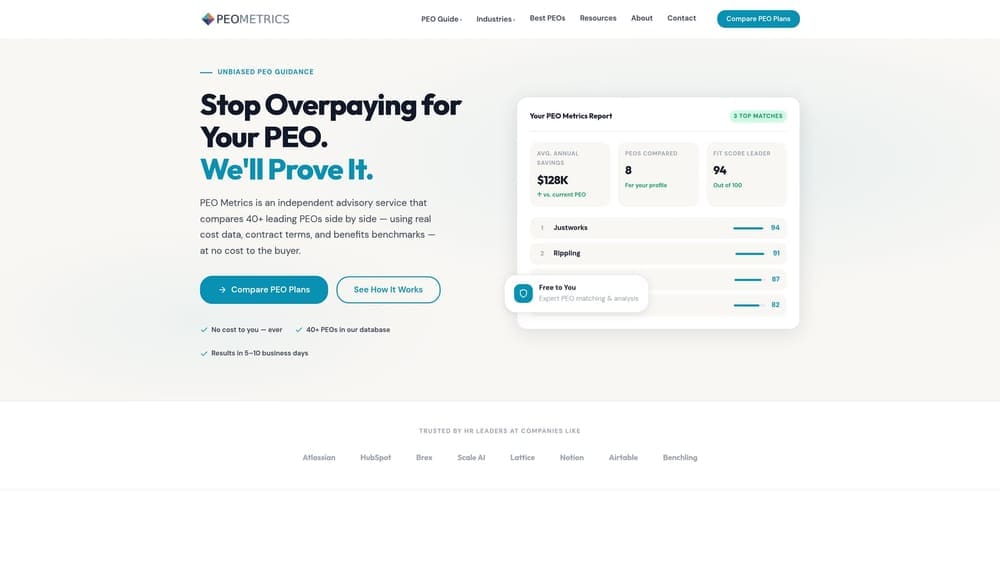
PEO Metrics is a PEO comparison resource built for business owners who want to see real pricing and program detail before signing anything.
Where This Tool Shines
Most PEO quotes arrive as dense proposals with bundled fees, workers’ comp structures that aren’t clearly explained, and contract terms that vary significantly between providers. For a grease trap pumping business, where workers’ comp classification and mod rate treatment are central to whether a PEO saves you money or costs you more, going in blind is a real risk.
PEO Metrics puts provider comparisons side by side so you can see pricing structures, program features, and workers’ comp approaches across multiple providers at once. The consultative approach is oriented toward helping you figure out which model actually fits your situation, not steering you toward a predetermined recommendation.
Key Features
Side-by-side provider comparisons: View pricing and program detail across multiple PEO providers in a single comparison rather than managing separate proposals.
Workers’ comp program guidance: Understand how different providers structure workers’ comp under their master policies, which matters significantly for trades with high exposure like liquid waste and pumping work.
Model fit evaluation: Helps you work through whether a PEO or payroll-only arrangement makes more sense given your workforce size, comp exposure, and benefits needs.
Transparency focus: The approach is consultative rather than prescriptive, which is useful when you’re trying to compare options that are genuinely hard to evaluate on your own.
Best For
Grease trap pumping operators and other field-service business owners who have received PEO quotes but can’t easily compare them, or who aren’t sure whether a PEO is worth the cost given their current workers’ comp situation and crew size.
Pricing
[CONFIRM: pricing or free-to-use model. Contact PEO Metrics directly at peometrics.com for current access details.]
2. Professional Employer Organization (PEO)
Best for: Growing grease trap pumping operations with high workers’ comp exposure, a rising mod rate, or crew retention pressure tied to benefits
A PEO is a co-employment arrangement where the PEO becomes the employer of record for HR, payroll tax, and benefits purposes, while you retain full operational control of your business and workforce.
Where This Tool Shines
The co-employment structure is what separates a PEO from every other HR service. When your employees are co-employed, they’re placed under the PEO’s master workers’ comp policy. That policy is rated on the PEO’s aggregate book of business, not your individual experience modification rate. If your mod rate has been climbing because of claims in your pumping crew, that’s where PEO access can make a material difference to your insurance cost. It’s not a guaranteed outcome, but it’s a real structural advantage worth evaluating with your actual numbers.
For grease trap pumping specifically, workers’ comp classification matters enormously. Depending on the work performed and the state, your crews may fall under different NCCI class codes, and placement affects your base rate. A PEO with experience in field-service or liquid waste work will understand these nuances better than a general HR vendor. Beyond comp, co-employment gives smaller operators access to group health benefits they couldn’t offer independently, which matters when you’re competing for experienced technicians who have other options.
Key Features
Master workers’ comp policy access: Your employees are covered under the PEO’s policy, which can benefit employers whose individual mod rate would otherwise produce high standalone premiums.
Group health and benefits access: Small employers gain access to group medical, dental, and vision plans that would be unavailable or unaffordable on a standalone basis.
Payroll processing and tax filing: Payroll calculation, direct deposit, federal and state tax filing, and year-end W-2 preparation are included as part of the service.
HR compliance support: Assistance with employment law compliance, employee handbook development, and HR documentation, though this does not substitute for legal counsel on specific situations.
CPEO and ESAC credentials: When evaluating providers, ask whether the PEO holds IRS Certified PEO (CPEO) status and ESAC accreditation. CPEO status, granted by the IRS under guidance including IRS Notice 2016-49, affects how certain federal tax liabilities are allocated. ESAC accreditation from the Employer Services Assurance Corporation is a financial assurance and ethical standard. Both are meaningful trust signals.
Best For
Grease trap pumping operations with five or more employees, a workers’ comp situation that’s getting expensive, or any business where benefits access is affecting your ability to hire and keep good technicians. Also worth evaluating seriously if your administrative HR time is growing faster than your crew.
Pricing
PEO pricing typically follows one of two structures: a flat per-employee-per-month (PEPM) fee or a percentage of total payroll. Neither model is universally cheaper. High-wage workforces often pay less under PEPM. The right structure depends on your average wages and crew size. Get quotes under both models before deciding.
3. Payroll Company
Best for: Very small grease trap pumping operations where workers’ comp coverage is already competitive and benefits administration isn’t a priority
A payroll company is a processing and tax filing service with no co-employment relationship and no shared employer-of-record responsibility.
Where This Tool Shines
Payroll companies do one thing well: they make sure your people get paid correctly and that your payroll taxes are filed on time. Providers like ADP Run, Gusto, and Paychex Flex handle payroll calculation, direct deposit, federal and state tax filing, and W-2 and 1099 preparation. For a small pumping operation where the owner already has a solid workers’ comp policy, doesn’t need group health benefits, and isn’t spending hours on HR compliance issues, a payroll company is often the right-sized tool.
The important thing to understand is what a payroll company does not do. It is not a co-employer. It does not provide access to a master workers’ comp policy. It does not offer group health benefits as part of its core product. Some payroll providers offer add-on brokerage services for benefits or workers’ comp, but those are separate arrangements, not co-employment, and they don’t carry the same structural features as a PEO relationship. If you’re comparing a payroll company’s add-on benefits brokerage against a PEO’s co-employment model, you’re comparing fundamentally different things.
Key Features
Payroll calculation and direct deposit: Accurate gross-to-net calculation and payment delivery for hourly and salaried employees.
Payroll tax filing: Federal and state payroll tax deposits and filings, including quarterly and annual returns.
W-2 and 1099 preparation: Year-end tax document preparation and distribution for employees and contractors.
No co-employment: You remain the sole employer of record. All HR and compliance responsibility stays with you. This is straightforward if you have the capacity to manage it, and it’s a liability if you don’t.
Best For
Sole operators or very small pumping crews where the owner manages HR directly, already carries competitive workers’ comp coverage independently, and does not need to offer group health benefits to attract or retain staff. Also appropriate during early-stage growth before workforce complexity justifies a PEO relationship.
Pricing
Payroll company pricing varies by provider and is typically structured as a per-employee-per-month fee or a per-payroll-run fee. Most providers also charge base fees plus per-employee additions. Get itemized quotes to compare true cost at your headcount.
Which Option Actually Fits Your Operation
Payroll companies and PEOs solve different problems. If your grease trap pumping operation is small, your workers’ comp rate is already competitive, and your crew doesn’t expect benefits, a payroll company may be all you need right now. It’s simpler, often cheaper at low headcount, and keeps your employer-of-record structure clean.
But if you’re growing, if your experience modification rate is climbing because of claims in a physically demanding crew, or if you’re losing technicians to competitors who offer health coverage, a PEO deserves a serious look. The confined space entry requirements under OSHA 29 CFR 1910.146, the DOT transport obligations, and the workers’ comp classification complexity in liquid waste work all add up to a compliance and risk profile that benefits from the co-employment structure a PEO provides.
The challenge is that PEO quotes are genuinely hard to compare on your own. Pricing structures vary between PEPM and percentage-of-payroll models. Workers’ comp treatment under each provider’s master policy is rarely explained clearly upfront. Contract terms differ in ways that matter when you eventually want to exit or switch providers.
PEO Metrics helps grease trap pumping businesses and other field-service operators compare PEO providers side by side with detailed pricing and program data, so you can see the real cost difference before you commit. This is informational guidance, not legal or benefits advice. Your specific situation determines which option fits. But going in with a clear picture of what each model actually covers is the right place to start.
Don’t auto-renew. Make an informed, confident decision.
Before you sign that PEO renewal, make sure you’re not leaving money on the table.
Many businesses unknowingly overpay because of bundled fees, hidden administrative markups, and contracts designed to limit flexibility. We give you a clear, side-by-side breakdown of pricing, services, and contract terms—so you can see exactly what you’re paying for and choose the option that truly fits your business.
