

When a payroll runs wrong or a tax filing lands late, the owner finds out the hard way. A penalty notice arrives. A direct deposit fails. An employee calls HR at 7am on a Friday. The whole point of hiring a PEO is to hand off that exposure to someone whose entire business model depends on getting it right.
But not every PEO earns that trust at the same level. Some have dedicated tax compliance teams and IRS-certified status that actually shifts liability away from you. Others rely on third-party processors and leave clients chasing corrections on their own. If you’ve ever used a payroll-only provider like Gusto or QuickBooks Payroll and are now weighing a PEO for the added compliance layer, the difference matters more than most sales decks let on.
This list focuses on one specific question: which PEO platforms do small business owners actually trust to run payroll and file taxes without needing to double-check the work? If you want foundational context on how PEOs work before reading further, the what is a PEO guide covers the co-employment mechanics behind all of this.
We cover eight providers across different size ranges and price points. Each entry names a genuine strength and a genuine limitation, because no single PEO is right for every company. We start with the one resource that helps you compare them before you sign anything.
1. PEO Metrics
Best for: Companies that want an independent, unbiased comparison before committing to any PEO.
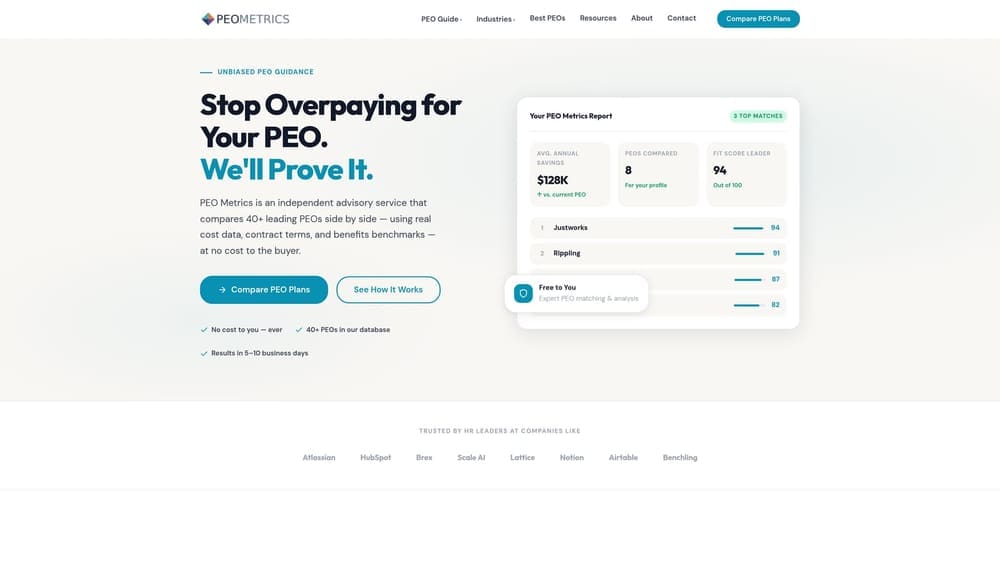
PEO Metrics is an independent advisory service that compares 40+ PEO providers side by side on cost, contract terms, compliance track record, and benefits benchmarks.
Where This Tool Shines
Most buyers approach PEO selection by talking to vendors directly. That means every data point you receive comes from someone who earns money if you sign. PEO Metrics sits on the opposite side of that table. The service is 100% free to the buyer, with no vendor commissions influencing which providers get recommended.
The comparison uses a 12-dimension methodology that includes payroll accuracy track record and tax filing infrastructure, which are exactly the factors that matter when you’re evaluating trust, not just features. Since 2019, PEO Metrics has matched 850+ companies and benchmarked $2.1B in PEO spend. That volume of real contract data means the recommendations are grounded in what companies your size actually pay and experience, not what a vendor’s marketing materials claim.
Key Features
12-Dimension Comparison Framework: Evaluates each PEO across cost, contract terms, compliance infrastructure, payroll accuracy track record, benefits quality, and more.
40+ PEOs Tracked: Covers the full market, from flat-rate platforms to enterprise-grade providers, so you’re not limited to whoever called you first.
$2.1B Benchmarked: Real pricing data from real contracts, which means your quote gets compared against what comparable companies actually paid.
Fast Turnaround: The intake takes roughly 8 minutes. Your comparison report arrives in 5-10 business days.
Serves 10-2,000 Employees: Useful whether you’re a 15-person startup or a 500-person company heading into renewal negotiations.
Best For
Any company evaluating a PEO for the first time, approaching a renewal, or unhappy with their current provider. Particularly valuable for HR directors and CFOs who want independent data before committing to a multi-year contract. If you’ve never compared PEOs side by side with real pricing benchmarks, this is the logical starting point.
Pricing
Free to the buyer. No fees, no commissions, no vendor relationships that influence the output. PEO Metrics earns nothing based on which provider you choose.
2. Justworks
Best for: Small and mid-size professional services or tech companies that want transparent flat pricing and CPEO-certified compliance.
Justworks is a CPEO-certified PEO with flat, transparent per-employee-per-month pricing and a compliance infrastructure built specifically for small and mid-size businesses.
Where This Tool Shines
The CPEO certification is the most important trust signal here. Under the IRS’s CPEO program, established through the Small Business Efficiency Act, CPEO status shifts the liability for federal employment tax deposits from the client company to the PEO for wages the CPEO pays. That’s not a marketing claim. It’s a legal mechanism. If Justworks misfiles a federal employment tax deposit, the penalty exposure falls on them, not you. You can verify current CPEO status for any provider at irs.gov/cpeo before signing.
Beyond certification, Justworks publishes its pricing tiers openly, which is unusual in a market where most competitors require a sales call to get a number. That transparency carries through to the self-service portal, where payroll visibility and reporting are straightforward rather than buried behind support tickets.
Key Features
CPEO Certification: Shifts federal employment tax deposit liability to Justworks, a meaningful legal protection for the employer of record.
Flat PEPM Pricing: Pricing tiers published on their website, reducing the likelihood of surprise fees at renewal.
Self-Service Portal: Clean payroll visibility and reporting without needing to call a rep for basic information.
Compliance Infrastructure: Built for white-collar employers in professional services, tech, and similar industries.
Publicly Traded: Justworks trades on the NYSE (ticker: JW), which means financial disclosures are public and the company operates under additional accountability standards.
Best For
Professional services firms, tech companies, and white-collar employers with 10-200 employees who want predictable pricing and a compliance structure they don’t have to audit. Less suited for companies with complex workers’ compensation needs or high-hazard industries, where Justworks’s model has known limitations.
Pricing
Flat PEPM pricing published on their website. Specific rates for larger groups or custom configurations require a quote. No hidden tier structure based on employee count alone.
3. Rippling
Best for: Tech-forward, distributed, or multi-state teams that want automated payroll error detection and a single platform for HR, payroll, and IT.
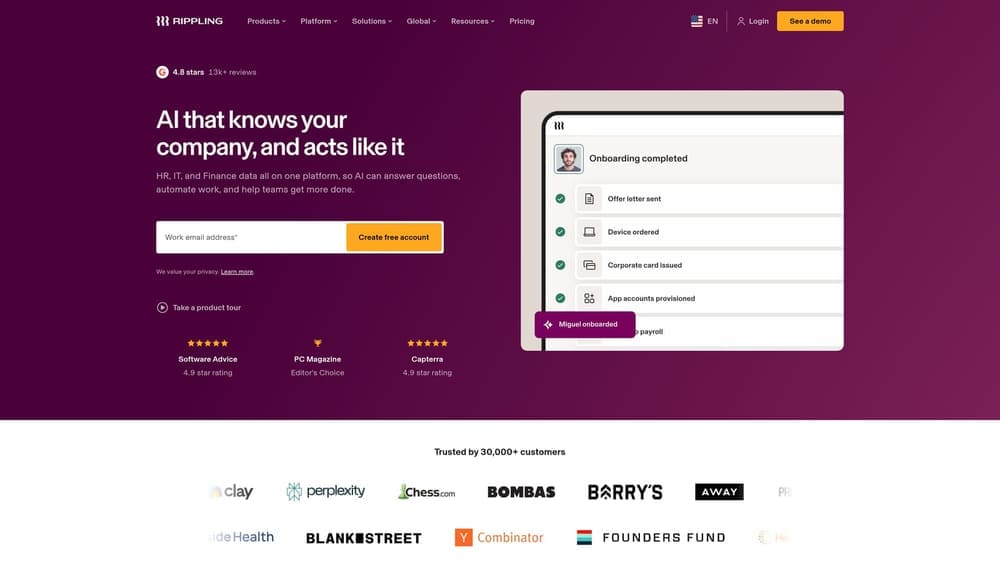
Rippling is a modular HR, payroll, and IT platform with a highly automated payroll engine and real-time error detection built for distributed teams.
Where This Tool Shines
Rippling’s payroll engine flags errors before a run is finalized. That’s a different approach from most PEOs, where you submit payroll and find out about a problem after the fact. For multi-state employers, Rippling automates tax registration in new states as you hire, which removes one of the most common sources of payroll compliance failures for growing companies.
The modular architecture means you’re not paying for features you don’t use. If you need payroll and HR but not IT device management, you buy those modules. That said, the same modularity makes total cost harder to predict as your needs grow.
Key Features
Real-Time Error Detection: Flags payroll errors before runs are finalized, not after employees notice a problem.
Automated Multi-State Tax Registration: Registers automatically in new states as you hire, reducing a common compliance gap for growing teams.
Modular Architecture: Buy payroll, HR, benefits, and IT management separately or together depending on what your company actually needs.
Integrated Platform: Payroll, benefits, and IT device management sit in one system, reducing data entry errors across tools.
CPEO Status: Rippling has pursued CPEO certification; verify current status at irs.gov/cpeo before signing, as certification can lapse.
Best For
Technology companies, startups, and remote-first employers who want automation and integration over a traditional service model. The platform suits teams comfortable managing their HR stack digitally. Companies that prefer a named HR specialist to call will likely find the model less personal than Insperity or Paychex.
Pricing
Modular pricing: a base platform fee plus per-module costs. Full PEO service requires a quote. Total cost can escalate as modules are added, so get a complete scope before comparing against flat-rate competitors.
4. Insperity
Best for: Growing companies that need multi-state compliance depth and a dedicated service team rather than a self-service portal.
Insperity is one of the largest PEOs in the US by revenue, known for dedicated service teams and deep multi-state payroll and compliance support.
Where This Tool Shines
Insperity’s service model is built around named HR specialists, not a ticket queue. When a multi-state payroll issue surfaces or a compliance question needs a real answer, you reach a person who knows your account. For companies scaling across state lines, that kind of continuity matters. Multi-state payroll is where many smaller PEOs expose their limits, and Insperity has built its compliance infrastructure specifically around that complexity.
The group purchasing scale also gives smaller employers access to benefits quality that would otherwise require 500+ employees to negotiate independently. That’s one of the core economic arguments for the PEO model, and Insperity delivers it reliably.
Key Features
Dedicated Service Team Model: Named HR specialists assigned to your account, not rotating support staff.
Multi-State Compliance Infrastructure: Deep expertise in payroll and compliance across state lines, suited for companies expanding geographically.
Group Benefits Purchasing: Access to large-group health rates through Insperity’s employer of record scale.
Long Operating History: Decades of compliance experience across a wide range of industries and regulatory environments.
Comprehensive HR Support: Goes beyond payroll to include HR consulting, risk management, and training resources.
Best For
Companies with 25-500 employees that are scaling across multiple states and need a service team that functions as an extension of their HR department. Smaller employers should ask directly about minimum employee counts and service tier expectations, as service attentiveness can vary based on account size.
Pricing
Quote-based. Not publicly listed. Pricing tends to run higher than flat-rate competitors like Justworks. Get a full scope of fees, including any per-module or benefits administration charges, before comparing quotes.
5. ADP TotalSource
Best for: Small and mid-size businesses that put compliance reliability first and want the backing of the largest payroll processing infrastructure in the market.
ADP TotalSource is a CPEO-certified PEO backed by ADP’s enterprise-grade tax filing infrastructure, serving employers who prioritize accuracy and regulatory coverage above all else.
Where This Tool Shines
ADP processes payroll for a significant share of the US workforce across its full product line. TotalSource sits on top of that infrastructure. The tax filing network handles an enormous volume of filings, and at that scale, accuracy processes are mature in ways that newer platforms haven’t had time to develop. CPEO certification means the same IRS liability shift applies here as with Justworks: for federal employment tax deposits, the exposure moves to ADP TotalSource, not to you.
The benefits marketplace is broad. Employers who need access to large-group health rates, dental, vision, and ancillary benefits through a single PEO relationship will find TotalSource’s purchasing scale competitive.
Key Features
CPEO Certification: IRS liability allocation for federal employment tax deposits, verified at irs.gov/cpeo.
Enterprise Tax Filing Infrastructure: ADP’s filing network handles high volume with established accuracy and regulatory update processes.
Broad Benefits Marketplace: Access to large-group health rates and a wide range of ancillary benefits through ADP’s employer of record scale.
Regulatory Update Infrastructure: ADP maintains dedicated compliance teams that monitor legislative and regulatory changes across all states.
Established Track Record: Decades of payroll and tax filing experience across industries and employer sizes.
Best For
Companies that want maximum compliance infrastructure and are willing to accept a more enterprise-style service experience in exchange. Not the best fit for founders or HR teams that want a personal relationship with their service rep. Contract terms at ADP TotalSource tend to be less flexible than newer competitors, so review the exit and amendment clauses carefully before signing.
Pricing
Quote-based. Not publicly listed. Given the enterprise infrastructure, pricing tends to reflect that positioning. Ask specifically about per-employee fees, benefits administration charges, and any annual escalators in the contract.
6. TriNet
Best for: Companies in regulated industries, tech, life sciences, or professional services that need industry-specific compliance guidance layered on top of payroll.
TriNet is a vertical-specific PEO offering industry-tailored HR, compliance, and payroll support with particular depth in technology, professional services, and life sciences.
Where This Tool Shines
Most PEOs handle payroll and compliance generically. TriNet’s model is built around industry verticals, which means your service team has domain knowledge relevant to your regulatory environment. For a biotech company navigating California employment law alongside federal research compliance, or a professional services firm managing exempt classification across multiple states, that industry context changes the quality of the guidance.
The enterprise-level benefits access is a genuine differentiator for smaller companies in competitive hiring markets. Tech and life sciences employers competing for talent against larger companies can offer benefits packages that would otherwise require a much larger headcount to access independently.
Key Features
Industry-Specific Compliance Guidance: HR and compliance support tailored to your vertical, not generic advice applied across all industries.
Regulated Industry Depth: Particular strength in tech, life sciences, and professional services where payroll intersects with sector-specific compliance requirements.
Enterprise Benefits Access: Group purchasing scale gives smaller employers access to competitive health and ancillary benefits packages.
Dedicated Industry Service Teams: Service staff with relevant domain knowledge, not generalist HR support.
Multi-State Payroll Support: Handles payroll complexity across state lines with compliance infrastructure suited for distributed teams.
Best For
Companies in technology, life sciences, financial services, or professional services with 10-300 employees that need more than generic compliance support. Buyers should be aware that TriNet’s pricing has historically been higher than flat-rate competitors, and some buyers report friction getting clear pricing during the sales process. Push for a complete fee breakdown before comparing quotes.
Pricing
Quote-based. Not publicly listed. Pricing has historically been on the higher end of the market. Ask for an itemized breakdown of the admin fee, benefits administration charges, and any variable components tied to payroll volume.
7. Paychex PEO
Best for: Small businesses outside major metros that want a local service representative and a phone number that reaches a person.
Paychex PEO is the PEO service from Paychex, with the largest local service representative network of any major provider and full payroll and tax filing backed by Paychex infrastructure.
Where This Tool Shines
In markets where Rippling or Justworks’s self-service model feels too hands-off, Paychex’s local network is a real differentiator. If something goes wrong with payroll, you can call a local representative who knows your account. For small business owners in non-metro markets who’ve been burned by impersonal support queues, that access matters more than any feature list.
The payroll and tax filing infrastructure is mature. Paychex has been processing payroll for small businesses for decades, and the compliance depth that comes with that history is genuine. The limitation is on the technology side: the self-service portal and digital experience are less modern than Rippling or Justworks, which can frustrate HR teams used to more intuitive platforms.
Key Features
Largest Local Service Network: More local representatives than any other major PEO, with coverage in non-metro and rural markets.
Mature Payroll Infrastructure: Decades of small business payroll and tax filing experience backing the PEO service.
Full Tax Filing Services: Complete payroll tax filing, including multi-state, through Paychex’s established compliance infrastructure.
HR and Benefits Add-Ons: Wide range of HR services and benefits options available through the PEO relationship.
Accessible Service Model: Suited for owners who want a person to call rather than a support ticket or chatbot.
Best For
Small businesses with 10-100 employees in non-metro markets, or owners who’ve had poor experiences with remote-only support models and want local accountability. Tech-forward HR teams that prioritize platform usability will likely find the interface limiting compared to more modern competitors.
Pricing
Quote-based. Not publicly listed. Pricing varies by employee count, location, and services selected. Ask specifically about per-employee fees and whether workers’ compensation is priced as pay-as-you-go or requires a deposit.
8. Oasis (a Paychex Company)
Best for: Very small employers under 50 employees that want simplified PEO onboarding and basic compliance support without enterprise complexity.
Oasis is a streamlined PEO service for smaller employers, backed by Paychex infrastructure, focused on payroll, basic compliance, and benefits access without the overhead of enterprise-tier platforms.
Where This Tool Shines
For a 15-person company that needs payroll handled reliably and compliance basics covered without navigating a complex enterprise platform, Oasis offers a simpler entry point into the PEO model. The onboarding process is designed for smaller employers, and the Paychex backing means the underlying payroll and tax filing infrastructure is the same mature system that processes payroll for millions of small businesses.
The trade-off is differentiation. Oasis is now fully integrated into Paychex, which means the product roadmap and service model reflect the parent company’s priorities. Buyers considering Oasis should compare it directly against Paychex PEO before choosing, because the distinction between the two has narrowed considerably since the acquisition.
Key Features
Simplified Onboarding: Designed for employers under 50 employees who want to get into a PEO without a lengthy implementation process.
Paychex Infrastructure: Payroll and tax filing backed by Paychex’s compliance and processing systems.
Basic HR Support: HR guidance and benefits access through the co-employment model without enterprise-tier complexity.
Lower Administrative Overhead: Less feature complexity than enterprise PEO platforms, which suits very small employers with straightforward needs.
Benefits Access: Group purchasing benefits access through the Paychex employer of record relationship.
Best For
Employers with 10-50 employees who want a straightforward PEO relationship and don’t need the advanced features of a platform like Rippling or TriNet. Before signing, compare Oasis and Paychex PEO directly: ask both for a full fee breakdown and service model description, since the two products now share significant infrastructure and the pricing difference may not justify choosing one over the other.
Pricing
Quote-based. Not publicly listed. Given the overlap with Paychex PEO, request quotes from both and compare the full fee structure, not just the headline number.
Which PEO Is Right for Your Company
The right answer depends on what’s driving the decision. Here’s how to think through it.
If transparent, predictable pricing is your first requirement, Justworks is the clearest starting point. The flat PEPM model and published pricing tiers remove the guesswork that makes most PEO comparisons frustrating. CPEO certification adds the compliance assurance on top.
If you’re scaling across multiple states and need compliance depth plus a dedicated service team, Insperity and ADP TotalSource are the strongest options. ADP brings the largest tax filing infrastructure in the market. Insperity brings the named-specialist service model. Both require a quote, so compare them directly rather than assuming one is more expensive.
If your team is tech-forward and distributed, Rippling’s automated error detection and multi-state tax registration automation address the specific payroll risks that grow with headcount and geography. Just get a full module-by-module cost breakdown before comparing against flat-rate alternatives.
If you’re under 50 employees and want simplicity, Oasis or Paychex PEO offer straightforward entry into the PEO model with mature payroll infrastructure behind them. Compare both before choosing, since the two products have converged significantly.
If you haven’t compared providers yet, don’t start with a vendor call. Start with independent data. PEO Metrics has matched 850+ companies since 2019 and benchmarked $2.1B in PEO spend across 40+ providers, using a 12-dimension methodology that includes payroll accuracy track record and tax filing infrastructure. The intake takes about 8 minutes. The report arrives in 5-10 business days. It’s 100% free to the buyer, with no vendor commissions influencing the output.
If you’re heading into a renewal, the switching to a PEO transition guide covers what to review before you auto-renew and what contract terms to push back on.
Don’t auto-renew. Make an informed, confident decision.
Before you sign that PEO renewal, make sure you’re not leaving money on the table.
Many businesses unknowingly overpay because of bundled fees, hidden administrative markups, and contracts designed to limit flexibility. We give you a clear, side-by-side breakdown of pricing, services, and contract terms—so you can see exactly what you’re paying for and choose the option that truly fits your business.
