

Food service employers don’t fit neatly into the standard PEO buyer profile. Your workforce includes tipped employees subject to FLSA Section 3(m), kitchen staff and delivery drivers who fall under different workers’ comp class codes, and hourly headcounts that can swing dramatically by season. Most PEO providers are built around office-based, salaried workforces, and that mismatch creates real compliance gaps and unexpected costs for restaurant groups, catering operations, and food manufacturers.
The providers on this list were selected because they offer something genuinely relevant to food service operators, whether that’s tipped wage administration, multi-state compliance depth, legal support for wage-and-hour complexity, or pricing models that work for high-turnover hourly teams. Read each entry with your specific workforce profile in mind, because the right fit depends heavily on your headcount, state footprint, and the HR tasks consuming the most internal time.
1. PEO Metrics
Best for: Food service operators who want to compare PEO providers side by side before committing.
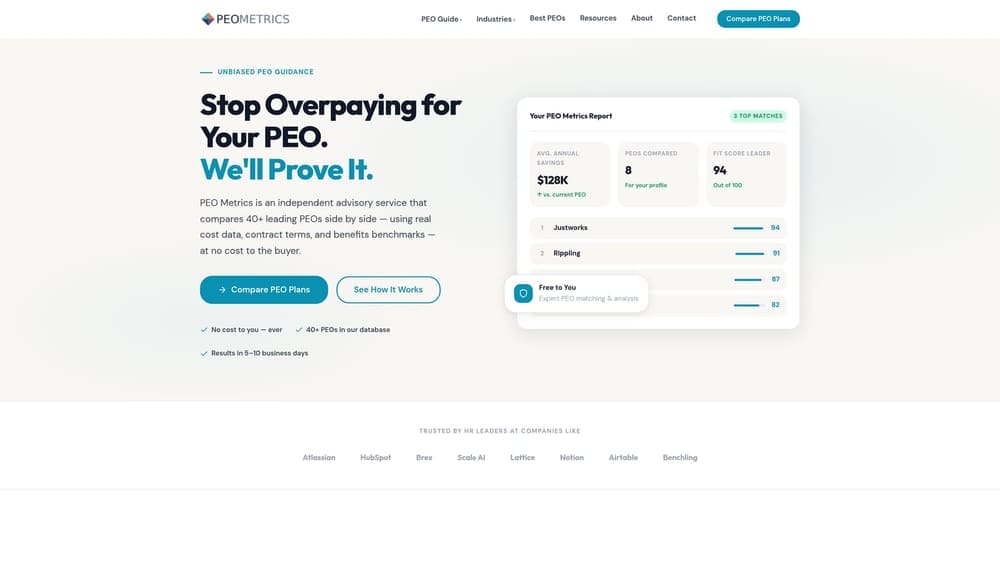
PEO Metrics is a PEO comparison service that helps food service businesses evaluate and select providers using structured, data-driven analysis tailored to their specific workforce profile.
Where This Tool Shines
Most food service operators request PEO quotes without a clear framework for evaluating what they receive. Proposals use different pricing structures, bundle services differently, and rarely make workers’ comp classification treatment or tipped employee handling transparent. PEO Metrics addresses that gap by giving you a structured way to compare providers on the criteria that actually affect your costs and compliance exposure.
For a restaurant group with tipped employees in multiple states, or a catering company with significant seasonal headcount variation, the difference between a well-matched PEO and a poor-fit one can be substantial. PEO Metrics helps you surface those differences before you sign a contract rather than after.
Key Features
Side-by-Side Provider Comparisons: Compares PEO providers using data specific to your workforce profile, including tipped employee counts and high-risk class codes.
Pricing Analysis: Accounts for tipped employees, variable headcount, and workers’ comp classification complexity when modeling provider costs.
Unbiased Guidance: Helps food service operators avoid overpaying or selecting a provider that is not built for their operating environment. Note that PEO Metrics may receive vendor placement fees; verify the fee structure directly.
Structured Evaluation Framework: Covers compliance capabilities, benefits access, and cost factors specifically relevant to food service operations.
Best For
Food service operators who are evaluating PEOs for the first time, renegotiating at renewal, or managing a workforce profile complex enough that a standard quote comparison is not sufficient. Particularly useful for regional restaurant groups, multi-state operators, and businesses with significant tipped employee populations.
Pricing
Contact PEO Metrics directly for details. Verify the fee structure and any vendor compensation arrangements before engaging.
2. TriNet
Best for: Food service businesses seeking industry-specific HR packages and dedicated specialist support.
TriNet is a publicly traded PEO (NYSE: TNET) offering industry-tailored HR packages, large-group benefits access, and dedicated HR specialist support rather than a generalist call center model.
Where This Tool Shines
TriNet’s industry-specific packaging is worth examining for food service operators who want HR support calibrated to their business type rather than a one-size-fits-all solution. The dedicated HR specialist model means you are working with someone familiar with your account rather than starting over each time you call.
For regional restaurant groups operating across multiple states, TriNet’s multi-state compliance infrastructure is a relevant capability. The access to large-group health benefits is also meaningful for food service operators trying to compete for talent in a high-turnover environment where benefits can be a genuine differentiator.
Key Features
Industry-Specific HR Packages: Structured for different business types rather than a single generic offering.
Large-Group Benefits Access: Gives smaller food service businesses access to benefit tiers they typically cannot reach independently.
Dedicated HR Specialists: Account-based support model rather than a shared service center.
Multi-State Compliance Support: Relevant for restaurant groups managing wage-and-hour obligations across different state jurisdictions.
Best For
Mid-sized restaurant groups and food service businesses that want dedicated HR support and are operating, or planning to operate, across multiple states. Also relevant for operators who want to use benefits access as a retention tool in a competitive hiring market.
Pricing
TriNet does not publish pricing publicly. Request a quote directly and verify current minimums before making any comparisons.
3. Paychex PEO
Best for: Food service businesses with established Paychex payroll relationships or strong tip reporting needs.
Paychex PEO is the co-employment arm of one of the largest payroll processors in the U.S., offering PEO services built on deep payroll infrastructure with particular strength in tip reporting and time-tracking integrations.
Where This Tool Shines
Paychex has processed payroll for a wide range of industries for decades, and that experience shows in their tip reporting and time-tracking capabilities. For food service operators, accurate tip credit administration is not optional, and a PEO with mature payroll infrastructure in this area reduces the risk of FLSA compliance errors.
Businesses already using Paychex for payroll processing will find the transition to Paychex PEO relatively straightforward, since the platform is familiar and the data migration is less disruptive than switching to an entirely new provider.
Key Features
Tip Reporting and Time-Tracking Integrations: Payroll infrastructure built to handle tipped wage administration accurately.
Platform Continuity: Familiar system for businesses already using Paychex payroll services.
Co-Employment Benefits Access: HR support and group benefits through the PEO structure.
Workers’ Comp Management: Administered within the PEO master policy framework.
Best For
Food service operators already in the Paychex ecosystem, or those who prioritize payroll accuracy and tip reporting depth over other PEO selection criteria. Also relevant for businesses that want a large, established provider with long-term operational stability.
Pricing
Paychex PEO does not publish pricing publicly. Request a quote directly and verify current minimums before making comparisons.
4. ADP TotalSource
Best for: Multi-state food service operations that need CPEO-certified compliance coverage and established HR technology.
ADP TotalSource is ADP’s CPEO-certified PEO service, offering broad compliance infrastructure, workers’ comp management, and benefits administration for businesses with complex, multi-state HR needs.
Where This Tool Shines
ADP TotalSource holds Certified Professional Employer Organization (CPEO) certification from the IRS, which affects how federal employment tax liability is allocated between the PEO and the client employer. For food service businesses with complex tax situations or those that want clear contractual clarity on tax responsibility, CPEO status is a meaningful distinction. You can verify CPEO status directly through the IRS CPEO registry.
ADP’s scale also means their compliance infrastructure covers a wide range of state and local requirements, which matters for restaurant groups dealing with a patchwork of predictive scheduling ordinances, tip pooling rules, and minimum wage variations across jurisdictions.
Key Features
CPEO Certification: IRS-certified status with specific implications for federal employment tax liability allocation.
Multi-State Compliance Infrastructure: Established capability across a wide range of state and local labor law requirements.
Workers’ Comp Management: Administered through the PEO master policy structure.
ADP Technology Integration: Access to ADP’s broader HR and payroll technology platform.
Best For
Larger food service operators and regional restaurant groups with significant multi-state complexity, or businesses where CPEO certification and tax liability clarity are priorities. Also relevant for companies already using ADP technology who want to consolidate within the same ecosystem.
Pricing
ADP TotalSource does not publish pricing publicly. Request a quote directly and verify current minimums before making comparisons.
5. Insperity
Best for: Food service operators focused on using comprehensive benefits to reduce turnover.
Insperity is a publicly traded PEO (NYSE: NSP) known for comprehensive employee benefits packages and dedicated HR support teams, with an emphasis on helping businesses reduce turnover through better benefits access.
Where This Tool Shines
In food service, turnover is a persistent operational cost. Insperity’s positioning around comprehensive benefits access is directly relevant to operators who want to use health, dental, vision, and retirement options as retention tools. Access to benefits that smaller food service businesses cannot typically offer independently can make a real difference in competitive hiring markets.
The dedicated HR support team model, rather than a shared service center, means your team has consistent points of contact for compliance questions and HR issues. For operators managing frequent new hires and complex wage-and-hour situations, that continuity has practical value.
Key Features
Comprehensive Benefits Packages: Health, dental, vision, and retirement options that smaller businesses typically cannot access independently.
Dedicated HR Support Teams: Consistent account-based support rather than a rotating shared service center.
Compliance Support: Coverage for wage-and-hour, benefits administration, and employment law obligations.
HR Technology Platform: Employee management and reporting tools for tracking your workforce.
Best For
Food service businesses where employee retention is a strategic priority and where offering competitive benefits could meaningfully reduce turnover costs. Particularly relevant for operators in competitive labor markets where benefits access is a real differentiator.
6. Oasis (a Paychex Company)
Best for: Smaller food service businesses looking for co-employment services with flexible service options.
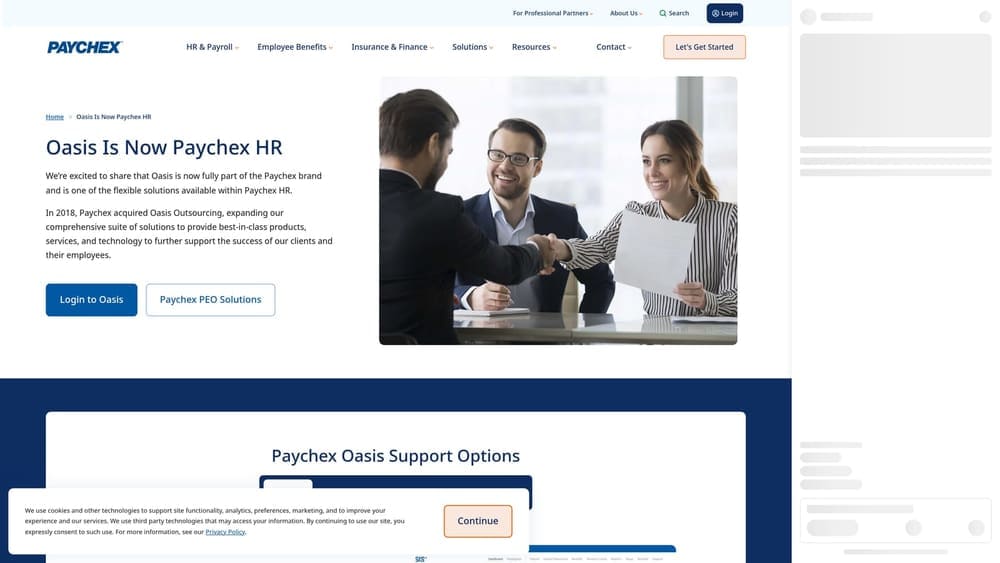
Oasis is a PEO service acquired by Paychex, positioned for smaller businesses seeking co-employment services with flexible service tiers and access to group benefits.
Where This Tool Shines
Not every food service business is large enough to meet the minimums of the major national PEO brands. Oasis has historically been positioned for smaller headcounts, which makes it worth evaluating for independent restaurants, small catering operations, or food businesses that are growing toward the scale where a larger PEO would make more sense.
Being backed by Paychex infrastructure following the acquisition provides some operational stability and access to payroll processing depth. However, it is worth verifying directly with Oasis whether the brand currently operates independently from Paychex PEO or whether the two services have been substantially integrated.
Key Features
Smaller Headcount Service Tiers: Designed to work at employee counts where larger PEOs may have higher minimums.
Paychex Infrastructure: Backed by Paychex’s payroll and HR technology following acquisition.
Compliance and Payroll Administration: Core HR compliance and payroll support for smaller operations.
Best For
Smaller food service businesses, including independent restaurants and small catering companies, that want co-employment benefits access and HR support at a headcount where larger PEOs may not be the right fit. Verify current minimums and service structure directly before engaging.
Pricing
Oasis does not publish pricing publicly. Request a quote directly and verify current minimums and whether the brand operates independently from Paychex PEO before making comparisons.
7. Justworks
Best for: Food service operators who want transparent, predictable per-employee pricing with a modern HR platform.
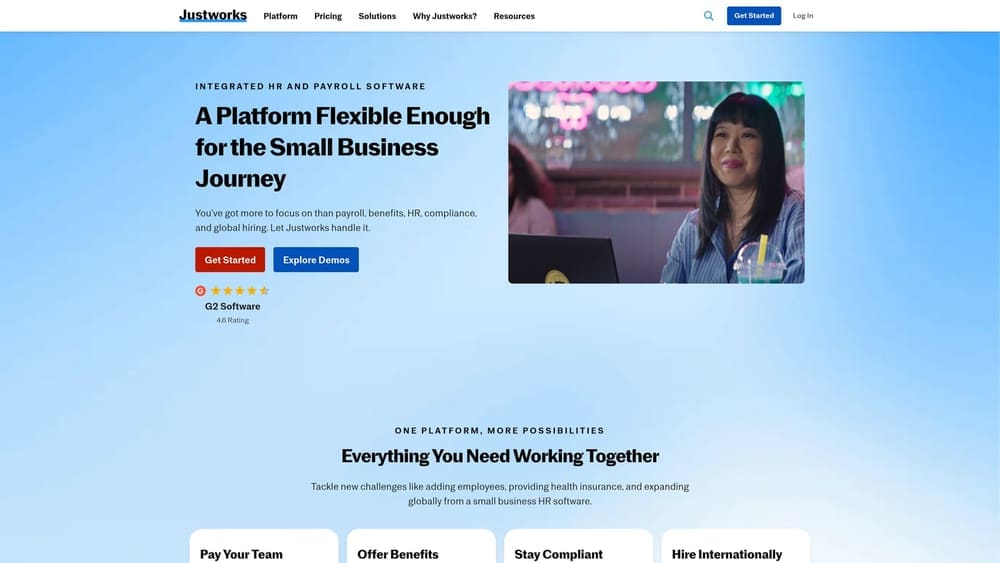
Justworks is a PEO known for flat per-employee-per-month pricing published directly on their website, combined with a modern, self-service HR platform for onboarding, payroll, and benefits administration.
Where This Tool Shines
Pricing transparency is genuinely rare in the PEO market. Justworks publishes their pricing tiers publicly, which makes it easier to model costs before entering a sales conversation. For food service operators who have been burned by bundled fees or opaque pricing structures in the past, that transparency is a real differentiator worth factoring into your evaluation.
The modern, self-service platform is also relevant for food service businesses with high onboarding volume. If you are processing new hires frequently, a clean onboarding interface reduces the administrative burden on your internal team. That said, verify that the platform handles tipped wage administration and the specific payroll complexity of your operation before committing.
Key Features
Transparent Flat Pricing: Per-employee-per-month tiers published on the Justworks website, verify current rates before use.
Modern Self-Service Platform: Clean interface for onboarding, payroll, and benefits management.
Group Health Benefits Access: Health coverage options through the PEO co-employment structure.
Payroll Tax Compliance: Support for payroll tax obligations and employment law compliance.
Best For
Food service operators who prioritize pricing transparency and want a modern platform that reduces manual HR administration. Worth evaluating for businesses with high new-hire volume where onboarding efficiency matters. Confirm tipped wage handling capabilities directly with Justworks before selecting.
Pricing
Justworks publishes pricing tiers on their website. Verify current rates at justworks.com before making any comparisons, as pricing tiers and amounts change.
8. Engage PEO
Best for: Food service operators in complex wage-and-hour environments who want legal depth built into their PEO support.
Engage PEO is a PEO that differentiates itself by having licensed employment attorneys on staff, providing compliance guidance with legal depth relevant to tip credit law, wage-and-hour audits, and predictive scheduling compliance.
Where This Tool Shines
Food service is one of the more legally complex employment environments in the U.S. Tip credit rules vary by state, predictive scheduling ordinances apply in a growing number of cities, and wage-and-hour audits in the restaurant industry are not uncommon. Most PEOs provide HR generalist support, not legal guidance. Engage PEO’s positioning around licensed employment attorneys on staff is a meaningful structural difference for operators who need more than compliance checklists.
For businesses operating in states or cities with aggressive labor enforcement, or those that have faced wage-and-hour issues in the past, having legal expertise embedded in your PEO support model rather than as a separate outside counsel engagement can reduce both risk and cost.
Key Features
Licensed Employment Attorneys on Staff: Legal depth built into HR support, not just generalist compliance guidance.
Wage-and-Hour Compliance Expertise: Relevant to tip credit law, audit defense, and predictive scheduling obligations.
Co-Employment Structure: Benefits access and workers’ comp management through the standard PEO model.
Compliance-Forward Positioning: Designed for businesses operating in heavily regulated labor environments.
Best For
Food service operators in high-enforcement labor markets, multi-state restaurant groups navigating tip pooling and predictive scheduling complexity, and any business that has faced or anticipates wage-and-hour scrutiny. Verify state availability and current minimums directly with Engage PEO before engaging.
Pricing
Engage PEO does not publish pricing publicly. Request a quote directly and verify current minimums and state availability before making comparisons.
Choosing the Right PEO for Your Food Service Operation
No single provider on this list is the right answer for every food service business. A ghost kitchen with 12 employees has fundamentally different needs than a regional restaurant group managing hundreds of hourly workers across multiple states. The decision factors that matter most in food service include workers’ comp classification accuracy, tipped wage compliance support, the ability to handle high-volume hourly onboarding, and whether the provider’s pricing model actually works at your headcount and seasonal variation.
Before requesting quotes, map your specific workforce profile. How many tipped employees do you have? Which states do you operate in? What is your current workers’ comp experience modifier? Which HR tasks consume the most internal time? Those answers determine which providers are worth evaluating and which ones are likely to be a poor fit regardless of how their sales presentation goes.
A few standouts worth highlighting based on specific criteria: Engage PEO is worth a close look if legal depth in wage-and-hour compliance is a priority. Justworks is worth evaluating if pricing transparency matters to your decision process. ADP TotalSource is relevant if CPEO certification and multi-state compliance infrastructure are key requirements. And if you want to structure the comparison before you start talking to sales teams, PEO Metrics can help you do that with a framework built around your specific workforce profile.
Many food service businesses overpay for PEO services because of bundled fees, hidden administrative markups, and contracts that limit flexibility. A structured comparison before you sign, or before you auto-renew, can surface those differences clearly. Don’t auto-renew. Make an informed, confident decision.
Before you sign that PEO renewal, make sure you’re not leaving money on the table.
Many businesses unknowingly overpay because of bundled fees, hidden administrative markups, and contracts designed to limit flexibility. We give you a clear, side-by-side breakdown of pricing, services, and contract terms, so you can see exactly what you’re paying for and choose the option that truly fits your business.
