

When your PEO and HR software don’t talk to each other, the friction shows up fast. Duplicate data entry, payroll discrepancies, benefits enrollment delays, and reporting gaps that eat up hours your HR team doesn’t have. For companies that have already invested in platforms like Workday, BambooHR, or ADP Workforce Now, a PEO that forces a full system migration isn’t a minor inconvenience. It’s a real operational risk.
Choosing a PEO with the right integration fit matters as much as pricing or benefits quality. A clean data connection between your PEO and existing tools means fewer manual reconciliations, faster onboarding, and HR reporting you can actually trust.
This guide covers eight PEOs and one comparison resource worth knowing, evaluated by how well they support HR software integration for mid-market and growing businesses. Each entry covers what the integration model actually looks like, which systems are supported, and what to verify before you sign. This is informational guidance, not individualized legal, tax, or benefits advice.
1. PEO Metrics
Best for: HR leaders who want an unbiased starting point before evaluating PEO options
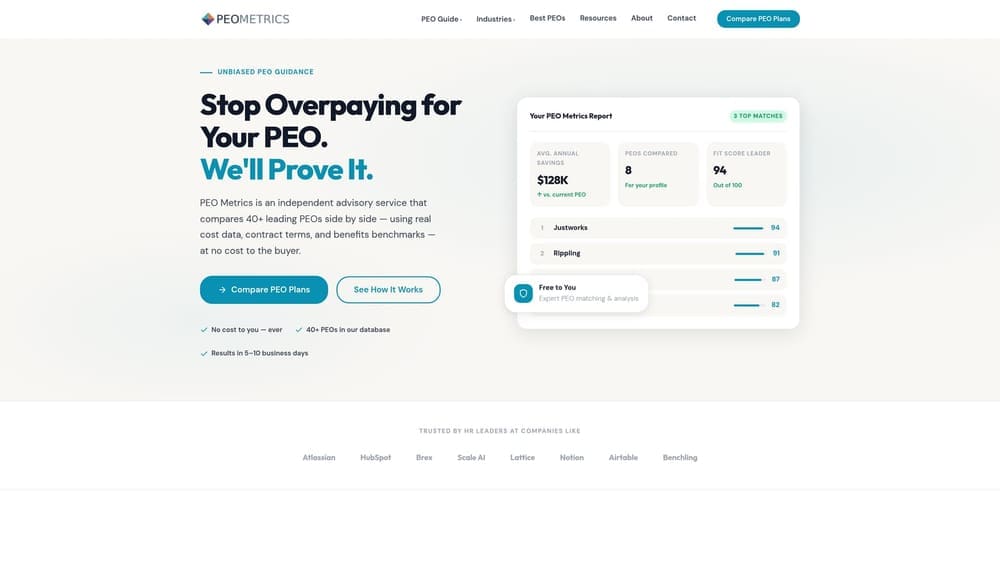
PEO Metrics is a comparison resource that helps HR leaders and business owners evaluate PEO providers side-by-side, including integration capabilities, pricing structure, and service depth.
Where This Tool Shines
PEO Metrics isn’t a PEO itself. It’s the research layer that sits before your vendor conversations, giving you a structured way to compare what different providers actually offer on technology, pricing, and HR service depth before you get on a sales call.
The platform is particularly useful for HR teams that already have an established tech stack and need to know whether a prospective PEO will work with it or replace it. Integration capability is one of the harder things to evaluate from a vendor’s marketing page alone, and side-by-side comparisons make that gap visible.
Key Features
Side-by-Side PEO Comparisons: Covers technology, integration data, pricing structure, and service depth across multiple providers in one view.
Pricing Analysis: Helps businesses identify where they may be overpaying due to bundled fees or administrative markups.
Vendor-Neutral Structure: Covers multiple providers rather than promoting a single option, though PEO Metrics may receive vendor placement fees.
Needs-Matching Guidance: Helps align PEO capabilities to specific business requirements, including integration priorities.
Best For
HR leaders and operations teams preparing to evaluate or renegotiate a PEO relationship, particularly those who want a clearer picture of integration options before entering vendor conversations. Also useful for businesses approaching a renewal and wondering whether they’re getting fair value.
Pricing
Free to use as a comparison resource. PEO Metrics may receive vendor placement fees from providers featured on the platform.
2. Rippling
Best for: Companies that want HR, IT, and payroll managed in a single unified platform
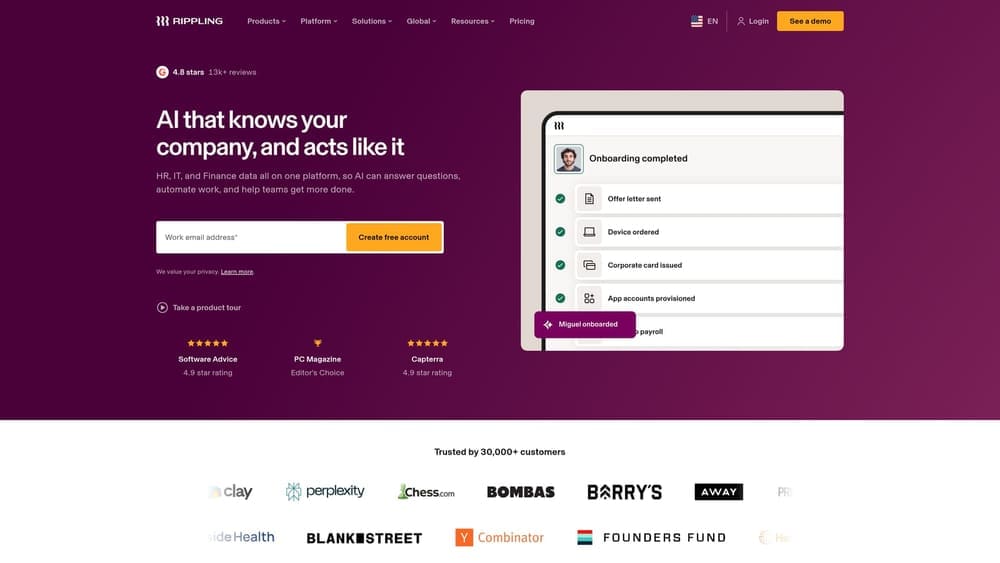
Rippling is a unified workforce platform that combines HR, payroll, IT device management, and benefits in one system, with a PEO option built on its own infrastructure rather than third-party middleware.
Where This Tool Shines
Rippling’s integration story is different from most PEOs because the integrations are native. They’re built on Rippling’s own platform rather than connected through external middleware, which typically means fewer sync failures and less manual reconciliation between systems.
The platform also handles IT provisioning alongside HR enrollment, so when a new hire is added to payroll, their software access can be set up at the same time. For fast-growing companies where IT and HR onboarding often happen separately, that kind of coordination reduces a real operational bottleneck.
Key Features
Native Integration Architecture: Integrations are built in-house rather than relying on middleware, which reduces failure points between connected systems.
Unified HR and IT Management: Covers HR, payroll, benefits, and device management in a single platform.
App Integration Library: Connects with hundreds of business tools across categories including finance, productivity, and communication.
Automated Onboarding: Provisions software access and HR enrollment simultaneously, reducing the gap between hire date and full system access.
Best For
Tech-forward companies and fast-growing businesses that want a single platform rather than a patchwork of connected tools. Also a strong fit for companies without an existing HRIS investment they need to preserve, since Rippling works best when adopted as the primary system.
Pricing
Pricing is not published publicly. Contact Rippling directly for current quotes and verify any employee minimums or state availability before making decisions.
3. Justworks
Best for: Smaller businesses needing a clean, straightforward PEO with common accounting integrations
Justworks is an IRS-certified PEO (CPEO) designed for smaller businesses, offering a transparent interface and reliable connections to common SMB accounting and HR tools.
Where This Tool Shines
Justworks holds CPEO status, an IRS certification that carries specific tax liability protections for clients. That distinction matters for businesses that want clarity on who holds tax responsibility within the co-employment arrangement.
On the integration side, Justworks connects with tools that smaller businesses actually use, including QuickBooks and Xero, rather than focusing exclusively on enterprise platforms. The onboarding experience is built for founders and managers who aren’t HR specialists, which makes it easier to get set up without dedicated IT or HR resources.
Key Features
CPEO Certification: IRS-certified status provides specific tax liability protections that standard PEOs don’t carry.
Accounting Tool Integrations: Connects with QuickBooks, Xero, and common benefits tools used by smaller businesses.
Transparent Pricing Structure: Pricing tiers are published on the Justworks website, which is less common among PEO providers.
Simplified Onboarding: Designed for non-HR-specialist founders and managers, reducing the setup burden on small teams.
Best For
Small businesses with 2 to roughly 200 employees, particularly those already using QuickBooks or Xero for accounting. Verify current employee minimums and integration availability directly with Justworks before committing.
Pricing
Justworks publishes pricing tiers on its website. Verify current rates at justworks.com before citing specific figures, as pricing can change.
4. TriNet
Best for: Companies in specialized industries that need HR platforms tailored to their sector
TriNet is a PEO with industry-specific HR platforms designed for sectors including technology, financial services, and professional services, with integration support tailored to each vertical.
Where This Tool Shines
Most PEOs offer one platform that tries to serve every industry. TriNet takes a different approach, building HR experiences specific to verticals like tech startups, financial services firms, and professional services companies. That means the benefits packages, compliance features, and HR tools are shaped around what those industries actually need rather than a generic configuration.
For companies in competitive talent markets, particularly tech and finance, TriNet’s benefits packages are designed to support recruiting in environments where employees expect strong healthcare and equity-adjacent benefits. The integration layer varies by vertical, so it’s worth confirming current integration partners directly with TriNet for your specific industry.
Key Features
Industry-Specific HR Platforms: Separate HR configurations for technology, financial services, startups, and other sectors rather than a single generic platform.
Competitive Benefits Packages: Benefits designed to support recruiting in high-demand sectors like tech and finance.
Dedicated HR Support: Human HR advisors alongside the technology layer for guidance on complex situations.
Vertical-Specific Integration Support: Integration availability varies by industry; verify current partners with TriNet directly for your sector.
Best For
Mid-sized companies in technology, financial services, or professional services that want an HR platform configured for their industry rather than a one-size-fits-all system. Less suited for businesses that need deep integration with a specific third-party HRIS they want to preserve.
Pricing
Not publicly listed. Contact TriNet directly for current pricing relevant to your industry vertical and headcount.
5. Paychex PEO
Best for: Companies already using Paychex Flex that want to add PEO services without switching ecosystems
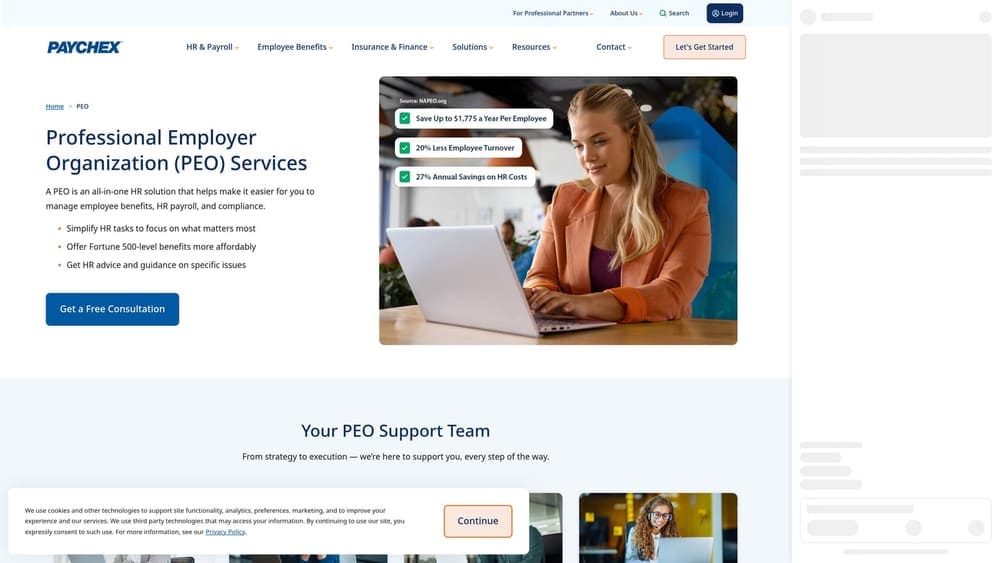
Paychex PEO is the PEO arm of Paychex, designed to work closely with Paychex Flex while also supporting third-party integrations through the Paychex Marketplace.
Where This Tool Shines
If your company is already running payroll or HR through Paychex Flex, moving to Paychex PEO is a lower-friction transition than switching ecosystems entirely. The data, workflows, and system familiarity carry over rather than requiring a full migration and retraining cycle.
For companies not already in the Paychex ecosystem, the Paychex Marketplace provides access to third-party software connections across HR, benefits, and business tools. The breadth of that marketplace and the quality of specific integrations should be verified directly with Paychex for the tools you’re using.
Key Features
Paychex Flex Continuity: Companies already using Paychex Flex can transition to PEO services with minimal platform disruption.
Paychex Marketplace: Third-party software connections available through the marketplace for companies outside the Paychex ecosystem.
Broad US Service Footprint: Paychex operates across the country, which matters for companies with employees in multiple states.
Bundled Services: HR, payroll, benefits, and compliance management under one provider relationship.
Best For
Businesses already using Paychex products who want to add co-employment benefits without a platform change. Also worth evaluating for companies with multi-state payroll complexity who want a single provider relationship.
Pricing
Not publicly listed. Contact Paychex directly for current PEO pricing specific to your headcount and service needs.
6. ADP TotalSource
Best for: Companies with complex payroll needs or existing ADP tools who want a large certified integration library
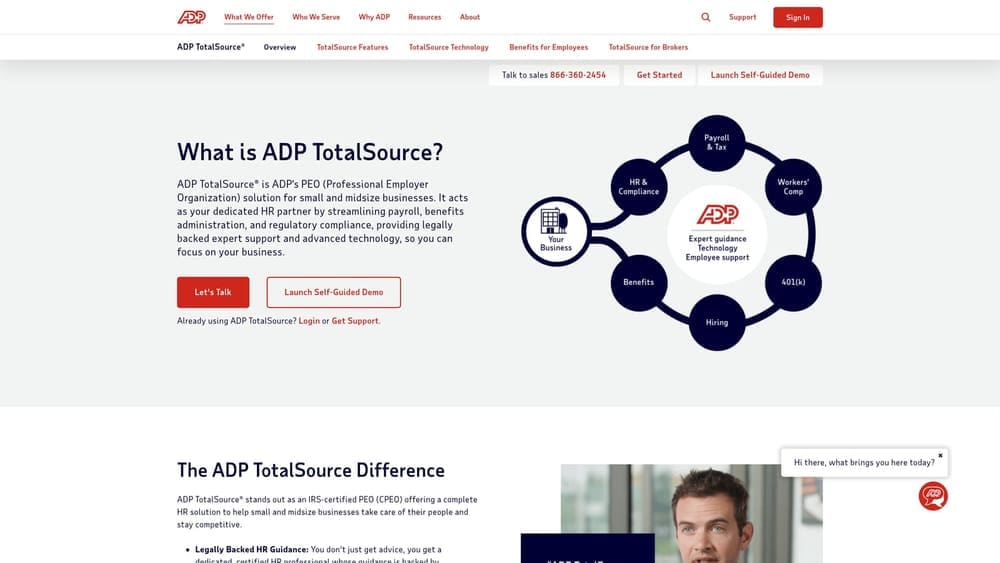
ADP TotalSource is ADP’s full-service PEO offering, backed by ADP Marketplace, one of the larger certified HR software integration libraries available through a PEO provider.
Where This Tool Shines
ADP Marketplace is a meaningful differentiator for companies that need their PEO to connect with a specific third-party tool. The library of certified integrations is broad, which reduces the likelihood that your existing HR software is unsupported. Certified integrations also tend to be more reliable than middleware-dependent connections because they’re tested against ADP’s own infrastructure.
ADP TotalSource also brings enterprise-grade payroll and compliance infrastructure, which matters for companies with multi-state operations, complex payroll runs, or regulatory environments that require detailed audit trails. The scale of ADP as an organization also translates into benefits buying power that smaller PEOs can’t always match.
Key Features
ADP Marketplace Integration Library: A broad library of certified third-party HR software integrations, one of the more developed in the PEO space.
Enterprise Payroll Infrastructure: Built for complex payroll needs including multi-state operations and detailed compliance requirements.
Benefits Buying Power: ADP’s scale supports competitive benefits options for mid-market companies.
Compliance Support: Payroll tax compliance and regulatory support built into the PEO relationship.
Best For
Mid-market companies with complex payroll requirements, multi-state workforces, or existing ADP tools. Also a strong candidate for HR teams that need a wide range of third-party integrations and want those connections certified rather than middleware-dependent.
Pricing
Not publicly listed. Contact ADP TotalSource directly for current pricing based on your company size and service requirements.
7. Insperity
Best for: Mid-market companies that want structured HR processes with high-touch service delivery
Insperity is a mid-market PEO that bundles its proprietary HR platform, Insperity Workforce Optimization, with full-service HR delivery including benefits, payroll, and compliance support.
Where This Tool Shines
Insperity’s model is built around the idea that mid-market companies need more than software. They need HR expertise alongside the technology. The Insperity Workforce Optimization platform is included as part of the PEO relationship, and it comes with dedicated HR professionals who support clients on compliance questions, employee relations issues, and benefits administration rather than leaving HR teams to navigate the system alone.
The tradeoff is that Insperity’s platform is more closed than open-marketplace alternatives like ADP TotalSource. External integrations exist, but companies with deep investments in third-party HRIS tools should verify current integration availability before assuming a clean connection is possible.
Key Features
Proprietary HR Platform: Insperity Workforce Optimization is included in the PEO relationship, covering HR, payroll, and benefits in one system.
High-Touch HR Service Delivery: Dedicated HR professionals alongside the technology, not just a support line.
Mid-Market Focus: Service model and platform designed for companies that have outgrown basic HR tools but aren’t enterprise-scale.
External Integrations: Available but more limited than open-marketplace competitors; verify current options directly with Insperity.
Best For
Mid-market companies that want structured HR processes and are comfortable adopting Insperity’s platform as their primary HR system. Less suited for teams with strong existing HRIS investments they’re not willing to migrate away from.
Pricing
Not publicly listed. Contact Insperity directly for current pricing based on your headcount and service scope.
8. BambooHR + PEO Partner Programs
Best for: HR teams with established BambooHR workflows that want to add PEO services without migrating platforms
BambooHR is an HRIS platform, not a PEO, but it maintains a partner ecosystem that includes PEO providers capable of integrating with or alongside BambooHR, allowing companies to add PEO-level services without abandoning their existing HR interface.
Where This Tool Shines
This entry is different from the others on this list because it describes a use case rather than a single vendor. Many HR teams have built significant operational workflows inside BambooHR, including onboarding sequences, performance management processes, and reporting configurations that took real time to set up. Migrating away from that to adopt a PEO’s proprietary platform is a genuine cost that doesn’t always show up in the pricing conversation.
BambooHR’s partner PEO programs allow companies to layer PEO services, including payroll administration and benefits, on top of their existing BambooHR setup, with data flowing between systems. This parallel platform model reduces migration risk but requires careful verification of how current and complete the data sync actually is. Integration depth varies by partner, so confirming specifics directly with BambooHR and the partner PEO is essential before committing.
Key Features
Workflow Preservation: Keeps existing BambooHR configurations intact rather than requiring migration to a PEO’s proprietary system.
Partner PEO Data Sync: Partner PEOs handle payroll and benefits administration with data flowing to BambooHR on a defined schedule.
Reduced Migration Risk: Particularly valuable for teams with complex BambooHR setups or strong staff familiarity with the platform.
Partner Availability: Current PEO partners and integration depth should be verified directly with BambooHR before making any decisions.
Best For
HR teams that have made a meaningful investment in BambooHR and want to add co-employment benefits, payroll outsourcing, or compliance support without a full platform change. Also relevant for companies whose employees are already comfortable with the BambooHR interface and where a migration would create adoption friction.
Pricing
BambooHR pricing is separate from any PEO partner fees. Verify both independently before building a budget estimate, as the combined cost will depend on your headcount and the specific PEO partner you select.
Matching the Right PEO to Your Integration Needs
The right PEO for HR software integration depends heavily on where you’re starting from. There’s no single answer, but there are clear patterns worth knowing as you narrow your options.
If you’re a startup or small business on a budget: Justworks is worth a close look. Its CPEO certification, published pricing, and straightforward integrations with QuickBooks and Xero make it a practical fit for companies that don’t have a dedicated HR team managing the relationship.
If you’re a mid-market company with an existing HRIS you want to keep: BambooHR’s partner PEO programs and ADP TotalSource’s Marketplace are the two options most likely to preserve your current workflows. ADP’s certified integration library is broader; BambooHR’s approach is more specific to teams already on that platform.
If your industry has specialized HR needs: TriNet’s vertical-specific platforms are built for sectors like technology and financial services where benefits competitiveness and compliance nuance matter more than generic HR configuration.
If you want a single platform to replace your current tools: Rippling’s native integration model and unified HR-IT approach make it the strongest candidate, provided you’re willing to migrate to their system rather than connect to an existing one.
Before you settle on any provider, it’s worth doing a structured comparison rather than relying on vendor-supplied information alone. Bundled fees, administrative markups, and contract terms that limit flexibility are common pain points that don’t surface in a standard sales conversation.
Before you auto-renew or sign a new agreement, make sure you’re seeing the full picture. Many businesses overpay simply because they didn’t compare options at the right moment. Don’t auto-renew. Make an informed, confident decision.
Before you sign that PEO renewal, make sure you’re not leaving money on the table.
Many businesses unknowingly overpay because of bundled fees, hidden administrative markups, and contracts designed to limit flexibility. We give you a clear, side-by-side breakdown of pricing, services, and contract terms, so you can see exactly what you’re paying for and choose the option that truly fits your business.
