

Warehousing and distribution operations carry some of the highest workers’ compensation exposure of any industry. Forklift operators, receiving dock crews, and fulfillment staff work in environments where injury rates run well above the national average, and a single claim can reshape your insurance costs for years.
Add multi-state compliance complexity, high seasonal headcount swings, and constant pressure to control labor costs, and it becomes clear why selecting the right PEO matters more in warehousing than in most other sectors. The wrong choice can mean paying for safety programs that exist only on paper, getting locked into contracts that penalize seasonal scaling, or discovering that your workers’ comp class codes were mishandled from day one.
This guide covers eight PEO providers that serve warehousing operations. Each entry focuses on what makes that provider genuinely relevant for warehouse-specific needs, including workers’ comp management, safety programs, payroll for hourly and shift workers, and benefits that help attract and retain warehouse talent. This is informational content, not individualized legal, tax, or benefits advice.
1. PEO Metrics
Best for: Warehousing companies that want to compare PEO providers objectively before signing anything
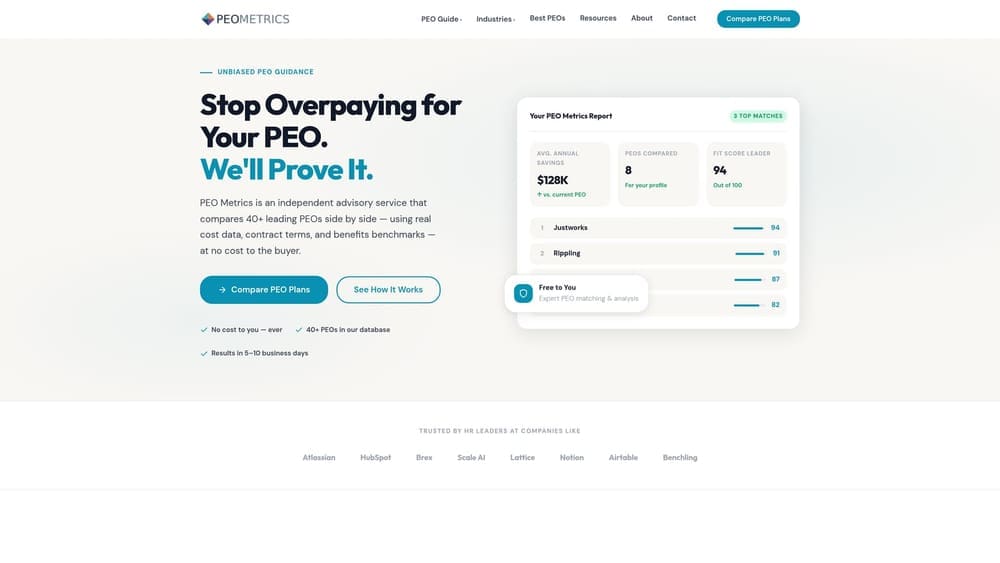
PEO Metrics is an independent PEO comparison platform that helps warehousing businesses evaluate providers side-by-side using detailed pricing analysis and service metrics.
Where This Tool Shines
Most businesses enter PEO conversations at a disadvantage. Vendors control the sales process, pricing is rarely transparent, and it’s difficult to know whether you’re comparing equivalent services or being quoted selectively. For warehousing operations, where workers’ comp handling and safety program quality can vary dramatically between providers, that information gap is expensive.
PEO Metrics addresses this by giving you a structured way to evaluate providers before you’re in a contract. Rather than relying on individual sales presentations, you can see how providers differ on the dimensions that matter most to warehouse operations: how they handle workers’ comp class codes, what safety resources they actually deliver, and how pricing is structured for high-volume hourly workforces.
Key Features
Side-by-Side Provider Comparisons: Detailed service and pricing metrics across multiple PEO providers, built for structured evaluation rather than vendor-led discovery.
Unbiased Guidance: Not tied to a single PEO vendor, which matters when you’re trying to assess providers with genuinely different strengths and pricing models.
Cost Difference Identification: Helps surface pricing gaps between providers before you commit, which is particularly relevant when workers’ comp rates and administrative fees vary widely in high-risk classifications.
Workers’ Comp Comparison Support: Relevant for warehousing companies evaluating how different PEOs handle workers’ comp pooling, class code accuracy, and experience modification rate management.
Due Diligence Structure: Supports a more disciplined evaluation process rather than letting vendor sales timelines drive your decision.
Best For
Warehousing and distribution companies at the beginning of a PEO search, businesses approaching a contract renewal, or any operation that suspects it may be overpaying under its current arrangement. Particularly useful for companies with complex workers’ comp exposure or multi-state operations where provider differences are significant.
Pricing
Contact PEO Metrics directly for service details. Note that PEO Metrics may receive vendor placement fees.
2. TriNet
Best for: Mid-size and larger warehousing companies prioritizing competitive health benefits access
TriNet is a nationally recognized, publicly traded PEO serving mid-size and larger businesses with large-group health benefits, HR support, payroll, and risk management services.
Where This Tool Shines
Recruiting and retaining hourly warehouse workers is a persistent challenge, and benefits quality plays a larger role than many employers expect. TriNet’s large-group purchasing model can give warehousing companies access to health benefits that would otherwise be out of reach for their size, which matters when you’re competing for workers in tight labor markets.
TriNet also supports multi-location payroll operations, which is relevant for distribution networks that run facilities across multiple states. Their HR support teams provide ongoing guidance rather than leaving HR administration entirely to the client.
Key Features
Large-Group Health Benefits: Access to benefits purchasing power that can be competitive when recruiting hourly workers who have options.
Dedicated HR Support Teams: Assigned HR professionals rather than a call-center model, providing more consistent guidance.
Multi-Location Payroll: Payroll processing designed to handle operations spread across multiple sites or states.
Workers’ Compensation Coverage: Covered under the PEO master policy arrangement, which can be advantageous for high-risk classifications.
HR Technology Platform: Centralized tools for HR administration, benefits enrollment, and employee data management.
Best For
Mid-size to larger warehousing and distribution companies that want strong benefits access as a recruiting tool and need multi-location HR and payroll support. Companies with smaller headcounts should verify whether they meet TriNet’s current employee minimums.
Pricing
Verify current pricing directly with TriNet. Pricing varies by company size, location, and benefits selections.
3. Insperity
Best for: Warehousing operations where safety program quality and loss control support are the top priority
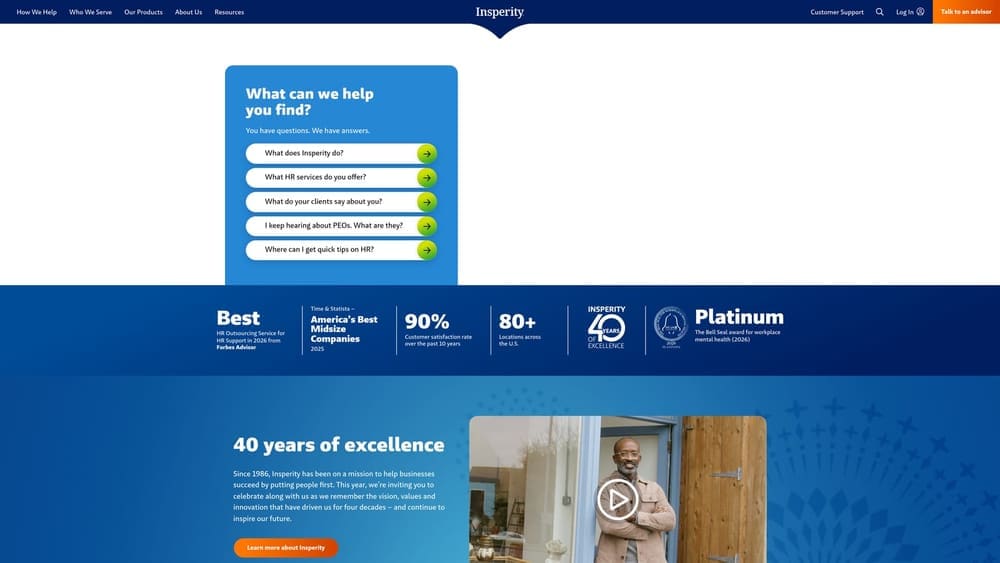
Insperity is a publicly traded PEO known for its emphasis on HR support, safety and risk management services, and employee benefits access for small and mid-size businesses.
Where This Tool Shines
In warehousing, safety isn’t a compliance checkbox. It’s a direct financial lever. A well-managed safety program affects your experience modification rate, which in turn affects what you pay for workers’ comp. Insperity has historically marketed dedicated safety and risk management consulting as a core part of its service model, which makes it worth examining for warehouse environments where OSHA compliance, forklift safety, and injury prevention are ongoing concerns.
Their dedicated service team model means clients typically work with an assigned team rather than rotating through generalist support. For warehouse operators managing complex safety requirements, that continuity can matter.
Key Features
Safety and Risk Management Consulting: Resources relevant to high-injury-risk environments, including support for OSHA compliance and loss control programs.
Workers’ Compensation Coverage and Loss Control: Coverage under the PEO master policy with loss control support that can help manage claim frequency and severity over time.
Dedicated Service Team Model: Assigned HR professionals providing more consistent guidance than a rotating support structure.
Employee Benefits Package: Health, dental, and vision coverage as part of the PEO arrangement.
Time, Attendance, and Payroll Technology: HR platform tools relevant to managing hourly workforces and shift schedules.
Best For
Small and mid-size warehousing companies where safety program quality and loss control support are the primary concerns. Also a reasonable fit for operations that want a dedicated service team model rather than self-service HR administration.
Pricing
Verify current pricing directly with Insperity. Pricing varies by workforce size and configuration.
4. ADP TotalSource
Best for: Warehousing operations with complex hourly, shift, and overtime payroll structures
ADP TotalSource is the PEO division of ADP, offering payroll processing, HR administration, benefits, and workers’ compensation services backed by one of the largest payroll processing infrastructures in the country.
Where This Tool Shines
Warehousing payroll is genuinely complicated. Shift differentials, overtime calculations across multiple states, piece-rate structures, and high headcount fluctuations during peak seasons all create payroll complexity that generic systems handle poorly. ADP TotalSource brings the underlying payroll infrastructure of ADP to a PEO model, which is meaningful when your payroll errors have real financial and compliance consequences.
ADP TotalSource holds CPEO certification from the IRS, which has specific tax implications for how employment taxes are handled under the arrangement. For companies that care about the technical structure of their PEO relationship, that certification is worth understanding.
Key Features
Hourly and Shift Payroll Processing: Deep capability for complex pay structures common in warehousing, including shift differentials, overtime, and variable schedules.
CPEO Certification: IRS-certified Professional Employer Organization status, which affects how employment tax liabilities are allocated between the PEO and the client.
Multi-State Payroll and Compliance: Infrastructure to handle the wage and hour law differences across states for distribution networks operating in multiple locations.
Workers’ Compensation Coverage: Covered under the PEO arrangement with access to ADP’s risk management resources.
ADP Technology Ecosystem Integration: Connects with ADP’s broader HR technology tools for time tracking, scheduling, and workforce management.
Best For
Warehousing and distribution companies where payroll complexity is the primary pain point, particularly those with multi-state operations, shift-based workforces, and significant overtime exposure. Also relevant for companies that want CPEO certification as part of their PEO structure.
Pricing
Verify current pricing directly with ADP TotalSource. Pricing varies by workforce size and service selections.
5. Paychex PEO
Best for: Smaller warehousing operations that need PEO services without large minimum headcount requirements
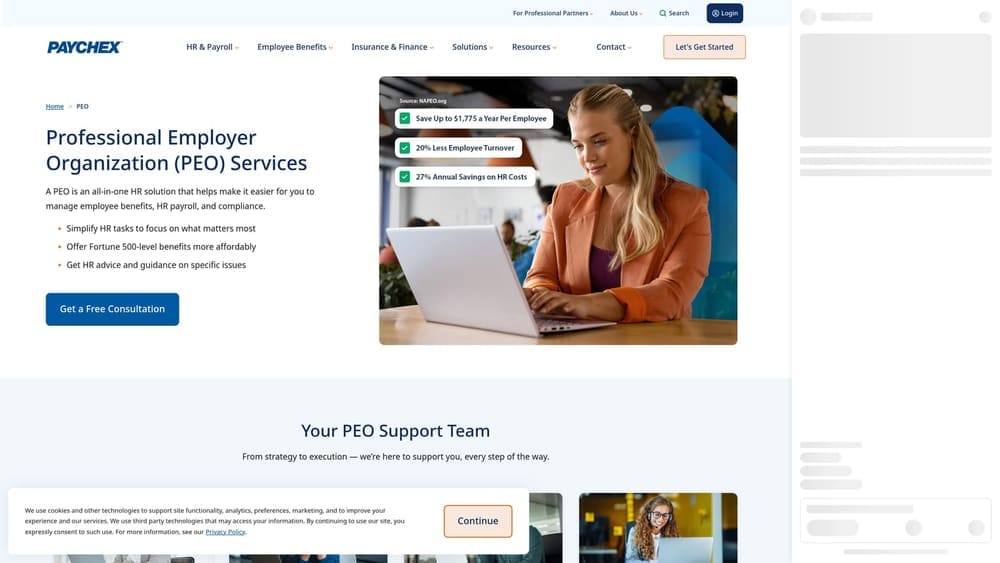
Paychex PEO is the PEO service offering from Paychex, designed to give small and mid-size businesses access to HR, payroll, benefits, and workers’ compensation support with dedicated HR generalist assistance.
Where This Tool Shines
Smaller warehousing operations often find that larger PEOs have employee minimums that effectively exclude them, or pricing structures that don’t make sense at their scale. Paychex PEO has historically been more accessible to smaller businesses, which makes it a practical option for regional distribution operations or smaller fulfillment centers that still need the core benefits of a PEO arrangement.
The dedicated HR generalist model means each client is assigned a specific person rather than working through a general support queue. For a small warehouse operation without an in-house HR function, that direct relationship can be more useful than a self-service platform.
Key Features
Accessible to Smaller Operations: Historically more accommodating of smaller headcounts than some larger PEO competitors, though current minimums should be verified directly.
Dedicated HR Generalist: Each client is assigned a specific HR generalist, providing a consistent point of contact for HR questions and compliance support.
Time and Attendance Tools: Payroll processing with integrated time and attendance capabilities relevant to shift-based warehouse workforces.
Workers’ Compensation Coverage: Covered under the PEO arrangement, which can be particularly valuable for smaller operations that face high workers’ comp costs on their own.
Benefits Access: Health insurance and retirement plan options that smaller warehousing operations might not be able to offer independently.
Best For
Small to mid-size warehousing operations, particularly those without a dedicated in-house HR function, that want the core benefits of a PEO arrangement without the scale requirements of larger providers. Verify current employee minimums and pricing directly with Paychex before assuming eligibility.
Pricing
Verify current pricing and employee minimums directly with Paychex. Pricing varies by company profile.
6. Oasis (a Paychex Company)
Best for: Businesses that want a more hands-on, locally present HR service model
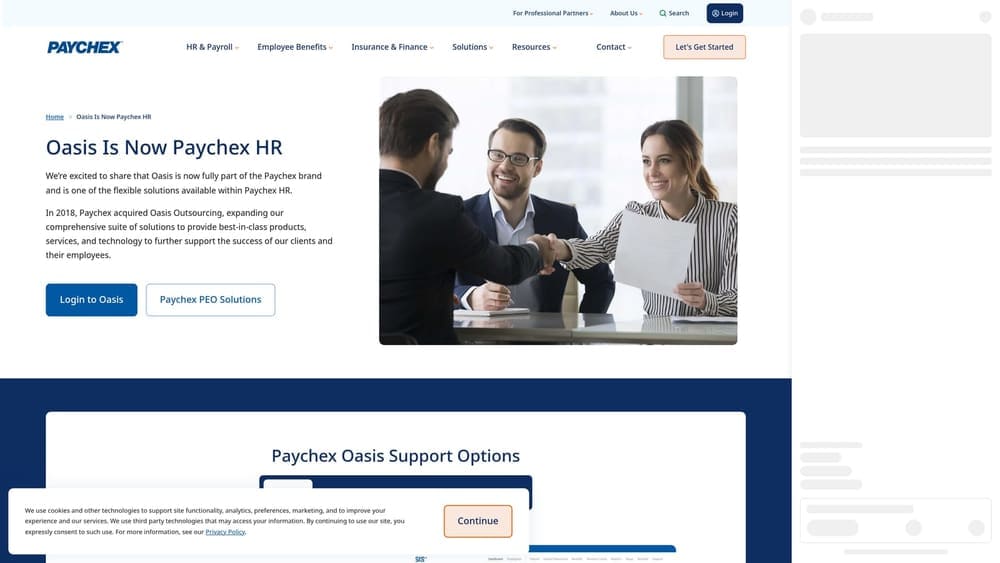
Oasis operates under the Paychex umbrella and has historically emphasized a personalized service model with local HR representative support, covering HR administration, payroll, benefits, and workers’ compensation.
Where This Tool Shines
One of the recurring complaints about PEO services is that the relationship becomes transactional after the contract is signed. Oasis has historically differentiated on local HR representative support, meaning clients work with someone who is geographically closer and more directly engaged than a remote support team. For warehouse managers who prefer a direct, relationship-based HR contact, that model has practical appeal.
Because Oasis operates under Paychex, it also has access to the broader Paychex infrastructure for payroll processing and compliance support. Prospective clients should verify the current service model and brand status directly, as the integration between Oasis and Paychex has evolved since the acquisition.
Key Features
Local HR Representative Model: More direct client contact through regionally assigned HR representatives rather than centralized support queues.
HR Administration and Payroll: Core PEO services covering HR administration, payroll processing, and employee data management.
Workers’ Compensation Coverage: Covered under the PEO arrangement, relevant for warehousing operations with significant workers’ comp exposure.
Compliance Support: State and federal compliance guidance for HR and employment matters.
Employee Benefits Access: Health and other benefits options through the PEO arrangement.
Best For
Warehousing operations that prioritize a hands-on, relationship-based HR service model over a self-service platform approach. Confirm current brand status, service model, and geographic availability directly with Oasis or Paychex before proceeding.
Pricing
Verify current pricing directly with Oasis or Paychex. Confirm current brand status and service structure before committing.
7. Engage PEO
Best for: Multi-state distribution networks where HR compliance complexity is a primary concern
Engage PEO is a privately held PEO that markets attorney-backed HR compliance guidance as a core differentiator, with services covering HR, payroll, benefits, and workers’ compensation.
Where This Tool Shines
Multi-state warehousing and distribution operations face a genuinely complex compliance environment. Wage and hour laws, workers’ comp regulations, leave requirements, and employment classification rules vary significantly across states, and the cost of getting them wrong is real. Engage PEO integrates attorneys into its HR support team, which means compliance questions get a different quality of answer than they would from a generalist HR representative.
For distribution networks that span multiple states or that are expanding into new markets, having legal-backed compliance guidance built into the PEO relationship rather than accessed separately through outside counsel can be a meaningful operational advantage.
Key Features
Attorney-Backed HR Compliance: Attorneys integrated into the HR support team, providing a higher threshold of compliance guidance for complex employment law questions.
Multi-State Compliance Support: Relevant for distribution networks operating across multiple states with different regulatory requirements.
Workers’ Compensation Coverage: Covered under the PEO master policy arrangement.
HR Administration and Payroll: Core PEO services for HR management and payroll processing.
Employee Handbook and Policy Development: Support for developing and maintaining compliant employment policies, which matters in high-turnover warehouse environments.
Best For
Warehousing and distribution companies operating across multiple states where employment law compliance is a primary concern, or businesses that have experienced compliance issues and want more substantive legal backing in their HR support structure.
Pricing
Verify current pricing directly with Engage PEO. Pricing varies by company size and location.
8. G&A Partners
Best for: Warehousing operations based in Texas or the broader South and Southwest region
G&A Partners is a regional PEO with a strong presence in Texas and the broader South and Southwest, offering HR, payroll, benefits, and workers’ compensation services with regional market knowledge.
Where This Tool Shines
Texas and the surrounding region carry significant warehousing and logistics activity, and a PEO with deep regional knowledge can navigate the specific regulatory and market conditions in those states more effectively than a nationally focused provider operating from a distance. G&A Partners has built its service model around that regional depth, with HR teams that understand local labor markets, state-specific compliance requirements, and the particular workforce dynamics of the South and Southwest.
Their dedicated HR service team model provides ongoing support rather than transactional assistance. For warehouse operators in their service area, regional familiarity combined with dedicated service can be a practical advantage over larger national providers whose support teams may have less specific knowledge of local conditions.
Key Features
Regional Expertise: Deep knowledge of states with significant warehousing activity, particularly Texas, where employment law and workers’ comp regulations have specific characteristics.
Dedicated HR Service Team: Assigned HR professionals providing ongoing support rather than a generalist call-center model.
Workers’ Compensation Coverage: Covered under the PEO arrangement, relevant for high-risk warehousing classifications.
Employee Benefits Access: Health and other benefits options available through the PEO relationship.
Payroll and HR Administration: Payroll processing and HR administration support for hourly workforces common in warehousing.
Best For
Warehousing and distribution operations based in Texas or the South and Southwest that want a regionally experienced PEO with a dedicated service model. Verify current states served and service availability directly with G&A Partners before assuming coverage in your specific location.
Pricing
Verify current pricing and states served directly with G&A Partners. Regional availability should be confirmed before proceeding.
Which PEO Is the Right Fit for Your Warehouse Operation?
Choosing a PEO for a warehousing or distribution operation is not the same as choosing one for an office-based business. Workers’ compensation class codes, safety program quality, experience modification rate management, and the ability to handle high-volume hourly payroll all carry much more weight when your workforce is on the floor rather than at a desk.
The providers on this list differ considerably in how they price workers’ comp, what safety resources they actually deliver versus what they advertise, and how they handle the seasonal headcount changes common in fulfillment and distribution. Those differences are worth understanding before you’re in a contract negotiation.
Here’s a quick orientation by primary concern:
If multi-state compliance is your main challenge: Engage PEO’s attorney-backed model deserves serious attention. Having legal expertise built into the HR support structure rather than accessed separately is a meaningful difference for distribution networks spanning multiple regulatory environments.
If safety program depth is the priority: Insperity has historically emphasized loss control services and risk management consulting, which is relevant when your experience modification rate directly affects what you pay for workers’ comp.
If payroll complexity for shift workers is the sticking point: ADP TotalSource’s infrastructure is worth examining, particularly for operations with multi-state payroll, shift differentials, and significant overtime exposure.
If you’re a smaller operation: Paychex PEO has historically been more accessible to smaller headcounts, though you should verify current minimums directly.
If you’re based in Texas or the Southwest: G&A Partners’ regional depth may offer advantages that a national provider operating from a distance cannot match.
Before contacting any of these providers directly, it’s worth understanding how their pricing structures and service models compare against each other. PEO Metrics offers a side-by-side comparison service designed to help you evaluate providers against your specific operation before you commit to anything.
Many businesses unknowingly overpay because of bundled fees, hidden administrative markups, and contracts designed to limit flexibility. A structured comparison gives you a clear view of what you’re actually paying for and where the differences between providers are real versus cosmetic.
Don’t auto-renew. Make an informed, confident decision.
Before you sign that PEO renewal, make sure you’re not leaving money on the table.
Many businesses unknowingly overpay because of bundled fees, hidden administrative markups, and contracts designed to limit flexibility. We give you a clear, side-by-side breakdown of pricing, services, and contract terms, so you can see exactly what you’re paying for and choose the option that truly fits your business.
