

Running payroll for an engineering firm looks straightforward until it isn’t. You’ve got licensed professionals working across multiple states, field engineers with different workers’ comp class codes than your office staff, and a competitive talent market where benefits packages genuinely influence hiring decisions. A basic payroll company can cut the checks. Whether it can handle the rest is a different question.
The choice between a Professional Employer Organization and a standalone payroll provider isn’t just about monthly fees. It touches co-employment liability, multi-state compliance, benefits access, and whether your HR setup can actually keep pace with a firm that staffs by project and hires by discipline.
This comparison covers eight platforms, from full-service PEOs built for professional services employers to payroll-first tools that work well for simpler setups. PEO Metrics appears first because it helps engineering firms evaluate all of these options before signing anything. The remaining seven are genuine market options with distinct profiles. Read the full comparison or jump to the section that matches your current situation.
1. PEO Metrics
Best for: Engineering firms that want to compare PEO providers side by side before committing to a contract.
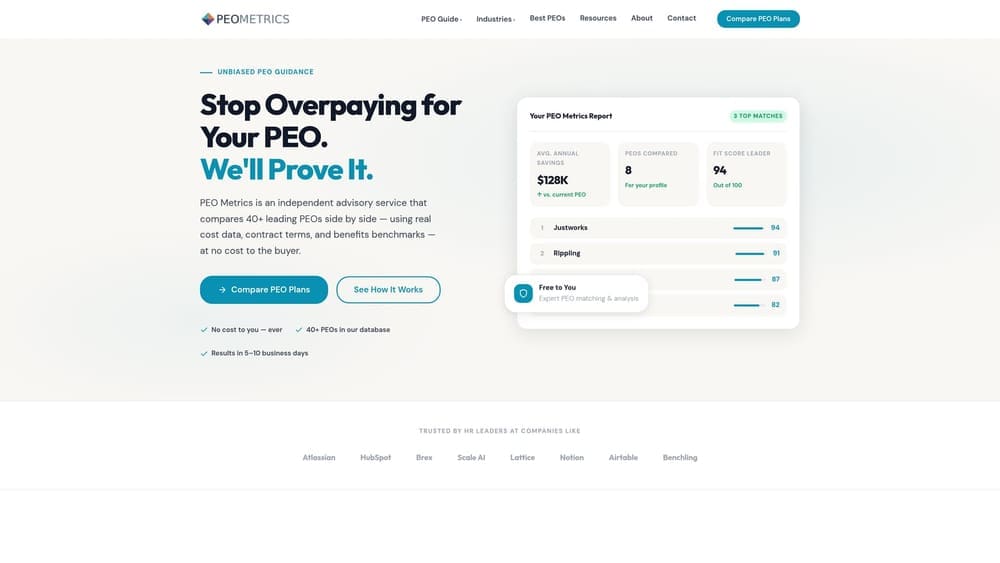
PEO Metrics is a PEO comparison and advisory service, not a PEO itself, designed to help businesses evaluate providers with more structure and depth than a typical vendor sales process offers.
Where This Tool Shines
Engineering firms often receive PEO proposals that use different pricing structures. One vendor quotes a percentage of payroll; another quotes per-employee-per-month. Comparing those proposals side by side without a framework is genuinely difficult, and vendors have little incentive to make it easier. PEO Metrics is built specifically to address that gap.
For engineering principals who are cautious about co-employment or unsure whether a PEO is even the right model, the advisory approach is more useful than going directly to a single vendor’s sales team. You get a structured view of the market before you’re deep into a contract negotiation.
Key Features
Side-by-Side Provider Comparisons: Compares multiple PEO providers on pricing, service depth, and contract terms using consistent metrics rather than each vendor’s own framing.
Pricing Structure Analysis: Accounts for the difference between percentage-of-payroll and PEPM fee models, which is a common source of confusion when comparing proposals.
Contract Guidance for Professional Services: Helps identify what to look for in PEO contracts that are specific to engineering and professional services firms.
Fit Assessment: Helps determine whether a PEO or payroll-only setup is the better match before you commit, rather than after.
Advisory Model: Operates as an advisory resource rather than a single-vendor sales funnel, though PEO Metrics may receive vendor placement fees from PEO providers.
Best For
Engineering firms that have received PEO proposals and want an independent framework for comparing them. Also useful for firms currently on a payroll-only setup who want to understand what switching to a PEO would actually involve before talking to vendors.
Pricing
Contact PEO Metrics directly for details. Note that PEO Metrics may receive vendor placement fees from PEO providers it recommends.
2. Insperity
Best for: Mid-size to larger engineering firms that want a full-service PEO with dedicated HR support teams.
Insperity is a full-service, publicly traded PEO operating under a co-employment model, with dedicated HR specialists and comprehensive benefits, payroll, and compliance infrastructure.

Where This Tool Shines
Insperity’s co-employment structure means it shares employer liability with your firm, which matters in an industry where multi-state project work creates compliance exposure that a payroll-only provider doesn’t absorb. For engineering firms with employees working across several states, that shared liability is a meaningful difference from simply outsourcing payroll.
The dedicated service team model is worth noting. Rather than routing HR questions through a generalist support line, Insperity assigns specialists to your account. For firms whose principals don’t have time to become HR experts, that structure tends to work better in practice.
Key Features
Co-Employment PEO: Operates as a co-employer, sharing employer responsibilities including certain compliance and liability obligations.
Large-Group Benefits Access: Gives smaller engineering firms access to health and benefits packages typically available only to larger employers.
Dedicated HR Teams: Account-level HR specialists rather than generalist support queues.
Multi-State Payroll and Compliance: Built to handle firms with employees registered across multiple states, which is common in engineering project work.
HR Technology Included: Performance management tools and HR software are included with the PEO service.
Best For
Engineering firms with meaningful headcount and multi-state complexity who want a well-established PEO with a track record in professional services. Better suited to mid-size and larger firms than to very small teams.
Pricing
Quote-based. Verify current pricing directly with Insperity. Specific figures are not published and should not be assumed from third-party sources.
3. TriNet
Best for: Engineering and professional services firms that want industry-tailored PEO packages for credentialed, white-collar workforces.
TriNet is a full-service PEO that has historically positioned its packages toward professional services, technology, and white-collar industries, with benefits and HR tools calibrated for those workforces.
Where This Tool Shines
Engineering firms often struggle to find a PEO that understands the difference between their workforce and a retail or manufacturing employer. TriNet’s industry-specific packaging means the benefits options and HR tools are designed with credentialed employees in mind, which is relevant when you’re competing for licensed engineers who compare offers carefully.
The co-employment structure provides shared employer liability, and the multi-state compliance support is built for firms whose project teams move across state lines. The included HR technology platform handles the day-to-day without requiring a dedicated internal HR team.
Key Features
Industry-Tailored PEO Packages: HR and benefits configurations designed for professional services workforces, not a one-size-fits-all approach.
Benefits for Credentialed Employees: Benefits options calibrated for white-collar and licensed professional populations.
Multi-State Compliance: Supports firms with distributed project teams working across state jurisdictions.
Included HR Technology: Platform tools for HR management are part of the PEO service.
Co-Employment Structure: Shared employer liability under the co-employment model.
Best For
Engineering firms where the workforce is primarily office-based or white-collar, and where benefits competitiveness is a priority for recruiting licensed professionals. Less suited to firms with significant field or construction-adjacent workforces.
Pricing
Quote-based. Verify current pricing directly with TriNet before making any budget assumptions.
4. Justworks
Best for: Smaller engineering firms that want co-employment PEO benefits with predictable, transparent monthly costs.
Justworks is a PEO with a flat per-employee-per-month pricing model, designed for smaller businesses that want access to co-employment benefits without the complexity of percentage-of-payroll pricing.
Where This Tool Shines
For small engineering firms, one of the most frustrating parts of evaluating PEOs is that pricing proposals are hard to compare. Justworks publishes its pricing tiers directly on its website, which removes a layer of friction in the evaluation process. You can run a rough cost estimate before ever talking to a sales rep.
The flat PEPM structure also makes budgeting more predictable than percentage-of-payroll models, which fluctuate as salaries change. For a small firm with a stable headcount, that predictability has real value in financial planning.
Key Features
Flat PEPM Pricing: Per-employee-per-month pricing that’s easier to budget and compare than percentage-of-payroll structures.
Co-Employment PEO: Provides co-employment status with access to group health and benefits packages.
Compliance and HR Tools: Compliance support and HR tools are included in the platform.
Transparent Published Pricing: Pricing tiers are available on the Justworks website, which is uncommon among PEOs.
Streamlined Onboarding: Setup process designed for smaller teams without large internal HR resources.
Best For
Small engineering firms, typically under 50 employees, that want co-employment benefits and predictable costs. May be less suited to firms with complex multi-state footprints or specialized workers’ comp needs that require more hands-on account management.
Pricing
Justworks publishes pricing tiers on its website. Verify current tiers at justworks.com before making any commitments, as tiers and features can change.
5. Gusto
Best for: Engineering firms that want payroll, benefits administration, and HR tools without a co-employment arrangement.
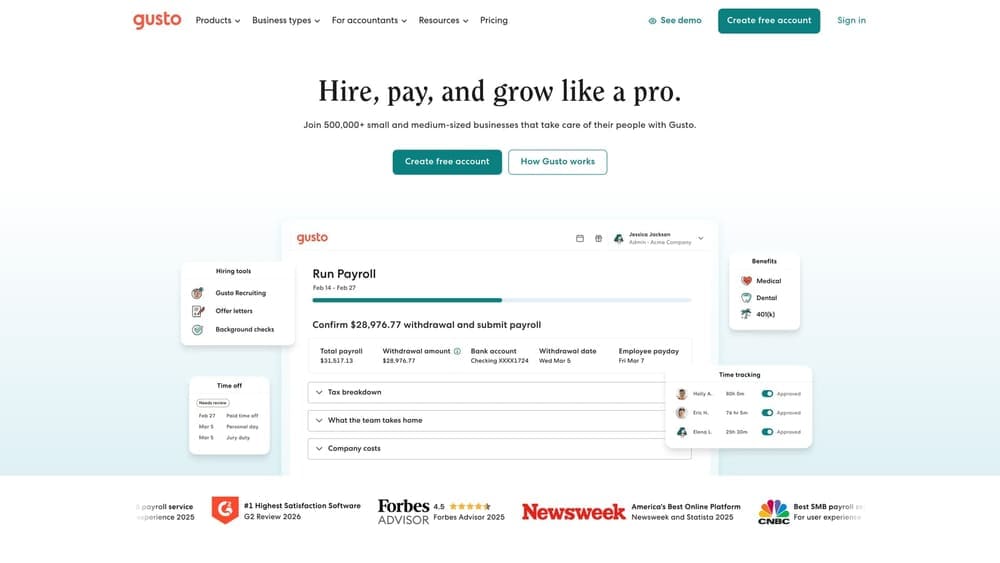
Gusto is a payroll-first platform offering payroll processing, benefits administration, and HR software. It is not a traditional co-employment PEO and does not take on employer co-employment liability in the same way a PEO does.
Where This Tool Shines
Some engineering firm principals are cautious about co-employment for legitimate reasons: concerns about control over HR decisions, complications with professional licensing, or simply not wanting a third party as a co-employer on record. For those firms, Gusto provides meaningful payroll and HR functionality without that arrangement.
Gusto’s setup is relatively straightforward, and its published pricing tiers make it easy to understand costs before engaging with sales. For small to mid-size engineering firms with straightforward payroll needs and a preference for keeping HR in-house, it’s a practical option.
Key Features
Full-Service Payroll: Payroll processing with automated tax filing across states.
Benefits Administration: Health insurance options and benefits administration tools, though without the co-employment structure that gives PEOs large-group rate access.
HR Tools: Onboarding, time tracking, and document management included in higher-tier plans.
No Co-Employment Required: You remain the sole employer of record, which suits firms that want to avoid co-employment complexity.
Published Pricing: Tiered pricing is available on the Gusto website for straightforward cost evaluation.
Best For
Engineering firms that want payroll and HR tooling without co-employment, have relatively simple multi-state needs, and don’t require the benefits purchasing power that a PEO’s large-group status provides.
Pricing
Gusto publishes pricing tiers on its website. Verify current tiers at gusto.com before making decisions, as plans and features are updated periodically.
6. ADP TotalSource
Best for: Engineering firms that want a CPEO-certified PEO with established payroll infrastructure and strong multi-state compliance support.
ADP TotalSource is ADP’s full-service PEO product, distinct from ADP’s payroll-only offerings, and holds Certified PEO (CPEO) status under the IRS CPEO program.
Where This Tool Shines
CPEO certification matters for engineering firms that care about tax liability clarity. Under the IRS CPEO program, a certified PEO assumes certain federal employment tax obligations, which has specific implications for how tax credits and liabilities are handled. This is a meaningful distinction from non-certified PEOs, and engineering firms with complex payroll tax situations should understand it before choosing a provider.
ADP TotalSource also benefits from ADP’s existing payroll infrastructure, which is one of the most established in the market. For firms that already use ADP payroll products and want to add PEO co-employment, TotalSource provides a path to do that within the same ecosystem.
Key Features
CPEO Certification: IRS-certified PEO status with specific tax liability implications that differ from non-certified PEOs.
Established Payroll Infrastructure: Built on ADP’s payroll systems, which are widely used and well-documented.
Multi-State Compliance: Strong support for firms operating across multiple state jurisdictions.
Co-Employment Model: Shared employer responsibilities under the co-employment structure.
Integrated HR Technology: Reporting tools and HR technology integrated with payroll operations.
Best For
Larger engineering firms with multi-state complexity that want CPEO certification and an established payroll infrastructure. Also a natural fit for firms already embedded in the ADP ecosystem.
Pricing
Quote-based. Verify current pricing directly with ADP TotalSource. Do not rely on third-party pricing estimates for this product.
7. Paychex PEO
Best for: Engineering firms outside major metro areas that want a co-employment PEO with local HR representative access.
Paychex PEO is Paychex’s PEO offering, distinct from its payroll-only products, combining Paychex payroll infrastructure with co-employment services and local HR representative support in many markets.
Where This Tool Shines
Many engineering firms are not headquartered in major metro areas. They’re regional firms, often with offices in mid-size cities or suburban markets, and they don’t always get the same attention from large PEO vendors as firms in New York or San Francisco. Paychex’s local HR representative model addresses that gap in a way that purely digital platforms don’t.
The co-employment structure provides shared employer liability, and the Paychex payroll infrastructure handles the mechanics reliably. For firms that want a human point of contact for HR questions rather than a support ticket system, Paychex PEO is worth evaluating.
Key Features
Co-Employment PEO: Shared employer liability under the co-employment model, including benefits and workers’ comp administration.
Local HR Representatives: Human HR contacts available in many markets, not just major metro areas.
Paychex Payroll Infrastructure: Established payroll processing with the PEO layer added on top.
Benefits and Workers’ Comp Management: Benefits administration and workers’ comp support included in the PEO service.
HR Compliance Tools: Compliance support and HR tools included with the service.
Best For
Engineering firms in regional markets that value local service access and want a co-employment PEO built on an established payroll infrastructure. Firms with complex workers’ comp class code situations should ask specifically about how Paychex handles professional services class codes during the evaluation.
8. Rippling
Best for: Engineering firms that want unified payroll, HR, and IT management with strong software integrations and an optional PEO add-on.
Rippling is a workforce management platform combining payroll, HR, and IT management. Its core product operates as employer-of-record payroll rather than traditional co-employment, though an optional PEO product is available.
Where This Tool Shines
Engineering environments tend to run on software: project management tools, CAD platforms, collaboration systems, and various technical applications. Rippling’s integration capabilities are unusually broad, and its ability to connect HR and payroll with the software tools your team already uses is a genuine differentiator. Onboarding a new engineer can trigger software provisioning automatically, which saves time in firms that hire frequently for project work.
The IT management layer is also something most HR platforms don’t offer. For engineering firms where IT and HR overlap more than they’d like, having both in one platform has practical value beyond just payroll processing.
Key Features
Unified Platform: Payroll, HR, and IT management in a single system rather than separate tools that need to sync.
Software Integrations: Broad integration capabilities with tools common in engineering and technical work environments.
Optional PEO Add-On: Firms that want co-employment can add Rippling’s PEO product, though the core platform does not operate as a traditional co-employment PEO.
Automated Workflows: HR process automation, including onboarding flows that can connect to software provisioning.
Multi-State Payroll: Multi-state payroll processing and compliance support for distributed teams.
Best For
Engineering firms that prioritize platform integration and workflow automation, and where the IT-HR connection has practical value. Firms that specifically need traditional co-employment should evaluate whether the optional PEO add-on meets their needs or whether a dedicated PEO is a better fit.
Pricing
Quote-based. Verify current pricing directly with Rippling before making any decisions.
Which Platform Fits Your Engineering Firm
Engineering firms sit in an unusual position in the HR market. The work is technical, the workforce is credentialed, and the compliance picture is more layered than most industries. Workers’ comp class code assignments, multi-state project registration, and benefits competitiveness for licensed professionals all factor into a decision that most payroll vendors treat as a simple product selection.
A payroll company handles the mechanics of paying people. A PEO takes on co-employment responsibilities, which changes your exposure on benefits, workers’ comp, and multi-state compliance in meaningful ways. That distinction matters more for engineering firms than it does for many other employers.
If you’re actively comparing PEO proposals and struggling to evaluate them on a consistent basis, PEO Metrics provides a structured way to see how providers stack up on pricing, contract terms, and service depth before you commit. For firms that have already decided on a full-service PEO, Insperity and ADP TotalSource are strong fits for larger operations, while Justworks suits smaller teams that want predictable, transparent costs. If co-employment isn’t the right model for your firm and you need payroll with solid HR tooling, Gusto and Rippling are both worth a closer look.
No platform is the right answer for every engineering firm. The right choice depends on your headcount, state footprint, benefits strategy, and how much employer-side risk you want to share with a third party. Use this comparison as a starting point, then verify current pricing and contract terms directly with each vendor before making a final decision.
This article is informational and does not constitute legal, tax, or benefits advice.
Before you sign that PEO renewal, make sure you’re not leaving money on the table. Many businesses unknowingly overpay because of bundled fees, hidden administrative markups, and contracts designed to limit flexibility. PEO Metrics gives you a clear, side-by-side breakdown of pricing, services, and contract terms so you can see exactly what you’re paying for and choose the option that truly fits your firm. Don’t auto-renew. Make an informed, confident decision.
