
Trucking, freight, and warehousing employers hit a wall that generic payroll software wasn’t designed for: CDL drivers and warehouse crews sit in very different workers’ comp classes, operations often span multiple states, and warehouse turnover keeps HR teams running onboarding and benefits enrollment almost continuously. Deciding whether a PEO’s co-employment model is worth the cost, or whether a payroll-only platform still covers the job, depends on your headcount, state footprint, and how much HR and risk liability you want to keep in-house. The providers below are commonly used by logistics employers, compared on what they publicly offer so you can see where each one actually fits.
Quick comparison
- PEO Metrics: best for logistics employers comparing PEO quotes before signing; quote-based; compares multiple PEO providers side by side using your own headcount and state data instead of one vendor’s pitch.
- Insperity: best for mid-market, multi-location operators; quote-based; assigns a dedicated HR service team per account.
- TriNet: best for companies wanting an industry-aware PEO structure; quote-based; organizes service tracks around specific industry verticals.
- G&A Partners: best for Texas and Southwest fleets; quote-based; bundles risk management and safety program support into its PEO service.
- Engage PEO: best for trucking and distribution companies; quote-based; underwrites workers’ comp specifically around transportation risk classes.
- ADP TotalSource: best for companies already on ADP; quote-based; runs on ADP’s own payroll and workforce management infrastructure.
- Paychex Flex: best for employers wanting payroll accuracy without co-employment; see website; offers an ASO tier that keeps workers’ comp liability with the employer.
- Gusto: best for small owner-operator fleets; see website; keeps pricing and setup simple for very small teams.
- QuickBooks Payroll: best for the smallest operators tracking books in QuickBooks; see website; integrates natively with QuickBooks Online accounting.
1. PEO Metrics
PEO Metrics is a comparison service built for logistics employers who want to see multiple PEO quotes and service terms lined up against each other before committing to a contract. Instead of evaluating providers one sales call at a time, you submit your headcount, state footprint, and risk profile, and the comparison is built around your actual operation rather than a generic proposal.
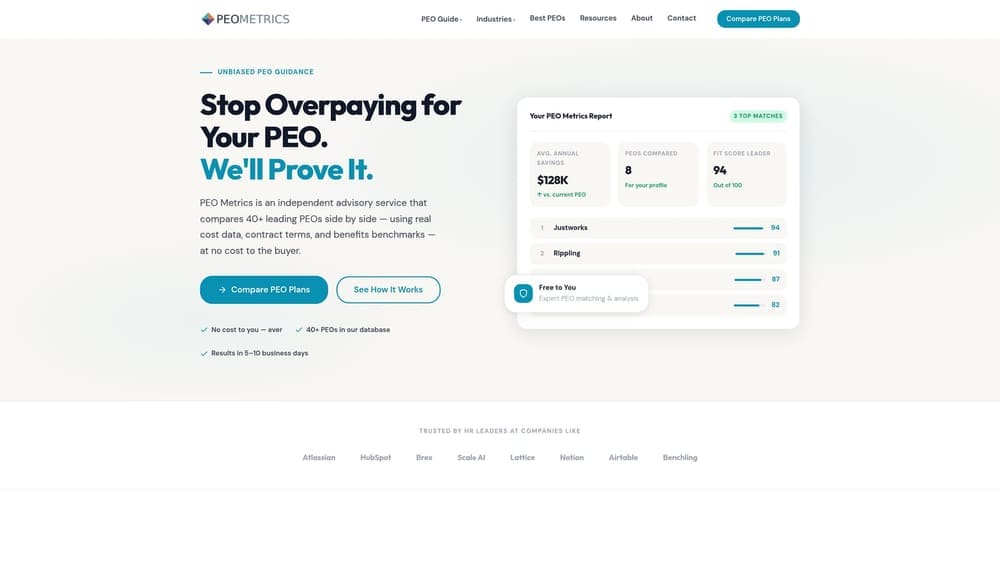
What sets it apart from every other entry on this list is that it isn’t a PEO itself. It sits in front of the decision, pulling quotes and service scope from providers like the ones listed below so you can compare workers’ comp terms, benefits access, and administrative fees side by side instead of negotiating blind.
- Puts PEO quotes and service scope from multiple providers into a single side-by-side view
- Builds the comparison around your company’s real headcount and the states you operate in
- Helps you evaluate how workers’ comp classification and benefits terms differ between providers
- Operates independently of any single PEO’s sales process, so the comparison isn’t slanted toward one vendor
There’s no software to integrate and no platform to log into day to day, since this is a decision-support step rather than a payroll or HR system. It doesn’t process payroll, administer benefits, or handle workers’ comp claims itself. Once you’ve picked a provider from the comparison, that PEO becomes the operating system for your HR, not PEO Metrics.
The main limitation is a matter of scope rather than quality: if you already know exactly which PEO you want and just need it implemented, this step adds less value. It’s most useful earlier in the process, when you’re still weighing whether a PEO makes sense at all or which one fits your driver and warehouse classifications best. Pricing is quote-based and depends on the scope of the comparison you request.
Best for: Logistics employers who want to compare PEO costs and coverage before signing a contract.
2. Insperity
Insperity is a full-service PEO that handles HR administration, payroll, benefits, and workers’ compensation programs, and it’s a common choice for mid-market employers running more than one location.
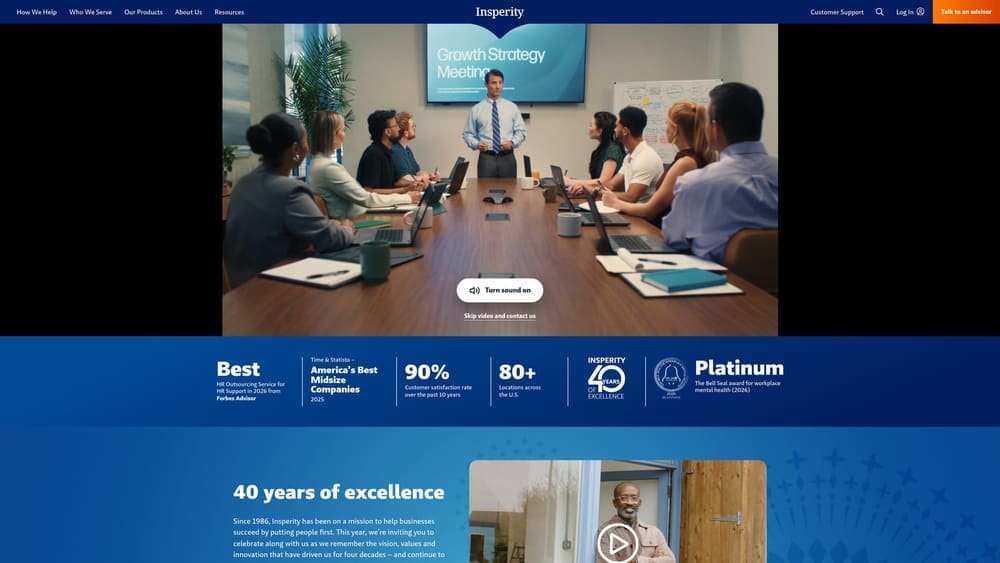
Its distinguishing feature is the account structure: rather than routing you through a general call center, Insperity assigns a dedicated HR service team to your account. For a logistics company juggling terminal locations and warehouse sites, having a consistent point of contact who understands your setup can matter more than any single software feature.
- Assigns a dedicated HR team so you’re not re-explaining your operation to a new rep every time
- Administers group benefits plans, giving warehouse and driver staff access to standard coverage options
- Runs payroll and tax administration across your operating states
- Administers workers’ compensation coverage as part of the bundled service
Setup involves onboarding your existing employee data, benefits elections, and payroll history into Insperity’s systems, typically managed jointly by your HR lead and the assigned account team. It connects with common time and attendance systems and offers applicant tracking add-ons for warehouses with high hiring volume.
The account structure and typical minimums tend to fit established, multi-location operations better than a single-terminal startup fleet. If you’re a very small operation, you may find the account requirements or cost structure less suited to your size than some of the other options here. Pricing is quote-based.
Best for: Mid-market logistics companies with multiple warehouse or terminal locations that want dedicated HR account support.
3. TriNet
TriNet is a PEO that organizes its service around industry verticals, pairing HR and benefits administration with a self-service platform for both employees and managers.
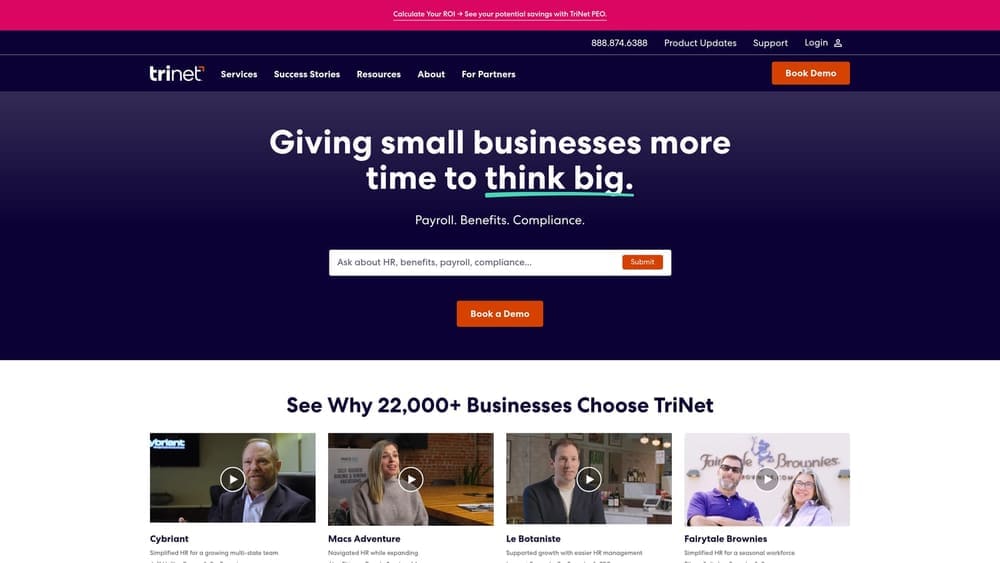
Where TriNet stands out is the combination of an industry-oriented account structure with a genuinely usable self-service tool. Employees can handle a fair amount of their own HR tasks and benefits management through the platform, which can reduce the administrative load on a lean HR team managing scattered warehouse locations.
- Groups clients into industry-specific service tracks intended to match support to sector needs
- Gives access to master benefits plans spanning multiple insurance carriers
- Handles multi-state payroll processing and related compliance tasks
- Provides a self-service platform so employees can manage basic HR tasks without going through HR staff
Integration options include applicant tracking systems and time tracking software, useful for warehouses with steady hiring churn. Implementation is generally managed by your HR lead working with a TriNet account rep, with day-to-day platform use split between HR staff and employees themselves.
The specific depth of service for logistics accounts, as opposed to TriNet’s other industry verticals, varies by account size and should be confirmed directly during the sales process rather than assumed from marketing materials. Pricing is quote-based.
Best for: Logistics companies wanting an industry-aware PEO account structure combined with self-service HR tools.
4. G&A Partners
G&A Partners is a PEO with a strong regional footprint in Texas and the Southwest, covering HR, payroll, benefits, and risk management.
What makes it different
The risk management piece is bundled in rather than sold as an afterthought. For fleets and warehouses managing driver safety programs and workers’ comp exposure, having safety program support built into the same relationship as payroll and benefits can simplify vendor management considerably.
- Bundles risk management and safety program support alongside standard HR and payroll services
- Handles payroll processing and general HR administration
- Provides access to benefits through group plans
- Staffs regional account teams with familiarity in core Southwest markets
Fit and setup
G&A Partners connects with common HRIS platforms and time and attendance tools. Implementation is typically led by your HR contact working with a regional account team, which is one of the firm’s practical advantages if your operation is concentrated in Texas or nearby states.
That regional strength is also the limitation: service depth and account presence outside its core Southwest and Texas markets can vary, so multi-state logistics operators with terminals scattered nationally should confirm coverage in each state before signing. Pricing is quote-based.
Best for: Freight and warehousing companies concentrated in Texas or the Southwest that need combined HR and safety program support.
5. Engage PEO
Engage PEO brings underwriting and service experience specifically in transportation, logistics, and distribution, which sets it apart from PEOs that treat trucking as one industry among many.
The distinctive value here is direct familiarity with how CDL driver classifications and warehouse risk classes affect your workers’ comp experience rating. A generalist PEO may quote workers’ comp coverage without fully accounting for how driver turnover or accident history in transportation specifically moves the number; Engage PEO’s underwriting relationships are built around that risk category.
- Designs workers’ compensation programs specifically around trucking and warehouse risk classifications
- Supports HR compliance issues that are common to transportation employers
- Administers payroll and benefits as part of the bundled PEO relationship
- Maintains underwriting relationships built specifically for industry risk, rather than general coverage
It integrates with common payroll and time tracking software, and day-to-day administration is generally run jointly between your HR or safety lead and Engage’s account team. Setup follows the standard PEO onboarding pattern: transferring employee records, benefits elections, and existing workers’ comp history into the new relationship.
Its national footprint is smaller than the largest PEOs on this list, so if your routes or warehouses span many states, confirm that Engage PEO has coverage and services available in each one before committing. Pricing is quote-based.
Best for: Trucking and distribution companies wanting a PEO with direct experience underwriting transportation risk.
6. ADP TotalSource
ADP TotalSource is ADP’s PEO product, built on top of ADP’s existing payroll infrastructure and adding HR, benefits, and workers’ comp services around it.
The advantage is continuity: if your logistics operation already runs payroll or time and attendance through ADP, TotalSource lets you add PEO-level services without switching platforms or reconciling data between two systems. That matters for warehouse operations with high shift volume, where migrating time and attendance data mid-year is disruptive.
- Runs payroll administration on ADP’s established platform
- Gives access to large-group benefits plans through ADP’s scale
- Provides HR compliance support across your operating states
- Administers a workers’ compensation program as part of the bundle
Integrations include ADP’s own time and attendance system and workforce management add-ons geared toward fleet and shift-based operations. Setup and ongoing administration are typically managed by your HR or payroll lead in coordination with an ADP TotalSource representative.
The flip side of that platform continuity is reduced flexibility if you’re not already an ADP customer: the case for TotalSource weakens considerably if you’re running payroll or time tracking elsewhere and don’t plan to move it. Pricing is quote-based.
Best for: Logistics companies already running ADP payroll or time tracking that want to add PEO services on the same platform.
7. Paychex Flex
The main limitation to know upfront: Paychex Flex does not include PEO-level workers’ compensation master policies unless you purchase a separate add-on, so it’s a different category of tool from the PEOs above.
Paychex Flex is a payroll platform with optional HR and ASO add-ons, aimed at logistics employers who want accurate payroll and tax filing without entering a co-employment arrangement. Because it offers an ASO structure rather than requiring co-employment, workers’ comp and general HR liability stay with your company instead of shifting to the provider.
- Processes payroll and files payroll taxes across your operating states
- Provides time and attendance tools built for hourly, shift-based workforces
- Offers optional HR support add-ons for companies that want more than bare payroll
- Includes an optional ASO service tier for employers who want administrative help without co-employment
It integrates with common accounting software and time clock hardware, and day-to-day use generally sits with your payroll or HR administrator rather than a dedicated account team. Setup is comparable to standard payroll onboarding: transferring employee and pay history data into the platform.
This structure suits companies that have decided they want to keep workers’ comp and HR liability in-house, whether for cost, control, or because their risk profile doesn’t justify co-employment yet. Pricing details are on Paychex’s website and vary by plan and add-ons selected.
Best for: Logistics employers who want accurate hourly payroll and time tracking without entering a co-employment arrangement.
8. Gusto
Gusto is a payroll platform built primarily for small businesses, pairing payroll processing with optional benefits brokerage but without full PEO co-employment.
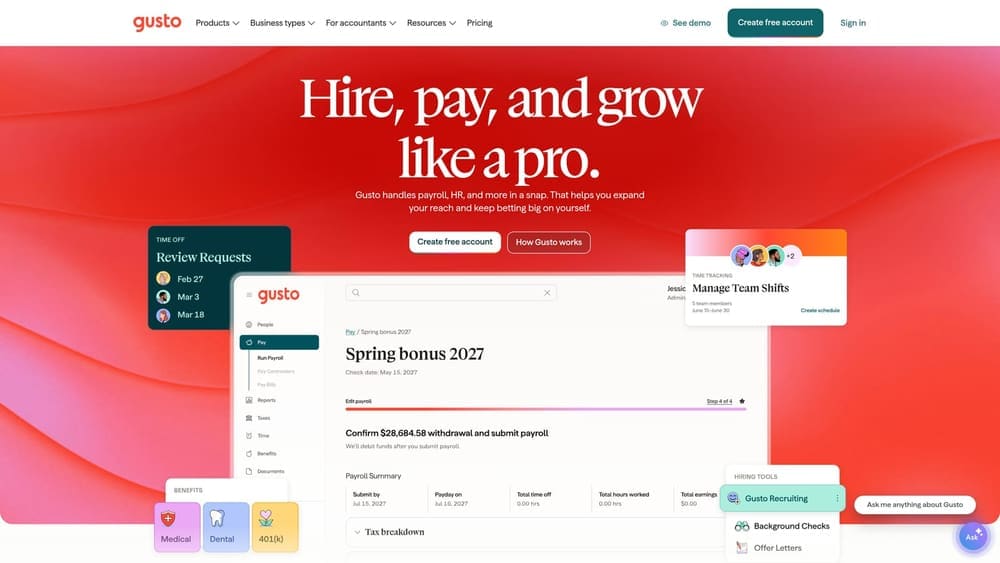
Its advantage over the PEOs on this list is simplicity: setup is fast, pricing is structured to be predictable, and a small warehouse or single-terminal operation can be running payroll within days rather than negotiating a PEO contract.
- Processes payroll and handles tax filing for your team
- Provides access to benefits brokerage services without requiring co-employment
- Uses a flat-rate pricing structure that’s easy to budget against
- Includes basic HR tools sized for small teams rather than enterprise HR departments
Gusto connects with common accounting software and time tracking apps, and it’s typically run directly by an owner or a small HR/admin staff member without a dedicated account rep. That’s part of the appeal for very small operations, but it’s also the limiting factor for larger ones.
Gusto isn’t built for the multi-state compliance obligations or the high-risk workers’ comp classifications that come with a growing fleet or multiple warehouse locations. As headcount and state footprint grow, most logistics operators outgrow it. Pricing details are on Gusto’s website and vary by plan.
Best for: Small owner-operator fleets or single-location warehouse operations with straightforward payroll needs.
9. QuickBooks Payroll
QuickBooks Payroll is Intuit’s payroll product, built to plug directly into QuickBooks Online bookkeeping rather than to stand as a broader HR platform.
For a small logistics operator already tracking fuel, maintenance, and other costs in QuickBooks, the native integration is the main draw: payroll data flows straight into the books without manual reconciliation, which is a real time saver for an owner-operator handling their own accounting.
- Processes payroll and files payroll taxes
- Integrates directly with QuickBooks Online accounting for unified bookkeeping
- Offers a basic time tracking add-on for hourly staff
- Provides same-day or next-day direct deposit options depending on the plan selected
Setup is straightforward for anyone already using QuickBooks Online, and it’s generally run by the owner or a bookkeeper rather than a dedicated HR person. There’s no account team or HR consulting layer here; it’s a payroll tool, not an HR platform.
It offers no dedicated HR compliance support and no workers’ compensation program administration, which limits its usefulness as a fleet adds drivers, expands into new states, or takes on warehouse staff with different risk classifications. It’s a fit for the smallest operators, not a long-term platform for a growing logistics business. Pricing details are on Intuit’s website and vary by plan.
Best for: The smallest logistics operators who already run their books in QuickBooks and need basic payroll only.
Matching the option to where your operation actually stands
If you’re still deciding whether a PEO is worth the cost at all, start with PEO Metrics and get quotes lined up side by side before any single vendor’s sales team gets in the room. Once co-employment, multi-state compliance, and workers’ comp classification for drivers and warehouse staff are real, ongoing needs, a logistics-focused or full-service PEO like Engage PEO, Insperity, TriNet, G&A Partners, or ADP TotalSource is where the co-employment model starts to pay for itself, particularly if your fleet’s workers’ comp experience rating is complicated by driver turnover or a mix of CDL and warehouse classes.
If your operation is still small, single-state, and not ready to hand workers’ comp and HR liability to a co-employment relationship, a payroll-only platform like Paychex Flex, Gusto, or QuickBooks Payroll is a reasonable place to stay for now. The mistake to avoid either way is picking based on the sticker price of the monthly fee alone, since workers’ comp experience rating for driver classifications can shift total cost between PEOs by a wide margin.
Don’t auto-renew. Make an informed, confident decision. Many businesses unknowingly overpay because of bundled fees, hidden administrative markups, and contracts designed to limit flexibility. We give you a clear, side-by-side breakdown of pricing, services, and contract terms, so you can see exactly what you’re paying for and choose the option that truly fits your business.
Before you sign that PEO renewal, make sure you’re not leaving money on the table.
Many businesses unknowingly overpay because of bundled fees, hidden administrative markups, and contracts designed to limit flexibility. We give you a clear, side-by-side breakdown of pricing, services, and contract terms, so you can see exactly what you’re paying for and choose the option that truly fits your business.
