

Engineering firms rarely fit the standard PEO template. A single company might carry licensed professional engineers in an office, field inspectors on job sites, and lab technicians handling equipment, all with different workers’ comp risk classes and, sometimes, different states. That mix makes benefits design, experience rating, and multi-state compliance harder to price and manage than for a typical office employer. The providers below were chosen for their track record with technical and professional services firms, their service model, and how deep their platforms go, not for marketing claims.
If you’re new to the space, a few terms matter before you start comparing quotes. A PEO enters a co-employment relationship with your business; a certified PEO (CPEO) has met IRS requirements and carries federal employment tax liability, according to the IRS’s CPEO program page. An EOR (Employer of Record) is a different structure used to hire workers without co-employment, often relevant if you have out-of-state or international engineers. An ASO (administrative services only) provider handles HR administration without any co-employment relationship at all. CPEO status can change, so verify it directly on the IRS CPEO list or the vendor’s site before treating it as a deciding factor.
Quick Comparison
- TriNet: best for mid-size technical and professional services firms; quote-based pricing; the one thing it does that others don’t is package benefits specifically around technology and professional services benchmarks.
- Insperity: best for firms wanting a steady, dedicated HR contact; quote-based pricing; the one thing it does differently is assign a consistent HR team rather than a rotating support queue.
- ADP TotalSource: best for firms already on ADP payroll; quote-based pricing; the one thing it does that others don’t is run directly on ADP’s own payroll and tax infrastructure.
- Justworks: best for early-stage firms wanting pricing certainty; published tiered pricing; the one thing it does that others don’t is post its pricing tiers publicly instead of requiring a sales call.
- Rippling PEO: best for teams wanting HR and device management together; quote-based, modular pricing; the one thing it does that others don’t is bundle PEO services with IT and device management on one platform.
- G&A Partners: best for firms with field or site staff; quote-based pricing; the one thing it does that others don’t is offer hands-on workers’ comp program administration built for mixed office and field workforces.
- Group Management Services (GMS): best for firms wanting local, relationship-based service; quote-based pricing; the one thing it does that others don’t is lead with regional account management instead of a national call center.
- Engage PEO: best for firms with a mix of salaried and hourly staff; quote-based pricing; the one thing it does that others don’t is design flexible benefit tiers for blended workforces.
1. TriNet
TriNet is a large national PEO that packages HR and benefits by industry, with plan designs historically marketed toward technology and professional services employers. That industry framing can work well for engineering firms whose staff mix looks more like a professional services shop than a traditional office employer.
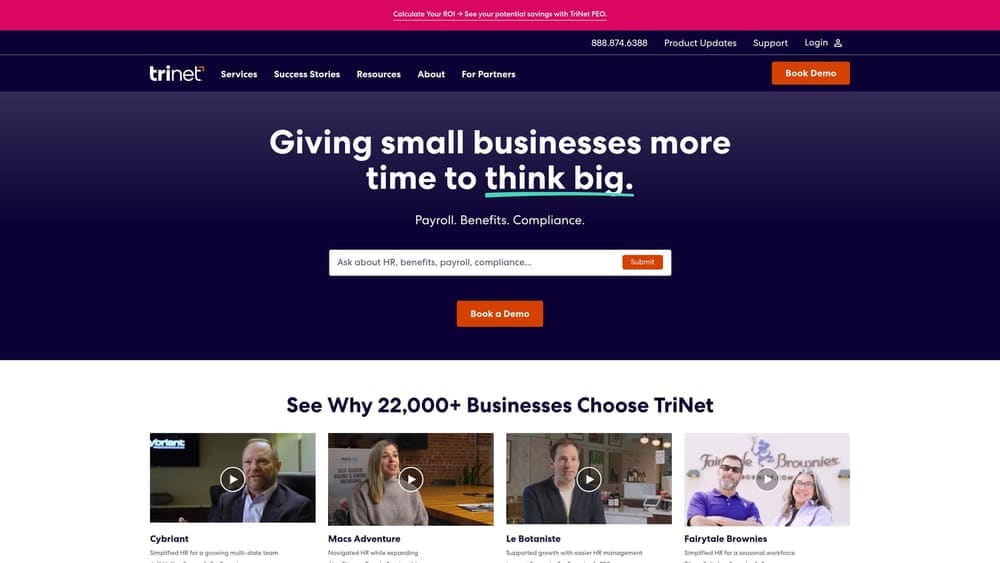
Compared with the rest of this list, TriNet’s advantage is its industry-specific packaging. Instead of a generic benefits menu, it builds plans around what similar employers in tech and professional services actually buy, which can shortcut some of the benchmarking work an HR leader would otherwise do alone.
- Industry-tailored HR and benefits packages built around technology and professional services norms
- Multi-state master health plans that simplify offering consistent coverage across office locations
- Payroll and tax administration handled on TriNet’s platform
- HR compliance support for multi-state employment rules
TriNet’s payroll and HR platform connects with common accounting and payroll tools, though the current integration list should be confirmed directly on TriNet’s site since it changes. Setup typically involves a dedicated implementation contact, and day-to-day administration is usually run by an HR generalist or office manager on the client side. The main friction point is that TriNet, like most large PEOs, doesn’t publish rates. You’ll need a sales conversation and a census of your workforce, including risk classifications, before you get real numbers.
Best for: Mid-size engineering or technical firms wanting industry-benchmarked benefits packages.
2. Insperity
Insperity built its reputation on a high-touch service model, pairing clients with a dedicated HR support team rather than routing requests through a general queue. For an engineering firm juggling licensed staff and field crews, having one team that knows your workforce structure can matter more than a longer feature list.

The main limitation is fit: Insperity’s service model and pricing structure tend to work best for firms with steadier, larger headcounts. A small engineering practice with five or six employees may find the model, and the price, better suited to a bigger team.
- Dedicated HR service team that stays consistent instead of rotating support reps
- Performance management tools for tracking reviews and goals across project teams
- Applicant tracking to support hiring for both office and field roles
- Payroll and benefits administration handled through Insperity’s platform
Current integrations should be confirmed directly with Insperity, since third-party connections can shift. Implementation is generally guided by an Insperity onboarding specialist, with your HR lead or office manager acting as the day-to-day point of contact afterward. As with most PEOs on this list, pricing is quote-based and depends on headcount, benefits selections, and your workers’ comp experience rating.
Best for: Engineering firms wanting a consistent, high-touch HR relationship over a self-service model.
3. ADP TotalSource
ADP TotalSource is ADP’s PEO offering, built on the same payroll and tax infrastructure that powers ADP’s broader payroll business. For engineering firms already running payroll through ADP, TotalSource offers a path to consolidate HR, benefits, and payroll under one vendor relationship.
What sets it apart
The direct tie-in to ADP’s established payroll and tax processing systems is the clearest differentiator here. You’re not asking a PEO to interface with your existing payroll vendor; the payroll vendor is the PEO.
- Payroll processing built on ADP’s core infrastructure rather than a bolted-on system
- Multi-state compliance monitoring for firms hiring engineers or field staff across state lines
- Reporting dashboards for tracking labor costs and compliance status
- Benefits administration integrated with payroll data
Where it fits less well
ADP’s ecosystem is built for scale, and TotalSource’s enterprise-oriented platform can feel heavier than necessary for a very small engineering practice. Firms with a handful of employees may find the tools more elaborate than what they need day to day. Integrations beyond ADP’s own ecosystem should be confirmed directly, as should current TotalSource pricing, which ADP does not publish. Setup is generally handled by an ADP implementation team, with ongoing administration falling to your internal HR or office lead.
Best for: Engineering firms already using ADP payroll that want to consolidate onto one vendor.
4. Justworks
Justworks stands out on this list for one reason: it publishes its pricing tiers instead of routing every prospect through a sales call. For an engineering startup trying to budget HR costs before a funding round or a big hiring push, that transparency has real planning value.
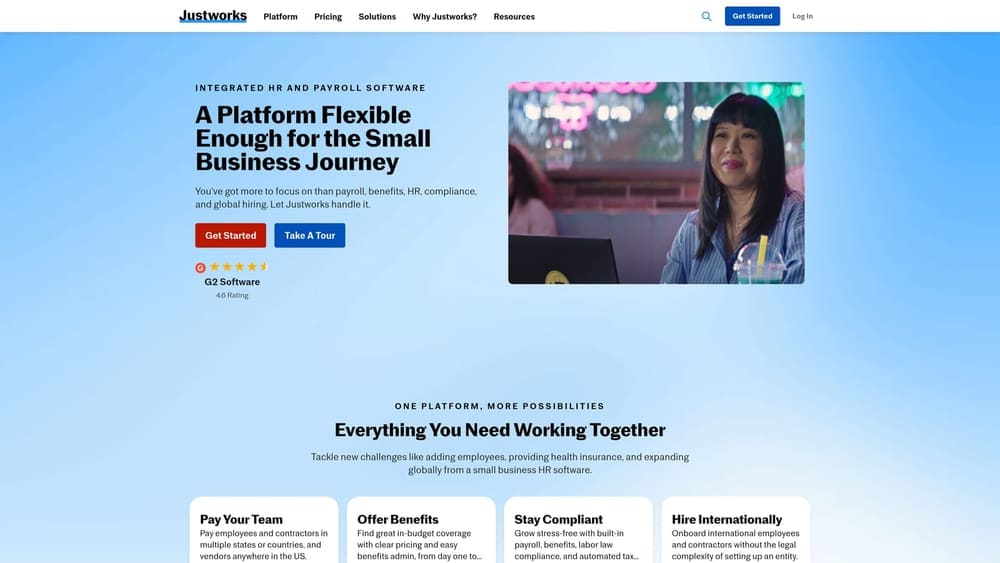
The platform itself is built to be simple. Onboarding, time tracking, and benefits enrollment are handled through straightforward software rather than a maze of portals, which suits founders or small HR teams without dedicated benefits staff.
- Published tiered per-employee pricing you can review before ever talking to sales
- Simple onboarding and time tracking software for fast-growing teams
- Benefits enrollment tools designed for self-service by employees
- Compliance support for multi-state hiring as a startup scales
Justworks connects with QuickBooks and other common accounting tools, according to its own site, though the current integration list should be checked directly since it can change. Setup is typically self-managed with support from Justworks’ onboarding team, and day-to-day administration usually falls to a founder, office manager, or small HR team.
The tradeoff is negotiating leverage. As an engineering firm scales past the startup stage, Justworks’ benefits purchasing power may lag larger PEOs that negotiate at a bigger volume. Confirm current published rates on Justworks.com as of 2026, since tier pricing and inclusions change periodically.
Best for: Early-stage engineering or technical startups that want predictable, published pricing.
5. Rippling PEO
Rippling takes a different approach by treating PEO services as one module within a broader HR and IT platform. For an engineering firm that issues laptops, manages CAD software licenses, or tracks specialized equipment alongside HR functions, having device management and PEO services in the same system can cut down on tool sprawl.
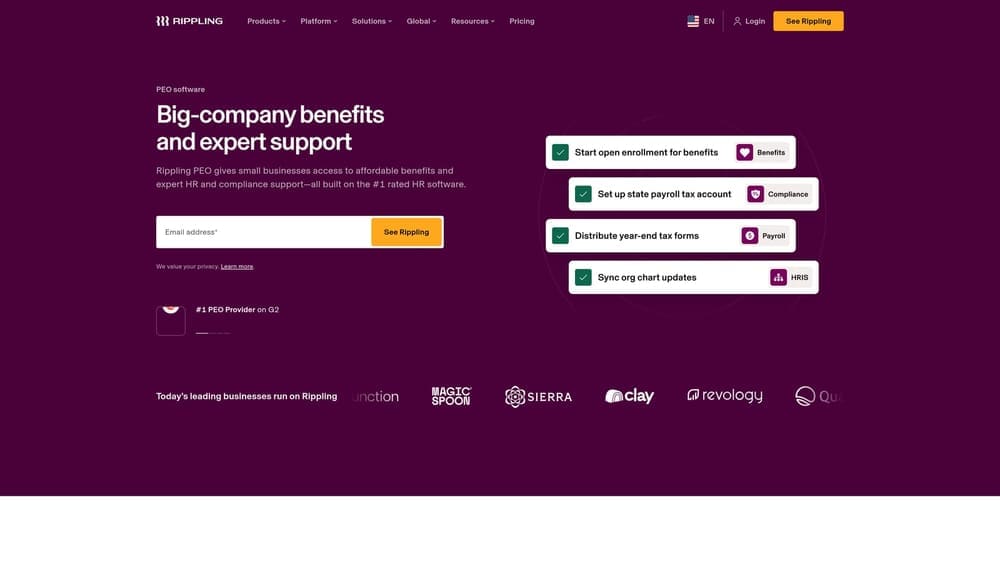
That’s Rippling’s real distinction here: no other provider on this list combines PEO administration with IT and device management as a native part of the platform.
- PEO module covering payroll and benefits administration
- IT and device management add-on for tracking company laptops and hardware
- Modular pricing that lets you pay only for the features you turn on
- Global payroll add-ons for firms with international contractors or employees
Rippling advertises a broad app marketplace, though current integrations should be confirmed directly on its site since the marketplace expands and changes. Implementation is generally guided by Rippling’s onboarding team, with ongoing administration handled by an internal HR or IT lead depending on which modules you activate.
The modular structure is also its main limitation. Rippling’s broader platform includes modules many engineering firms simply won’t need, so it’s worth scoping carefully before you buy, or you risk paying for capability you’ll never use. Pricing is quote-based and modular by feature; confirm current rates directly with Rippling.
Best for: Engineering teams that want HR and hardware/device management managed on one platform.
6. G&A Partners
For engineering firms with real workers’ comp exposure, the workers’ comp program itself is often the deciding factor in a PEO search, and that’s where G&A Partners makes its case. The provider is known for hands-on administration of workers’ comp programs, which matters directly for firms with site-visit staff, field inspectors, or lab technicians whose risk classification differs sharply from office-based engineers.
G&A Partners also allows a customizable HR outsourcing scope, so you can hand off as much or as little administrative work as fits your internal team’s capacity.
- Customizable HR outsourcing scope that scales with your internal HR capacity
- Hands-on workers’ compensation program administration for mixed-risk workforces
- Payroll and tax filing across the states where you employ staff
- Benefits administration handled alongside payroll and comp management
Current integrations should be confirmed directly with G&A Partners, as should state coverage. The provider’s national footprint is smaller than the largest PEOs on this list, so if your engineering firm operates across many states, verify that G&A Partners actively supports each one before signing. Setup involves an implementation team working through your workforce classifications, and ongoing administration typically runs through your HR lead alongside a G&A account manager. Pricing is quote-based and depends heavily on your workers’ comp experience rating and headcount mix.
Best for: Engineering firms with field or site-visit staff carrying higher workers’ comp exposure than office-only teams.
7. Group Management Services (GMS)
Group Management Services, known as GMS, is a certified PEO built around regional, account-manager-led service rather than a large national call-center model. If your engineering firm values being able to reach the same person every time you call, and that person actually knows your account, GMS’s structure is worth a look.
Its regional, relationship-based account management is the clearest point of difference from the larger national PEOs on this list, most of which route support through broader service teams.
- Regional account management that keeps the same contact assigned to your account
- Payroll and tax administration across the states where you have staff
- Benefits administration for both salaried and hourly employees
- HR compliance support tailored to your regional employment laws
Integrations should be confirmed directly with GMS, as its technology stack and third-party connections aren’t as widely documented as the larger national PEOs. Setup runs through a GMS implementation contact, and account management afterward stays with a regional team member. The tradeoff is scale: GMS carries lower national brand recognition and narrower geographic coverage than legacy PEOs, so if your engineering firm has offices spread across many states, verify current availability in each one before moving forward.
Pricing is quote-based and not published; GMS pricing reflects headcount, benefits selections, and workers’ comp classification, consistent with the rest of the PEO market.
Best for: Engineering firms in GMS’s core service regions wanting closer, local account support.
8. Engage PEO
Engage PEO serves employers across multiple industries with a focus on flexible benefit plan design, which suits engineering firms carrying both salaried professional staff and hourly field or lab employees on the same payroll.
The standout feature is benefit tiering built for blended workforces. Rather than a one-size plan, Engage structures benefits to accommodate different pay structures and eligibility needs within the same employer group.
- Flexible benefit plan design that accommodates salaried and hourly staff differently
- Payroll and tax administration across the states where you operate
- HR compliance support for multi-state and mixed-classification workforces
- Risk and safety resources relevant to firms with field or site-based staff
Integrations should be confirmed directly with Engage PEO, since its technology partnerships aren’t as extensively documented publicly as the larger national providers. Implementation typically involves an Engage onboarding team working through your benefit design and payroll setup, with day-to-day administration handled by your internal HR lead.
Engage PEO is smaller and newer than the legacy national PEOs on this list, so before signing, confirm its current certified PEO status directly, either through the IRS CPEO list or Engage’s own site, since certification status can change year to year. Pricing is quote-based and not published, driven by headcount, benefits selections, and risk classification mix.
Best for: Engineering firms with a mix of professional and hourly field staff needing flexible benefit tiers.
Matching the Provider to Your Workforce Mix
The right fit here usually comes down to your workforce structure rather than brand recognition. If you’re an early-stage engineering or technical startup that wants to see pricing before making a call, Justworks’ published tiers make budgeting easier than the quote-only approach most of this list uses. If your workforce includes field inspectors, lab technicians, or site-visit staff with meaningfully different workers’ comp risk than your office-based engineers, G&A Partners’ hands-on comp program administration is built for exactly that mix. And if you’re already standardized on ADP for payroll and want to avoid managing a second vendor relationship, ADP TotalSource keeps everything on infrastructure you already use.
Every provider on this list prices differently once you factor in your actual headcount, benefits selections, and workers’ comp experience rating, and the quotes you get back can vary more than most HR leaders expect. Before you renew or sign with any of these providers, it’s worth putting their proposals side by side against the same criteria: admin fees versus pass-through benefits costs, workers’ comp handling for mixed-classification staff, and contract flexibility. PEO Metrics builds exactly that kind of side-by-side comparison, using verified pricing and service data rather than sales pitches. Don’t auto-renew. Make an informed, confident decision.
Before you sign that PEO renewal, make sure you’re not leaving money on the table.
Many businesses unknowingly overpay because of bundled fees, hidden administrative markups, and contracts designed to limit flexibility. We give you a clear, side-by-side breakdown of pricing, services, and contract terms, so you can see exactly what you’re paying for and choose the option that truly fits your business.
