

If you run HR or finance at a SaaS company, you probably hire engineers and customer-facing staff in more than one state, field questions about equity and health plans from people with other offers in hand, and spend more time on payroll tax registrations than anyone planned. A PEO can take much of that off your plate, but the providers differ a great deal in how they serve remote, tech-heavy teams.
These tools are ordered by fit for SaaS needs, not by company size. We looked at benefits flexibility, multi-state payroll and compliance support, HR technology and integrations, pricing transparency, and how clearly each vendor documents its terms. Details such as pricing, minimums, state availability, and product names change often, so confirm everything with the vendor before you commit. For background on how PEOs compare with other models, see [LINK CHECK: related PEO guides].
Quick Comparison of the PEOs and Services Covered
- PEO Metrics: best for SaaS teams that have not yet chosen a PEO; pricing on request via the website; compares several PEOs on pricing and metrics before you commit to one.
- Justworks: best for early-stage startups wanting a straightforward PEO; see vendor site for pricing; a small-business orientation built around a self-serve platform.
- TriNet: best for tech companies wanting an industry-tailored program; quote-based; industry-specific PEO programs, including one aimed at technology.
- Insperity: best for scaling SaaS firms that want hands-on HR advisors; quote-based; a service-heavy model with assigned HR support.
- Rippling PEO: best for tech-forward teams that want HR and IT in one system; see vendor site for pricing; PEO services tied to a unified HR, IT, and payroll platform.
- Gusto: best for early-stage teams starting with payroll and considering a PEO later; see vendor site for pricing; a payroll-first product with a PEO option.
- Paychex PEO: best for companies wanting one large vendor for several services; quote-based; PEO bundled with payroll, retirement, and insurance services.
- ADP TotalSource: best for larger multi-state SaaS companies; quote-based; the weight of a very large compliance and benefits operation.
1. PEO Metrics
PEO Metrics is our own service, and it sits first because it answers a different question from the rest of this list: not “which PEO runs payroll,” but “which PEO should we choose.” It is a comparison and consulting service, not a PEO. It does not run payroll, administer benefits, or provide HR services, so you still need a provider from this list or elsewhere.
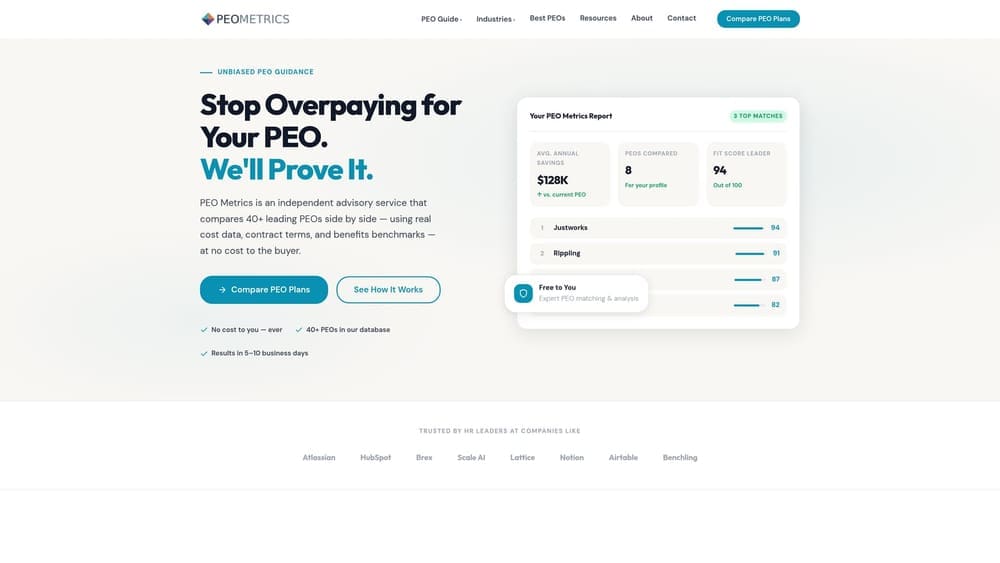
What it does well is put several PEOs next to each other before you sign. PEO pricing is rarely published in full, and structures differ in ways that are hard to see from separate sales calls. A side-by-side view of pricing and provider metrics makes those differences visible, which matters if you want to avoid paying for services you will not use.
- Side-by-side provider comparison, so you can weigh benefits, services, and terms in one view.
- Pricing analysis, to help you see what a quote includes and where fees sit.
- Detailed provider metrics that go beyond marketing pages.
- Selection guidance for teams that want a second opinion on a shortlist.
Integrations do not apply, since this is an advisory service. Setup is a conversation, usually owned by whoever leads HR or finance, and you do not migrate anything to use it.
The limits are plain. It is no help if you want a single product that handles payroll on day one, and PEO Metrics may receive vendor placement fees, so you should weigh its guidance with that in mind. For pricing, see the website.
Best for: SaaS teams that have not yet chosen a PEO and want a data-led shortlist.
2. Justworks
Justworks is a PEO aimed at small and growing businesses, which makes it a natural first stop for a seed or Series A software company with a young team and no HR department. It combines payroll, benefits administration, and compliance support behind an employee self-service platform.
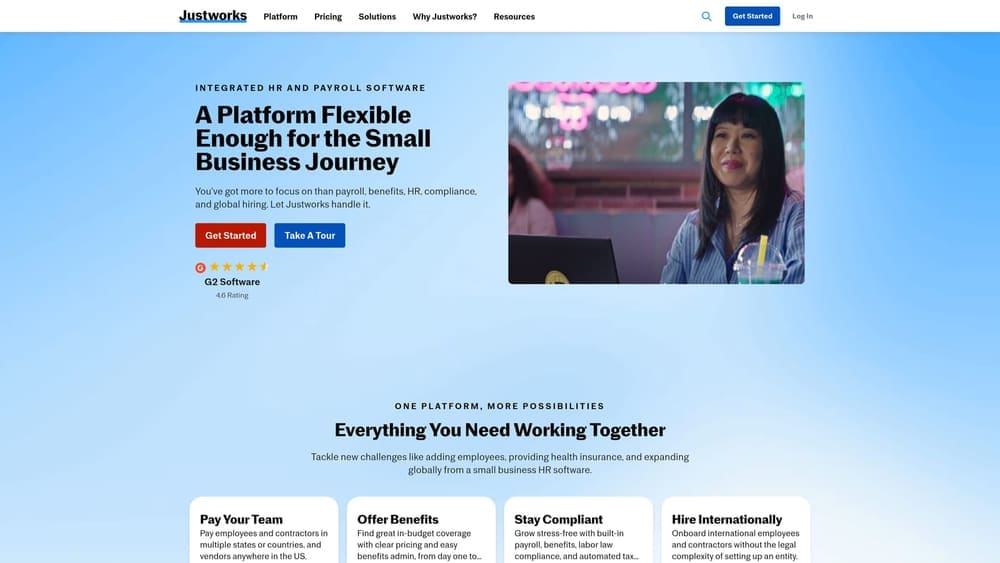
Its distinguishing trait on this list is the startup orientation. Where some providers lead with dedicated advisors or industry programs, Justworks leans on a self-serve experience, so a founder or office manager can handle most admin without a specialist. Confirm current plan structure on its site, since tiers and what they include have changed over time.
- Payroll and benefits administration in one system, so new hires are enrolled without a separate benefits portal.
- HR compliance support that reduces the need for in-house expertise on employment rules.
- An employee self-service platform where staff manage their own information and enrollments.
Check the vendor’s integrations page for the accounting, time, and HRIS tools your team uses, and confirm that your states are supported as of 2026. Setup is typically owned by a founder, finance lead, or first HR hire.
The open question is fit for larger or more complex benefit needs. If you expect to compete for senior engineers with richly tailored benefit packages, ask what plan options you will actually get at your headcount. Pricing is listed on the vendor’s site; confirm what moves it, which in PEOs is commonly headcount and plan selection.
Best for: Early-stage SaaS startups wanting a straightforward PEO.
3. TriNet
TriNet is an established PEO that organizes parts of its offering by industry, including a program for technology companies. For a SaaS business, the appeal is a package designed around tech-company concerns rather than a generic small-business bundle. Review the current technology program details directly with TriNet, since scope and eligibility can change.
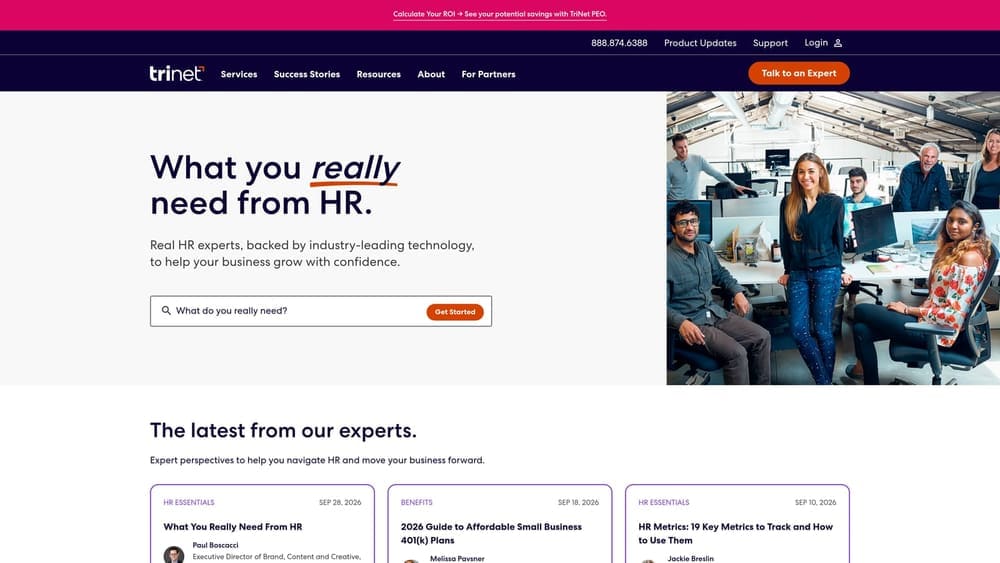
Beyond the industry framing, it covers the usual PEO functions: benefits and payroll administration and HR compliance support. The practical difference is in how the program is packaged and positioned, so ask the sales team to show you what the tech-focused version includes that the standard one does not.
- Industry-specific programs, so the package starts closer to what a software company needs.
- Benefits administration that handles enrollment and carrier relationships for you.
- Payroll administration across the states where your team works.
- HR compliance support to cover employment-law questions as you hire in new locations.
Ask about integrations with your finance and HR stack, as the vendor documents these on its own site. Setup usually involves an implementation team on the vendor side and an HR or finance owner on yours.
Pricing is quote-based, so you will not see a rate until you talk to sales, and it makes direct comparison harder. Confirm any minimum headcount or contract terms during the quote. That opacity is the main reason to compare it against other quotes before agreeing.
Best for: Tech companies that want an industry-tailored PEO program.
4. Insperity
Insperity is built around a service-heavy model, with assigned HR support rather than a mostly self-serve experience. For a SaaS company that has outgrown founder-run HR but is not ready to hire a full HR team, that human layer can stand in for one.
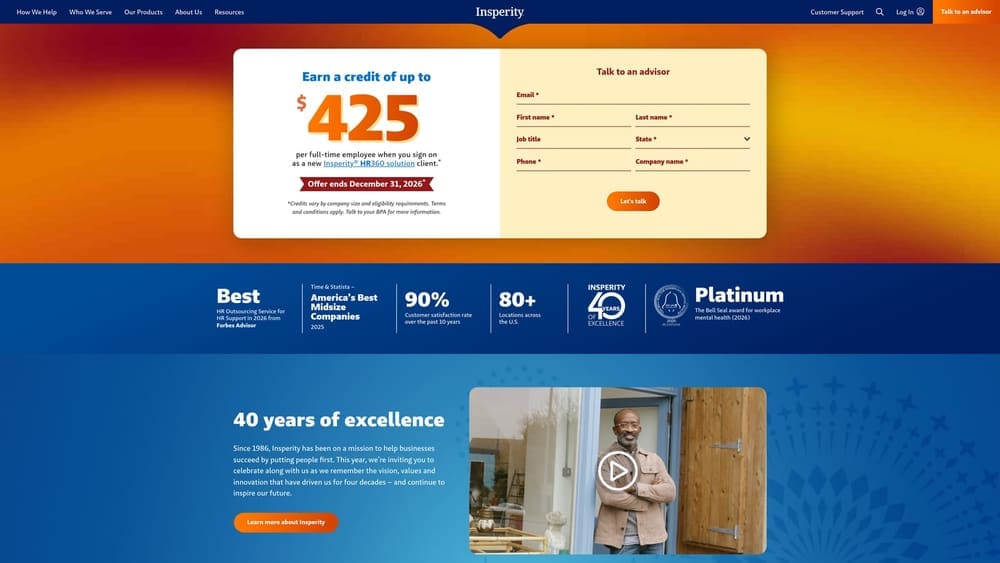
This is the sharpest contrast with Justworks and Gusto on this list. If your managers regularly face performance issues, terminations, or leave questions across multiple states, having a named advisor to call is different from searching a help center. Verify the current service model and how support is assigned to your account.
- Dedicated HR support, so managers get guidance on people issues from a consistent contact.
- Benefits administration covering enrollment and plan management.
- Payroll and compliance services to keep filings and employment rules handled.
- A workforce platform where employees and managers handle routine tasks.
Check Insperity’s site for current integrations and state coverage. Implementation is usually vendor-led, with your HR or finance lead as the day-to-day contact.
Pricing is quote-based. Confirm whether minimum headcount requirements apply, because fit for very small remote teams is something to check before you invest time in a proposal. A hands-on service model can also cost more than a self-serve alternative, so compare quotes line by line.
Best for: Scaling SaaS firms that want hands-on HR advisors.
5. Rippling PEO
Rippling offers PEO services within a broader platform that combines HR, IT, and payroll. For a software company, the draw is that employee onboarding, payroll, benefits, and device and app management can sit in one system rather than several.
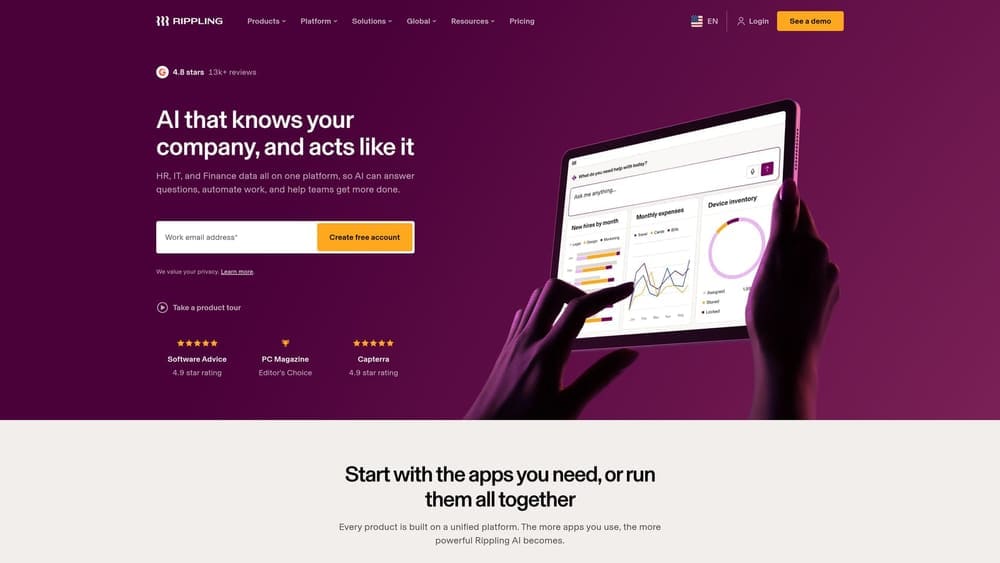
That is what separates it from the others here. Most PEOs focus on payroll, benefits, and compliance; Rippling pitches a single employee record that also drives IT provisioning. If your pain is onboarding an engineer in a new state and also needing their laptop and tool access ready, that matters. Verify how the PEO is structured within the platform and whether it is available to your company in 2026.
- A PEO tied to a unified HR platform, so employee data is entered once.
- Payroll and benefits handled alongside the PEO relationship.
- Device and app management through the platform, which links HR events to IT tasks.
Confirm which app integrations are supported on Rippling’s site, since the value of a unified system depends on connecting to what you already use. Setup effort depends on how many modules you adopt, and ownership may span HR and IT.
The caveat is that PEO requirements and pricing need to be checked directly; check pricing on its site. A platform with many modules can also be more than a small team wants to manage. Cost will typically vary with headcount and the modules you choose.
Best for: Tech-forward teams wanting HR and IT in one system.
6. Gusto
Gusto is first a payroll and HR platform, and it also offers a PEO option. That distinction matters: Gusto’s payroll-only plans are not a PEO, and they do not involve co-employment. Only the PEO option does, so confirm which product you are buying.
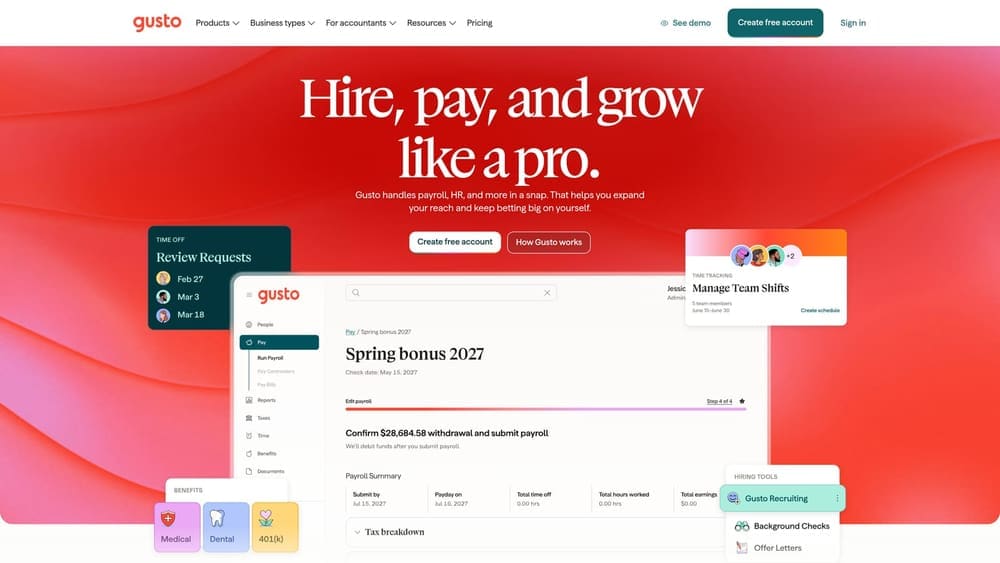
Its strength on this list is the path it offers. A very small SaaS team can start with payroll, benefits, and HR tools in a self-serve product, then consider moving to a PEO arrangement as headcount and complexity grow. Verify the current scope and availability of the PEO option, including state coverage, on Gusto’s site.
- Payroll that handles pay runs and tax filings for your team.
- Benefits administration so you can offer coverage without a separate broker setup.
- HR tools for onboarding and basic people management.
- A PEO option for companies that want pooled benefits and shared compliance responsibility.
Check the integrations page for accounting and other tools. Setup tends to be light enough for a founder or finance lead to manage.
Limitations: the PEO option’s scope may be narrower than a dedicated PEO’s, and it is worth asking how it compares with the specialists above. Pricing is on the vendor’s site and generally moves with headcount and the plan tier you choose.
Best for: Early-stage SaaS teams starting with payroll and considering a PEO later.
7. Paychex PEO
Paychex is a large payroll and HR provider that offers PEO services alongside payroll, retirement, and insurance. Confirm the current product naming, since Paychex packages its offerings under several names.
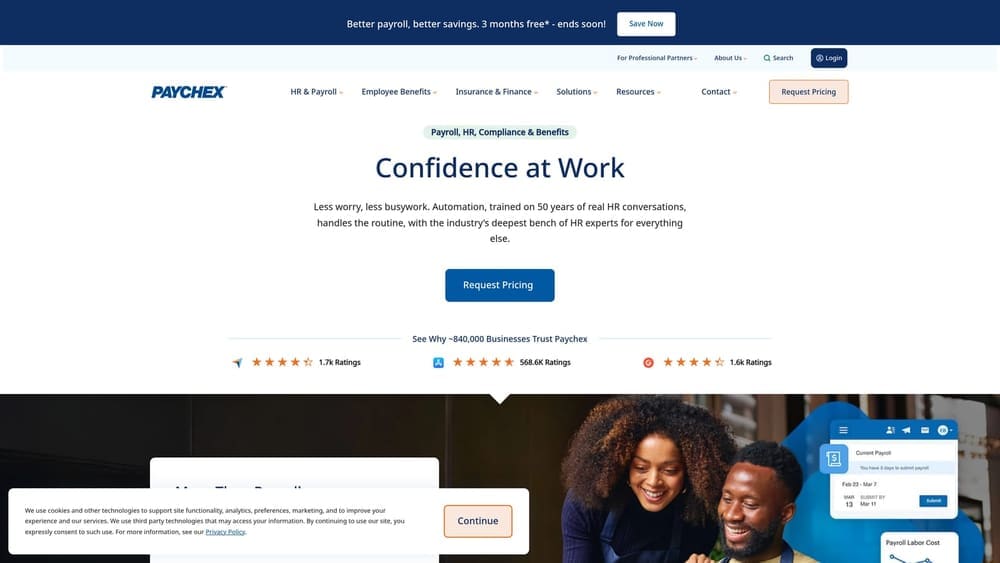
The differentiator is breadth from one vendor. If you would rather buy payroll, a 401(k), and insurance from the same company that runs your PEO, this consolidates those relationships. That can simplify vendor management, though it does not guarantee the best option in each category.
- PEO services covering co-employment, benefits, and compliance support.
- Payroll from a provider with long experience in the category.
- Retirement and insurance services that can sit under the same contract.
- HR support for day-to-day employee questions.
Ask which integrations are supported for your accounting and HR tools. Setup typically involves a vendor implementation team and a designated HR or finance owner on your side.
Fit for a tech company is the question to press. Ask to see the employee platform and how it handles remote, multi-state employees, since a broad service set does not guarantee a modern experience. Pricing is quote-based; confirm minimums and contract terms.
Best for: SaaS companies wanting one large vendor for multiple services.
8. ADP TotalSource
ADP TotalSource is ADP’s PEO offering, positioned for companies that want the infrastructure of a very large provider. Its weight is in compliance and benefits operations, which can matter once you employ people across many states and need consistent coverage.
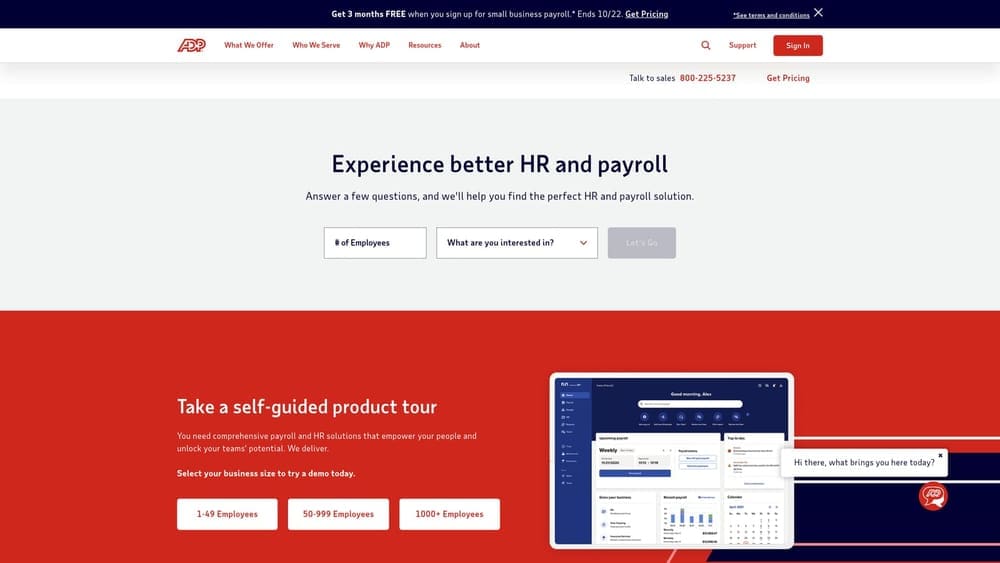
It is the most established-vendor option here, and the one most associated with larger employers. That can suit a SaaS company past its early stage, with a growing multi-state footprint and a benefits program that needs to scale. Verify current eligibility, covered states, and terms with ADP, as they can change.
- PEO services that move employment responsibilities into a shared arrangement.
- Benefits and payroll under one provider relationship.
- Compliance support backed by a large operation across jurisdictions.
Ask about integrations with your finance systems and HRIS. Setup is usually vendor-guided, with an HR or finance lead as your day-to-day owner.
Limitations to check: minimums, contract terms, and whether a small team is a good fit. A big vendor can feel less flexible than a startup-oriented one, so ask about contract length and exit terms. Pricing is quote-based and typically moves with headcount and benefit selections.
Best for: Larger, multi-state SaaS companies needing established compliance resources.
Matching a PEO to Your SaaS Stage and Setup
Three picks cover most situations. For a team that has not picked a provider, start with PEO Metrics to compare options on pricing and metrics before talking to sales. For a seed-stage company that wants simple administration, Justworks is the natural first look, while Gusto suits a team that wants payroll now and a PEO decision later. For a company with a growing multi-state workforce that wants advisor support, Insperity and ADP TotalSource are worth quoting, and Rippling fits if HR and IT consolidation is the priority. TriNet is worth a quote if an industry-tailored program appeals, and Paychex if you want bundled services.
Whatever you shortlist, confirm pricing, minimums, state availability, and contract terms directly with each vendor, since they change. For a broader comparison hub, see [LINK CHECK: PEO comparison hub]. PEO Metrics may receive vendor placement fees, and this article is informational, not legal, tax, or benefits advice.
Before you sign that PEO renewal, make sure you’re not leaving money on the table.
Many businesses unknowingly overpay because of bundled fees, hidden administrative markups, and contracts designed to limit flexibility. We give you a clear, side-by-side breakdown of pricing, services, and contract terms, so you can see exactly what you’re paying for and choose the option that truly fits your business.
