

If you run a software company, a PEO decision looks different from the one a ten-person retailer faces. Your payroll includes equity-adjacent pay, your team is probably spread across several states, and people will judge the HR platform the way they judge any other software you buy. This list is for founders, finance leads, and HR leaders at SaaS and technology companies. The providers were chosen on technology-company fit, multistate support, benefits flexibility, platform quality, and pricing transparency.
Vendor details change often, so confirm current pricing, minimums, state coverage, and product names on each official site before you decide. Where this article gives no price, none was verified as of October 2026.
Quick Comparison of the Eight Options
- PEO Metrics: best for SaaS teams that want quotes normalized before choosing; pricing on its website; the only option here that compares several PEOs on equal terms, though it is not a PEO itself.
- Justworks: best for early-stage startups that want a modern interface; pricing on its website; a self-serve employee experience with a published plan structure.
- TriNet: best for venture-backed tech companies wanting broad benefits; quote-based; a dedicated technology-industry offering.
- Insperity: best for growing SaaS firms that want an HR partner; quote-based; an assigned, hands-on HR advisory model.
- Paychex PEO: best for companies already on Paychex payroll; quote-based; ties into a broad payroll and HR product family.
- Rippling: best for tech teams wanting HR and IT in one system; pricing on its website; a single employee record spanning HR, IT, and payroll.
- Gusto: best for tiny teams needing payroll with light HR; pricing on its website; the simplest setup, but it is payroll software rather than a co-employment PEO.
- ADP TotalSource: best for larger SaaS companies wanting an established vendor; quote-based; the scale and carrier access of a major payroll vendor.
1. PEO Metrics
PEO Metrics is a comparison service, not a PEO. It helps businesses line up PEO providers side by side, with provider metrics and pricing analysis, so you can see what each option actually costs and covers before you commit. It is built for buyers who would otherwise collect three or four quotes in different formats and try to reconcile them by hand.
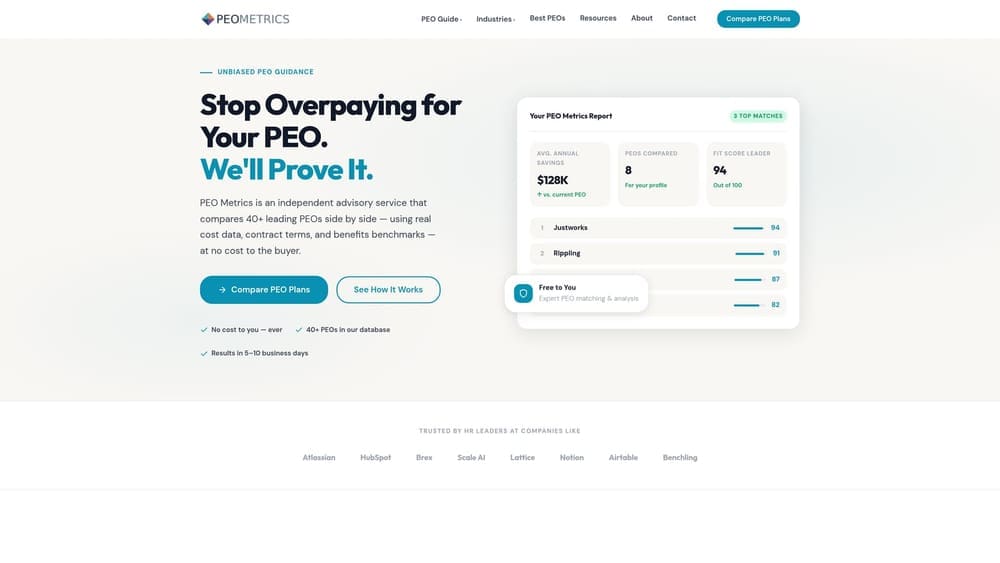
That reconciliation is where SaaS buyers get burned. One quote bundles administration into a per-employee fee, another prices it as a percentage of payroll, and a third separates out benefits markups. Putting them on equal terms is the service’s main contribution, and it is the one thing on this list that no PEO will do for you, since each PEO has an interest in its own quote.
- Side-by-side PEO comparisons that show differences in services and contract terms in one view.
- Pricing analysis that exposes bundled fees and administrative markups.
- Detailed provider metrics, so you can weigh platform and service factors, not only cost.
- Consultative guidance if you want a person to talk through trade-offs, such as multistate coverage or benefits flexibility.
Integrations don’t apply, because there is nothing to connect to your payroll or HRIS. Setup is a conversation about your headcount, states, and benefits priorities, and whoever owns HR or finance at your company typically runs it.
The limits are plain. PEO Metrics does not run payroll, administer benefits, or provide HR services. You still need to pick and implement a provider afterward. It may also receive vendor placement fees, so you should factor that into how you weigh any recommendation, and it is one reason to check vendor details independently on their official sites. Pricing for the service itself is listed on the website.
Best for: SaaS teams that want quotes normalized before choosing a PEO.
2. Justworks
Justworks is a PEO that leads with software. It is aimed at small and growing companies that want payroll, benefits, and compliance handled through a clean employee-facing interface rather than a phone-and-email service model.
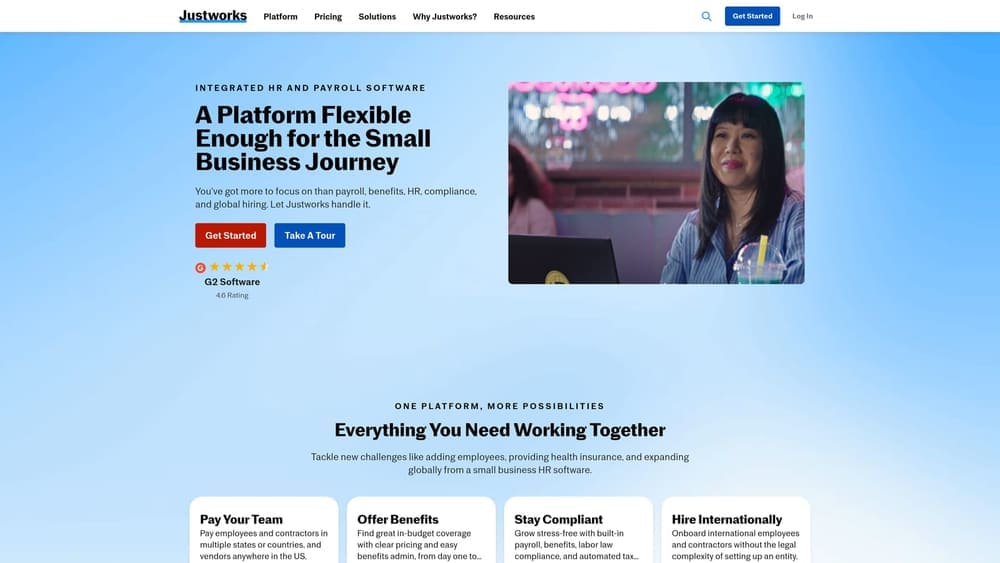
What it does well compared with the rest of this list is the self-serve experience. Employees can handle much of their own onboarding, benefits enrollment, and paperwork in the platform, which matters to engineering-heavy teams that expect HR tooling to feel like other modern software. Its plan structure is also published on its site, so you can form a rough cost picture before talking to sales, which is rarer among PEOs.
- Payroll processing built into the same platform employees use for benefits and documents.
- Benefits administration, so open enrollment and changes don’t run through a separate broker portal.
- Compliance support that covers employment-law and filing obligations in the states where you have staff.
- An employee self-service platform that reduces routine HR questions landing on a founder.
Setup is generally led by whoever handles operations or finance, and for a small team it is not a heavy project. Check its integration list on the official site against your accounting and HRIS tools, since this article has not verified specific connections.
The limitation to test is fit at the edges. Larger companies or those with highly customized benefits needs should confirm that plan options will cover them, and any company with unusual equity or multistate payroll situations should ask how those are handled. Pricing details are on Justworks’ website, and cost generally moves with headcount and the plan you choose, so confirm current figures there.
Best for: Early-stage startups wanting a modern interface.
3. TriNet
Technology companies are one of the segments TriNet markets to directly. It is an established PEO with industry-focused offerings, and its technology-industry package is the reason it sits on this list. If you want a provider that already thinks in terms of software companies, this is the clearest example here.
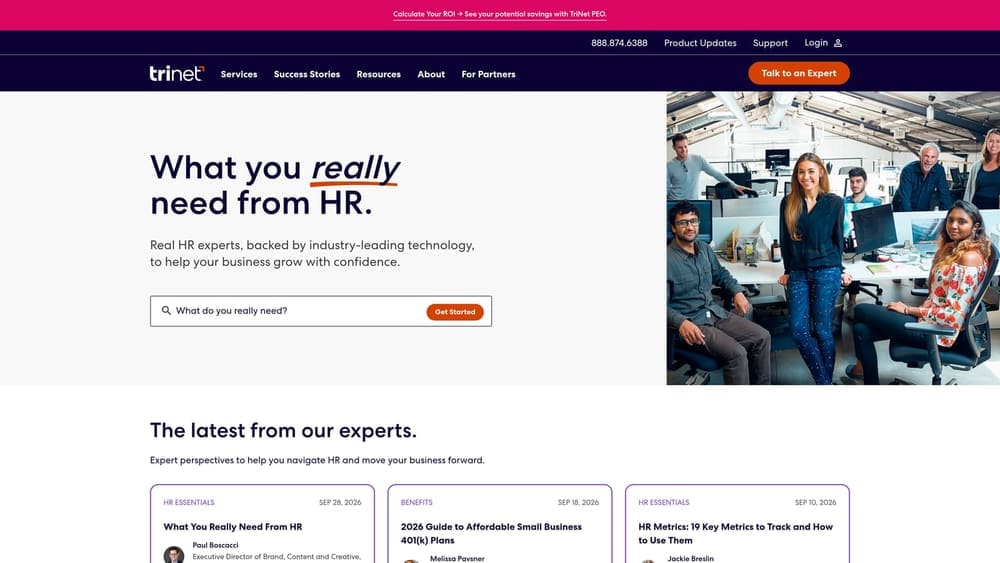
Most PEOs sell one general model; TriNet’s pitch is that benefits, risk, and compliance packages can be shaped around an industry. For a venture-backed company that is hiring quickly and wants a wide benefits menu to compete for engineers, that orientation can matter more than a slick interface.
What you get
- Industry-specific plans, including a technology-focused offering, so the package starts closer to what a software company needs.
- Benefits access intended to support competitive packages as headcount grows.
- Payroll processing run through the PEO relationship.
- Risk and compliance support, useful when hiring across multiple states.
What to check
Pricing is quote-based, which means the number you see depends on headcount, benefits selections, and how fees are structured. That is exactly where quotes become hard to compare, so ask for fees broken out. Contract terms deserve a careful read, including length and exit conditions, and you should confirm whether a very small team is a good fit, since this is not the lightest-weight option. Confirm integrations with your own stack on the official site; this article has not verified them.
Implementation usually involves HR or finance working with an onboarding contact, so budget some weeks of attention rather than a same-day signup.
Best for: Venture-backed tech companies wanting broad benefits.
4. Insperity
Insperity sits at the service-heavy end of this list. Insperity is a large PEO that pairs its payroll, benefits, and compliance offerings with assigned HR support, so you have a named advisor rather than only a portal.
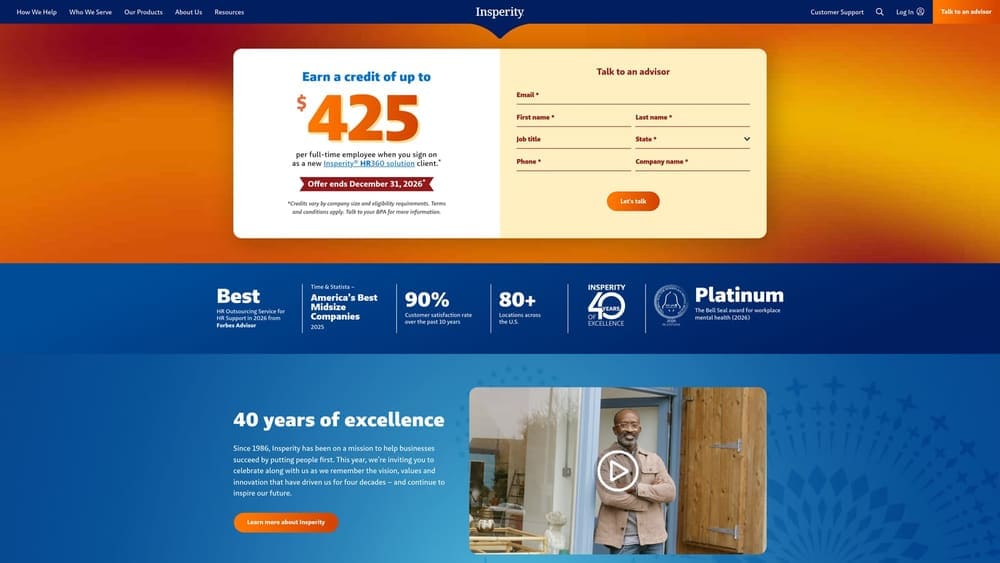
That model is the whole point. If your company has no dedicated HR person and a founder is currently fielding employee-relations questions, termination paperwork, and handbook updates, an assigned advisor can absorb real work. Software-first competitors on this list lean the other way, expecting employees and administrators to resolve more themselves.
Where it is strongest
- HR advisory support for situations like performance issues, policy questions, and employee relations.
- Payroll handled within the PEO arrangement.
- Benefits offered through the PEO’s plans.
- Compliance support to keep up with employment obligations as you add states.
The trade-off is the same feature. Teams that want to self-serve everything and treat HR as a software category may find a service-led relationship heavier than they need, and may be paying for advisory capacity they don’t use. Weigh that against your actual headcount in HR, not your hopes for one.
Pricing is quote-based, so what you pay depends on headcount, benefits choices, and how service fees are structured. Ask what the advisory model includes versus what costs extra. Check integrations on the official site, since this article has not verified specific connections. Day to day, an HR lead or office manager typically works with the assigned representative, and onboarding is a guided project rather than a self-serve one.
Best for: Growing SaaS firms wanting an HR partner rather than self-service.
5. Paychex PEO
Companies that already run payroll through Paychex have a natural reason to look at Paychex PEO. It is a PEO offering from a large payroll provider, which means it connects to a wider family of payroll and HR products you may already know.
The distinguishing value here is continuity. Moving from payroll-only service into a PEO inside the same vendor can reduce the number of systems and contacts involved, and it gives you a single party responsible for the payroll side. That is a different pitch from specialist PEOs, which are built around co-employment from the start.
- Payroll tied to the vendor’s broader platform, which helps if you already use it.
- Benefits offered through the PEO arrangement.
- Compliance support for employer obligations.
- HR services to cover the administrative work a small team would otherwise handle.
The question to press on is fit for a remote, multistate technology team. Confirm which states are covered, how multistate payroll registration is handled, and how the platform deals with the pay structures software companies use. This article has not verified those points, so get them in writing. Because a PEO changes who the employer of record is for certain purposes, also confirm exactly how the PEO product differs from standard Paychex payroll you may already have.
Pricing is quote-based and typically depends on headcount, benefits selections, and fee structure. Ask for fees itemized so you can compare against others. Check the official site for integrations. Implementation is usually led by HR or finance with vendor onboarding support, and an existing Paychex relationship may shorten the data-migration step.
Best for: Companies already using Paychex for payroll.
6. Rippling
Few vendors on this list connect HR to IT the way Rippling does. It is a unified platform covering HR, payroll, and device and app management, with PEO services available alongside its core software. The current PEO structure should be verified on its site, because how it is offered and how it differs from the standard product can change.
Its distinctive feature is the single employee record. When someone is hired, the same record can drive payroll setup, benefits, laptop provisioning, and app access, and when they leave, access can be removed from the same place. For a software company that handles customer data and cares about offboarding hygiene, that overlap between HR and IT is the reason to consider it.
- HR and payroll working from one employee record, which cuts re-entering data between systems.
- Device and app management, so IT onboarding and offboarding follow HR events.
- PEO services for companies that want co-employment, where available.
- Benefits administration inside the same platform.
The caution is that Rippling is a broad product with modular parts, and not every module is a PEO feature. Ask exactly what you get under the PEO arrangement versus the non-PEO software, which states are supported, and what that does to benefits options and cost. Do not assume the two are interchangeable.
Pricing is on the Rippling website, and it generally depends on which modules you choose and how many employees you have, so cost can climb as you add IT and other modules. Check integrations on the official site. Setup is bigger than for a payroll-only tool, and often involves HR, IT, and finance together, so assign an owner before you start.
Best for: Tech teams wanting HR and IT in one system.
7. Gusto
This is the entry that needs the clearest label. Gusto is payroll and HR software for small businesses, and it is primarily payroll software, not a full co-employment PEO. Verify on its site whether any PEO-like product is offered today, and treat it as a different category if not.
PEO, ASO, EOR, and payroll-only
The distinction affects your risk and your options. A PEO enters a co-employment relationship: it becomes a co-employer for certain purposes, and typically pools employees for benefits and handles payroll tax filings under its own account. A CPEO is a PEO certified by the IRS, which you can verify on the IRS CPEO list. An ASO provides administrative services without co-employment. An EOR is the legal employer of a worker, often used to hire in places where you have no entity. Payroll-only tools run pay and filings while you remain the sole employer, and that is where Gusto sits.
For a very small SaaS team, payroll-only plus a separate benefits broker is a legitimate alternative to a PEO, and it is worth pricing against any PEO quote.
- Payroll that is quick to set up for small teams.
- Benefits administration, including connecting to plans you source separately.
- Onboarding tools to collect new-hire paperwork.
- Time tracking for hourly or mixed workforces.
The limitation follows from the category: you remain the employer for all purposes, so compliance responsibility and benefits purchasing stay with you, and you won’t get pooled-buying leverage from co-employment. Check the official site for integrations and state coverage. Pricing is on the website and typically depends on plan tier and headcount. Setup is light and is usually run by a founder or office manager.
Best for: Tiny teams needing payroll with light HR.
8. ADP TotalSource
Scale is the argument for ADP TotalSource, ADP’s PEO offering. It comes from one of the largest payroll vendors, and the pitch rests on that size: established infrastructure, broad carrier relationships, and a long operating history. Confirm current product details on the official site, since ADP offers multiple HR and payroll products and you want the PEO specifically.
Compared with the software-first options above, this is a more conventional enterprise-vendor experience. That can be reassuring for a company approaching a financing round, an audit, or a headcount level where investors and finance teams want a recognizable provider behind payroll and benefits.
- Payroll run by a large, established processor.
- Benefits access that draws on the vendor’s carrier relationships, which can matter for plan variety.
- Compliance support for employer obligations as you grow across states.
- HR support for day-to-day employee questions and administration.
The caution is fit and entry terms. Ask about minimum company size or headcount, which states are covered, and how contracts and renewals work. This article has not verified those points, and they are the details most likely to rule a vendor in or out. A very young company might also find the experience less modern than the software-first alternatives, so ask for a demo of the employee-facing platform and judge it with your own team’s expectations.
Pricing is quote-based, generally shaped by headcount, benefits selections, and fee structure, so request an itemized quote. Check integrations on the official site. Implementation tends to be a managed project led by HR or finance with vendor support, and it takes longer than a self-serve signup.
Best for: Larger SaaS companies wanting an established vendor.
Matching the Right Option to Your Stage
A few situations tend to point in clear directions. If you’re an early-stage startup that values a modern employee experience, Justworks is the most natural place to start. A venture-backed scale-up hiring fast and competing on benefits should look hard at TriNet’s technology offering, with ADP TotalSource as the established-vendor alternative. A remote team spread across many states should ask every provider for written state coverage, and Rippling is worth a look if device and app management matter as much as HR. If all you need is payroll with light HR, Gusto, possibly with a benefits broker, may be enough, and you can price that against any PEO quote to see whether co-employment pays for itself. It doesn’t always.
Whichever way you lean, quotes from different PEOs rarely match in structure, and listed prices aren’t always final. PEO Metrics may receive vendor placement fees, so verify details with each provider directly as well.
Before you sign that PEO renewal, make sure you’re not leaving money on the table. Many businesses unknowingly overpay because of bundled fees, hidden administrative markups, and contracts designed to limit flexibility. We give you a clear, side-by-side breakdown of pricing, services, and contract terms, so you can see exactly what you’re paying for and choose the option that truly fits your business.
