

If you run crews, clinics, salons, or technician routes across several states, compliance changes every time you cross a state line. Payroll tax registrations, wage and hour rules, paid leave laws, and workers’ comp class codes all follow the work location. This list is for the owner or HR lead who is weighing whether a PEO can carry part of that load.
The tools were chosen because they either compare PEOs or publicly market multi-state compliance support. They were judged on state registrations, workers’ comp handling, local rules, and how honestly the co-employment model’s limits are described. Vendor details change, so confirm everything in writing before you rely on it.
Quick Comparison of Multi-State PEO Compliance Options
- PEO Metrics: best for buyers comparing several PEOs on state coverage and cost; pricing on its website; the only independent side-by-side comparison on this list, though it is not a PEO.
- Insperity: best for mid-sized multi-location employers wanting an assigned HR advisor; quote-based; markets a hands-on HR representative model.
- TriNet: best for employers in a vertical it specifically packages for; quote-based; industry-focused plan packaging.
- Justworks: best for smaller multi-state teams wanting price transparency; pricing on its website; publicly listed pricing tiers.
- Paychex PEO: best for businesses already using or considering Paychex payroll; quote-based; a path from payroll-only products into a PEO inside one vendor.
- ADP TotalSource: best for larger multi-state employers wanting an established provider; quote-based; backed by ADP’s large payroll operation.
- Vensure HR: best for small and mid-sized service employers; quote-based; positioned around smaller employers, with a brand structure you should confirm.
- Rippling PEO: best for tech-forward employers wanting HR and IT together; quote-based; one system of record across HR, payroll, and IT.
1. PEO Metrics
PEO Metrics is a PEO comparison and consulting service, not a PEO. It doesn’t co-employ your workers, run payroll, file taxes, or administer ongoing compliance. What it does is help you compare several PEO providers on one set of metrics and pricing analysis before you commit, which matters when your question is whether a given PEO actually covers the states where your locations sit.
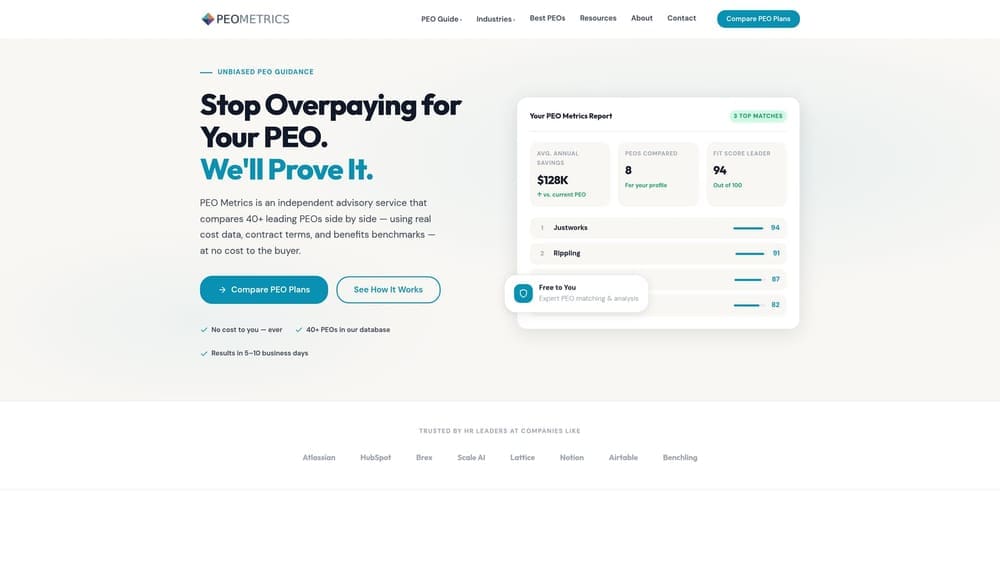
That independence is its main strength on this list. Every other entry is a vendor describing itself. A side-by-side view lets you put state coverage, fees, and contract terms next to each other, so you aren’t comparing a polished sales deck to a quote built on different assumptions.
- Side-by-side provider comparison, so you see differences in coverage and terms in one place.
- Pricing analysis, which shows what you’d pay across providers rather than one quote at a time.
- Detailed provider metrics to test against your own location footprint.
- Selection guidance for working out which questions to put to each provider.
Use it to build your testing checklist. Ask every PEO which states it serves, who registers you for state payroll tax accounts, how workers’ comp class codes are assigned by location, and who bears liability if a filing is wrong. Check the IRS list of certified PEOs rather than assuming a provider is one. Also confirm in writing whether the product is a true PEO, an ASO (where you stay the sole employer of record), or payroll only.
Limitations are plain. It can’t file anything for you, and you still need a PEO or other provider for execution. PEO Metrics may also receive vendor placement fees, so treat it as a comparison aid and verify provider details directly. Integrations aren’t applicable, since it’s an advisory service. Pricing details are on its website.
Best for: Buyers who want to compare several PEOs on state coverage and cost before choosing.
2. Insperity
Insperity is a PEO that markets HR compliance support alongside assigned HR representatives. For a multi-location employer, the appeal is having a named person to call when a new state, a new hire type, or a leave question comes up, rather than a general support queue. Verify the current wording of that model on its site, since service structures get repackaged.
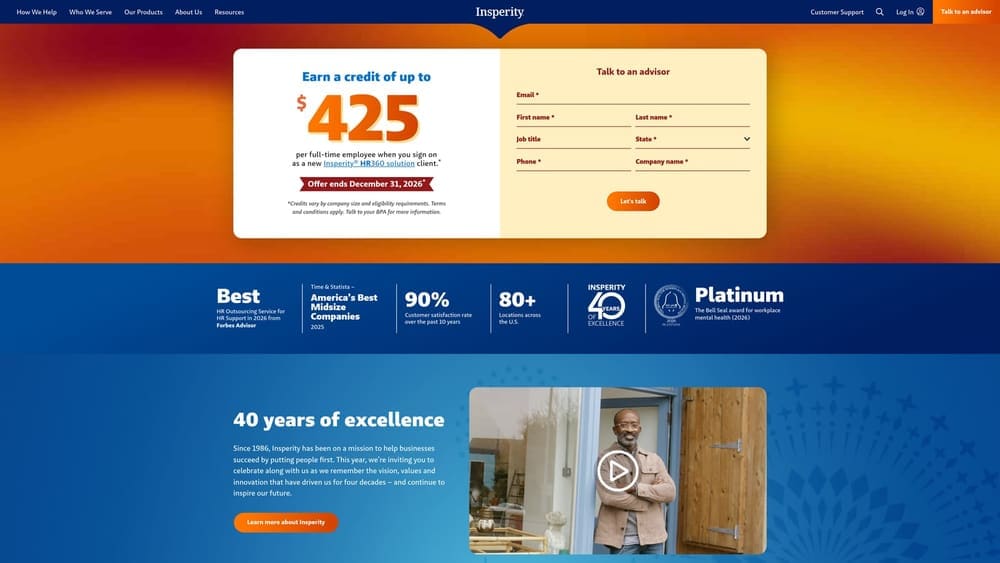
Its distinguishing angle against this list is that advisory emphasis. Several competitors lean on platform tools or scale; Insperity’s pitch leans on people.
What you get
- PEO services under a co-employment arrangement, covering shared employer responsibilities as defined in your contract.
- HR advisory support, useful when location managers keep asking different versions of the same question.
- Payroll and tax administration, which should include the state registrations tied to where your employees work. Ask for the state list in writing.
- Benefits administration, so one plan structure can cover employees in different places.
Fit and limits
Integrations are listed on its website, so check them against your scheduling, timekeeping, and accounting systems. Setup usually involves an onboarding process with the provider, and day-to-day administration typically sits with an HR lead or owner who works with the assigned representative. Confirm the implementation timeline for a multi-state rollout.
Minimum size requirements may apply, so verify eligibility before investing time in a proposal. A very small crew may not qualify. Advisory models also depend on who is actually assigned to you, so ask what experience that representative has with your industry and states.
Pricing is quote-based. Expect cost to move with headcount, benefits selections, and the states you operate in. Get fees itemized so you can see what’s service and what’s markup.
Best for: Mid-sized multi-location employers wanting an assigned HR advisor.
3. TriNet
TriNet is a PEO that offers industry-focused plans across a range of business verticals. The idea is that a provider packaging services for your kind of business may already account for common issues, such as the wage rules and risk profile that come with field or client-facing work.
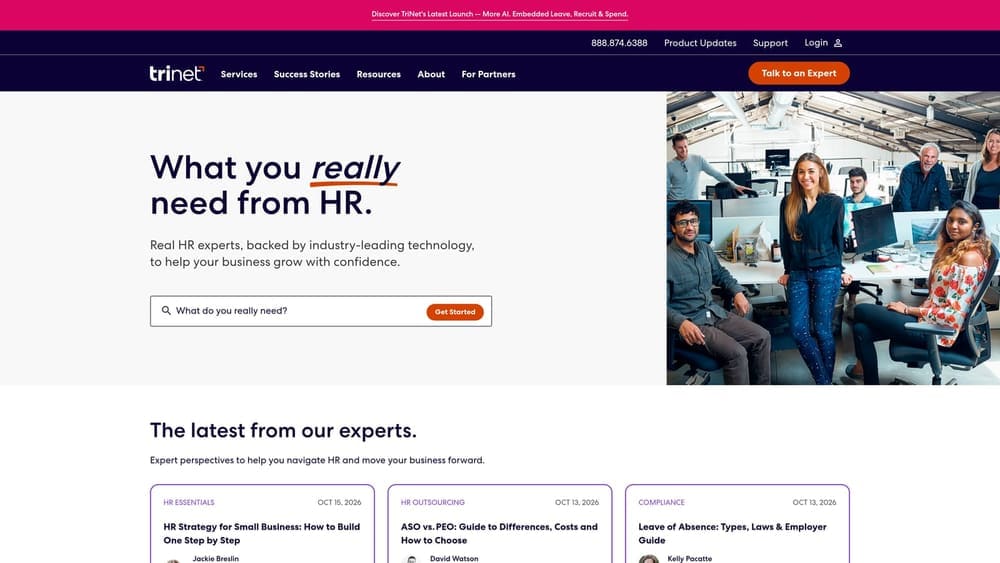
That vertical packaging is its distinguishing feature here. Confirm which verticals it currently packages and whether yours is one of them, because the offering can change. If your business is a salon group or home services company, ask whether there’s a specific plan for it and what differs from a generic plan.
- PEO services that place certain employer responsibilities under the co-employment agreement.
- Industry-specific plans, which can save you from paying for features your type of business doesn’t use.
- Payroll and tax support, including multi-state filings where your employees are located. Verify the states served.
- Benefits access, giving staff in different locations a common plan menu.
Integrations are detailed on its website, and you should test them against the tools your locations already use. Setup effort depends on how many states and entities are being migrated. Plan for someone internal, usually HR or finance, to own the data cleanup and approvals during onboarding, then manage day-to-day requests.
Limits: eligibility and size limits need to be checked, and pricing isn’t public. If your business falls outside the verticals TriNet packages, the main advantage fades and you’re comparing it as a general PEO. Also ask how workers’ comp is handled for your specific class codes, since packaging doesn’t guarantee how each state is treated.
Pricing is quote-based. What moves it: headcount, the plan selected, benefits choices, and state mix. Request a fee schedule showing admin fees separately from benefits and insurance costs.
Best for: Employers in a vertical TriNet specifically packages for.
4. Justworks
Justworks is a technology-led PEO known for publishing its pricing tiers. For a buyer who is tired of quote forms, that openness is the draw. Check the pricing page for the current tiers and the date they apply, since published rates move.
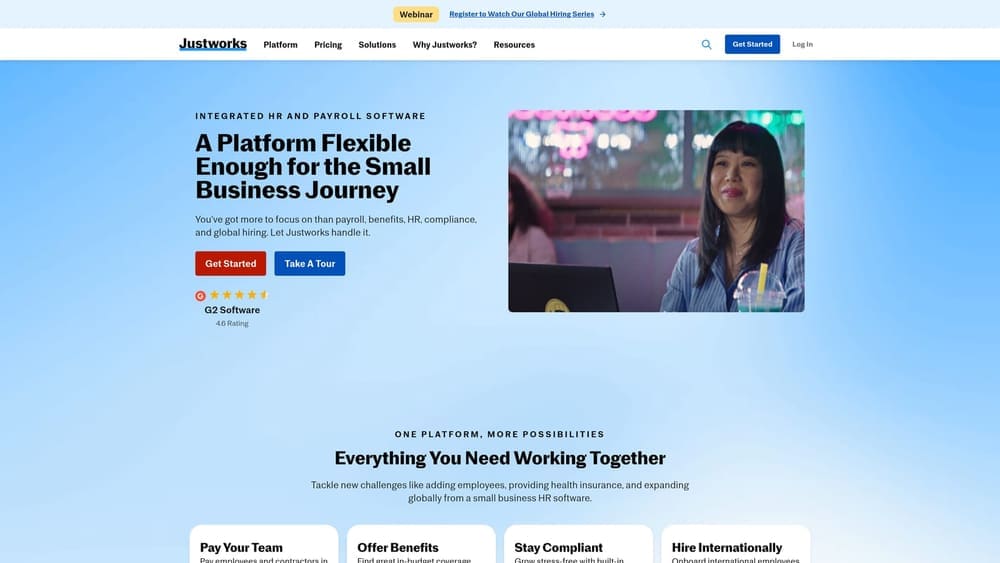
No other provider on this list leads with public pricing, so you can estimate cost before a sales call. That helps when you’re deciding whether a PEO is even affordable for a small multi-state team.
- PEO services under co-employment, with shared employer responsibilities defined in the agreement.
- An online platform where employees and managers handle common tasks themselves, reducing admin back-and-forth.
- Payroll and tax filing, which should cover the states where your people work. Confirm the list of supported states.
- Benefits administration through one enrollment flow.
Integrations are listed on its website; confirm those for time tracking and accounting. Setup is built around its online platform, so the person running it day to day is often an office manager or HR generalist working mostly in software.
That self-service design is also the limitation. It may suit buyers who are comfortable handling questions themselves better than those who want hands-on advisory, so verify what support is included. Because published tiers are simpler, ask what’s outside them: state-specific issues, unusual workers’ comp classes, or complex scheduling rules. Also check whether any size or industry restrictions apply to your business.
Pricing is on its website, and you should verify it as of the date you’re evaluating. Costs typically move with headcount and plan choice, plus whatever benefits you select.
Best for: Smaller multi-state teams wanting price transparency.
5. Paychex PEO
Paychex PEO is the PEO offering inside Paychex’s wider payroll and HR product family. The naming matters here: Paychex sells payroll-only products as well, and those are not the same thing as a PEO. Confirm exactly which product you’re being quoted.
The distinguishing angle is the upgrade path. If you already run payroll with Paychex, or expect to start there, you may be able to move into a PEO without changing vendors. Verify how that transition works and what changes legally, since moving to a PEO changes who is responsible for certain employer functions.
- PEO services with co-employment responsibilities defined by contract.
- Payroll, which can remove a vendor handoff if you’re already a Paychex customer.
- Benefits administration across your locations.
- HR compliance support, which you should test by asking how it handles a state-specific leave or wage question.
Integrations are on its website, and existing Paychex users should check whether current connections carry over. Setup effort is lighter in principle for current customers but still involves a conversion, so ask for a written timeline. Day-to-day, an HR lead or owner usually works with the vendor’s service team.
Limits: pricing is quote-based, and you need to confirm minimums and whether what you’re being offered is a PEO or a payroll-only package. Bundles can blur lines, so get the service scope in the contract rather than the brochure. Ask which states are covered for tax filing and workers’ comp, and who holds liability for errors.
Pricing is quote-based. Headcount, benefits, and the number of states influence the quote, so ask for fees itemized.
Best for: Businesses already using or considering Paychex payroll.
6. ADP TotalSource
ADP TotalSource is ADP’s PEO offering. It is separate from ADP’s payroll-only and ASO products, and that distinction is worth pinning down early. An ASO leaves you as the sole employer of record, while a PEO shares employer responsibilities. Ask any ADP rep which product the quote covers.
What stands out on this list is the scale of ADP’s multi-state payroll infrastructure. For a business spread over many states, an established provider with broad payroll operations may reduce the risk of being the first multi-state client a vendor has seen. Treat that as something to verify, not assume, by asking for the specific states served.
- PEO services under a co-employment agreement.
- Payroll tax administration, which should cover registrations and filings in the states where you employ people.
- Benefits access for employees across locations.
- HR compliance support, which you can test with a real scenario from one of your states.
Integrations are listed on its website, and larger employers should check them against HRIS, scheduling, and accounting tools. Setup for a multi-state employer can be a bigger project, so ask about implementation resources and who inside your business owns it, typically HR or finance.
Limits: pricing is quote-based and eligibility rules need verification. A very small business may not fit, and a larger vendor may offer less flexibility on contract terms, so read renewal and termination clauses closely. Scale doesn’t remove your own duties, and you should still confirm workers’ comp class codes by location.
Pricing is quote-based. Headcount, benefits choices, and state mix are the main drivers, and fees should be broken out.
Best for: Larger multi-state employers wanting a large established provider.
7. Vensure HR
Vensure HR is a PEO provider, and its brand structure deserves a careful look. Some providers operate under several names or entities, and the one on your contract is the one that carries the obligations. Confirm on its official site which entity would be your PEO, and check that against the IRS list of certified PEOs if CPEO status matters to you.
It positions itself toward small and mid-sized employers, which may suit a service business with a handful of locations. Verify current positioning, because it can shift with growth and acquisitions.
- PEO services with shared employer responsibilities under contract.
- Payroll, including tax filings in the states where employees work. Confirm the list.
- Workers’ comp support, which is worth probing for class code assignment by location and who handles audits and claims.
- Benefits for staff across your sites.
Integrations are on its website; check them against your timekeeping and accounting tools. Setup effort and who runs it day to day depend on the service model you’re placed in, so ask who your point of contact would be and what happens when that person changes.
Limits: brand and offering details need confirmation before you rely on anything here, and if you can’t get a clear answer on who the contracting entity is, treat that as a signal to keep looking. State coverage and workers’ comp terms should be verified in writing.
Pricing is quote-based. Headcount, benefits, workers’ comp class codes, and states influence what you’re offered. Ask for a written breakdown of admin fees versus pass-through costs.
Best for: Small and mid-sized service employers, once the provider’s structure and coverage are confirmed.
8. Rippling PEO
Rippling PEO is a PEO offered alongside Rippling’s HR, payroll, and IT platform. If you want one system of record for employee data, payroll, and the devices and apps your staff use, this is the entry built around that idea. Verify the scope, since what’s included in the PEO versus the broader platform may differ.
That unified approach is the distinguishing factor. Employee data entered once can flow into payroll, benefits, and device or app access, which can matter when you have technicians or clinic staff coming and going across locations.
- PEO services under co-employment, with responsibilities set in the agreement.
- A unified HR and payroll platform, which cuts duplicate data entry between systems.
- Device management, handy if you issue phones or tablets to field crews.
- Benefits administration, so enrollment sits in the same system.
Integrations are listed on its website, and you should check them against scheduling and accounting tools. Setup is software-driven, so whoever runs it day to day should be comfortable administering a platform, often an HR lead working with IT or an operations manager. If you don’t have anyone like that, ask what the vendor provides.
Limits: state coverage and pricing structure need to be verified, and a platform strength doesn’t tell you how each state’s registrations or workers’ comp classes are handled. If you don’t need IT management, you may be paying attention to features you won’t use. A buyer wanting a consultative HR advisor should ask how support works.
Pricing is quote-based. Headcount, modules selected, benefits, and state mix are the likely drivers, so ask for line items.
Best for: Tech-forward multi-location employers wanting HR and IT in one platform.
Matching a Provider to Your Multi-Location Situation
Three picks stand out depending on where you are. If you haven’t shortlisted anyone, start with PEO Metrics, since comparing several PEOs on state coverage and cost before you talk to sales teams keeps you from anchoring on the first quote. If you want an assigned advisor for a mid-sized footprint, Insperity is the one to test. If price transparency and a software-first setup matter for a smaller team, Justworks is the natural comparison point.
Others fit narrower cases. Paychex PEO suits existing Paychex payroll users, ADP TotalSource suits larger employers wanting an established name, TriNet suits a vertical it packages for, and Rippling suits teams that want HR and IT together. Vensure HR may fit smaller service employers once its structure is confirmed.
With any provider, get state coverage, workers’ comp terms, and liability allocation in writing, and check the IRS list if CPEO status matters. A PEO shares employer duties; it doesn’t erase yours.
Before you sign that PEO renewal, make sure you’re not leaving money on the table. Many businesses unknowingly overpay because of bundled fees, hidden administrative markups, and contracts designed to limit flexibility. We give you a clear, side-by-side breakdown of pricing, services, and contract terms, so you can see exactly what you’re paying for and choose the option that truly fits your business. PEO Metrics may receive vendor placement fees. Don’t auto-renew. Make an informed, confident decision.
