
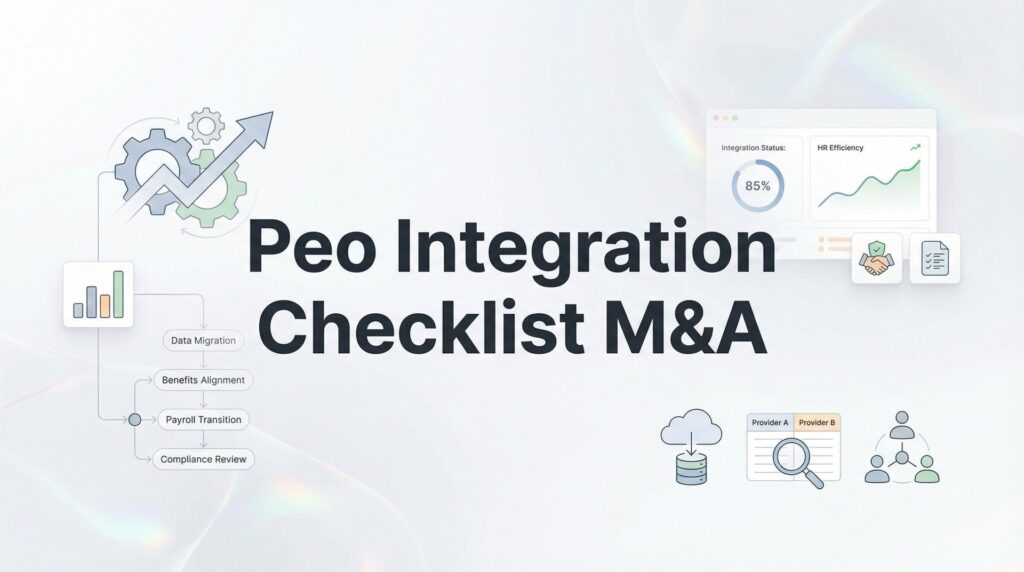
M&A deals create HR chaos fast. When you’re acquiring a company—or being acquired—the PEO situation becomes one of those urgent-but-overlooked problems that can derail employee experience and compliance overnight. Maybe the target company uses a different PEO. Maybe they have no PEO at all. Maybe you’re consolidating three entities onto one platform.
Whatever the scenario, you need a clear integration checklist before Day 1 hits.
The problem? Most M&A teams treat PEO integration as post-close cleanup. They focus on the big financial models and strategic synergies, then scramble to figure out payroll and benefits after the deal closes. That’s when you discover the target company’s PEO contract has a 90-day termination clause, their workers’ comp mod rate is significantly higher than yours, or their employees have benefit packages you can’t legally change for six months.
This guide walks through the specific steps to evaluate, consolidate, or transition PEO relationships during M&A—covering due diligence flags, timeline realities, and the cost decisions that actually matter. No generic M&A advice here—just the PEO-specific integration moves that prevent expensive surprises.
1. Audit Both Entities’ PEO Arrangements Before LOI
The Challenge It Solves
You can’t make informed integration decisions without understanding what you’re actually acquiring. Hidden in those PEO contracts are termination clauses, fee structures, claims history, and compliance issues that can materially affect deal valuation and post-close execution timelines.
Many acquirers discover these details too late—after they’ve already committed to closing dates and integration plans that don’t account for contractual realities.
The Strategy Explained
Request complete PEO documentation during due diligence, not after. This means current contracts, recent invoices showing actual fees paid, workers’ compensation loss runs, benefits census data, and any compliance violations or state audit findings from the past three years.
You’re looking for deal-affecting issues: contracts with auto-renewal clauses that lock in unfavorable terms, unusually high administrative fees that suggest the target company overpaid, workers’ comp claims history that will affect your combined mod rate, or compliance gaps that create immediate post-close liability. A comprehensive PEO due diligence checklist helps ensure you don’t miss critical verification areas.
Pay particular attention to termination notice requirements. If the target company’s PEO requires 90 days notice and you’re planning a 60-day integration, you’ve got a problem that affects your timeline and potentially your cost structure.
Implementation Steps
1. Include PEO contract review in your initial due diligence request list—don’t wait for HR integration planning to start asking questions.
2. Request itemized invoices from the past 12 months to understand actual costs beyond quoted rates, including per-employee fees, benefits administration markups, and any usage-based charges.
3. Obtain workers’ compensation experience modification worksheets and loss runs to assess claims history and understand how it might affect your combined insurance costs.
4. Review any state audit findings, DOL violations, or compliance issues documented in the past three years that could create immediate post-close liability.
5. Document termination notice requirements, renewal dates, and any contractual penalties for early exit—these directly affect your integration timeline.
Pro Tips
Don’t rely on the target company’s HR team to summarize their PEO relationship. Get the actual contracts and invoices. You’ll often find fees they didn’t realize they were paying or contractual obligations they forgot existed. If the target company can’t produce clear documentation of their PEO arrangement, that’s a red flag about their overall HR compliance posture.
2. Map Employee Benefit Gaps Between Entities
The Challenge It Solves
Benefit harmonization is where M&A integration gets real for employees. When acquired employees discover their new health plan has higher deductibles, their PTO accrual drops, or their 401(k) match disappears, retention problems start immediately.
You need to understand these gaps before you announce the deal, not after employees start asking questions you can’t answer.
The Strategy Explained
Create a detailed side-by-side comparison of all benefit programs across both entities. This isn’t just health insurance—it’s PTO policies, retirement matching, FSA/HSA options, disability coverage, life insurance, and any voluntary benefits like legal services or pet insurance that employees have come to expect.
The goal is identifying where harmonization creates winners and losers. Maybe your health plan is better but their 401(k) match is more generous. Maybe they have unlimited PTO but you have better parental leave. These tradeoffs affect employee perception and retention risk.
Document the cost implications too. If you’re bringing 50 acquired employees onto your benefits platform and their average age is 10 years older than your current workforce, your health insurance premiums will increase. Understanding how to track and account for benefits expenses under a PEO arrangement helps you model these costs accurately.
Implementation Steps
1. Request complete benefits summary documents from both PEOs, including plan designs, employee contribution rates, and eligibility requirements.
2. Build a comparison spreadsheet covering health insurance (deductibles, co-pays, network coverage), retirement plans (match percentage, vesting schedule, plan fees), PTO accrual rates, and all ancillary benefits.
3. Calculate the financial impact of harmonization options—what does it cost to bring everyone up to the better benefit in each category versus creating tiered structures or grandfathering existing employees.
4. Identify benefits that have legal constraints on changes, such as accrued PTO that must be paid out or retirement plans with specific termination procedures.
5. Flag retention-critical benefits where downgrading coverage could trigger employee departures, particularly for key talent you’re acquiring specifically to retain.
Pro Tips
Talk to employees during due diligence if possible—not about the deal, but about what benefits they actually value. Sometimes the expensive benefit nobody uses matters less than the small perk everyone loves. And remember that benefits changes often can’t happen immediately. Many plans require you to maintain coverage through the end of the plan year, which affects your integration timeline and cost assumptions.
3. Evaluate Keep, Consolidate, or Exit Decisions
The Challenge It Solves
Not every M&A deal requires immediate PEO consolidation. Sometimes maintaining separate arrangements temporarily makes more sense than forcing a rushed integration that creates compliance gaps and employee disruption.
The challenge is making this decision strategically based on actual operational needs and cost tradeoffs, not just defaulting to consolidation because it feels cleaner.
The Strategy Explained
Evaluate three distinct options: keep both PEOs operating independently for a transition period, consolidate everyone onto one existing PEO platform, or exit both arrangements and select a new PEO that better serves the combined entity.
Keeping separate PEOs makes sense when you need time for benefit harmonization, when the acquired entity operates in states where your current PEO lacks strong coverage, or when contractual termination penalties make immediate consolidation expensive. The downside is ongoing administrative complexity and potentially higher combined fees.
Consolidating onto one platform simplifies administration and often reduces per-employee costs through volume pricing. But it requires clean execution—you can’t have payroll gaps or benefits coverage lapses during the transition. Understanding how to adjust for PEO relationships in M&A valuation helps you model the financial impact of each option.
Exiting both and selecting a new PEO is the nuclear option that makes sense when neither existing arrangement serves the combined entity well, when you’re creating a genuinely new organizational structure, or when both current PEOs have significant limitations.
Implementation Steps
1. Assess whether your current PEO can handle the acquired entity’s geographic footprint, industry classification, and headcount without service degradation.
2. Calculate the all-in cost of each option, including termination penalties, implementation fees, benefits plan changes, and any gap coverage you need during transition.
3. Evaluate timeline constraints—if you need 90 days for clean consolidation but the deal closes in 45 days, maintaining parallel arrangements temporarily might be necessary.
4. Consider operational complexity tolerance—can your HR team manage two PEO relationships effectively, or does that create unacceptable administrative burden?
5. Factor in employee experience—what creates the least disruption and uncertainty for the people you’re trying to retain?
Pro Tips
Don’t let ego drive this decision. Just because you’re the acquirer doesn’t mean your PEO is automatically better. If the target company has a superior arrangement for the combined entity’s needs, consolidating onto their platform might make more sense. Run the numbers objectively and choose based on operational fit and cost, not organizational hierarchy.
4. Negotiate Contract Terms for the Transition Window
The Challenge It Solves
Standard PEO contracts aren’t designed for M&A scenarios. They have fixed termination notice periods, renewal dates that don’t align with your deal timeline, and penalties for early exit that can cost thousands per employee.
You need contractual flexibility that accommodates the uncertainty and compressed timelines inherent in M&A transactions.
The Strategy Explained
Negotiate special provisions with both PEOs before you commit to an integration path. This means securing flexible exit clauses that allow termination with shorter notice if the deal closes early, extension options if integration takes longer than planned, and clear pricing for transition services like COBRA administration or benefits continuation during the handoff period.
For the PEO you’re exiting, you want minimal termination penalties and clear documentation of final responsibilities—who handles the last payroll, who files final tax returns, who manages COBRA notifications for employees who lose coverage during transition. Our PEO contract negotiation guide covers the specific terms to push for.
For the PEO you’re consolidating onto, you need implementation timelines that account for M&A complexity, pricing that reflects the volume increase from acquired employees, and service level commitments that don’t degrade during the integration rush.
Implementation Steps
1. Contact both PEOs as soon as you know M&A is likely and explain the situation—most providers have handled integrations before and can offer standard accommodation terms.
2. Request written amendments to existing contracts that specify M&A-related exit provisions, including reduced notice periods and waived termination fees if certain conditions are met.
3. Negotiate extension options that let you maintain the relationship month-to-month if integration takes longer than planned, avoiding forced renewal into another annual contract.
4. Clarify transition service responsibilities in writing—who handles benefits reconciliation, who manages the final workers’ comp audit, who files which tax returns.
5. Get pricing commitments for the combined entity in writing before you finalize integration decisions, so you’re not surprised by rate increases after consolidation.
Pro Tips
PEOs want to keep your business, which gives you negotiating leverage during M&A. If you’re consolidating onto one platform and bringing significant additional headcount, that’s a volume increase the winning PEO values. Use it to negotiate better rates or waived implementation fees. And don’t accept vague promises—get everything in writing as contract amendments, not side emails.
5. Build the 90-Day Integration Timeline
The Challenge It Solves
PEO transitions aren’t instant. You need time for system setup, data migration, benefits enrollment, payroll testing, and regulatory filings. Rushing this process creates compliance gaps, payroll errors, and employee frustration.
Most M&A teams underestimate how long clean PEO integration actually takes, then scramble when they realize Day 1 operations aren’t ready.
The Strategy Explained
Map out a realistic 90-day timeline that accounts for everything that must happen before, during, and after deal close. This isn’t a project plan with hundreds of tasks—it’s a milestone-based roadmap that identifies critical dependencies and ensures nothing falls through the cracks.
Pre-close activities include finalizing PEO decisions, negotiating contract terms, and preparing employee communications. Day 1-30 focuses on payroll continuity, benefits coverage, and initial system access. Day 31-90 handles full migration, contract termination, and compliance cleanup. Understanding the PEO onboarding implementation process helps you set realistic expectations for each phase.
The key is building buffer time for problems. Systems integrations always take longer than vendors promise. Benefits enrollment always has edge cases. Payroll testing always reveals data issues. Plan for delays and you won’t be caught off guard.
Implementation Steps
1. Establish a pre-close checklist covering PEO selection, contract amendments, benefits harmonization decisions, and employee communication drafts.
2. Define Day 1 requirements—what absolutely must work on closing day versus what can be handled in the following weeks.
3. Map the 30-day window for critical migrations: payroll system setup, benefits enrollment, workers’ comp coverage transfer, and state tax registration.
4. Schedule the 60-90 day period for final cleanup: contract termination, final tax filings, COBRA administration handoff, and benefits reconciliation.
5. Build in two-week buffers before critical deadlines to account for unexpected issues—payroll can’t be late, benefits coverage can’t lapse.
Pro Tips
Don’t try to do everything on Day 1. It’s okay to run parallel payrolls for a few weeks if that’s what ensures accuracy. It’s okay to maintain separate benefits administration temporarily if that prevents coverage gaps. Clean execution beats speed when you’re dealing with employee paychecks and health insurance. And assign a single point person who owns the entire integration—this can’t be managed by committee.
6. Address Multi-State Compliance Gaps
The Challenge It Solves
When you combine two entities with different geographic footprints, you create immediate compliance complexity. State unemployment insurance rates change when you merge employer identification numbers. Workers’ compensation classifications might not transfer cleanly between PEOs. Wage and hour rules vary by state in ways that affect how you harmonize PTO policies.
These aren’t theoretical risks—they’re compliance gaps that create real liability if you don’t address them proactively.
The Strategy Explained
Identify every state where the combined entity will have employees and map the compliance requirements that change because of the merger. This includes SUI rate recalculations when you combine workforces under new employer IDs, workers’ comp experience modification rates that don’t automatically transfer between carriers, and state-specific benefit requirements that might affect your harmonization decisions.
Pay particular attention to states where only one entity currently operates. If you’re acquiring a company with California employees but you’ve never had California payroll, you’re taking on a complex compliance environment with specific meal break rules, sick leave requirements, and wage statement formats. Reviewing your legal obligations as a PEO client helps clarify what you still own versus what the PEO handles.
The goal is building a compliance checklist that ensures nothing gets missed during the integration chaos—every required registration gets filed, every rate recalculation gets completed, every state-specific requirement gets addressed.
Implementation Steps
1. List every state where the combined entity will have employees and identify which states are new to your operations.
2. Determine how SUI rates will be calculated for the merged entity—some states allow transfer of experience rating, others require starting fresh.
3. Review workers’ comp classifications for both entities and identify where acquired employees might need reclassification that affects premium costs.
4. Check state-specific benefit requirements that might limit your harmonization options, such as mandatory sick leave or disability insurance.
5. Confirm that your chosen PEO has proper registration and tax accounts in all required states before you migrate employees.
Pro Tips
Your PEO should handle most state compliance details, but don’t assume they’ll catch everything automatically. Explicitly review the multi-state implications with them and get written confirmation that all registrations and rate calculations are complete. And remember that some compliance requirements can’t be delegated—certain state notices must come from you as the employer, not from the PEO.
7. Plan Employee Communication and Retention Safeguards
The Challenge It Solves
M&A creates uncertainty, and uncertainty drives turnover. When employees don’t understand what’s happening with their paycheck, their health insurance, or their 401(k), they start looking for jobs. When they hear about changes through rumors instead of clear communication, trust erodes fast.
Poor communication during PEO integration can cost you the key talent you acquired the company to retain.
The Strategy Explained
Develop a communication plan that addresses employee concerns proactively, times announcements strategically, and provides clear answers to the questions employees actually care about. This isn’t corporate PR—it’s practical information about when paychecks will arrive, how to access new benefits, and what changes to expect.
Time your communications carefully. Don’t announce PEO changes before you can answer basic questions about how they affect employees. Don’t wait so long that employees hear rumors and fill in gaps with worst-case assumptions. Find the middle ground where you can provide clear, accurate information that reduces uncertainty.
Build retention safeguards for critical employees. If you’re acquiring a company specifically to retain their engineering team or sales force, make sure benefits changes don’t inadvertently trigger departures. Sometimes grandfathering better benefits for acquired employees costs less than replacing key talent. For serial acquirers, developing a PEO roll-up strategy creates repeatable processes for these decisions.
Implementation Steps
1. Draft FAQ documents that address the questions employees will actually ask—not what HR wants to tell them, but what they want to know about paychecks, insurance, and retirement.
2. Schedule communications in phases: initial announcement when the deal is public, detailed benefits information 30 days before changes take effect, and ongoing updates during the transition.
3. Identify retention-critical employees and ensure they understand how changes affect them personally—don’t rely on mass communications for your most important talent.
4. Provide direct access to benefits specialists during the transition period so employees can get answers to individual questions, not just generic information.
5. Monitor employee sentiment during integration through informal check-ins and be ready to adjust your approach if you’re seeing unexpected turnover or dissatisfaction.
Pro Tips
Employees care most about three things: when they get paid, whether their health insurance continues without interruption, and what happens to their accrued PTO. Make sure you can answer these questions clearly and specifically before you announce anything. And don’t underestimate the value of overcommunication—send reminders about enrollment deadlines, confirm paycheck delivery, follow up after benefits changes go live. People remember how you treated them during uncertainty.
Putting It All Together
PEO integration during M&A isn’t a post-close afterthought—it’s a due diligence essential that affects deal valuation, employee retention, and Day 1 operations. Start with the audit, map your benefit gaps early, and build realistic timelines that account for contract constraints and compliance complexity.
The companies that handle this well treat PEO decisions as strategic integration priorities, not administrative cleanup. They involve HR in due diligence from the beginning. They negotiate contract flexibility before they need it. They communicate clearly with employees instead of hoping nobody asks questions.
Whether you’re consolidating onto one platform or maintaining parallel arrangements temporarily, having a clear checklist prevents the scramble that leads to compliance gaps and unhappy employees. Most PEO transitions require 60-90 days minimum for clean execution, which means you need to start planning well before the deal closes.
And here’s something worth considering: if you’re evaluating PEO options as part of M&A integration, make sure you’re not leaving money on the table with your decision.
Many businesses unknowingly overpay because of bundled fees, hidden administrative markups, and contracts designed to limit flexibility. We give you a clear, side-by-side breakdown of pricing, services, and contract terms—so you can see exactly what you’re paying for and choose the option that truly fits your combined entity’s needs.
