
If you’re shortlisting PEOs, the hard part is rarely finding names. It’s telling providers apart when each one prices differently, serves a different size of employer, and runs a different service model. This list is for HR leads and owners who want to sort providers by fit. Each entry is judged on pricing transparency, service model, technology, benefits access, and what to check about contract and exit terms. Details change, so confirm current pricing, minimums, and state availability on each provider’s official site as of November 2026.
One note on scope: a PEO shares employer responsibilities with you through co-employment, and that is different from a payroll-only service, an ASO, or an EOR. A few entries below flag where that distinction matters.
Quick Comparison of the Providers
- PEO Metrics: best for employers at the shortlisting stage; pricing on request via its website; compares multiple PEOs side by side with metrics and pricing analysis before you sign anything.
- Justworks: best for small teams that want cost clarity; pricing published on its website; per-employee pricing you can estimate before talking to sales.
- TriNet: best for employers in industries it targets; quote-based; industry-specific PEO packages.
- Insperity: best for employers wanting personal HR advisory; quote-based; assigned HR representatives.
- ADP TotalSource: best for employers already using ADP; quote-based; a direct tie-in to ADP’s wider payroll and HCM platform.
- Paychex PEO: best for current Paychex clients moving to co-employment; quote-based; connection to the Paychex payroll platform and local service footprint.
- Rippling PEO: best for teams wanting HR, IT, and payroll data in one system; see website for pricing; PEO services inside a platform that also manages apps and devices.
1. PEO Metrics
PEO Metrics is our own service, so read this entry with that in mind. It is not a PEO. It’s a comparison and guidance service that puts providers next to each other with metrics and pricing analysis, so you can choose before a contract is signed. It’s built for employers at the shortlisting stage who are worried about overpaying or missing hidden terms.
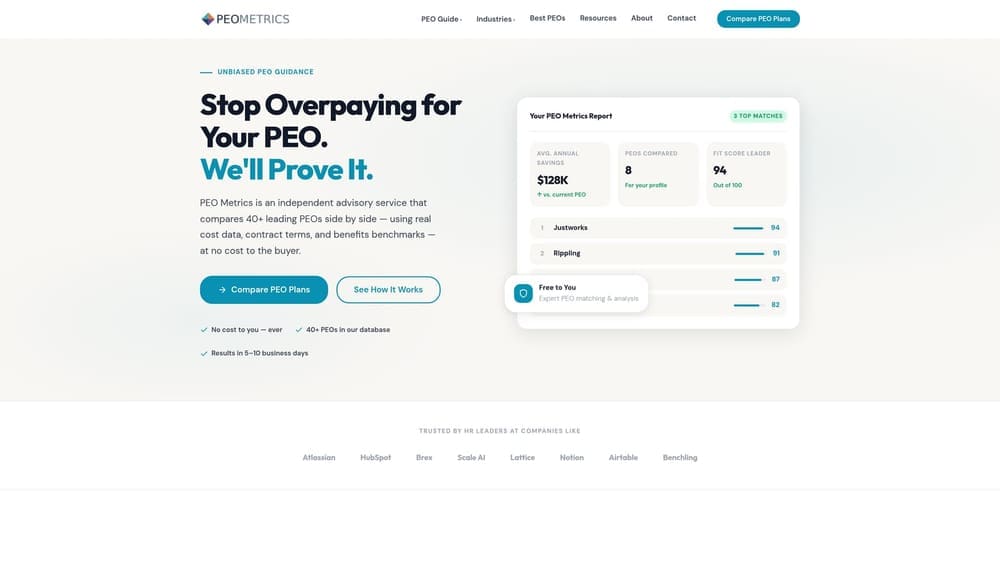
What it does differently from everything else on this list is compare several PEOs at once. Every other entry here describes a single provider’s own offer. Because PEO quotes bundle admin fees, benefits costs, and workers’ comp in different ways, a lower admin fee doesn’t automatically mean a lower total cost. Putting quotes on equal terms is where a comparison service earns its place.
- Side-by-side provider comparisons, so you can weigh service model, benefits access, and fees together instead of in separate sales calls.
- Detailed metrics and pricing analysis, which help you see what sits inside each bundled quote.
- Guidance on selecting a provider, useful if your team hasn’t bought a PEO before.
- Help comparing quotes on equal terms, so differing fee structures don’t hide the real cost gap.
There is nothing to integrate, because it isn’t a payroll or HR platform. Your HR lead or owner would simply use it during the evaluation. Setup effort is limited to sharing what you need and reviewing the comparison.
Limitations are plain. PEO Metrics doesn’t provide payroll, benefits, or co-employment, so it can’t replace a provider. It may receive vendor placement fees, which you should weigh when judging any comparison service. And if you’ve already chosen a provider and signed, it has little left to offer you. Pricing details are available on the website.
Best for: Employers at the shortlisting stage who want neutral-style comparison data.
2. Justworks
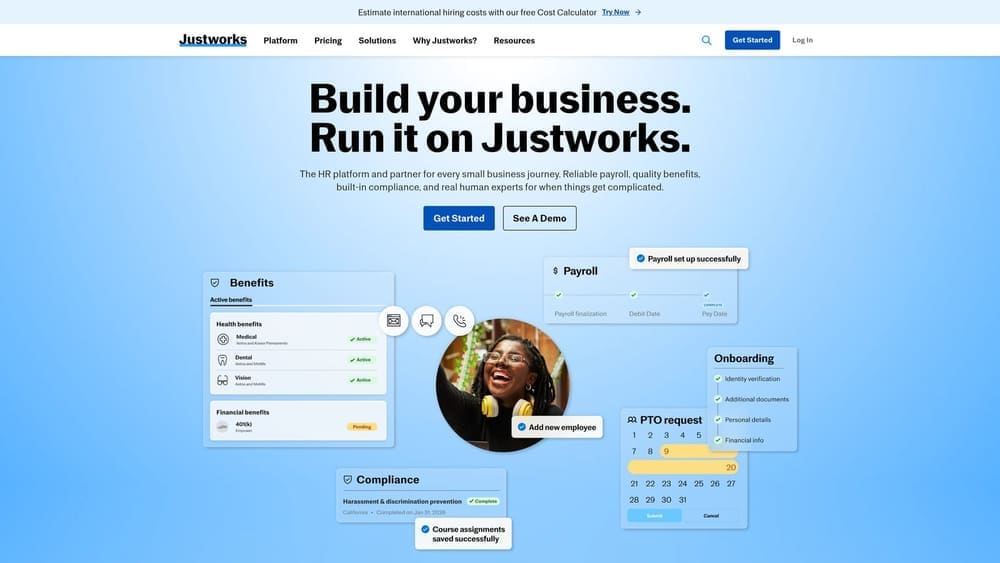
Justworks is a PEO aimed at small businesses, with a software-first platform. Its most useful trait for a buyer is that it publishes per-employee pricing, so you can build a rough budget before any sales conversation. Few PEOs do that, and for a small employer worried about surprises it changes how early you can compare.
What you get
- Payroll, so wages and filings sit on the same platform as everything else.
- Benefits administration, which handles enrollment and ongoing management for employees.
- Compliance support, helping a small team without in-house HR meet employer obligations.
- An employee mobile app for self-service tasks, which cuts routine questions to your admin.
- HR support for day-to-day people questions.
Fit, setup, and limits
Day-to-day running usually falls to an owner or a single HR generalist, which suits the platform’s self-service design. Check its site for accounting and time-tracking integrations before you assume your existing tools connect.
The trade-off is scale. Justworks is built for smaller employers, and it may not suit larger companies or those with highly customized benefit needs. Even with published pricing, remember that the per-employee fee isn’t your total cost; benefits and workers’ comp still drive much of it, so ask what’s included and how renewals work.
Pricing: Published on its website; verify current plans as of November 2026. Cost moves with headcount and plan choice.
Best for: Small teams that want cost clarity up front.
3. TriNet
TriNet offers HR, payroll, benefits, and compliance services, and its distinguishing move is packaging by industry. It has offered PEO packages tailored to sectors such as technology and financial services, though you should verify the current list on its site. If your business sits in one of those sectors, the pitch is that benefits and risk services are shaped around how your industry actually operates.
That sector focus is the main reason to put TriNet on a shortlist. A generalist PEO can serve many industries adequately, but an employer with sector-specific hiring patterns, compliance exposure, or benefit expectations may prefer a provider that designs around them.
- Payroll processing integrated with the rest of the employment stack.
- Benefits access through the PEO’s group arrangements, which matters if you’re too small to get strong carrier terms alone.
- HR consulting for policy and employee relations questions.
- Compliance and risk support that helps you stay current on employer obligations.
- Industry-focused packages, so the service mix reflects your sector.
Integrations vary, so check its site for the current list before assuming your HRIS, accounting, or time tools connect. Expect an HR lead or operations manager to own the relationship, with a sales-led onboarding.
The limitation is pricing opacity. TriNet is quote-based, so costs and contract terms need close review. Ask for written quotes that break out admin fees, benefits costs, and workers’ comp, and read the renewal and termination language before committing. Employers outside its targeted industries may find less of an advantage.
Pricing: Quote-based. Headcount, industry, benefit choices, and location typically influence the quote.
Best for: Employers in industries it targets that want sector-aware support.
4. Insperity
Service model is the story at Insperity. It pairs payroll and benefits with assigned HR representatives and an advisory-style approach, which is closer to having an outsourced HR department than a self-service portal. If your team wants a person to call when a termination, leave request, or manager dispute lands on your desk, that’s the draw.
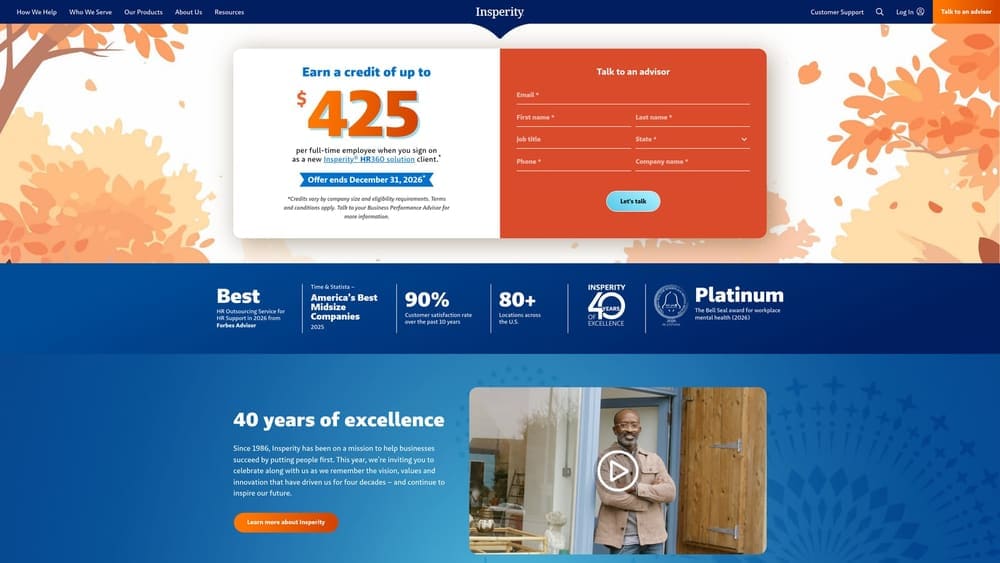
Where a software-first provider like Justworks expects you to handle routine tasks yourself, Insperity’s model leans on guidance. That can be worth a lot to an owner with no HR background, and less to a team that already has experienced HR staff.
- Payroll handled alongside the rest of your employment administration.
- Benefits access through the PEO, with enrollment support for employees.
- HR advisory from an assigned representative who learns your business.
- Talent and performance tools for reviews and development.
- Compliance support to keep employer obligations on track.
Check its site for current integrations. Day to day, the assigned representative becomes your main contact, so your internal workload depends on how much you lean on them.
The limits are cost structure and fit. Pricing is quote-based, and a service-heavy model may be more than a very small or simple team needs. You’re paying, in part, for that hands-on support, so ask exactly what the representative covers and what falls outside it. Compare the written quote line by line against lighter-touch alternatives, and read the exit terms.
Pricing: Quote-based. Headcount, benefits selections, and service scope typically shape the figure.
Best for: Employers that want personal HR advisory support over self-service.
5. ADP TotalSource
Limitations first: ADP TotalSource may be heavier than a very small team needs, and you should confirm eligibility requirements and minimums directly with ADP, since they can change. With that said, ADP TotalSource is ADP’s PEO offering, and its advantage is connection to the wider ADP payroll and HCM ecosystem.
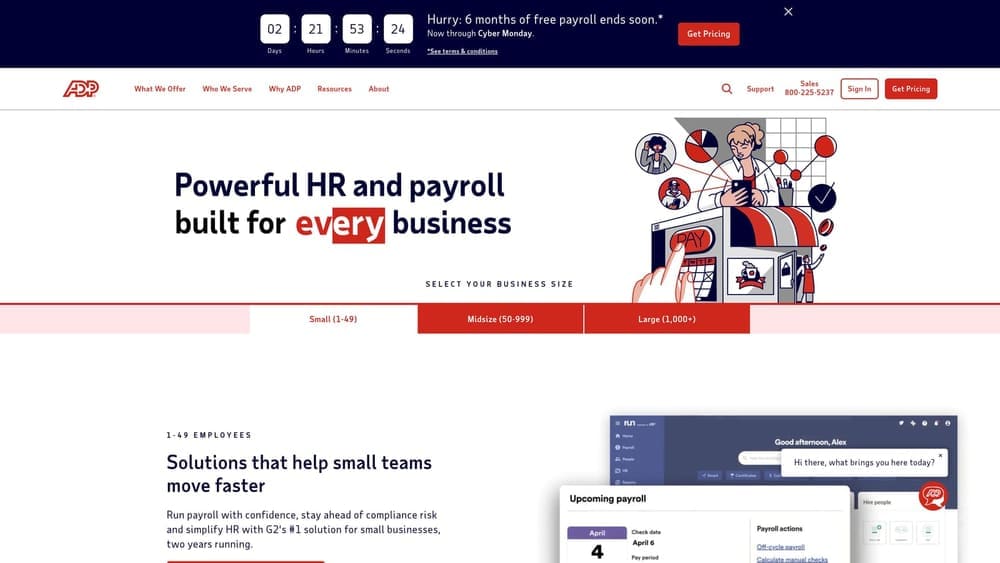
That matters most if you already run ADP products. Staying within one vendor’s ecosystem can reduce data handoffs between payroll, time, and HR, and it gives you a familiar environment during the move into co-employment. If you don’t use ADP, that advantage mostly disappears and TotalSource has to win on other terms.
- Payroll tied into ADP’s broader platform, useful if your data already lives there.
- Benefits access through the PEO’s group programs.
- Risk and compliance services that support employer obligations.
- HR support for everyday employee and manager questions.
- A workers’ comp program offered within the PEO arrangement.
Integrations center on ADP ecosystem products, so confirm specifics on its site, including how it works with any non-ADP tools you rely on. Setup is typically led by an implementation team with an HR or finance owner on your side.
Pricing is quote-based. Ask for a written quote that separates fees from benefits and workers’ comp costs, and review contract length and exit terms. Note that the website link for ADP is its main corporate site, so look for the TotalSource pages there.
Pricing: Quote-based; headcount, benefits, and workers’ comp classifications commonly influence it.
Best for: Employers already invested in ADP products.
6. Paychex PEO
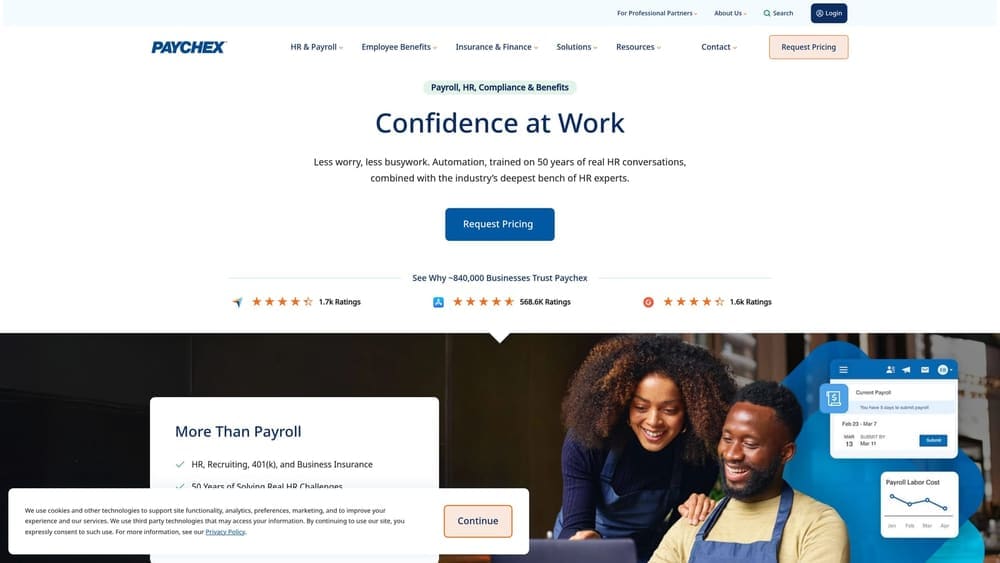
Paychex PEO builds on the company’s payroll heritage and broad service presence. It connects to the Paychex payroll platform and a local service footprint, which can appeal to employers who like having regional support rather than a purely remote relationship.
Check the model before the price
The most useful warning here concerns terms. Paychex offers several kinds of services, and a PEO involves co-employment while payroll-only or ASO-style services do not. Co-employment changes who is the employer of record for certain purposes, how benefits and workers’ comp are pooled, and what your contract says. Confirm exactly which service you’re being quoted before comparing prices.
Features
- Payroll that connects to the Paychex platform you may already use.
- Benefits access through the PEO arrangement.
- Workers’ comp coverage as part of the package.
- Compliance support for employer obligations.
- HR support for routine employee questions.
Integrations center on Paychex platform products; verify specifics on its site. Setup tends to run through an implementation team, with an HR or finance contact on your side.
It suits current Paychex clients best, since the move is easier when payroll data and relationships already exist. It’s a weaker fit if you’re starting from scratch and simply want to compare the field. Pricing is quote-based, so get it in writing and review renewal and termination language.
Pricing: Quote-based; headcount, benefits, and coverage choices typically influence it.
Best for: Employers already using Paychex who want to move to a co-employment model.
7. Rippling PEO
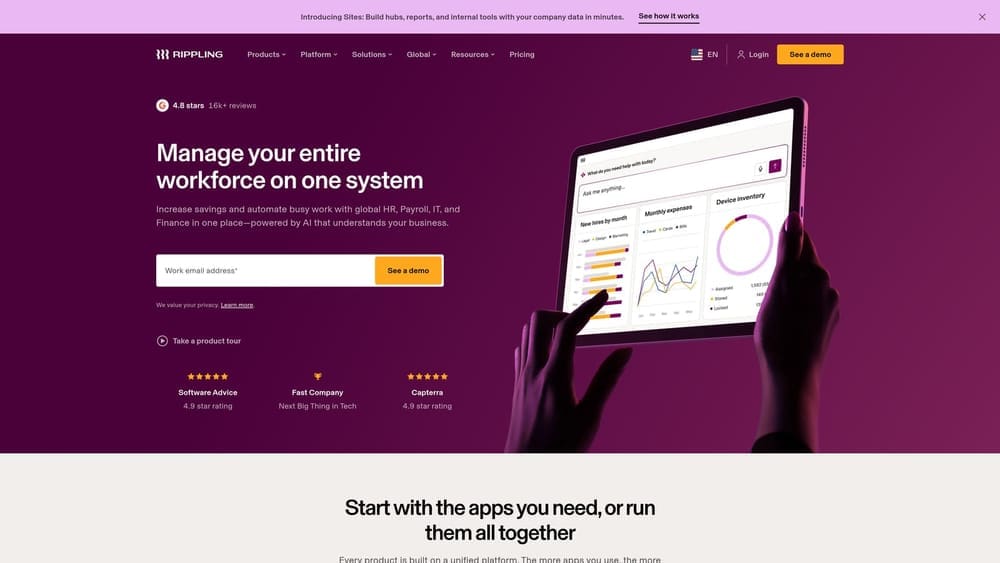
Rippling PEO offers PEO services inside Rippling’s platform, which also covers HR, IT, and device management. No other provider here pairs co-employment with app and device control in the same system. If onboarding a hire means creating payroll records, benefits enrollment, and laptop and software access, doing it from one record is the pitch.
- Unified employee data, so a change in one place updates payroll, benefits, and access.
- Payroll built on that same data set.
- Benefits through the PEO arrangement.
- App and device management, which lets IT provision and lock down tools alongside HR actions.
- HR tools for the broader people workflow.
Integrations run through the Rippling app ecosystem, so check the current list against your stack. Because it spans HR and IT, ownership can be shared between HR and whoever manages IT, which is a benefit for lean teams and a coordination question for larger ones.
The main caution is maturity of the PEO side. It’s a newer part of Rippling’s offering, so verify state availability, plan options, and service depth before you commit, and ask how its support model compares with a provider that has run PEOs for longer. If you don’t need the IT features, you may be paying attention to capabilities you won’t use.
Pricing: See website. Headcount and modules selected typically move the cost.
Best for: Teams wanting HR, IT, and payroll data in one system.
Matching a Provider to Your Situation
Three picks cover most situations. Start with PEO Metrics if you haven’t shortlisted yet and want neutral-style, side-by-side comparison data. Remember that it may receive vendor placement fees, so use it as one input alongside your own written quotes. Choose Justworks if you’re a small team that values published pricing, and Insperity if you’d rather have a named HR representative than a self-service portal.
The rest depend on your circumstances. TriNet makes sense if your industry matches its packages. ADP TotalSource and Paychex PEO fit employers already tied to those payroll ecosystems. Rippling PEO suits teams that want HR and IT in one platform, once you’ve verified its state availability and service depth.
Whichever you pick, request written quotes that separate admin fees from benefits and workers’ comp costs, since the cheapest admin fee doesn’t guarantee the lowest total. Read the renewal and exit terms before signing. This article is informational and not legal, tax, or benefits advice.
Before you sign that PEO renewal, make sure you’re not leaving money on the table.
Many businesses unknowingly overpay because of bundled fees, hidden administrative markups, and contracts designed to limit flexibility. We give you a clear, side-by-side breakdown of pricing, services, and contract terms, so you can see exactly what you’re paying for and choose the option that truly fits your business.
