
You’ve built a payroll system that works. Your team knows it, your accountant trusts it, and you’re not particularly excited about ripping it out to switch to a PEO. But here’s the problem: your benefits options are terrible. You’re too small to negotiate decent rates, your broker keeps presenting the same underwhelming plans, and you’re watching good employees leave for companies with better healthcare.
This is where most business owners assume they’re stuck choosing between two bad options: keep your payroll independence and accept mediocre benefits, or hand everything over to a full-service PEO and lose control of the systems you’ve already invested in building.
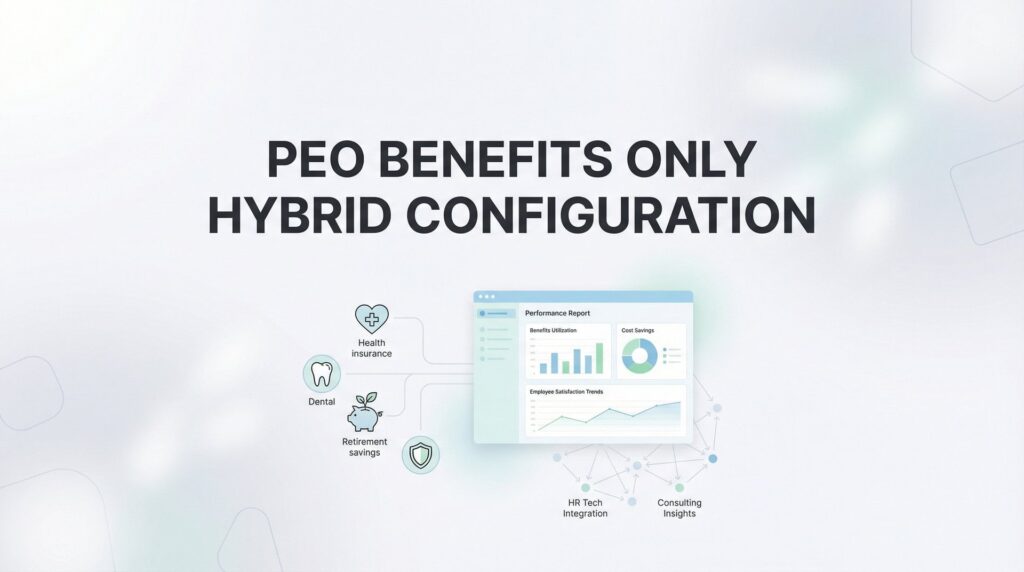
There’s a third option that doesn’t get talked about enough: the benefits-only PEO hybrid. This isn’t a workaround or a compromise arrangement—it’s a legitimate service model offered by select PEO providers. You get access to large-group benefits rates through co-employment, but you keep your payroll processing, tax filing, and workers’ comp in-house or with your existing vendors.
It sounds ideal on paper. In practice, it works extremely well for certain businesses and creates unnecessary complexity for others. This article covers when this configuration actually makes sense, how it operates day-to-day, and the real tradeoffs you’re accepting when you split your HR infrastructure this way.
How a Benefits-Only PEO Arrangement Actually Works
The core mechanism is still co-employment. Your employees become co-employed with the PEO specifically for benefits purposes. That co-employment relationship is what unlocks access to large-group health insurance rates, better plan options, and the purchasing power that comes from being part of a larger risk pool.
But unlike a full-service PEO arrangement, the co-employment stops at benefits. You retain complete control over payroll processing, tax filing, and workers’ compensation. If you’re using QuickBooks, ADP, Gusto, or industry-specific payroll software, you keep using it. If you have a relationship with a workers’ comp carrier you trust, that stays in place. The PEO handles benefits enrollment, carrier relationships, compliance for benefits-related regulations, and employee support for healthcare questions.
This creates a coordination layer that doesn’t exist in full-service arrangements. Your payroll system needs to know what benefits elections employees have made so deductions can be processed correctly. The PEO’s benefits platform needs to know about new hires, terminations, salary changes, and status updates that affect benefits eligibility. These two systems don’t naturally talk to each other.
Most benefits-only PEOs handle this through regular data file exchanges. You’ll typically export employee data from your payroll system and import it into the PEO’s benefits platform on a schedule—weekly, bi-weekly, or monthly depending on your payroll frequency. Some providers offer API integrations if your payroll software supports it, which reduces manual work but doesn’t eliminate the need for oversight.
During open enrollment, employees log into the PEO’s benefits portal to make their elections. Those elections generate deduction amounts that you need to configure in your payroll system. When someone has a qualifying life event and changes their coverage mid-year, you need to update payroll deductions to match. When you process payroll, you’re responsible for ensuring the benefits deductions align with what employees actually elected.
The PEO invoices you separately for benefits costs—typically the total premium amount plus their administrative fee. You’re paying the PEO for benefits, paying your payroll provider for payroll processing, and potentially paying separate vendors for workers’ comp and HR support. This isn’t necessarily more expensive, but it’s structurally different from the single consolidated invoice you’d get with full-service PEO.
One thing that surprises businesses: you’re still subject to PEO contract terms and minimum participation requirements, even though you’re only using benefits. Most benefits-only arrangements require a minimum number of employees (often 5-10) and mandate that a certain percentage of eligible employees enroll in medical coverage. The PEO’s risk pool depends on adequate participation, so they can’t offer this configuration to every small business that asks.
The Business Scenarios Where This Configuration Fits
The clearest fit is companies with established payroll infrastructure they’ve invested in building and don’t want to abandon. This often means businesses using industry-specific payroll software that handles unique requirements—construction companies with certified payroll reporting, healthcare practices with complex scheduling integrations, or professional services firms with project-based time tracking built into payroll.
Migrating off these systems to a PEO’s standardized payroll platform means losing functionality you depend on. The benefits-only hybrid lets you keep the operational tools that work while solving the benefits administration outsourcing problem.
Government contractors represent another common scenario. Certain federal contracts have specific co-employment restrictions or require direct employment relationships for compliance purposes. A benefits-only arrangement can provide access to better benefits without triggering the co-employment complications that full-service PEO creates for contract eligibility or reporting requirements.
Regulated industries sometimes face similar constraints. Companies in sectors with strict licensing requirements, professional liability considerations, or regulatory oversight may find that full PEO co-employment creates complications with their governing bodies. Benefits-only co-employment is narrower in scope and often easier to navigate through industry-specific compliance frameworks.
Businesses with strong internal HR teams also fit this profile. If you have dedicated HR staff who handle payroll, compliance, employee relations, and policy administration competently, the value proposition of full-service PEO diminishes. Your team doesn’t need the PEO to run payroll or answer basic HR questions. What they need is benefits purchasing power and access to better plan options. The benefits-only model gives them that without displacing the HR infrastructure they’ve built.
The configuration also makes sense for companies that have already solved other pieces of the HR puzzle independently. Maybe you have a workers’ comp program with excellent rates through an industry association. Maybe you’ve invested in an HRIS platform you want to keep using. Maybe you have a relationship with an employment law attorney who handles your compliance questions. In these situations, you’re not looking for a comprehensive HR outsourcing solution—you’re looking to solve one specific problem.
What doesn’t fit: businesses hoping this will be simpler or cheaper than figuring out their broader HR needs. If your payroll is a mess, your workers’ comp is expensive, and you’re constantly worried about compliance, adding a benefits-only PEO creates a fragmented solution rather than addressing the underlying operational issues.
Cost Structure Differences vs. Full-Service PEO
Per-employee-per-month fees for benefits-only arrangements are lower than full-service PEO because you’re not paying for payroll administration, tax filing, or workers’ comp management. Where a full-service PEO might charge $150-200 per employee per month in administrative fees, a benefits-only arrangement might run $40-80 per employee per month.
That looks like significant savings until you account for what you’re still paying for separately. You’re maintaining your own payroll system, which has its own per-employee costs. If you’re using a payroll service provider, you’re paying their fees. If you’re running payroll internally, you’re paying staff time and software costs. You’re also handling your own workers’ comp, which means you’re paying premiums directly rather than through the PEO’s pooled rates.
The benefits-only PEO fee covers benefits administration, carrier relationship management, compliance support for benefits-related regulations, and employee support for healthcare questions. You’re still getting value, but you’re not getting the operational efficiency that comes from consolidating everything under one provider.
Hidden costs show up in coordination overhead. Someone on your team needs to manage the data exchange between your payroll system and the PEO’s benefits platform. Someone needs to reconcile deductions each pay period to ensure accuracy. Someone needs to handle the communication flow when employees have questions that span both systems—”Why is my paycheck deduction different from what I elected?” requires coordinating information from two separate sources.
This coordination work isn’t massive, but it’s ongoing. For a company with 20 employees, it might be an hour or two per pay period. For a company with 100 employees, it could be a part-time role. You need to factor this time into your cost comparison. If you’re paying an HR coordinator $25 per hour and they’re spending 4 hours per pay period on benefits-payroll coordination, that’s $200 per month in labor costs that wouldn’t exist with full-service PEO.
Compliance costs can also be duplicated. The PEO handles benefits-related compliance—ACA reporting, COBRA administration, HIPAA requirements. But you’re still responsible for payroll tax compliance, wage and hour law, workers’ comp compliance, and general employment law. If you need outside support for these areas, you’re paying for it separately. Full-service PEO clients get broader compliance coverage included in their administrative fee.
The cost equation becomes even more complex when you factor in risk. If your payroll tax filing has an error, that’s on you. If your workers’ comp classification is wrong and you get audited, you’re handling it. The PEO’s liability is limited to the benefits administration they’re providing. You’re retaining more operational risk than you would with full-service co-employment.
That said, for the right business, the math still works. If you have efficient internal payroll operations, good workers’ comp rates, and competent HR staff, the benefits-only model can deliver meaningful savings while solving your benefits purchasing problem. The key is doing the full cost accounting—not just comparing PEO administrative fees in isolation.
Operational Complexity You’re Signing Up For
The day-to-day reality of running a benefits-only hybrid is managing two systems that need to stay synchronized but don’t automatically talk to each other. Every time you hire someone, you’re entering them into your payroll system and separately enrolling them in the PEO’s benefits platform. Every time someone terminates, you’re processing the termination in payroll and notifying the PEO so benefits can be terminated or COBRA can be initiated.
Status changes create coordination points. An employee goes from full-time to part-time and loses benefits eligibility—you need to update payroll and notify the PEO. Someone gets a raise that affects their contribution amount for certain benefits—payroll needs to reflect the new deduction. An employee adds a dependent mid-year due to a qualifying life event—the PEO processes the enrollment change, and you need to adjust payroll deductions accordingly.
Deduction reconciliation becomes a regular task. Each pay period, you’re verifying that the benefits deductions processed through payroll match what employees have elected through the PEO. Discrepancies happen—someone’s election didn’t get updated correctly, a deduction was missed, an amount changed and payroll wasn’t notified. Catching these errors quickly prevents bigger problems during benefits invoice reconciliation at month-end.
Open enrollment is the most intensive coordination period. Employees make their elections through the PEO’s portal over a 2-3 week window. Once enrollment closes, you receive a file with all the new deduction amounts. You need to update every employee’s payroll record with their new benefits deductions before the first payroll of the new plan year. If you have 50 employees and 30 of them made changes, that’s 30 payroll records to update manually unless your systems integrate.
Communication complexity increases because employees don’t always know which system handles which question. They’ll ask payroll questions to the PEO’s benefits team and benefits questions to your payroll staff. You need clear protocols for routing inquiries and ensuring employees get accurate answers. “Why is my paycheck deduction different from what I elected?” requires pulling data from both systems to diagnose.
Invoice reconciliation happens monthly when the PEO bills you for benefits costs. You’re matching their invoice against your records of who was enrolled, what coverage levels they selected, and what the expected costs should be. Discrepancies require investigation—did someone’s enrollment not process correctly? Did a termination not get communicated? Is there a rate error? This reconciliation step doesn’t exist with full-service PEO because enrollment and payroll deductions are managed in the same system.
Technology helps, but it doesn’t eliminate the coordination burden. Even with API integrations between your payroll software and the PEO’s platform, you’re still overseeing two separate systems with different interfaces, different reporting capabilities, and different support teams. When something goes wrong, troubleshooting requires coordinating between vendors who each claim the problem is on the other side.
When This Configuration Creates More Problems Than It Solves
If your payroll system is already causing headaches, adding a separate benefits layer doesn’t fix anything—it compounds the complexity. Businesses struggling with payroll accuracy, tax filing errors, or employee payment issues need to solve the payroll problem first. A benefits-only PEO doesn’t address payroll dysfunction, and now you’re managing two systems instead of one.
The coordination burden gets underestimated by companies without dedicated HR staff. A small business owner who’s currently handling payroll themselves and thinks they’ll “just add benefits through a PEO” often doesn’t account for the ongoing reconciliation work, the enrollment coordination, and the employee questions that span both systems. This isn’t a set-it-and-forget-it arrangement. It requires consistent attention.
If you’re a 15-person company with no HR staff and the owner is managing payroll in QuickBooks while also running operations, the benefits-only hybrid probably creates more work than it’s worth. You’re better off either keeping your current benefits broker arrangement or moving to full-service PEO that handles everything in one place.
The model makes even less sense if you’re also struggling with workers’ comp costs, compliance concerns, or HR support needs. At that point, you’re solving one problem (benefits purchasing power) while leaving three other problems unaddressed. Full-service PEO becomes more efficient because you’re consolidating multiple pain points under one provider rather than managing separate vendors for each HR function.
Companies that value simplicity over control should skip the benefits-only hybrid. If your preference is having one system, one invoice, one point of contact, and one support team for all HR functions, that’s full-service PEO. The benefits-only model is for businesses that specifically value maintaining independence over certain HR functions and are willing to accept the coordination overhead that comes with it.
The provider landscape also limits this option. Fewer PEOs offer true benefits-only configurations compared to full-service arrangements. If you’re in a small market or a niche industry, you might not have access to benefits-only providers that serve your area or understand your business. The smaller provider pool means less competitive pricing and potentially fewer plan options than you’d get with full-service PEO.
Contract flexibility is another consideration. Some benefits-only arrangements still lock you into multi-year commitments, even though you’re only using a fraction of the PEO’s services. If your business is growing rapidly or your needs might change, committing to a benefits-only contract could limit your options down the road. You might find yourself wanting to add payroll services later and having to renegotiate or switch providers entirely.
Making the Right Call for Your Business
The benefits-only PEO hybrid is a legitimate solution for a specific set of circumstances. It’s not a universal answer, and it’s not a way to get PEO-level benefits “on the cheap” without accepting tradeoffs. The right fit depends on your existing infrastructure, your internal HR capacity, and whether the coordination overhead is worth maintaining payroll independence.
If you have established payroll systems that work well, dedicated HR staff who can manage the coordination, and a clear reason why full-service PEO doesn’t fit your business model, this configuration can deliver meaningful value. You get access to large-group benefits rates without disrupting the operational systems you’ve built.
If you’re struggling with multiple HR pain points, lack dedicated HR resources, or value operational simplicity, the benefits-only model probably creates more complexity than it solves. You’re better off evaluating whether full-service PEO addresses your broader needs or whether fixing your benefits purchasing through a traditional broker makes more sense.
The decision shouldn’t be driven by cost alone. The administrative fee savings look attractive, but they don’t tell the full story when you account for coordination overhead, duplicate compliance efforts, and the operational risk you’re retaining. Do the full cost accounting before you commit.
Before you sign that PEO renewal, make sure you’re not leaving money on the table. Many businesses unknowingly overpay because of bundled fees, hidden administrative markups, and contracts designed to limit flexibility. We give you a clear, side-by-side breakdown of pricing, services, and contract terms—so you can see exactly what you’re paying for and choose the option that truly fits your business. Contact our team
