
Law firms spend their days managing legal risk for clients. They draft airtight contracts, navigate complex regulatory frameworks, and build litigation defenses that can withstand years of scrutiny. Yet many of these same firms operate their own employment practices with surprising informality—relying on managing partner judgment calls, inconsistent documentation, and processes that evolved organically rather than systematically.
The irony becomes painfully clear when a passed-over associate files a discrimination claim, or a former paralegal brings a wage and hour lawsuit. Suddenly, the firm that counsels clients on employment law finds itself defending the same types of claims in court. And the stakes are higher than just settlement costs. In a profession built entirely on credibility and reputation, being named as a defendant in employment litigation creates damage that extends far beyond the courtroom.
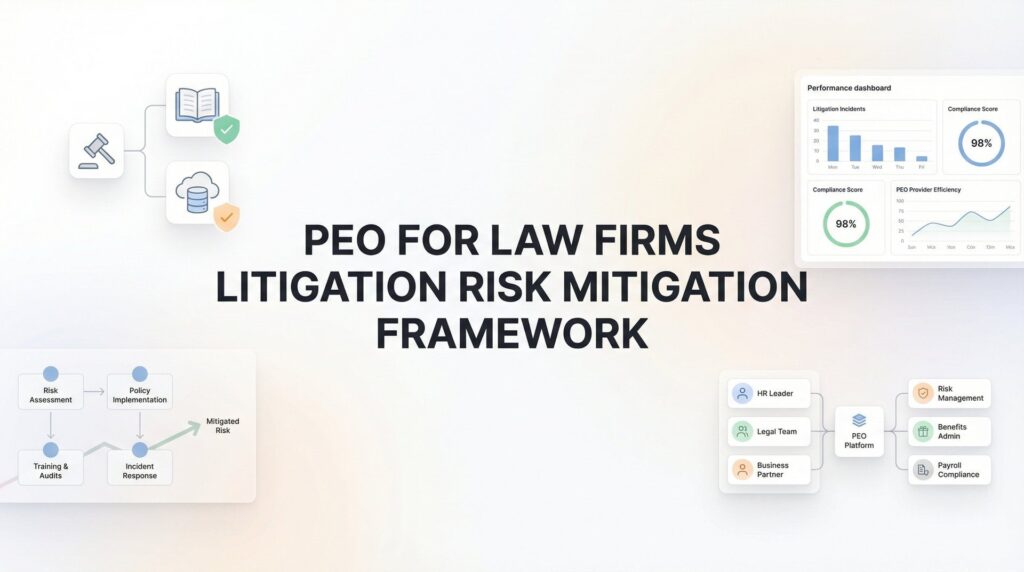
A PEO-supported litigation risk framework addresses this gap—not by outsourcing judgment or replacing legal expertise, but by building systematic protection where informality currently creates exposure. This isn’t about adding another vendor. It’s about creating defensible records, consistent processes, and third-party documentation that holds up when former employees lawyer up.
The Structural Reasons Law Firms Face Elevated Employment Risk
Law firms don’t just face employment litigation exposure. They face elevated exposure created by the very structure of legal practice itself.
Start with the billable hour culture. Associates and paralegals work long hours under intense pressure to meet utilization targets. The temptation to misclassify these roles as exempt from overtime can be strong—especially when the work feels “professional” in nature. But FLSA exemption requirements are strict, and many firms have learned the hard way that calling someone an associate doesn’t automatically make them exempt if their actual duties don’t meet the professional exemption criteria.
The wage and hour vulnerability extends beyond classification. Time tracking systems designed for client billing don’t always capture actual hours worked for compliance purposes. Paralegals who work through lunch or answer emails on weekends create potential off-the-clock work claims if those hours aren’t properly recorded and compensated.
Then there’s the partnership track. The up-or-out culture combined with subjective advancement criteria creates a minefield of potential discrimination claims. Partnership decisions involve complex judgments about client development, technical skills, cultural fit, and business generation potential. When those decisions go against someone who’s invested years in the firm, the rejected candidate often looks for patterns—and plaintiffs’ attorneys are happy to help them find evidence of age, gender, or racial bias in the decision-making process.
The confidentiality requirements that govern legal practice add another layer of complexity. When you terminate an underperforming associate, you can’t always document the specific performance issues without revealing client matters or work product. This creates a documentation gap that becomes a problem in wrongful termination litigation. You can’t prove the legitimate business reason for the termination without compromising client confidentiality.
Partnership structures themselves create classification questions. Is that of-counsel attorney really an independent contractor, or should they be treated as an employee? What about contract attorneys who work on extended projects? The flexible arrangements that make sense for practice management can create worker classification exposure if the relationship doesn’t actually match the paperwork.
Finally, there’s the reputational dimension that matters more for law firms than almost any other business. When a manufacturing company faces an employment lawsuit, it’s a business problem. When a law firm faces the same lawsuit, it’s a credibility problem. Clients who hire you to handle their employment matters start asking uncomfortable questions when you’re defending your own practices in court.
The Four Pillars That Form a Defensible Risk Framework
A litigation risk mitigation framework for law firms rests on four structural pillars. Each addresses a specific vulnerability created by how legal practices actually operate.
Pillar One: Classification Audits That Go Beyond Surface Titles
The first pillar involves systematic review of every employment classification in the firm. Not just obvious roles like receptionists and IT staff, but the gray areas that create real exposure: associates who primarily do document review, of-counsel attorneys with limited autonomy, paralegals with advanced degrees, and contract attorneys who work on-site for extended periods.
The audit needs to examine actual job duties against FLSA exemption criteria—not just job titles or salary levels. An associate making $85,000 who spends 60% of their time on routine document coding may not meet the professional exemption requirements, regardless of their law degree. A paralegal with a master’s degree who exercises independent judgment on complex matters might qualify for exemption, even though the title suggests otherwise.
This pillar also addresses independent contractor relationships. The analysis needs to look at behavioral control, financial control, and the relationship type—not just what the engagement letter says. If that of-counsel attorney works exclusively for your firm, uses your equipment, follows your scheduling requirements, and can’t work for competitors, the IRS and DOL may view them as a misclassified employee regardless of the contract language.
Pillar Two: Documentation Protocols That Create Defensible Records
The second pillar builds documentation systems that create contemporaneous performance records without compromising client confidentiality. This means separating performance documentation from client matter files, using anonymized examples when discussing work quality, and creating evaluation frameworks that assess skills and behaviors rather than specific case outcomes.
The key is contemporaneous documentation. Performance notes created in real-time carry far more weight in litigation than reconstructed justifications written after someone files a claim. But many firms only document performance when problems reach a crisis point—creating a record that looks suspiciously like pretext for a discriminatory termination decision.
This pillar also addresses the partnership decision documentation challenge. Creating clear criteria for advancement, documenting how candidates measure against those criteria, and maintaining consistent evaluation processes across practice groups builds a defensible record when someone challenges a partnership denial.
Pillar Three: Policy Standardization Across Practice Groups
The third pillar tackles the inconsistent treatment problem that fuels many discrimination claims. Different practice groups often operate as semi-autonomous fiefdoms with their own cultures, expectations, and informal rules. What’s acceptable in the corporate group may be grounds for discipline in litigation. Remote work flexibility varies by partner preference rather than consistent policy.
These inconsistencies become plaintiff evidence when someone can show they were treated differently than similarly situated employees. Standardized policies—actually enforced consistently—eliminate the “they let other people do it” arguments that undermine defense positions.
This doesn’t mean every practice group needs identical operating procedures. It means the differences need to be based on legitimate business reasons that are documented and consistently applied, not partner whims or historical accident.
Pillar Four: Separation Procedures That Minimize Retaliation Exposure
The fourth pillar creates systematic separation procedures that reduce wrongful termination and retaliation claims. This includes documentation requirements before termination decisions, consistent severance offer processes, standardized reference protocols, and clear procedures for handling departures that involve client transitions.
The retaliation piece matters particularly for law firms because associates and staff often observe potential misconduct—billing irregularities, conflicts of interest, trust account issues. When someone raises concerns and gets terminated shortly afterward, you’ve created textbook retaliation exposure even if the termination was legitimately performance-based.
Separation procedures also need to address the unique aspects of law firm departures: client notification requirements, file transition protocols, restrictions on client solicitation, and return of firm property including confidential information. Getting these wrong creates both employment litigation exposure and potential ethics violations.
How PEO Infrastructure Strengthens Each Framework Element
A PEO doesn’t just provide HR services. The right PEO relationship creates infrastructure that reinforces each pillar of the litigation risk framework in ways that matter when you’re defending claims.
Third-party involvement creates documentation that carries more weight in litigation. When performance evaluations, policy acknowledgments, and disciplinary records are created and maintained by an independent PEO rather than the firm itself, they’re harder to dismiss as self-serving or fabricated. The contemporaneous nature of PEO-maintained records—created as part of ongoing HR processes rather than in anticipation of specific litigation—makes them more credible to judges and juries.
PEO compliance systems catch gaps before they become plaintiff exhibits. Regular audits of wage and hour practices, benefits administration, leave management, and policy compliance identify issues while you can still fix them. Many firms have learned about FLSA violations or FMLA failures only when a former employee’s attorney sends a demand letter. PEO compliance reviews surface these problems during routine audits when the stakes are lower.
Standardized processes reduce the inconsistent treatment arguments that fuel discrimination claims. When the PEO administers leave requests, performance review cycles, and disciplinary procedures according to consistent protocols, it’s harder for a plaintiff to argue they were treated differently because of protected characteristics. The standardization creates a paper trail showing everyone went through the same process.
This matters particularly for law firms where different partners have historically operated with significant autonomy. The litigation partner who’s always been tough on associates can’t create disparate treatment exposure if the PEO-managed performance system applies the same standards and documentation requirements across all practice groups.
PEO expertise in professional services employment law provides specialized knowledge that general HR staff often lack. Issues like exempt status for knowledge workers, handling of billable hour requirements, and professional licensing compliance require understanding that goes beyond standard HR training. PEOs with professional services experience bring this specialized knowledge without requiring the firm to hire dedicated employment law HR staff.
The co-employment structure also creates a buffer in certain situations. When the PEO is the employer of record for benefits and payroll purposes, some employment claims may name the PEO rather than the firm. This doesn’t eliminate the firm’s exposure, but it can provide additional defense resources and potentially reduce the reputational impact of being the named defendant.
Finally, PEO infrastructure supports the documentation protocols that address law firm confidentiality challenges. Separate HR systems maintained by the PEO allow performance documentation that doesn’t live in client matter files. Anonymized evaluation frameworks can be implemented consistently when the PEO manages the performance review process. This separation helps maintain client confidentiality while still creating the contemporaneous performance records that matter in wrongful termination defense.
Law Firm Considerations Most PEO Providers Get Wrong
Most PEO providers understand professional services businesses at a surface level. They’ve worked with accounting firms, consulting practices, and similar knowledge worker environments. But law firms have specific requirements that generic professional services experience doesn’t address.
Client confidentiality requirements affect HR systems in ways most PEO providers don’t anticipate. Background checks for lateral hires can’t involve contacting current employers when the candidate hasn’t disclosed their job search to their firm. Reference checks need to navigate the restrictions on discussing client matters. Performance documentation systems need to separate employee records from client files in ways that maintain privilege and work product protection.
Many PEO platforms aren’t designed for this level of information segregation. They assume HR can access whatever information is needed to evaluate performance or conduct investigations. But in law firms, HR systems that allow broad access to work product or client information create confidentiality breaches and potential malpractice exposure.
Bar licensing and CLE tracking requirements need to integrate with HR systems in ways that matter for law firms. Attorneys must maintain active licenses, meet continuing education requirements, and comply with state-specific practice rules. The PEO’s HRIS needs to track license expiration dates, CLE completion, and multi-state admission status—not just as nice-to-have features but as compliance requirements that affect whether someone can legally perform their job.
Most PEO providers treat professional licensing like any other credential tracking. But for law firms, an attorney practicing with a lapsed license creates malpractice exposure, potential ethics violations, and questions about whether their work product is protected by attorney-client privilege. The PEO system needs to flag these issues proactively, not just maintain static records.
Lateral partner compensation structures and equity transitions create complexities that standard PEO payroll systems struggle to handle. Partnership draws, capital account contributions, profit distributions, and the transition from associate to non-equity partner to equity partner involve compensation arrangements that don’t fit neat W-2 employee or 1099 contractor categories.
The PEO needs to handle these arrangements correctly for tax purposes while maintaining the flexibility law firms need for individualized partner compensation. Many PEO providers want to standardize everything, but law firm economics require customization that most platforms aren’t built to accommodate.
Professional liability insurance coordination presents another gap. Law firms carry malpractice coverage that interacts with employment practices liability insurance in complex ways. When an employment claim involves allegations about how the firm handled a client matter—a harassment claim related to client development activities, or a discrimination claim tied to case assignment decisions—the professional liability and EPLI coverage questions become intertwined.
PEO providers who don’t understand this intersection may structure EPLI coverage that creates gaps or conflicts with the firm’s existing malpractice insurance. The claims handling process needs to account for potential malpractice implications when investigating employment complaints.
When a PEO Framework Doesn’t Make Sense for Your Firm
A PEO-supported litigation risk framework solves real problems for many law firms. But it’s not the right answer for every situation, and recognizing the limitations matters as much as understanding the benefits.
Firms with complex international operations or secondment arrangements often find PEO structures too constraining. If you’re sending associates to work in foreign offices, seconding attorneys to client locations, or managing employment relationships across multiple countries, the PEO’s co-employment model may create more complexity than it solves. Multi-country PEO services exist, but they add cost and administrative overhead that may exceed the litigation risk mitigation value.
The cross-border employment issues that matter for international law firms—work permits, tax treaty considerations, social insurance obligations, and foreign labor law compliance—require specialized expertise that most PEOs don’t provide. You’ll still need separate international employment counsel, which reduces the value of the PEO relationship.
Partner-level HR decisions sometimes need to remain entirely internal for strategic or confidentiality reasons. Partnership admission decisions, equity adjustments, practice group leadership changes, and compensation committee deliberations involve firm governance and competitive strategy that shouldn’t involve third-party HR providers. If your firm operates in a way where these decisions are frequent and complex, the PEO relationship may feel like an obstacle rather than support.
Some firms also have legitimate concerns about PEO access to sensitive information. If your practice involves government security clearances, highly confidential client matters, or work that requires strict information controls, bringing in a PEO creates additional parties with access to employee information that may include security-sensitive details.
The cost-benefit calculation also matters. Smaller firms—particularly those with fewer than 20 employees—may find that targeted employment law counsel costs less than a comprehensive PEO relationship while providing more relevant value. If your exposure is primarily around a few specific issues rather than systematic gaps across all HR functions, paying for full PEO services to address narrow problems doesn’t make economic sense.
A five-attorney boutique firm with straightforward employment arrangements might be better served by an annual employment practices audit from a good employment lawyer, plus an employee handbook update and basic policy implementation. The PEO’s value increases with organizational complexity—more employees, multiple locations, diverse practice areas, and higher-stakes employment decisions.
Finally, some firms have already built sophisticated internal HR infrastructure that addresses the litigation risk framework elements. If you’ve invested in experienced HR leadership, implemented robust HRIS systems, and developed comprehensive employment policies with ongoing legal counsel, adding a PEO may create redundancy rather than filling gaps. The framework matters more than whether a PEO delivers it.
Questions That Separate Law Firm-Competent PEO Providers from Everyone Else
When you’re evaluating PEO providers, the generic questions about pricing and services won’t tell you what you need to know. Law firm-specific questions reveal whether a provider actually understands your risk profile or just thinks they do.
Ask how their HRIS handles confidential client information in performance documentation. A good answer describes specific features for segregating employee performance records from client matter information, role-based access controls that prevent broad HR access to work product, and audit trails that track who viewed sensitive information. A weak answer focuses on general data security without addressing the privilege and confidentiality issues that matter for law firms.
Ask about their experience with FLSA exemption analysis for attorneys and paralegals. The provider should demonstrate understanding that job titles don’t determine exemption status, that associates performing primarily routine tasks may not qualify for professional exemption regardless of salary, and that state law variations matter for firms with multiple office locations. If they immediately assume all attorneys are exempt, they don’t understand the nuances.
Ask how they handle bar licensing and CLE tracking across multiple states. The answer should address proactive monitoring of license expiration dates, integration with state bar databases where available, automated alerts for upcoming CLE deadlines, and escalation procedures when attorneys fall out of compliance. If they treat this like tracking any other professional credential, they’re missing the malpractice and ethics implications.
Ask about their approach to partnership compensation structures and equity transitions. A sophisticated provider will discuss experience with guaranteed payments to partners, capital account management, profit distribution timing, and the tax implications of different partnership structures. They should acknowledge that law firm partnership economics don’t fit standard employment models and explain how their systems accommodate these complexities.
Ask who would handle an employment investigation involving allegations related to client matters. The answer needs to address how they’d conduct an investigation without accessing privileged information, how they’d coordinate with the firm’s general counsel or outside employment counsel, and how they’d document findings in ways that maintain privilege. If they describe a standard investigation process without acknowledging the confidentiality complications, they lack law firm sophistication.
Red flags emerge when providers can’t distinguish between law firms and other professional services businesses. Generic statements about “working with professional services clients” without law firm-specific examples suggest limited relevant experience. Inability to discuss conflicts of interest issues, client confidentiality implications, or bar regulation compliance indicates they’re approaching law firms like any other knowledge worker environment.
For firms considering a PEO relationship without full commitment, ask about pilot program structures. Some providers allow you to start with specific employee populations—staff and paralegals but not attorneys, or a single office location rather than the full firm. This lets you evaluate the relationship with limited risk before expanding scope. Providers who insist on all-or-nothing arrangements may not be confident enough in their value to offer graduated implementation.
Building Systematic Protection in a Credibility-Dependent Business
Law firms face employment litigation exposure that goes beyond financial risk. When you’re in the business of providing legal counsel, being named as a defendant in employment claims damages credibility in ways that matter for client confidence and lateral recruiting. The associate who sues for discrimination doesn’t just cost settlement dollars—they create questions about whether your firm practices what it preaches.
A PEO-supported litigation risk framework addresses this exposure by building systematic protection where informality currently creates gaps. This isn’t about outsourcing the judgment calls that require legal expertise and firm-specific knowledge. It’s about creating contemporaneous documentation, consistent processes, and third-party involvement that produces defensible records when former employees lawyer up.
The framework works because it addresses the structural reasons law firms face elevated risk: the billable hour culture that creates wage and hour vulnerabilities, the subjective partnership decisions that invite discrimination claims, the confidentiality requirements that complicate documentation, and the up-or-out advancement model that produces disappointed former employees looking for legal recourse.
But the framework only works when it’s implemented with law firm-specific sophistication. Generic PEO services that treat your firm like any other professional services business miss the nuances that matter—the confidentiality implications, the licensing requirements, the partnership compensation complexities, and the reputational stakes that make employment litigation more damaging for law firms than most other businesses.
The right PEO relationship provides infrastructure that reinforces systematic protection: third-party documentation that holds up in litigation, compliance expertise that catches gaps before they become claims, and standardized processes that eliminate inconsistent treatment arguments. The wrong PEO relationship adds cost and administrative burden without addressing your actual risk profile.
Before you sign that PEO renewal, make sure you’re not leaving money on the table. Many businesses unknowingly overpay because of bundled fees, hidden administrative markups, and contracts designed to limit flexibility. We give you a clear, side-by-side breakdown of pricing, services, and contract terms—so you can see exactly what you’re paying for and choose the option that truly fits your business. Connect with our team
