
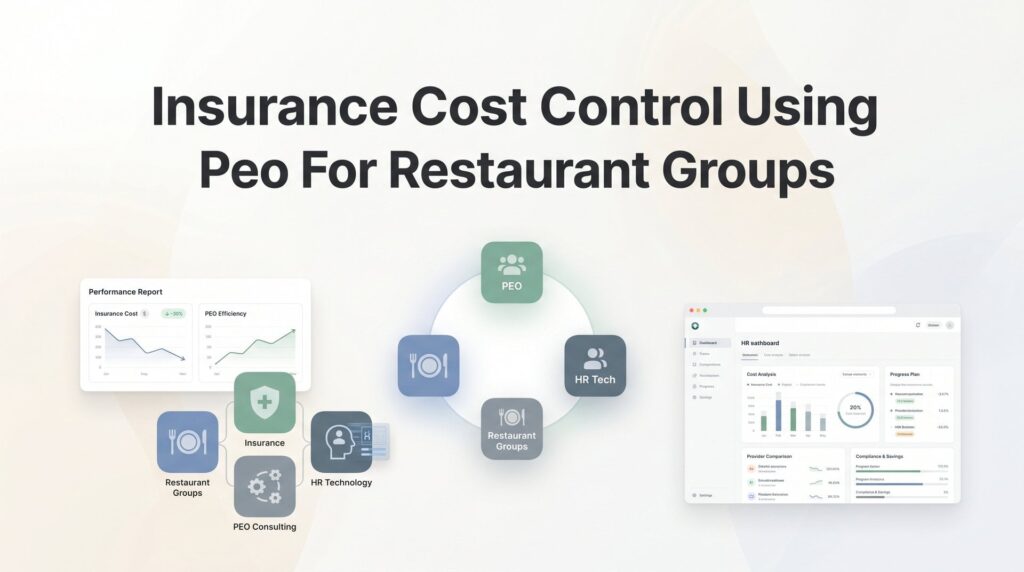
Insurance costs for restaurant groups aren’t just high—they’re structurally punishing in ways most other industries never experience. Between workers’ comp claims from burns, cuts, and slips, health insurance for a workforce that churns through part-timers and seasonal staff, and liability coverage that multiplies with every new location, you’re looking at 8-12% of your labor costs disappearing into premiums before you’ve plated a single dish. And here’s the part that keeps multi-unit operators up at night: the math gets worse as you scale. Each location adds regulatory complexity. Each state brings different workers’ comp rules. Each new hire affects your experience modification rate in ways that can haunt you for years.
A PEO can fundamentally change this equation. By pooling your employees with thousands of others, you access master insurance policies you’d never qualify for on your own. You get safety programs designed by professionals who understand restaurant risk. You shift the administrative burden of tracking ACA eligibility, managing COBRA, and filing workers’ comp claims to someone whose entire business model depends on doing it well.
But most restaurant operators discover this too late: not every PEO understands hospitality risk, and the wrong partnership can lock you into costs that don’t improve over time—they just get repackaged with fancier reporting. The groups that actually see 15-25% savings on workers’ comp aren’t the ones who signed the first contract that landed on their desk. They’re the ones who treated PEO selection like the high-stakes financial decision it is.
This guide walks you through the specific steps to evaluate, negotiate, and implement a PEO relationship that genuinely controls your insurance costs—not just shifts them around on paper.
Step 1: Audit Your Current Insurance Cost Structure Across All Locations
You can’t improve what you don’t measure. Before you talk to a single PEO, you need a clear picture of what you’re actually spending on insurance—and where the pain points are hiding.
Start with workers’ comp. Pull your premiums, experience modification rates, and claims history for each location separately. Don’t just look at the total annual premium. Break it down by location, by job category, and by type of claim. You’ll often discover that two or three locations are driving the majority of your costs, or that kitchen staff injuries represent 70% of your claims volume while accounting for 40% of your headcount.
Your experience mod rate is the single most important number in this analysis. If you’re running above 1.0, you’re paying a penalty based on your claims history. If you’re below 1.0, you’re getting a discount. Either way, this number will follow you for three years based on rolling claims data—which means a serious injury today affects your premiums through 2029. Document where you stand now, because this is your baseline for measuring whether a PEO actually delivers improvement. Understanding how PEOs handle high insurance mod rates can help you set realistic expectations.
Next, calculate your true health insurance cost per employee. Don’t just look at the premium. Add in your administrative time managing enrollment, COBRA notices, ACA compliance tracking across variable-hour employees, and broker fees. For most restaurant groups, the hidden administrative overhead adds 8-12% to the stated premium cost. This is cost a PEO can genuinely eliminate, but only if you know it exists.
Document your current broker relationships and any multi-year commitments. Some restaurant groups discover they’re locked into broker agreements that make switching to a PEO more complicated than it should be. Others find out their workers’ comp policy has a minimum earned premium clause that creates an exit penalty. Know what you’re dealing with before you start negotiating.
Finally, identify patterns in your claims data. Are slips and falls concentrated in locations with older flooring? Are kitchen burns spiking at units with newer, less experienced staff? Are back injuries tied to specific tasks like lifting kegs or moving equipment? The PEOs that actually reduce your costs are the ones whose safety programs address your specific risk drivers—but they can’t do that if you can’t articulate what those drivers are.
Step 2: Identify PEOs With Proven Restaurant and Hospitality Experience
Generic PEOs struggle with restaurant risk profiles. They’re built for office environments where the biggest workers’ comp claim is carpal tunnel, not third-degree burns from a fryer malfunction. The difference matters because it affects everything from how they price your risk to whether their safety programs actually prevent the injuries your people experience.
When you’re evaluating PEOs, ask directly about their restaurant client concentration. You want to hear that 20-40% of their book is hospitality. Too low, and they don’t understand your risk. Too high, and you’re not benefiting from pooling with lower-risk industries—you’re just sharing costs with other restaurants. A comprehensive PEO cost containment strategy for restaurants starts with finding the right partner.
Ask for their claims data specific to restaurant clients. What’s their average experience mod trajectory for restaurant groups? How many of their restaurant clients have seen mod rate improvements over three years? If they can’t answer these questions with numbers, they’re not managing restaurant risk well enough to help you.
Here’s a red flag test: ask them about tip credit compliance, FICA tip credit, and kitchen-specific safety protocols. If they look confused or give you generic answers about “comprehensive compliance support,” walk away. The FICA tip credit alone can save you thousands per location annually—it’s a tax credit on employer FICA taxes paid on reported tips. A PEO that doesn’t proactively structure their payroll to preserve this benefit is costing you money from day one.
Verify their workers’ comp carriers actually have appetite for hospitality risk. Some PEOs use carriers that consider restaurants “high risk” and price accordingly. Others have negotiated master policies with carriers who specialize in hospitality and understand that a well-managed restaurant group isn’t the same risk as a poorly-run single location. Ask which carrier underwrites their workers’ comp, then research whether that carrier actively writes hospitality business.
Talk to their existing restaurant clients if possible. Ask specifically whether the PEO’s safety programs reduced their claims frequency, whether their experience mod improved, and whether they felt the administrative fee was justified by actual cost savings. You’re looking for evidence of results, not just promises of support.
Step 3: Analyze the PEO’s Insurance Structure and Your True Cost Exposure
This is where most restaurant operators get lost in jargon and end up signing contracts they don’t fully understand. The structure of how the PEO handles insurance determines whether you’ll see sustainable cost reduction or just temporary relief followed by steady increases.
There are three main structures you’ll encounter. Fully-insured arrangements mean the PEO buys insurance and passes the cost to you with a markup. You have predictable costs, but limited upside if your claims improve. Loss-sensitive arrangements mean you share in the actual claims costs through deductibles or retrospective adjustments. You can save significantly if you manage risk well, but you’re exposed if claims spike. Captive arrangements mean the PEO uses its own insurance company, which can offer the best pricing but requires the most scrutiny about financial stability.
Ask for complete transparency on how your specific claims affect your rates over time. Some PEOs pool all clients together and spread costs evenly—which means you could be subsidizing poorly-managed restaurant groups if your safety culture is strong. Others use experience-rated pricing within their pool, so your rates reflect your actual performance. You want the latter, but you need to ask explicitly because most PEOs won’t volunteer this information. Learning how to estimate your PEO insurance pooling savings before signing helps you evaluate these structures.
Request a breakdown of the administrative fee markup on insurance pass-through costs. Some PEOs charge 3-5% on top of actual insurance premiums as part of their administrative fee. Others bundle it into a per-employee charge. Either way, you need to know what you’re paying for administrative overhead versus actual insurance cost. If they won’t give you this breakdown, that’s a red flag about transparency.
Evaluate whether you’ll actually benefit from their pool or just subsidize worse performers. Ask about their claims frequency and severity for restaurant clients compared to industry benchmarks. If their restaurant clients have worse experience mod rates than the industry average, you’re joining a pool that will drag your costs up, not down. The whole value proposition of a PEO is accessing better rates through pooling—but that only works if the pool is well-managed.
For loss-sensitive arrangements, model your potential exposure. Ask for examples of how claims would flow through to your costs. A single serious injury—say, a kitchen manager suffering severe burns requiring surgery and months of recovery—could cost $150,000 in workers’ comp claims. Under a loss-sensitive arrangement, you might absorb the first $50,000 through a deductible. Make sure you understand your maximum exposure and have the cash flow to handle it.
Finally, ask about rate stability and what drives increases. Some PEOs guarantee rates for 12 months, then adjust based on your claims and overall market conditions. Others lock rates for multiple years with caps on increases. The best arrangements include improvement sharing—if your experience mod drops because you’ve reduced claims, you should see that reflected in lower rates, not just slower increases.
Step 4: Negotiate Contract Terms That Protect Your Cost Control Goals
Your leverage is highest before you sign. Once you’re locked in, the PEO knows switching is expensive and disruptive. Use that leverage to negotiate terms that actually protect your ability to control costs over time.
Push for rate guarantees and caps on annual increases. A good starting point is a 12-month rate lock with a cap of 5-8% on subsequent annual increases, adjusted only for claims experience and documented market rate changes. If the PEO won’t commit to caps, ask why—and get their answer in writing. Vague promises about “competitive pricing” mean nothing when you’re facing a 20% increase in year two. Understanding how to forecast your PEO costs gives you leverage in these negotiations.
Negotiate experience mod rate improvement sharing. If you invest in safety programs, reduce claims frequency, and drive your experience mod from 1.15 to 0.92 over three years, you should see that translate to lower costs—not just slower increases. Some PEOs will agree to pass through 75-100% of the savings from mod rate improvements. Others keep the benefit and just slow your rate increases. Get the formula in writing.
Clarify exit provisions upfront, especially what happens to your experience mod rate if you leave. Your mod rate is based on claims history, and in some PEO structures, those claims are reported under the PEO’s policy number—which means when you leave, you start over with a 1.0 mod rate instead of taking your improved rate with you. Other PEOs use structures where your mod rate is portable. This difference can cost you tens of thousands of dollars if you need to switch PEOs or bring insurance in-house after two years.
Address multi-state complexity now if your locations cross state lines. Workers’ comp rules vary dramatically by state. Some states are monopolistic, requiring coverage through a state fund. Others allow private carriers but have unique filing requirements. If you operate in California, New York, and Texas, your PEO needs demonstrated experience navigating all three regulatory environments. Reviewing multi-state payroll governance strategies for restaurant groups can help you prepare for these conversations.
Negotiate transparency requirements into the contract. Require quarterly reporting on claims by location, experience mod rate updates, and a breakdown of how your rates are calculated. Some PEOs will resist this, claiming proprietary pricing models. Push back. You’re entitled to understand how your money is being spent and whether the relationship is delivering value.
Step 5: Implement Safety and Claims Management Programs That Actually Work
Signing with a PEO doesn’t automatically reduce your insurance costs. The savings come from reducing claims frequency and severity—which requires active execution, not passive outsourcing.
Start by leveraging the PEO’s safety resources, but customize them for restaurant-specific hazards. Generic office safety training doesn’t prevent fryer burns or walk-in freezer injuries. Ask your PEO for restaurant-tailored programs covering knife safety, burn prevention, proper lifting techniques for kegs and equipment, and slip prevention in kitchens and dining areas. If they only offer generic content, supplement it with industry-specific training from the National Restaurant Association or state restaurant associations.
Set up early intervention protocols for injuries. The difference between a $2,000 workers’ comp claim and a $50,000 claim often comes down to how quickly you get injured employees appropriate medical care and back to modified duty. Work with your PEO to establish relationships with occupational health clinics near each location. Train managers to report injuries immediately—not at the end of the shift, not the next day. Immediate reporting means immediate treatment, which means faster recovery and lower costs. Understanding advanced workers’ comp structuring strategies helps you maximize these programs.
Return-to-work programs matter enormously for controlling costs. An employee who’s out for six weeks costs you far more than one who returns to modified duty after one week. Work with your PEO to create modified duty options that make sense for restaurants—light prep work, hosting duties, administrative tasks. The goal is keeping people engaged and recovering while minimizing lost-time claims that drive up your experience mod.
Train your managers on incident reporting that protects your experience mod. Not every injury needs to become a workers’ comp claim. Minor cuts treated with first aid and documented properly don’t affect your mod rate. But if managers don’t understand the difference between OSHA-recordable injuries and workers’ comp claims, they’ll either over-report (driving up costs) or under-report (creating compliance problems). Your PEO should provide this training, but you need to reinforce it at the unit level.
Establish quarterly reviews of claims data with your PEO contact. Look at trends by location, by job category, and by type of injury. If one location has three slip-and-fall claims in six months, that’s a facilities issue that needs addressing. If back injuries are spiking across all locations, that’s a training issue. Use the data to drive operational improvements, not just to track costs after the fact.
Step 6: Track Results and Know When the PEO Isn’t Delivering
Create a dashboard comparing pre-PEO and post-PEO insurance costs by category. Track workers’ comp premiums, health insurance costs, administrative time saved, and your experience mod rate. Update it quarterly. You should see improvement within 12 months on administrative efficiency and within 18-24 months on experience mod rate if the relationship is working. Implementing PEO cost reporting best practices ensures you’re tracking the right metrics.
Monitor your experience mod trajectory closely. If you started at 1.15 and you’re still at 1.12 after 18 months despite implementing safety programs and reducing claims frequency, something’s wrong. Either the PEO isn’t reporting claims properly, the pool you’re in is dragging you down, or the safety programs aren’t actually preventing injuries. Demand answers. A mod rate forecasting model can help you predict where your costs should be heading.
Watch for warning signs the relationship isn’t working. Opaque reporting that doesn’t break down costs by category. Rate increases that aren’t explained with specific claims data or market factors. Difficulty getting answers from your account representative. Safety resources that are promised but never delivered. Any of these indicate you’re not getting the value you’re paying for.
Know when to renegotiate versus when to walk away. If the PEO is delivering administrative value but costs aren’t improving, renegotiation might work—perhaps moving to a different insurance structure or negotiating better improvement-sharing terms. If they’re not delivering on promised services, not providing transparency, or if your costs are increasing faster than market rates, it’s time to explore alternatives.
Understand your options if you need to leave. Some restaurant groups find that after two years with a PEO, they’ve improved their safety culture and claims history enough to bring insurance in-house at lower cost. Others switch to a different PEO with better restaurant expertise. Either way, plan your exit carefully—make sure you understand how your experience mod transfers, what happens to ongoing claims, and whether you’ll face any penalties or gaps in coverage during the transition.
Making PEO Insurance Partnerships Work Long-Term
Controlling insurance costs through a PEO isn’t a set-it-and-forget-it decision. It requires upfront diligence to find a partner who actually understands restaurant risk, ongoing attention to claims management and safety execution, and the willingness to renegotiate or walk away if the numbers don’t improve.
The restaurant groups that see real savings—often 15-25% on workers’ comp alone—are the ones who treat the PEO relationship as active cost management, not passive outsourcing. They use the PEO’s resources but own the results. They track data quarterly and hold the PEO accountable for delivering value. They understand that insurance cost control is an ongoing process that requires operational discipline, not just a contract signature.
Use this process as your framework, but remember: your leverage is highest before you sign, and your results depend on execution after you do. The PEO can provide tools, resources, and access to better insurance markets. But reducing claims, improving your experience mod, and controlling costs over time—that’s on you and your management team.
Before you sign that PEO renewal, make sure you’re not leaving money on the table. Many businesses unknowingly overpay because of bundled fees, hidden administrative markups, and contracts designed to limit flexibility. We give you a clear, side-by-side breakdown of pricing, services, and contract terms—so you can see exactly what you’re paying for and choose the option that truly fits your business. Don’t auto-renew. Make an informed, confident decision.
