
If you’ve ever written a large upfront check for workers comp coverage based on what your payroll might look like over the next twelve months, you already understand the problem. You’re guessing. The carrier is guessing. And somewhere around month eleven, an auditor shows up to reconcile the difference — sometimes in your favor, often not.
The pay-as-you-go workers comp model through a PEO is a structural answer to that problem. Not a discount program, not a marketing pitch. Just a different billing mechanism that ties your premium to actual payroll processed each cycle instead of an annual estimate you’re committed to from day one.
This article breaks down exactly how that works, where the real advantages are, and where the model gets oversold. It also covers the experience mod rate dynamics that most PEO sales conversations skip over entirely — because what happens to your claims history when you’re under a master policy matters a lot if you ever plan to leave.
One note on scope: this is a focused deep dive into the pay-as-you-go billing structure specifically. If you’re newer to how PEOs handle workers comp more broadly, it’s worth reading the foundational PEO workers compensation guide first before getting into the mechanics here.
How the Billing Mechanics Actually Work
Traditional workers comp operates on an estimated premium model. At the start of your policy year, your carrier looks at your projected payroll, assigns class codes to your workforce based on job type and risk level, applies a rate per $100 of payroll, and hands you a premium figure. You pay that upfront or in installments. Then, at year-end, they audit your actual payroll and either send you a bill for the difference or issue a refund.
The audit is where things get painful. If your business grew faster than expected, hired into higher-risk roles, or reclassified any workers, you can end up with a true-up bill that nobody budgeted for. If your payroll came in lower than projected, you get a refund — but you’ve been sitting on that cash all year.
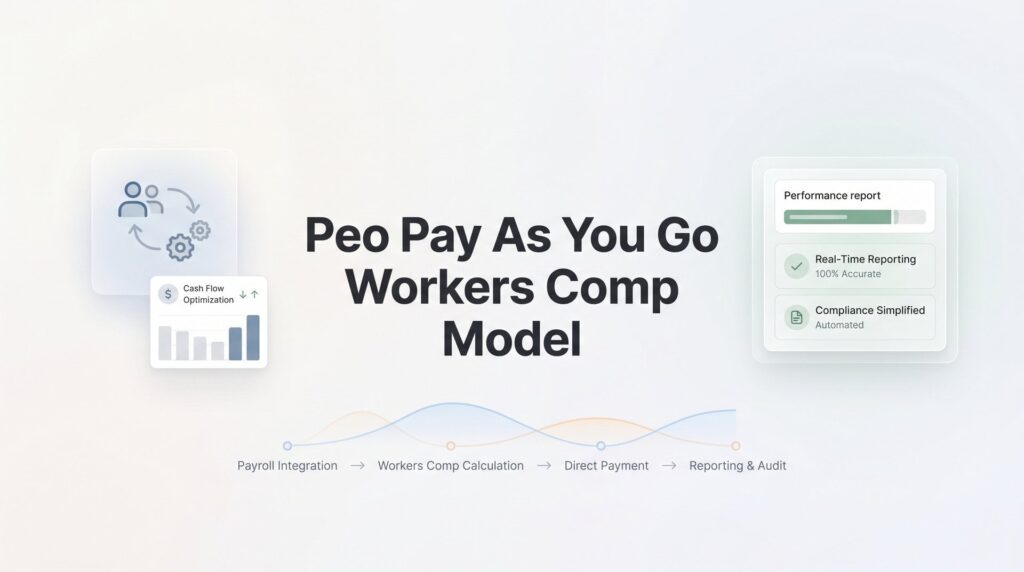
Pay-as-you-go through a PEO works differently at a structural level. The PEO holds a master workers compensation policy that covers all of its client companies’ employees under a single carrier relationship. When you run payroll each cycle, the PEO calculates the workers comp premium owed for that specific payroll run, broken down by class code and actual wages paid. That cost gets bundled into your total PEO invoice for the period.
There’s no annual deposit. No estimated premium to commit to. No year-end audit where someone recalculates everything from scratch. You pay based on what actually happened, not what someone predicted would happen.
The PEO’s master policy is what makes this operationally possible. Because your employees are co-employed by the PEO, they sit under the PEO’s policy rather than a standalone policy in your name. The PEO negotiates rates with the carrier, manages class code assignments across its entire client base, and handles the compliance and filing requirements on the back end. You’re accessing that infrastructure without needing the policy yourself.
What this means practically: your per-payroll workers comp cost is a line item in your PEO invoice, calculated each cycle as a percentage of wages or a rate per $100 of payroll by class code. The math runs automatically. The reconciliation happens in real time rather than once a year.
It’s worth understanding that the underlying insurance product hasn’t fundamentally changed. Workers comp is still workers comp. The class code logic, the rate structures, the claims process — that all works the same way. What’s different is the billing cadence and who holds the policy. Those two changes have meaningful downstream effects on cash flow and administrative burden, but they don’t transform the nature of the coverage itself.
Where the Cash Flow Advantage Is Real (and Where It Gets Oversold)
The genuine benefit of this model is straightforward: you don’t have to write a large upfront check based on a payroll estimate that may or may not be accurate. For businesses with volatile headcount, seasonal swings, or rapid growth, that’s a real and meaningful advantage.
Seasonal businesses in particular feel this acutely. If your payroll doubles during peak season and drops significantly in the off-season, an annual estimated premium either overcharges you for the slow months or undercharges you for the busy ones — and you won’t know which until the audit. Pay-as-you-go eliminates that problem entirely. You pay for what you actually ran, when you ran it.
The elimination of the year-end audit is also underrated. Audits aren’t just a financial risk. They’re an administrative burden: gathering payroll records, sorting workers by class code, responding to auditor questions, potentially disputing findings. For a small HR team managing a lot of other priorities, removing that annual process has real operational value.
Here’s where it gets oversold, though. A common claim in PEO marketing is that pay-as-you-go workers comp saves you money on premiums. That’s not automatically true. The billing cadence changes. The underlying rate per $100 of payroll may or may not be lower than what you’d get on a standalone policy.
Whether the PEO’s effective rate is better than your standalone rate depends on your industry, your loss history, your class code mix, and the PEO’s carrier relationships. In some cases, particularly for higher-risk industries or businesses with poor loss history, the PEO’s pooled buying power genuinely does produce better workers comp rates. In other cases, a well-run business with a clean record and a competitive standalone policy might find the PEO’s bundled rate is higher, not lower.
The harder problem is that the workers comp cost inside a PEO invoice isn’t always transparent. PEOs bundle comp costs into a broader per-employee or percentage-of-payroll fee that also includes HR administration, payroll processing, benefits access, and compliance support. If you can’t isolate the workers comp component of that fee, you can’t actually evaluate whether you’re paying less for coverage or just paying differently.
This is a critical due diligence point. Before you attribute any savings to the pay-as-you-go structure, you need to know exactly what you’re paying for comp versus what you’re paying for everything else. A PEO that can’t or won’t break that out clearly is one you should scrutinize carefully.
What Happens to Your Experience Mod Rate
This is the part of the conversation most PEO sales reps don’t lead with, and it matters more than most businesses realize.
Your experience modification rate (mod rate) is a multiplier applied to your workers comp premium based on your claims history relative to others in your industry. A clean loss history earns you a mod below 1.0, which reduces your premium. A history of frequent or costly claims pushes your mod above 1.0, which increases it.
Under a PEO master policy, your employees’ claims typically roll into the PEO’s aggregate loss experience rather than building a separate mod rate in your name. The PEO’s mod rate reflects the collective claims experience of its entire client base.
For a business with a poor claims history, this can be a genuine advantage. You’re effectively pooled with other businesses, and the PEO’s broader experience may produce a better effective rate than your standalone mod would. That’s real value if your loss history has been rough.
For a business with a clean record, the dynamic is less favorable. You’re contributing to a pool where other clients with worse loss histories are also participating. You may not directly subsidize their claims dollar-for-dollar, but the pooling effect means your clean record isn’t earning you the full premium reduction it would under a standalone policy with your own mod.
The exit risk is where this gets complicated. If you leave the PEO after several years, you may have no independent mod rate to take with you — or the mod that gets reconstructed from your claims history may be less favorable than you’d expect, simply because the data wasn’t tracked in a way that builds your own standalone record cleanly.
Some PEOs, particularly larger ones, offer experience-rated or loss-sensitive programs where your claims history is tracked separately even though you’re under the master policy. This is worth asking about explicitly before you sign, because it directly affects your leverage at renewal and your options if you ever want to exit. If a PEO can’t clearly explain how your claims are tracked and what happens to your loss data when you leave, that’s a meaningful gap in the conversation.
Industries and Scenarios Where This Model Fits Best
Pay-as-you-go workers comp through a PEO isn’t universally better or worse. It fits some business profiles well and adds friction to others. Here’s where it tends to make the most sense.
Seasonal and high-turnover businesses: Hospitality, landscaping, agriculture, event staffing, and similar industries see payroll fluctuate dramatically across the year. Traditional estimated premiums are almost guaranteed to be wrong in one direction or the other. The pay-as-you-go model tracks actual payroll in real time, which means your comp cost rises and falls with your actual workforce rather than being front-loaded or back-loaded based on a projection.
Fast-scaling startups and growth-stage companies: If your headcount is changing quarter to quarter, locking into an annual workers comp estimate creates ongoing reconciliation risk. A company that doubles its workforce mid-year under a traditional policy will face a meaningful true-up at audit. Under a PEO’s pay-as-you-go structure, growth is reflected in real time without creating a surprise liability.
Businesses in higher-risk class codes struggling to find standalone coverage: Small companies in construction, manufacturing, or other elevated-risk categories sometimes find it difficult to secure standalone workers comp at reasonable rates — or at all. Carriers are less enthusiastic about writing small policies in high-risk classes because the exposure is concentrated and the premium volume is limited. The PEO’s pooled buying power and master policy can open access to carriers and rates that simply aren’t available to a small business going direct. For businesses stuck in the assigned risk pool, a PEO can offer a viable assigned risk exit strategy.
Companies with poor or limited loss history: As discussed in the mod rate section, businesses with above-average claims history can benefit from pooling into a larger risk pool where their individual experience has less weight. This isn’t a long-term strategy, but it can provide meaningful relief while a business works on improving its safety practices and claims outcomes.
When the Model Doesn’t Work in Your Favor
There are clear situations where the pay-as-you-go PEO model adds cost or complexity rather than solving a real problem.
Stable headcount with a clean loss history: If your workforce size is predictable year over year and you’ve built a strong experience mod on a standalone policy, you may already have competitive rates. The PEO’s pooled structure could dilute the benefit of your clean record. In this scenario, the billing convenience of pay-as-you-go doesn’t offset what you might give up in rate quality.
Low-risk, office-only operations: Workers comp for clerical and professional service roles is already inexpensive. The rates per $100 of payroll for low-risk class codes are low enough that the PEO’s percentage-of-payroll pricing structure can actually cost more than a flat standalone policy. This is a situation where understanding the workers comp cost allocation model matters, especially if the admin fee isn’t clearly separated from the coverage cost.
Businesses that need granular claims control: Under a PEO master policy, the PEO manages the carrier relationship, the claims process, and often the return-to-work programs. For many small businesses, that’s a feature. For businesses with mature safety programs, dedicated HR staff, or specific operational requirements around how claims are handled, ceding that control can create friction. If you need to direct the claims management process or select specific carrier partners, the PEO model limits your ability to do that.
The honest framing here is that the pay-as-you-go model solves specific problems. If those aren’t your problems, the solution isn’t adding value proportional to what you’re paying for it.
Questions to Ask Before You Sign Anything
If you’re evaluating a PEO and workers comp is part of the conversation, these are the questions that actually matter.
How is the workers comp cost broken out in my invoice? You need a clear, line-item answer. If the PEO can only give you a total per-employee fee without separating the comp component, you can’t evaluate what you’re actually paying for coverage. Understanding how to track and verify workers comp accounting through your PEO is essential here.
What carrier backs the master policy? The carrier matters. It affects claims handling quality, financial stability, and the rates available to the pool. A PEO that’s vague about its carrier relationship is a yellow flag.
How are my claims tracked — pooled or experience-rated? This is the mod rate question in practical terms. Get a direct answer. If claims are pooled, understand what that means for your rate over time. If the PEO offers experience-rated tracking, understand how that data is maintained and what you’d receive if you exit.
What happens to my loss history and mod rate if I leave? This question surfaces the exit risk that doesn’t get discussed enough. A good PEO should be able to explain clearly what data you’d take with you and how a standalone carrier would use it to build your independent mod.
Red flags to watch for: A PEO that refuses to break out the workers comp cost from the bundled admin fee, can’t name the carrier backing the master policy, or can’t explain the class code assignments applied to your workforce is one that deserves more scrutiny before you commit. A thorough PEO workers comp program evaluation can help you systematically assess these factors. These aren’t unreasonable questions. Any PEO worth working with should answer them without hesitation.
The Bottom Line on Pay-As-You-Go Workers Comp
Pay-as-you-go workers comp through a PEO is a billing and risk-pooling structure. That’s the accurate description. It’s not a magic discount, and it’s not right for every business. Whether it adds genuine value depends on your payroll volatility, your loss history, the risk class of your workforce, and how long you expect to stay with the PEO.
The businesses that benefit most are those where traditional estimated premiums create real cash flow problems or where standalone coverage is difficult to access at reasonable rates. The businesses that should be more cautious are those with stable, low-risk workforces and clean loss histories who are already well-served by the standalone market.
The most important practical step is isolating the workers comp cost inside any PEO proposal you’re evaluating. Compare that number across providers. Don’t let it stay buried in a bundled fee where you can’t see what you’re actually paying for coverage versus administration.
If you’re approaching a renewal and aren’t certain you have a clear view of what you’re paying for each component of your PEO contract, that’s worth fixing before you sign anything. Don’t auto-renew. Make an informed, confident decision. PEO Metrics provides detailed side-by-side breakdowns of PEO proposals so you can see exactly what you’re paying for workers comp, administration, and every other bundled service — and compare that clearly across providers before you commit.
