
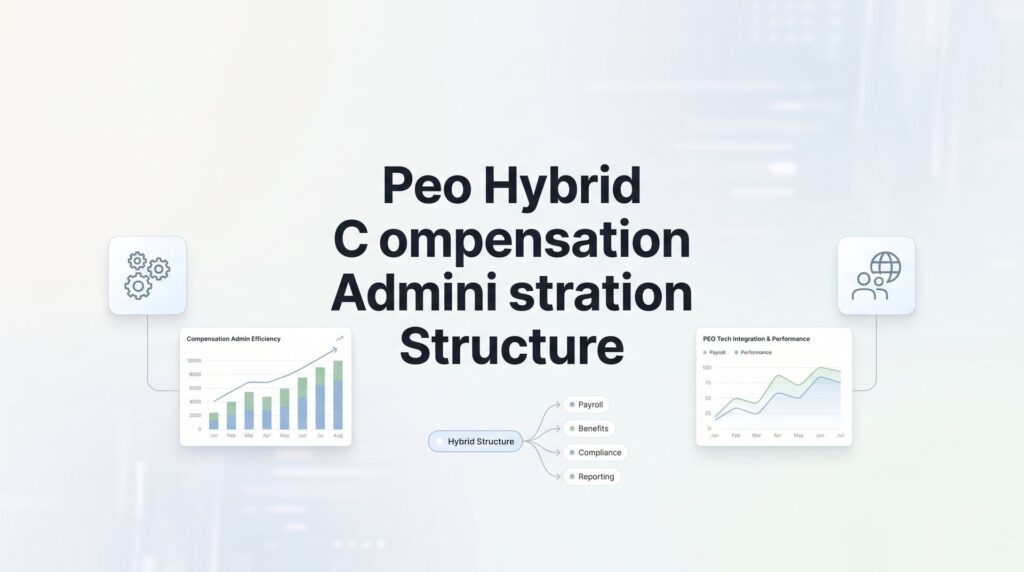
Most companies using a PEO end up with a hybrid compensation structure whether they planned for it or not. You hand over payroll processing and benefits administration, but commissions, bonuses, equity grants, and incentive plans stay on your side of the fence. That’s just how it works in practice — and the operational seam it creates is where a lot of expensive surprises live.
This isn’t a feature you select during PEO onboarding. There’s no checkbox that says “hybrid compensation mode.” It’s an operational reality that emerges the moment your company runs any kind of variable pay alongside standard base salary. The PEO processes what flows through payroll; you design and govern everything else. The question is whether that handoff is clean or chaotic.
What follows is a practical breakdown of how that split actually works: where the boundary falls, what the data handoffs look like, what it costs you that nobody mentions in the sales process, and how to structure your agreement so the arrangement doesn’t blow up during a bonus cycle or a compliance audit. If you’re still getting oriented on what a PEO is or how co-employment works at a foundational level, start with a broader PEO guide first — this article assumes you’ve got that baseline and want to go deeper on the compensation administration layer specifically.
Where the Line Actually Falls Between PEO and Employer
The co-employment model creates a natural boundary, even if nobody draws it explicitly on a diagram. The PEO is the employer of record for tax purposes on the wages it processes. That means base salary, standard payroll taxes, and benefits deductions sit squarely in the PEO’s lane. They run those numbers, file the taxes, and handle the remittance.
Variable compensation is a different story. Commission structures, bonus plans, equity vesting schedules, deferred compensation arrangements — those are compensation strategy decisions. The employer owns them. The PEO doesn’t design them, doesn’t approve them, and in most cases doesn’t want to. They’re a processor, not a compensation consultant.
The hybrid structure emerges from that division. Your PEO handles the mechanical execution of payroll; you handle the business logic behind what people get paid. The problem is that those two worlds have to connect every pay period, and the connection point is where things get messy. Understanding how a PEO works step by step helps clarify where that mechanical execution ends and your responsibility begins.
Here’s something that trips up a lot of companies: “hybrid” isn’t a formal product tier that PEOs offer. You won’t find it in a pricing brochure. It’s just what happens when a company doesn’t hand over 100% of compensation administration — which describes most companies with any kind of performance pay. If you have a sales team on commission, a leadership team on annual bonuses, or anyone with equity, you’re operating a hybrid structure by default.
The practical implication is that your in-house team retains meaningful administrative responsibility even after signing with a PEO. Someone on your side has to calculate commissions, approve bonus amounts, track equity vesting events, and get that data to the PEO in time for payroll processing. If you assumed the PEO would absorb that work, that’s a gap worth closing before it creates a problem.
Some PEOs are more flexible about accommodating variable comp than others. A few have built integrations with commission tracking software or offer supplemental payroll runs as a standard feature. Many haven’t. Evaluating how different providers handle this split is one of the more useful things you can do before committing to a PEO relationship — and it’s worth asking specifically, not just reading the marketing materials. A practical integration guide for PEO and internal HR can help you map out those responsibilities clearly.
The Mechanics Nobody Walks You Through: Data Handoffs, Cutoffs, and Reconciliation
Let’s get into the operational reality of how variable comp data actually moves from your team to the PEO’s payroll system.
Every pay period, someone on your side has to calculate what’s owed in variable compensation, get it approved through whatever internal process you have, and then transmit that data to the PEO before their payroll processing cutoff. That cutoff is non-negotiable. Miss it, and you’re either delaying payment to employees or paying for an off-cycle payroll run — assuming your PEO even offers that option without additional fees.
The data format matters more than most people expect. PEOs typically accept variable comp data via spreadsheet upload, and the column headers, employee ID formats, and compensation codes have to match their system exactly. If your commission calculation lives in a custom spreadsheet or a CRM-adjacent tool, you’re probably doing a manual translation step every cycle. That’s a human error waiting to happen.
Some PEOs have APIs that can connect to commission tracking platforms or HCM systems, but the integration depth varies significantly. In many cases, “integration” means a scheduled file export rather than a real-time data sync. Middleware tools can help bridge the gap, but they add cost and complexity, and they require someone to own the configuration and maintenance. Companies exploring this challenge may benefit from understanding the broader PEO hybrid HR operating model to see how data flows fit into the larger picture.
The reconciliation burden is where the real operational weight sits. When your team calculates the compensation and the PEO runs the payroll, there’s a gap between those two systems that has to be owned by someone. Gross-to-net calculations on variable comp aren’t always straightforward — supplemental wages have different withholding treatment than regular wages under IRS rules, and the rates can vary depending on how the payment is structured and whether it’s paid alongside or separately from regular wages.
Multi-state employers have an additional layer of complexity. Commission sourcing rules differ by state, meaning the same commission payment might be taxed differently depending on where the work was performed versus where the employee is located. If your PEO’s system doesn’t handle that allocation correctly, the error sits in a gray zone between what they processed and what you calculated — and reconciling it after the fact is tedious and sometimes costly.
The practical advice here: document your reconciliation process before you need it. Know exactly who on your team owns the comparison between what you calculated and what the PEO processed. Build that review into your payroll cycle, not as an afterthought. Errors caught before payroll runs are cheap. Errors caught after employees are paid — or worse, after a tax filing — are expensive.
The Cost and Compliance Surprises That Don’t Show Up in the Sales Deck
PEO pricing is typically structured as either a per-employee-per-month fee or a percentage of total payroll processed. If your arrangement is percentage-based, your PEO costs go up whenever your total payroll goes up — including when variable comp spikes. A detailed breakdown of PEO pricing and cost structure can help you understand exactly where those fee escalations come from.
Think about what that means in practice. A large quarterly bonus payout or a commission-heavy month increases your PEO invoice, even though the PEO had nothing to do with designing or approving that compensation. They processed the payroll, yes. But the administrative work on their end is marginal compared to the fee increase you’re absorbing. This isn’t a hidden fee exactly — it’s in the contract — but it’s something many companies don’t model when they’re evaluating PEO cost versus in-house payroll.
Compliance ownership is the other area where hybrid structures create friction. Supplemental wage withholding rates are set by the IRS and vary by state, and the rules differ depending on whether a payment is a bonus, a commission, or equity-related income. In a hybrid model, the question of who ensures those rates are applied correctly doesn’t always have a clear answer. Choosing an IRS certified PEO can provide additional protections, but it doesn’t eliminate the need for clear compliance ownership on variable comp.
The PEO will apply withholding based on the data you submit and their system configuration. If the configuration is wrong, or if your submission doesn’t flag the payment type correctly, the withholding will be wrong. When an employee or auditor catches it later, the finger-pointing starts. The PEO will say they processed what you gave them. You’ll say they should have caught the error. The contract language usually determines who’s actually liable — which is why that language matters so much before you sign.
Workers’ compensation premium is another cost implication that gets overlooked. Wages processed through the PEO payroll feed into your workers’ comp premium calculation. Large variable comp payouts — especially in roles that carry higher risk classifications — can distort your experience mod and drive up your workers’ comp costs in ways that aren’t obvious until renewal. Understanding how PEO workers’ compensation management actually works helps you anticipate these premium impacts before they hit your bottom line.
None of this means a hybrid structure is the wrong choice. It means you need to model the full cost — not just the base PEO fee — and understand where compliance responsibility lives before something goes wrong.
When Hybrid Works and When It Quietly Breaks Things
Hybrid compensation administration works well in a fairly specific set of conditions. If your base pay is straightforward, your PEO handles it cleanly, and you have one variable comp program with predictable timing and clean data — a quarterly bonus, for example, with a fixed approval process — the handoff is manageable. Your team calculates the number, submits it to the PEO on schedule, and payroll runs without drama.
It starts to break down when the variable comp side gets complicated. Multi-tier commission plans with different rates, accelerators, draws, and clawbacks are hard to reconcile even internally. Adding a PEO payroll layer on top of that complexity creates a reconciliation burden that can consume significant administrative time every cycle. The more moving parts in your commission structure, the higher the risk that something gets submitted incorrectly or processed differently than intended. Using a PEO cost structure modeling template can help you quantify that administrative overhead before it spirals.
Equity compensation is its own category of complexity. RSU vesting events, ESPP purchases, and stock option exercises all have specific tax treatment that differs from regular wages. The timing of when those events hit payroll, how they’re reported, and how withholding is handled requires coordination between your equity plan administrator, your payroll processor, and potentially your tax advisor. Expecting a PEO to absorb that coordination without explicit, detailed process design is optimistic.
Deferred compensation is another area where hybrid arrangements struggle. Non-qualified deferred comp plans have specific ERISA and IRS compliance requirements, and the interaction between deferred comp elections, payroll processing, and W-2 reporting is something most PEOs aren’t set up to manage as part of a standard arrangement.
The decision framework is straightforward, even if the execution isn’t: if your in-house team can own the reconciliation and compliance gap between what they calculate and what the PEO processes, hybrid can work. If they can’t — because the comp structure is too complex, the team is too thin, or the data systems don’t connect cleanly — the hybrid model will cost you more in errors, corrections, and audit exposure than the PEO convenience is worth. At that point, you’re either better off bringing more compensation administration in-house or finding a PEO with deeper variable comp capabilities. Comparing internal HR costs versus PEO expenses can help you make that call with real numbers.
What to Lock Down in the Contract Before You Sign
The PEO contract is where hybrid compensation arrangements either get properly defined or left to interpretation. Most standard PEO agreements aren’t written with complex variable comp in mind, so you’ll need to push for specificity on several points.
Data submission deadlines and error correction ownership: Get the payroll cutoff dates in writing, and specify what happens when variable comp data is submitted late or incorrectly. Who owns the correction? Who pays for the off-cycle payroll run if one is needed? These aren’t hypotheticals — they’ll happen, and you want the answer documented before the situation is live.
Fee calculation on variable comp: If your PEO charges a percentage of payroll, negotiate clarity on how variable comp is treated in that calculation. Some PEOs will cap the percentage on supplemental wages or exclude certain comp types from the fee base. It’s worth asking even if the default answer is no — and it’s worth modeling what your fees look like in a high-commission month before you assume the arrangement is cost-effective.
Off-cycle payroll runs: Commission payouts and bonus cycles don’t always align with standard payroll schedules. Many PEOs charge additional fees for off-cycle runs, and some restrict when they can be processed. If your compensation structure requires irregular payroll timing, get the specific terms — frequency limits, per-run fees, processing windows — in the contract, not in a verbal assurance from the sales rep.
Audit rights over payroll processing accuracy: You should have the contractual right to audit the PEO’s payroll processing for your employees. This is especially important for multi-state employers where tax allocation and withholding complexity is high. If the PEO resists this provision, that’s worth noting. Understanding the PEO compliance audit hybrid structure can help you frame what audit access should look like in practice.
Exit and data migration terms: If you leave the PEO, you need clean access to all compensation data processed during your relationship. Year-end W-2 accuracy depends on it, and tax filing continuity requires it. Specify how data is exported, in what format, and who is responsible for corrections to prior-period filings if errors surface after the relationship ends. A thorough PEO exit and cancellation guide covers the data migration pitfalls you’ll want to avoid.
Putting It Together Before You Commit
Hybrid compensation administration isn’t a problem to be solved — it’s a structure to be managed. Most companies using a PEO are operating some version of it, whether they’ve named it that or not. The difference between companies that make it work and companies that spend months untangling payroll errors usually comes down to one thing: how clearly they defined the boundary before the relationship started.
Know exactly what your PEO owns and what you own. Build a reconciliation process and assign it to someone. Understand how your variable comp volume affects your PEO fees. Get the compliance ownership questions answered in the contract, not assumed in conversation. And if your compensation structure is genuinely complex — multi-tier commissions, equity, deferred comp — be honest about whether the PEO arrangement is actually simplifying your operations or just shifting the complexity around.
Before you sign or renew a PEO agreement, it’s worth looking at how different providers handle hybrid arrangements. The flexibility, fee structures, and data integration capabilities vary more than most businesses realize, and those differences matter a lot when variable comp is part of the picture.
Don’t auto-renew. Make an informed, confident decision. Many businesses overpay because their PEO contract wasn’t structured around the actual complexity of their compensation mix. A side-by-side comparison of providers — with real pricing and contract terms — gives you the leverage to negotiate better or switch to a provider that’s genuinely built for how your company pays people.
