
You get a notice from the Department of Labor. Or a state wage and hour agency. Maybe it’s an OSHA citation. Your first instinct is to call your PEO, because you’ve been paying them to handle this stuff. Then someone on their end says, carefully, that this particular issue falls under your responsibility as the worksite employer.
That moment — the scramble to figure out who dropped the ball and who’s actually on the hook — is exactly what the layered compliance accountability model is designed to prevent. Most business owners never think about it until they’re already in trouble.
Co-employment doesn’t work the way a lot of people assume it does. Signing a PEO agreement doesn’t transfer your compliance obligations to another party. It distributes them. Some sit clearly with the PEO. Some sit clearly with you. And a meaningful chunk lands in a gray zone where both parties have partial responsibility and neither has taken explicit ownership. That gray zone is where most compliance failures actually happen.
This article breaks down how the layered model works in practice, what your contract language is actually telling you, where the real exposure lives, and what to look for before you sign or renew with any PEO.
Co-Employment Doesn’t Mean Compliance Transfer
Here’s the structural reality: in a co-employment arrangement, your PEO becomes the employer of record for tax and benefits purposes. You remain the worksite employer with direct control over operations. Both relationships are legally real, and both carry compliance obligations tied to them.
The mistake most business owners make is treating the PEO contract like a compliance outsourcing agreement. It isn’t. What it actually does is split employer responsibilities across regulatory domains, and which party owns which domain depends on the nature of the obligation.
Think about it this way. Payroll tax filing requires a defined employer of record with remittance authority. That’s the PEO’s lane. But workplace safety requires someone with direct control over the physical work environment. That’s yours. Those aren’t arbitrary distinctions — they reflect how the underlying regulations actually work and who the relevant agencies hold accountable. Understanding what PEO HR compliance services actually cover is essential before making assumptions about your exposure.
The IRS, DOL, and OSHA each look at co-employment differently. OSHA, for example, has been consistent for years: the worksite employer is primarily responsible for workplace safety regardless of whether a PEO is involved. The agency’s position is that the party controlling the work environment controls the safety risk. Your PEO relationship doesn’t change that calculus.
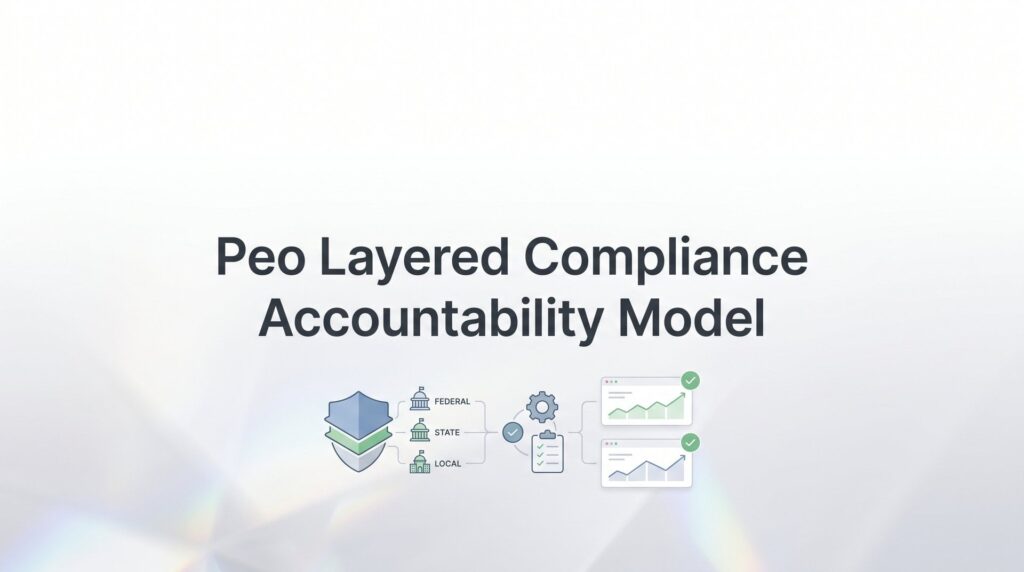
This is where the “layered accountability” framework becomes useful. Instead of thinking about compliance as something you’ve handed off, think about it as a map. Each regulatory domain has an owner. Some domains are clearly the PEO’s. Some are clearly yours. And some require both parties to actively coordinate, which is where things break down when no one has defined the handoffs.
The businesses that get hurt aren’t usually the ones who ignored compliance entirely. They’re the ones who assumed a layer was covered when it wasn’t, because nobody sat down and mapped it explicitly at the start of the relationship.
Mapping the Layers: What the PEO Owns, What You Own, and What Nobody’s Claimed
Let’s get specific, because vague descriptions of “shared responsibility” aren’t useful when you’re trying to understand your actual exposure.
PEO-Owned Compliance: In a well-structured co-employment arrangement, the PEO typically owns payroll tax filing and remittance, federal and state unemployment insurance administration, workers’ compensation claims processing, benefits plan compliance under ERISA, and ACA reporting obligations. These are the areas where the PEO’s employer-of-record status gives them both the authority and the accountability to act.
Client-Owned Compliance: You own OSHA workplace safety. You own hiring and termination decisions. You own day-to-day employee supervision. You own anti-discrimination and harassment prevention at the worksite level. And critically, you own compliance with many state-specific employment laws that apply based on where your employees actually work — not where your PEO is headquartered.
That last point trips people up constantly. Your PEO may be excellent at federal compliance and completely passive about a state-level predictive scheduling ordinance, a local pay transparency law, or a new state leave requirement that took effect last quarter. If it’s not in their scope of services, it’s not on their radar. This is especially critical for businesses navigating multi-state payroll compliance across several jurisdictions.
The Gray Zone: This is where the real risk lives. Worker classification decisions — 1099 versus W-2 — involve both parties but often default to client responsibility when challenged. Multi-state wage and hour compliance requires someone to actively track which state’s rules apply to which employee, and that coordination is frequently undefined in the contract. Leave law administration under FMLA and state leave laws sits in a particularly murky space: the PEO may administer the paperwork while you’re still responsible for the underlying policy decisions and worksite-level compliance.
Employee handbook policies are another gray zone issue. A PEO might provide a template handbook, but enforcement of those policies happens at your worksite, under your management structure. When a policy violation leads to a discrimination claim, the question of whether the handbook language was adequate and whether it was consistently enforced falls on you.
The gray zone isn’t a design flaw — it’s an inherent feature of dual-employer structures. The problem is that most PEO sales conversations gloss over it entirely, and most client service agreements don’t define it clearly enough to be useful when something goes wrong.
Reading Your Client Service Agreement Like a Compliance Document
Your CSA is the actual governing document for compliance accountability, and most business owners never read it with that lens. Here’s what to look for.
Scope of Services Language: This section defines what the PEO is actually committing to do. Watch for the difference between “compliance support” and “compliance management.” Support typically means they’ll give you information or templates. Management means they’re taking operational ownership. Those two things are not the same, and the distinction matters enormously when a regulatory agency comes knocking.
Indemnification Clauses: Many PEO agreements contain indemnification language that sounds mutual but is structured to shift most regulatory liability back to the client for anything outside the PEO’s explicitly defined service scope. Read it carefully. If the indemnification section is broad on the client side and narrow on the PEO side, that’s a signal about how they view their compliance exposure. Knowing how to negotiate these provisions is critical — review these PEO indemnification negotiation tips before you sign.
Limitation of Liability Provisions: Some agreements cap the PEO’s total liability at a fixed dollar amount or limit it to fees paid. If you’re running a 50-person company and your potential wage-and-hour exposure is significant, a liability cap that’s a fraction of your risk isn’t meaningful protection.
Regulatory Correspondence and Audit Response: Who handles it when a government agency sends a notice? Who responds to an unemployment audit, an IRS inquiry, or a DOL investigation? Strong agreements define this explicitly — which party is the primary point of contact, what the escalation path looks like, and what the PEO’s obligations are in terms of documentation support. Weak agreements leave this undefined, which means you find out how it works when you’re already under pressure. Understanding how a PEO supports you during audit protection scenarios should be part of your due diligence.
Red flags to watch for: vague “compliance assistance” language without defined deliverables, blanket disclaimers that the PEO is not responsible for client-side regulatory compliance without specifying what “client-side” actually includes, and missing language around new law tracking in your operating states.
What strong accountability language looks like: a compliance responsibility matrix that maps specific obligations to specific parties, explicit protocols for agency audit response, defined timelines for notifying the client of relevant regulatory changes, and mutual indemnification structured around each party’s actual domain of control.
Where the Model Actually Breaks Down
The structural analysis above is useful, but it’s worth walking through what failure actually looks like in practice — because the scenarios are more common than most PEO sales conversations suggest.
The multi-state leave law gap: A business operating in five states assumes their PEO is tracking state-specific leave requirements across all of them. The PEO’s agreement, buried in the scope of services section, lists only the states where the PEO has established payroll operations. A new paid family leave law takes effect in one of the client’s operating states. Nobody notifies the client. An employee requests leave, gets denied, and files a complaint. The state agency investigates and holds the employer — the client — liable for non-compliance. The PEO’s position: that state wasn’t in scope. Businesses with employees in multiple jurisdictions should understand the specific challenges covered in our guide to PEOs for multi-state companies.
The advisory-only safety program: A PEO markets a robust workplace safety program. The client assumes this means their OSHA obligations are covered. What the contract actually says is that the PEO provides safety resources and recommendations. When an employee is injured and OSHA investigates, the citation goes to the worksite employer. The PEO’s safety program had no enforcement mechanism, no site-specific hazard assessments, and no documentation trail that would support a reduced penalty. The client is left with the fine and the litigation.
The misclassification no-man’s-land: A company uses a mix of W-2 employees (through the PEO) and independent contractors. A state agency audits the contractor relationships and determines several workers should have been classified as employees. The client assumed the PEO would flag classification risk. The PEO’s position is that contractor relationships are outside their scope entirely. Neither party had taken clear ownership of classification review. The client faces back taxes, penalties, and potential benefit liability.
On the tax side, it’s worth understanding what IRS Section 3511 actually does and doesn’t do. The Certified Professional Employer Organization (CPEO) designation, established under the Small Business Efficiency Act, makes CPEOs solely liable for federal employment tax obligations on wages they pay. That’s a meaningful accountability shift — it gives clients real protection on payroll tax penalty protection. But it’s limited to federal employment taxes. It doesn’t touch OSHA liability, discrimination claims, wage and hour disputes, or state-level compliance obligations. CPEO status is a positive signal, but it’s not a compliance umbrella.
When compliance accountability is genuinely ambiguous, regulatory agencies often hold both parties responsible. The co-employment relationship doesn’t create a shield — it creates a question of which employer had control over the relevant conduct. Business owners who assume they can hide behind the PEO relationship in a regulatory dispute typically find out the hard way that the agency doesn’t see it that way.
How to Evaluate a PEO’s Compliance Structure Before You Commit
The good news is that you can pressure-test a PEO’s compliance accountability model before you sign. Most business owners don’t do this because they don’t know what to ask. Here’s a practical framework.
Ask for the compliance responsibility matrix upfront. Any PEO with a serious compliance infrastructure should be able to hand you a document that maps specific obligations to specific parties. If they can’t produce one, or if the answer is “that’s covered in the CSA” without a clear breakdown, that’s a meaningful data point about how they think about compliance ownership. You should also verify their financial disclosure requirements to ensure transparency across the relationship.
Ask how they handle regulatory correspondence. Specifically: if you receive a notice from a state agency tomorrow, what happens? Who is the primary contact? What’s the response timeline? What documentation support do you get? The answer tells you a lot about whether their compliance function is operational or just a checkbox on a sales sheet.
Ask what happens when a new law passes in your operating states. Do they proactively notify clients? Is there a dedicated compliance team monitoring state-level changes, or does that responsibility default to the client? If you’re operating in multiple states, this is a critical question with a real cost if the answer is inadequate. Tracking these obligations systematically is part of understanding the broader compliance reporting requirements your business faces.
Verify whether they have dedicated compliance staff or outsource it. Some PEOs have in-house compliance attorneys and HR compliance specialists. Others rely on third-party resources or push compliance questions to a general HR support line. The difference matters when you’re dealing with something nuanced.
On certifications: CPEO certification and ESAC accreditation are both worth understanding as baseline indicators. CPEO status signals that the IRS has verified the PEO’s financial stability and operational standards for payroll tax purposes. ESAC accreditation provides independent financial assurance and operational standards verification across the broader PEO operation. Neither guarantees perfect compliance outcomes, but both indicate that the PEO has submitted to external accountability standards — which is more than you can say for uncertified providers. Our CPEO evaluation guide walks through what these certifications actually mean in practice.
The cost dimension is worth addressing directly. PEOs with stronger compliance accountability structures often charge more. That’s real. But the cost of a compliance gap — regulatory penalties, back-pay liability, litigation costs, reputational damage — typically dwarfs the difference in administrative fees. Evaluating PEO cost without evaluating compliance depth is a false economy. The right frame is risk-adjusted cost: what does this provider cost, and what risk am I absorbing at that price point?
The Bottom Line on Compliance Ownership
The layered compliance accountability model isn’t a theoretical framework — it’s the operating reality of every co-employment relationship, whether or not anyone has named it explicitly. The business owners who get burned are almost always the ones who assumed their PEO was handling something that was actually sitting in the gray zone, unowned by either party.
Before you sign or renew with any PEO, do three things. Map the compliance layers explicitly against your actual regulatory exposure — not just the standard list, but the state-specific obligations for every state where you have employees. Read your CSA with compliance ownership in mind, not just service scope. And pressure-test the gray areas with specific questions, not general reassurances.
If a PEO can’t clearly articulate who owns what on compliance, that’s not a minor detail. It’s a structural signal about how disputes will go when something breaks down.
Compliance accountability should be a primary evaluation criterion when comparing PEO providers, not an afterthought. Most businesses evaluate PEOs on price and HR features. The ones who’ve been through a regulatory dispute evaluate them on accountability structure first.
Before you sign that PEO renewal, make sure you’re not leaving money on the table. Many businesses unknowingly overpay because of bundled fees, hidden administrative markups, and contracts designed to limit flexibility. PEO Metrics gives you a clear, side-by-side breakdown of pricing, services, and contract terms — so you can see exactly what you’re paying for and choose the option that truly fits your business. Don’t auto-renew. Make an informed, confident decision.
