
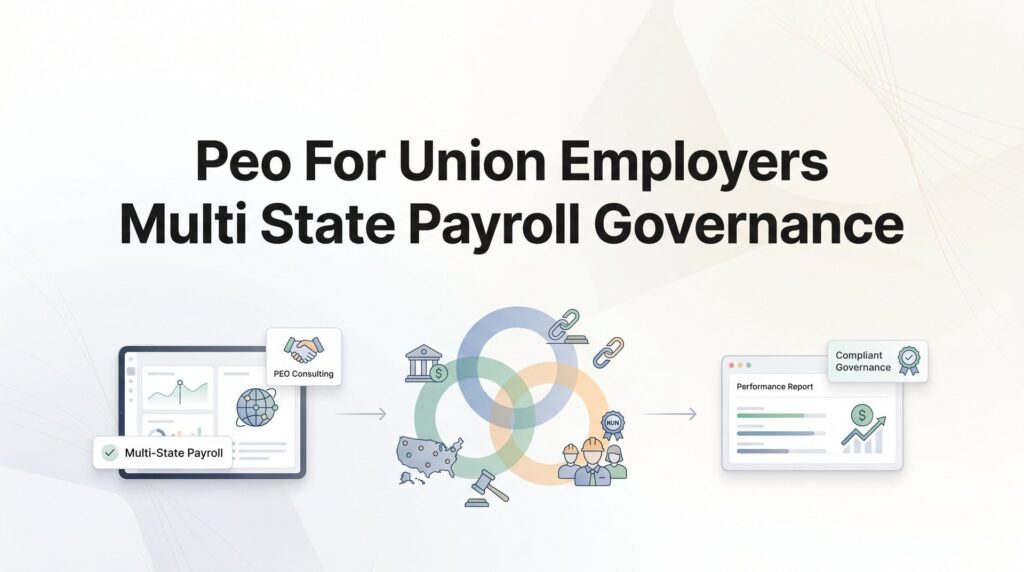
Union employers with multi-state operations face a payroll governance challenge that most PEO providers simply aren’t built to handle. You’re not just managing different state tax withholding rules and wage laws — you’re layering collective bargaining agreements, union trust fund remittances, prevailing wage requirements, and jurisdictional reporting obligations on top of all that.
The typical PEO pitch glosses over this complexity. Most providers are designed for non-union, single-state employers with straightforward W-2 payroll. When you introduce union dues deductions, multi-jurisdictional fringe benefit calculations, and CBA-driven pay scales that vary by trade and locality, the standard PEO model starts to crack in ways that aren’t obvious until payroll errors trigger union grievances or a state audit flag lands in your inbox.
This guide walks through the specific steps to evaluate, structure, and govern a PEO relationship when your workforce is unionized and spread across state lines. We’re not covering PEO basics here. If you need foundational context on what a PEO does or how co-employment works, start with a foundational PEO comparison guide first. This article assumes you already understand the model and need to know how to make it work for the particular complexity that is union payroll across multiple states.
You’ll walk away with a practical framework for vetting providers, structuring your governance model, and avoiding the costly mistakes that happen when union payroll requirements fall through the cracks of a co-employment arrangement.
Step 1: Map Every CBA Payroll Obligation by State and Local Jurisdiction
Before you talk to a single PEO provider, you need a complete picture of what you’re actually asking them to handle. Most employers underestimate how much variation exists across their own active agreements until they try to put it in writing.
Start by building a master matrix of every active collective bargaining agreement your organization operates under. For each CBA, document the following: applicable pay scales by job classification, fringe benefit contribution rates (health and welfare, pension, training, vacation funds), overtime calculation rules, and union trust fund remittance schedules. Break this out by state and, where applicable, by local union jurisdiction. A single state can have multiple locals with materially different contribution rates and reporting requirements.
Next, identify where CBA terms conflict with or exceed state wage and hour laws. This is where multi-state payroll compliance complexity compounds quickly. Prevailing wage states like California, New York, and Illinois impose their own wage determination frameworks for public works projects, and those requirements layer on top of your CBA obligations. In right-to-work states, union security clause enforceability changes, which directly affects how you configure dues deduction setups in payroll. The PEO must be capable of handling the more restrictive standard in every jurisdiction — not just the state baseline.
Flag every jurisdiction where you have certified payroll reporting obligations. If you’re doing public works projects in California, you’re dealing with the Department of Industrial Relations’ electronic certified payroll system. New York has its own prevailing wage enforcement framework. Illinois has project-level reporting requirements that most generic payroll platforms can’t handle natively. These aren’t edge cases — they’re core compliance requirements, and they need to be in your mapping exercise before you evaluate any vendor.
Also document your union trust fund remittance schedules. Most CBAs require contributions to be remitted monthly, but the specific deadlines, reporting formats, and fund administrator contacts vary. Some funds require electronic remittance through specific portals. Others still accept paper reports. This operational detail matters enormously when you’re asking a PEO to take on remittance execution.
Why does this inventory step matter so much? Because if you skip it, you’ll discover gaps after onboarding, when payroll errors have already triggered union grievances or state employment law risk flags. Walking into a PEO conversation without this matrix means you’re evaluating vendors based on their sales pitch rather than their actual capability to handle your specific obligations. Build the matrix first. It becomes your vetting checklist, your contract annex, and your ongoing audit reference all at once.
Step 2: Vet PEO Providers for Real Union Payroll Capabilities
Here’s the honest reality of the PEO market: the vast majority of providers serve non-union small-to-midsize businesses. Union-capable PEOs represent a genuinely small segment, which means your provider selection process is more constrained than a typical PEO comparison for multi-state companies. You’re not choosing from a wide field — you’re filtering down to a short list of providers that can actually do the job.
The most important thing you can do in this phase is ask direct questions and demand proof. Not demos, not promises of customization — proof in the form of current union clients who will speak with you.
Start with these screening questions:
Trust fund remittances: Can the PEO process contributions to multiple union trust funds across different locals, on different remittance schedules, with different reporting formats? Ask them to walk you through exactly how this works operationally, not conceptually.
Multi-rate payroll: Can their platform handle multiple pay rates per employee based on job classification and jurisdiction within the same pay period? A carpenter working on two different job sites in the same week — one prevailing wage, one not — needs accurate rate tracking at the project level.
Fringe benefit allocation: Can they automate the allocation of fringe benefit obligations between cash wages and trust fund contributions, per CBA specifications? This is a common failure point for platforms designed around simple benefits administration outsourcing.
Prevailing wage tracking: Do they support certified payroll reporting in the specific states where you operate? Ask which states they’ve actually done this in, not which states they theoretically support.
CBA rate table management: When your CBA renews and pay scales change mid-contract, how does that update flow through their system? Manual workarounds are a red flag — they introduce error risk and put compliance burden back on your team.
The red flag to watch for: if a PEO responds to these questions with “we can customize that for you” but can’t produce a reference from an existing union client, walk away. Customization promises in PEO sales conversations often translate to manual workarounds that break down under operational pressure. You need a provider who has solved these problems before, not one who’s willing to try.
Also ask about their implementation team’s experience with union payroll specifically. A PEO with strong non-union capabilities can still struggle badly on a union implementation if the people running your setup don’t understand CBA mechanics.
Step 3: Define the Co-Employment Boundary Around Union Obligations
This is where a lot of union employers get into trouble. The co-employment model creates shared employer status between you and the PEO, but it does not transfer your obligations under the National Labor Relations Act. You remain the employer of record for purposes of collective bargaining, CBA compliance, and labor relations. The PEO is not your buffer against union grievances.
Get this in writing, clearly, before you sign anything.
The service agreement should explicitly define which party is responsible for each category of obligation. A workable structure typically looks like this: the PEO handles payroll execution — wage calculations, tax withholding, union dues deductions, trust fund remittances, and certified payroll report generation. You retain governance over CBA interpretation, grievance resolution, labor relations decisions, and any pay adjustments that result from grievance outcomes or arbitration. Understanding the full scope of PEO payroll services helps you define exactly where the PEO’s responsibilities begin and end.
The reason this boundary matters operationally: when a union grievance results in a retroactive pay adjustment, someone has to calculate what’s owed, process the correction, and potentially remit additional trust fund contributions. If the contract doesn’t define this clearly, you’ll find yourself in a dispute with your PEO about who’s responsible for fixing it and who absorbs the cost of any penalties.
Also address fringe benefit compliance liability explicitly. If the PEO makes an error in trust fund remittances — wrong amount, wrong fund, missed deadline — who is liable for the resulting penalties? Most PEOs will accept liability for errors caused by their processing, but they’ll resist liability for errors caused by incorrect information you provided. That distinction needs to be documented.
One step most employers skip: bring your union representatives into the conversation early. Some CBAs contain language that restricts or complicates co-employment arrangements. A CBA that defines “employer” narrowly, or that requires the employer to maintain direct payroll processing, could create a compliance problem the moment you move to a PEO model. A thorough risk mitigation assessment should include reviewing these CBA provisions before you’ve signed contracts and announced the transition.
Your labor counsel should review the co-employment agreement alongside your CBA obligations. This isn’t optional for union employers — it’s the step that prevents a governance structure that looks clean on paper from creating legal exposure in practice.
Step 4: Build a Multi-State Tax and Compliance Governance Layer
Multi-state union payroll creates tax complexity that compounds in ways that aren’t obvious until you’re dealing with the consequences. The two areas that generate the most expensive surprises are State Unemployment Insurance rate management and reciprocal state tax handling for traveling workers.
On SUI: each state administers its own unemployment insurance program with different rate structures, taxable wage bases, and experience rating methodologies. When a PEO registers under its own Federal Employer Identification Number in each state, your individual experience rating may be pooled with the PEO’s broader client base. Depending on your claims history, that pooling can work in your favor or against you significantly.
Ask every PEO you’re evaluating a direct question: do you register under your FEIN or ours in each state where we operate? If they register under their FEIN, understand exactly how your SUI rates are determined within their pooled structure. Get a clear comparison between your current standalone rates and what you’d pay under the PEO’s pool. For union employers with construction or trades workforces, seasonal layoffs and project-end separations can drive unemployment claims higher than average — which means unfavorable pooling has real dollar consequences. Proper payroll tax liability accounting becomes essential for tracking these costs accurately across states.
The same FEIN question applies to workers’ compensation. If the PEO carries workers’ comp under their policy, your experience modification rate may be absorbed into their broader pool. For union contractors, where workers’ comp is a significant cost line, understanding how your mod rate translates under the PEO structure is critical — especially if you’re considering workers’ comp multi-entity consolidation across your business structure.
For traveling workers — union members who move between job sites in different states within the same pay period or quarter — you need to address reciprocal state tax agreements and resident vs. work-state withholding rules. Some states have reciprocal agreements that simplify withholding; others don’t, and you end up with employees needing to file in multiple states. The PEO’s platform needs to handle this accurately, and your payroll team needs to understand the rules well enough to catch errors.
Finally, build a compliance calendar that layers all of these obligations together: state tax filing deadlines, quarterly SUI filings, certified payroll report submission windows, CBA reporting periods, and union trust fund remittance due dates. This calendar becomes your governance baseline. Without it, things fall through the cracks — and in union payroll, things falling through the cracks typically means penalties and grievances.
Step 5: Establish Ongoing Audit and Reconciliation Protocols
Setting up the governance structure is step one. Keeping it working is the ongoing job. Union payroll across multiple states generates enough moving parts that errors will occur — the question is whether you catch them quickly or discover them when a fund administrator sends a delinquency notice.
Set up monthly reconciliation between PEO payroll reports and union trust fund statements. This is the single most important operational habit you can build. Discrepancies between what the PEO remitted and what the trust fund received are the primary source of grievances and penalty assessments for union employers. The reconciliation doesn’t need to be elaborate — it needs to be consistent and documented. Understanding payroll accrual adjustments helps ensure your books stay aligned with actual remittance activity.
Require the PEO to provide jurisdiction-level payroll detail, not just company-wide summaries. You need to be able to verify prevailing wage compliance and CBA rate accuracy by job site, by local union, and by pay period. If the PEO can only give you aggregate data, you lose the ability to audit compliance at the level where errors actually occur. This is a non-negotiable data requirement — put it in the contract.
Build in quarterly governance reviews where you compare actual PEO costs against your pre-contract financial model, broken out by state and union local. PEO costs in multi-state union environments tend to drift from initial projections as headcount, job classifications, and jurisdictional mix change. Quarterly reviews let you catch cost creep before it accumulates into a significant variance.
Define escalation paths for payroll errors that trigger union grievances. Specifically: who identifies the error, who calculates the correction, who processes the adjustment, who pays any resulting penalties, and what’s the service level agreement for resolution? Employers who have invested in PEO audit protection understand that documented processes are your best defense when regulators come calling. If this isn’t documented before a grievance happens, you’ll be negotiating the process under pressure while a clock is running on the grievance timeline. That’s not a position you want to be in.
One practical addition: designate a single point of contact on your team who owns the PEO relationship operationally. Multi-state union payroll is complex enough that having multiple people managing different pieces without a central owner creates coordination gaps. The person in this role needs to understand both payroll mechanics and CBA obligations — or have direct access to someone who does.
Step 6: Plan Your Exit Strategy Before You Sign
This step gets skipped constantly, and it’s the one that creates the most painful situations when PEO relationships end. Union payroll transitions are significantly harder than non-union transitions. You’re not just reclaiming payroll processing — you’re reclaiming state registrations, SUI experience ratings, workers’ comp policies, trust fund remittance processes, and certified payroll reporting obligations, often across multiple states simultaneously.
Negotiate data portability clauses before you sign the initial contract. Specifically, you need a contractual guarantee that you’ll receive complete payroll history broken out by jurisdiction, job classification, and union local — not just aggregate totals. If you ever face an audit, a grievance arbitration, or a trust fund delinquency dispute, you need transaction-level data. Generic summary reports won’t be sufficient.
Understand the PEO contract’s termination notice period and map it against your CBA renewal dates and open enrollment windows. A 90-day termination notice requirement that falls in the middle of a CBA negotiation cycle creates operational and legal complexity you don’t want. If you can negotiate termination timing flexibility tied to your labor calendar, do it.
Also think through what reclaiming SUI experience ratings looks like in each state. When you leave a PEO that registered under its own FEIN, re-establishing your own state registrations and experience ratings takes time and involves state-specific processes that vary considerably. Some states have provisions for transferring experience; others require you to start fresh. Know this before you’re in a situation where you have to exit quickly.
Finally, be honest about whether the PEO model is actually the right fit. If your CBA complexity genuinely exceeds what any PEO platform can automate reliably — multiple trades, multiple locals, complex fringe benefit structures, heavy prevailing wage exposure across several states — an Administrative Services Organization model paired with a union-specialized payroll processor may be the better operational path. ASO arrangements give you access to HR and compliance support without the co-employment structure, and some firms specialize specifically in construction and trades union payroll with the platform depth to handle it properly. Evaluating the differences between a PEO vs a payroll company can help clarify which model actually fits your operational reality. It’s not a failure to conclude the PEO model doesn’t fit. It’s a better outcome than signing with a PEO that can’t actually execute your payroll accurately.
Putting It All Together
Union employers running multi-state payroll need a PEO governance approach that’s fundamentally different from what works for a typical mid-market company. The steps in this guide aren’t optional extras — they’re the difference between a PEO relationship that delivers real value and one that creates grievances, audit exposure, and costs that wipe out whatever savings were promised in the sales process.
The core checklist: map your CBA obligations before you talk to anyone, vet providers for real union capabilities with client references to back it up, define co-employment boundaries in writing with your labor counsel’s review, build a multi-state compliance layer that accounts for SUI and traveling worker complexity, run monthly reconciliation and quarterly governance reviews, and plan your exit before you sign.
Skip any of these steps and you’re taking on risk that tends to surface at the worst possible time — mid-grievance, mid-audit, or mid-CBA negotiation.
If you’re in the evaluation phase and want to compare providers based on actual capability data rather than sales pitches, the provider landscape for union-capable PEOs is narrow enough that the comparison process matters a lot. Don’t auto-renew. Make an informed, confident decision. The depth of analysis you need for this decision is available — use it before you commit.
