
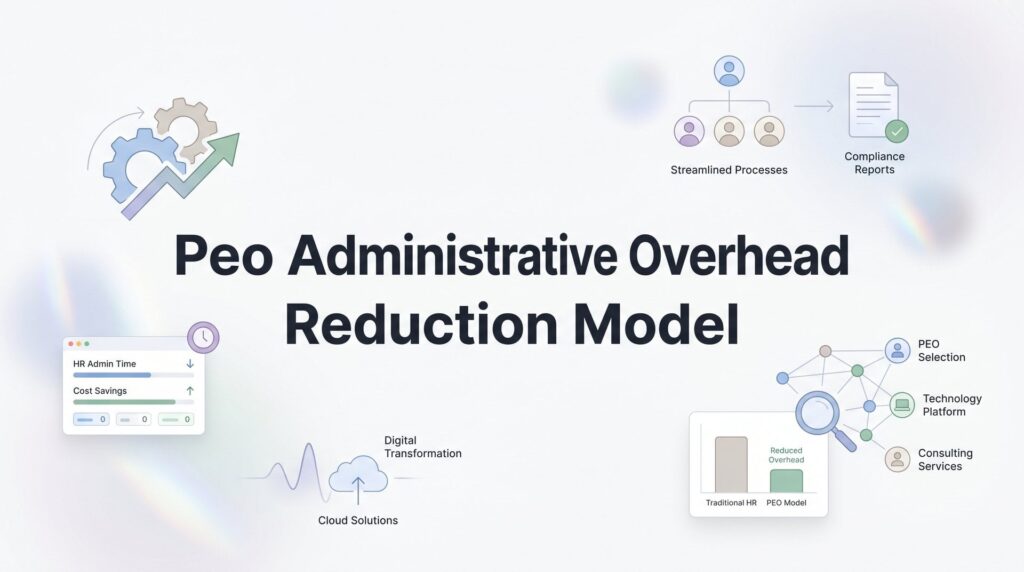
Most business owners know the pitch: bring in a PEO, and your administrative burden drops. Less time on payroll, fewer compliance headaches, better benefits at lower cost. It sounds clean and compelling.
The problem is that “administrative burden” is vague enough to mean almost anything. And when a concept is vague, it’s easy to believe you’re saving money when you’re really just moving expenses around. Some businesses genuinely do cut overhead significantly through a PEO arrangement. Others pay PEO fees on top of their existing costs and end up worse off than before. The difference usually comes down to whether they understood the overhead reduction model before signing.
This article is about the mechanics. Where does administrative overhead actually live in your business? What does a PEO specifically absorb, and what stays with you? How do you calculate whether the math works for your situation? And critically, when does the model fail to deliver? If you’re evaluating a PEO, or already in one and wondering whether you’re getting the value you expected, this framework will help you think through it clearly.
Where Administrative Overhead Actually Lives
Before you can measure a reduction, you need an honest map of what you’re currently spending. Most business owners dramatically undercount their administrative overhead because they only track the obvious line items.
The hard costs are the easier category to audit. These include payroll processing software or service fees, benefits broker commissions, HR software subscriptions, employment law compliance tools, and the salary of any dedicated HR or payroll staff. If you’re outsourcing pieces of this to an accountant or fractional HR consultant, those fees belong here too.
The soft costs are where most businesses leave a significant chunk of overhead unaccounted for. Think about how much time your office manager, operations lead, or you personally spend each week on HR-adjacent tasks. Answering benefits questions. Processing a new hire’s paperwork. Dealing with a workers’ comp claim. Reviewing a termination to make sure you’re not creating legal exposure. If you apply an honest hourly rate to those hours, the number often surprises people.
There’s also a category worth naming separately: context-switching cost. Every time a manager or owner pivots from revenue-generating work to handle an HR task, there’s a cognitive and productivity cost beyond just the time spent. It’s hard to quantify, but it’s real, and it compounds across a team.
Here’s the dynamic that makes this particularly important at growth stages: administrative overhead doesn’t scale linearly. A company with 15 employees doesn’t face three times the administrative complexity of a company with five. It often faces ten times the complexity, because of regulatory thresholds that kick in, benefits plan administration requirements, and the likelihood of multi-state employees or varying classification situations. The ACA employer mandate, FMLA obligations, EEO-1 reporting requirements — these don’t apply at five employees, but they can hit all at once as you grow. That non-linear scaling is exactly the environment where a PEO’s overhead absorption model starts to look attractive. Understanding how to build an HR scalability financial model can help you anticipate these inflection points before they hit.
The point of this mapping exercise isn’t to make your current situation look bad. It’s to establish a real baseline. Without it, any comparison to PEO fees is incomplete.
What a PEO Actually Takes Off Your Plate
The co-employment arrangement is the mechanism that makes overhead absorption possible. When you work with a PEO, your employees become co-employed: you retain control over day-to-day management, job duties, and compensation decisions, while the PEO becomes the employer of record for tax and benefits purposes. If you’re unfamiliar with how this structure works in practice, a detailed look at how a PEO works step by step is worth reviewing. That legal structure is what allows the PEO to consolidate administrative functions across hundreds of client companies and achieve economies of scale that a single small business can’t replicate on its own.
In practical terms, here’s what a full-service PEO typically absorbs:
Payroll tax administration: The PEO handles federal and state payroll tax filings, W-2 issuance, and tax deposits under their employer identification number. This eliminates a significant chunk of your payroll processing labor and the compliance risk that comes with it.
Workers’ compensation management: PEOs typically provide workers’ comp coverage under their master policy. This removes the need for you to maintain your own policy, handle audits, or manage claims administration. For businesses in higher-risk industries or states with complex workers’ comp rules, this can be one of the most meaningful cost shifts. You can explore how workers’ comp cost allocation models actually work to understand the pricing mechanics behind this benefit.
Benefits enrollment and ongoing administration: Because the PEO pools employees from many client companies, they can offer access to large-group health insurance rates that a 20-person company couldn’t access independently. They also handle the administrative work of open enrollment, qualifying life events, COBRA administration, and carrier communication.
Compliance monitoring and reporting: Regulatory compliance is one of the fastest-growing sources of administrative overhead for small and mid-size businesses. PEOs track changing requirements, handle required reporting, and provide guidance on compliance obligations — though the depth of this support varies significantly by provider.
Unemployment claims handling: Managing unemployment claims is time-consuming and requires careful documentation. PEOs typically handle this process, which reduces both the time burden and the risk of mishandled claims that increase your unemployment tax rate.
What the PEO does not absorb is equally important to understand. Day-to-day people management stays with you. Hiring decisions, performance conversations, disciplinary processes, culture building, team structure — these are yours. So is any strategic HR work: workforce planning, compensation strategy, employee development. If you were hoping a PEO would handle those things, you’ll be disappointed, and your savings projections will be off.
This is where a lot of businesses miscalculate. They project savings based on the full scope of their HR-related time, when in reality the PEO is only absorbing the transactional and compliance-oriented portion of it.
Running the Numbers: A Framework for Calculating Real Reduction
Generic projections from PEO sales teams are almost always optimistic. The only number that matters is the one calculated against your specific cost structure. Here’s a practical framework for doing that honestly.
Step 1: Audit your current hard costs across each admin function. Pull actual invoices and allocate costs by function: payroll processing, benefits administration, HR software, compliance tools, employment law counsel, and any dedicated HR staff salary (prorated if the role covers other functions). Be specific. Don’t estimate — pull the actual numbers. Using a structured cost modeling approach to compare PEO vs internal HR can help you organize this audit systematically.
Step 2: Estimate soft costs using a time-tracking approach. Ask every person who touches HR-related tasks to log their time for two to four weeks. Apply their loaded hourly rate (salary plus benefits, divided by working hours) to those hours. Annualize the result. This is the number most businesses have never calculated, and it’s often the one that makes the PEO math work.
Step 3: Get the PEO’s all-in per-employee fee and model it against your headcount. Make sure you understand exactly what’s included. Some PEOs quote a base fee and then charge separately for certain services. The number you need is total annual cost at your current headcount, and you should model what happens if you grow by five or ten employees, since PEO fees scale with headcount. A thorough breakdown of how much a PEO actually costs can help you benchmark what’s reasonable.
Step 4: Subtract the functions you’ll still need to maintain internally. If you have an HR generalist who handles both transactional admin and strategic people work, the PEO may only absorb half of their role — not all of it. If you’re not going to eliminate or reduce that position, you need to remove their salary from the savings calculation. This step is where most projections go wrong.
A few variables that are easy to miss:
Compliance knowledge maintenance: Keeping current on employment law changes requires either ongoing legal counsel, a compliance-savvy HR person, or a service that tracks it for you. If a PEO absorbs this function, the cost of maintaining that knowledge in-house goes away. If you’d need to retain it anyway, it doesn’t.
Risk-adjusted penalty exposure: Employment law violations, payroll tax errors, and benefits compliance failures carry real financial risk. A PEO doesn’t eliminate all of this risk, but it does shift some of it. Factoring in even a conservative estimate of your current penalty exposure can meaningfully change the math.
The opportunity cost of leadership time: If you’re a founder spending six hours a week on HR administration, and your time is worth several hundred dollars an hour to the business, that’s a meaningful annual cost. Whether a PEO actually frees up that time depends on what tasks they absorb and whether you’ll actually redirect that time productively.
The most common mistake in this calculation is comparing PEO fees only against payroll software costs. That comparison will almost always make the PEO look expensive. The model only holds when you capture the full administrative cost stack — hard costs, soft costs, risk exposure, and opportunity cost together.
When the Overhead Reduction Model Doesn’t Deliver
The PEO overhead reduction model is a real phenomenon. But it doesn’t apply equally to every business, and there are specific situations where the math simply doesn’t work in your favor.
You already have efficient internal HR infrastructure. If you have a capable HR generalist who handles compliance, benefits administration, and payroll smoothly and cost-effectively, a PEO may absorb functions your team already handles well — without allowing you to reduce that headcount. You’d be paying for redundant capacity. Understanding how to use a PEO alongside your internal HR department can help you avoid this overlap.
You’re a single-state business with a simple compliance profile. Multi-state employment is one of the biggest drivers of administrative complexity. If all your employees are in one state, you’re not dealing with varying state tax registrations, different leave laws, or multi-state workers’ comp requirements. Your compliance overhead may be manageable enough that the PEO’s value proposition doesn’t hold up.
Your turnover is very low and your workforce is stable. A significant portion of HR administrative work is driven by change events: new hires, terminations, open enrollment updates, life event changes, unemployment claims. If your team is stable and your annual change volume is low, the PEO is absorbing functions you rarely use, and the per-employee fee doesn’t reflect that efficiency.
The “duplicate overhead” trap deserves particular attention because it’s the most common way businesses end up worse off after adopting a PEO. The scenario looks like this: a company brings on a PEO, continues to employ the same HR coordinator they had before, keeps their existing payroll software running in parallel, and doesn’t cancel any of the compliance tools they were already paying for. Total administrative cost goes up, not down, because the PEO fee is additive rather than substitutive.
This happens because restructuring internal roles is uncomfortable. Telling your HR coordinator that their job description is changing, or that the position is no longer needed, is a difficult conversation. So many companies avoid it and absorb the PEO cost on top of their existing structure. The overhead reduction model only works if you’re willing to actually eliminate or significantly reduce the internal resources the PEO is replacing.
There’s also a headcount consideration on both ends of the spectrum. Very small companies — under five employees — often don’t generate enough administrative volume for the PEO fee structure to represent a net savings. The per-employee fees add up quickly relative to the actual administrative work involved. On the other end, companies above 50 employees often reach a point where building internal HR infrastructure becomes more cost-effective than paying PEO fees at scale, particularly if they’re in a single state with manageable complexity. For mid-range companies, exploring strategies for a PEO at the 20-employee mark can clarify where the sweet spot lies.
Evaluating PEO Providers Through the Overhead Lens
Not all PEOs absorb the same scope of administrative functions. This is the detail that gets glossed over in most PEO evaluations, and it’s the one that most directly affects whether your overhead reduction model holds in practice.
Some PEOs are genuinely full-service: they take on payroll, tax administration, benefits, workers’ comp, compliance monitoring, unemployment claims, and HR policy support as a bundled offering. Others operate more like enhanced payroll processors — they handle the transactional work but leave significant compliance and benefits administration responsibility with the client. If you’re projecting savings based on a full-service assumption and you end up with a limited-service provider, your overhead doesn’t drop the way you modeled. Reviewing PEO pricing and cost structure details before signing helps you understand exactly what’s bundled and what’s not.
Pricing structure matters too, and the math changes depending on your workforce composition. PEOs typically price in one of two ways: a flat per-employee-per-month fee, or a percentage of total payroll. The flat fee model is generally more predictable and tends to favor companies with higher average salaries, since the cost doesn’t increase as compensation rises. The percentage-of-payroll model can look attractive at lower salary levels but becomes expensive as your team’s compensation grows. Neither structure is inherently better — the right one depends on your specific headcount and salary distribution.
Generic marketing claims about overhead savings are not a substitute for modeling your actual numbers against a specific provider’s specific offering. “We save businesses an average of X%” tells you nothing useful about your situation. What you need is a clear breakdown of exactly which administrative functions are included, what the per-employee cost is at your headcount, and what additional fees apply for services outside the standard bundle.
Side-by-side comparisons across multiple providers are worth the effort here. The variation between PEOs in scope, pricing, and service quality is significant enough that the “best” option for a 12-person company in Texas might be a poor fit for a 30-person company in California. A practical comparison of top PEO providers can give you a starting point for evaluating providers against your specific overhead categories rather than against general marketing claims.
The Bottom Line on the Overhead Reduction Model
The PEO administrative overhead reduction model is a real and useful framework. For the right business, in the right situation, with the right provider, it genuinely works. Administrative costs drop, compliance risk decreases, and leadership time gets redirected toward growth.
But it’s not automatic, and it’s not universal. The model depends on your current cost structure, your willingness to actually restructure internal resources when the PEO absorbs those functions, and the specific scope of services the provider you choose actually delivers. Businesses that skip the calculation framework and rely on provider projections often end up disappointed — not because PEOs don’t work, but because the savings were never modeled against their real numbers.
Run the framework against your own cost stack before you make a decision. Audit the hard costs. Estimate the soft costs honestly. Model the PEO fee against your actual headcount and composition. And be ruthlessly clear about which internal resources you’re actually willing to reduce or eliminate.
If you’re already in a PEO arrangement, it’s worth revisiting this calculation periodically. The overhead reduction you projected at signing may look different now that you know what the provider actually absorbs versus what stayed on your plate.
Before you sign that PEO renewal, make sure you’re not leaving money on the table. Many businesses unknowingly overpay because of bundled fees, hidden administrative markups, and contracts designed to limit flexibility. PEO Metrics gives you a clear, side-by-side breakdown of pricing, services, and contract terms across providers — so you can see exactly what you’re paying for and choose the option that actually fits your business. Don’t auto-renew. Make an informed, confident decision.
