
Gig economy platforms face a compliance problem that most traditional PEO providers weren’t designed to solve. You’re managing a workforce that fluctuates week to week, spans multiple states, and blends W-2 employees with independent contractors — all while state legislatures and federal agencies keep tightening the screws on worker classification. California’s AB5 was just the opening act. Similar legislation has followed in Massachusetts, New Jersey, Illinois, and elsewhere, and the DOL’s updated FLSA guidance on independent contractor classification has added another layer of federal exposure.
Traditional PEOs were built for stable, single-state, W-2-only workforces. Many of them price and operate accordingly. Plugging one of those providers into a platform-based business model creates new risks rather than reducing existing ones.
The tools below were selected based on how well they handle the specific demands gig platforms face: multi-state compliance infrastructure, misclassification risk advisory, pricing that doesn’t penalize workforce volatility, scalability for rapid headcount swings, and technology that integrates with existing platform systems. It’s also worth noting upfront that a PEO isn’t always the right answer — for some platforms, an EOR or ASO structure fits better. The right evaluation starts with understanding your options clearly.
1. PEO Metrics
Best for: Gig economy platforms evaluating multiple PEO providers before committing to one.
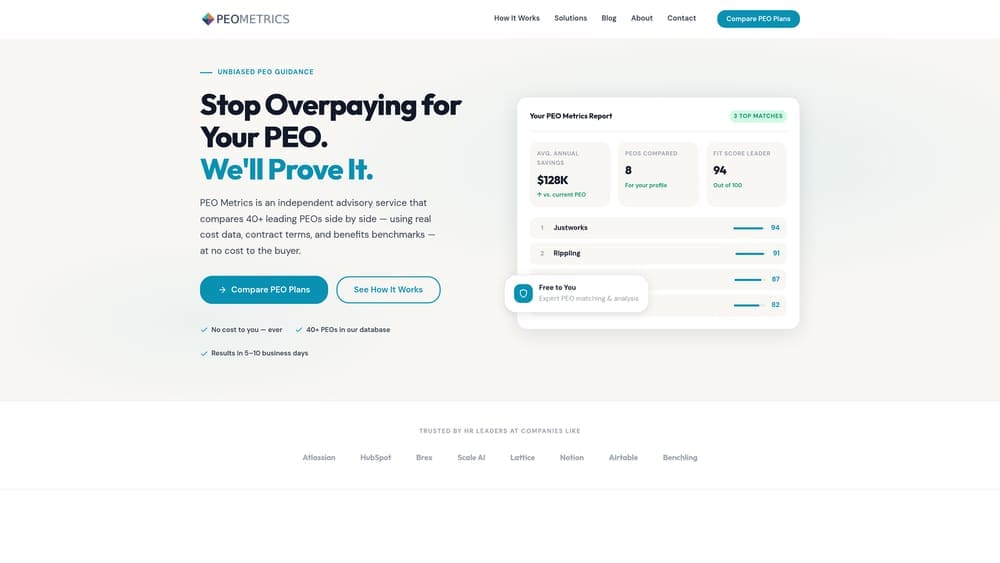
PEO Metrics is an unbiased PEO comparison platform that helps businesses evaluate and shortlist providers based on compliance capabilities, pricing transparency, and risk management depth.
Where This Tool Shines
Here’s the problem most gig platforms run into: they evaluate PEOs the way they’d evaluate any SaaS vendor — a demo, a proposal, and a gut check. That process works fine when the stakes are low. When you’re dealing with multi-state employment law, misclassification exposure, and a workforce that scales up and down by hundreds of people, signing the wrong PEO contract is an expensive mistake.
PEO Metrics solves the evaluation problem before you ever talk to a sales rep. It gives you a structured, side-by-side view of how providers actually compare on the dimensions that matter for variable workforces — not just headcount pricing, but compliance depth, contract flexibility, and risk management capabilities. Because it’s not tied to any single provider, the guidance doesn’t steer you toward whoever pays the highest referral fee.
Key Features
Side-by-Side Provider Comparisons: Detailed compliance metrics across multiple PEO providers, structured for direct comparison rather than vendor-controlled narratives.
Pricing Analysis for Variable Workforces: Evaluates how pricing models hold up under headcount fluctuation — a critical factor gig platforms often overlook until the invoice arrives.
Unbiased Matching: No provider affiliations, no referral incentives — guidance is based on your actual industry, geography, and risk profile.
Risk Profile Alignment: Matches platforms to providers based on compliance infrastructure depth, not just price or brand recognition.
Best For
Any gig economy platform in the early stages of PEO evaluation, or one reconsidering an existing provider relationship. Particularly valuable for HR leaders who need to build an internal business case with real data rather than vendor-supplied comparisons.
Pricing
Free comparison service. No cost to evaluate providers, no commitment required to access the comparison data.
2. ADP TotalSource
Best for: Large gig platforms with complex multi-state regulatory obligations and 50+ W-2 employees.
ADP TotalSource is an enterprise-grade PEO with dedicated compliance teams and deep multi-state infrastructure built for large, operationally complex workforces.
Where This Tool Shines
At the enterprise level, compliance isn’t just about filing correctly — it’s about having dedicated specialists who track regulatory changes across every state you operate in and flag exposure before it becomes a liability. ADP TotalSource brings that kind of institutional depth. Their compliance teams monitor state and federal changes proactively, which matters enormously when you’re operating in a regulatory environment that shifts as often as gig economy law does.
The integration with ADP’s broader workforce management ecosystem is also a practical advantage. If you’re already using ADP for payroll or time tracking, TotalSource extends that infrastructure rather than requiring a parallel system.
Key Features
50-State Compliance Coverage: Dedicated regulatory specialists across all U.S. jurisdictions, with proactive monitoring rather than reactive fixes.
Enterprise Payroll and Tax Filing: Handles complex workforce structures including variable pay, multi-state withholding, and high-volume payroll cycles.
Workers’ Compensation Management: Risk management and liability administration built into the PEO relationship.
ADP Ecosystem Integration: Connects with ADP’s HR, time, and workforce management tools for platforms already operating within that stack.
Best For
Established gig platforms with significant W-2 headcount, multi-state operations, and the operational complexity that justifies enterprise-level PEO pricing. Less suited for early-stage platforms or those with primarily contractor-based workforces.
Pricing
Custom pricing based on headcount and services. Typically positioned for companies with 50 or more employees; pricing is not published and requires a direct quote.
3. Papaya Global
Best for: Gig platforms managing cross-border workforces with a mix of employees and contractors across multiple countries.
Papaya Global is a global workforce management platform offering PEO and EOR services across 160+ countries, built for hybrid employee-contractor models operating internationally.

Where This Tool Shines
Most PEOs stop at the U.S. border. For gig platforms that operate internationally — or plan to — that limitation creates a fragmented compliance picture where domestic operations are covered and international exposure isn’t. Papaya Global’s unified compliance engine spans 160+ countries, which means you’re not stitching together separate local providers for each market.
The platform also handles contractor management alongside employee PEO services, which is directly relevant for gig platforms running hybrid workforces. Automated local labor law compliance and worker classification tools reduce the manual burden of tracking jurisdiction-specific requirements.
Key Features
Unified Global Compliance Engine: Covers employment law, tax compliance, and regulatory requirements across 160+ countries in a single platform.
Automated Worker Classification: Local labor law compliance with built-in classification tools to reduce misclassification exposure in each jurisdiction.
Global Payroll with Tax Compliance: Multi-currency payroll with built-in tax filing across jurisdictions.
Contractor and Employee Management: Manages both workforce types within the same platform, reducing tool fragmentation for hybrid workforces.
Best For
Gig platforms with international operations or cross-border workforce complexity. Also well-suited for platforms that need contractor management and employee PEO services under one roof without managing separate vendors.
Pricing
EOR services from $599/employee/month; contractor management from $30/contractor/month. Pricing is per-worker and transparent, which works well for variable headcounts.
4. Justworks
Best for: Scaling gig platforms that want transparent pricing and solid multi-state compliance without enterprise-level complexity.
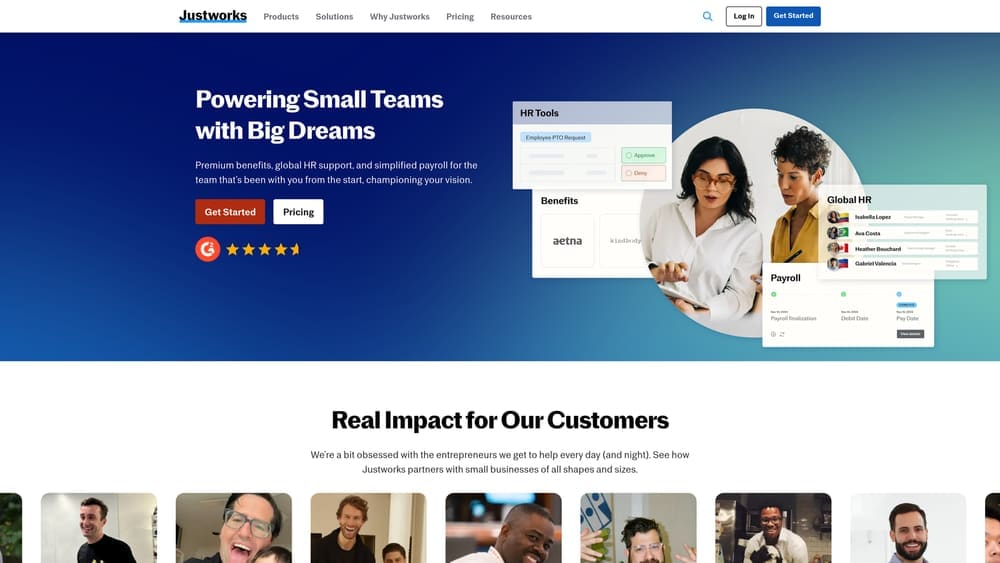
Justworks is a PEO platform with flat per-employee pricing and strong multi-state compliance, designed for companies growing quickly without the overhead of a large HR function.
Where This Tool Shines
Pricing transparency is genuinely rare in the PEO industry. Most providers bundle services in ways that make it difficult to understand what you’re actually paying for — and variable workforces get hit hardest when pricing structures penalize headcount fluctuation. Justworks publishes its pricing, which makes forecasting easier and eliminates the invoice surprises that catch fast-scaling platforms off guard.
The onboarding and offboarding workflows are also worth noting. For platforms that bring workers on and off regularly, having streamlined processes reduces administrative drag and compliance exposure during transitions — which is often where misclassification issues surface.
Key Features
Flat Per-Employee Pricing: Published monthly rates with no hidden fees — straightforward to model against variable headcount scenarios.
Multi-State Payroll and Compliance: Handles payroll tax obligations and compliance requirements across multiple states.
Benefits Administration: Access to large-group health insurance rates even for smaller companies, which helps with W-2 employee retention.
Streamlined Onboarding/Offboarding: Automated workflows that reduce manual steps and compliance gaps during workforce transitions.
Best For
Mid-size gig platforms with 20-200 W-2 employees, multi-state operations, and a need for pricing predictability. Less suited for platforms with primarily international workforces or highly complex regulatory environments.
Pricing
Basic plan starts at $59/employee/month; Plus plan (includes benefits) at $109/employee/month. Pricing is published and consistent.
5. Rippling PEO
Best for: Tech-forward gig platforms with high onboarding velocity and complex automated compliance requirements.
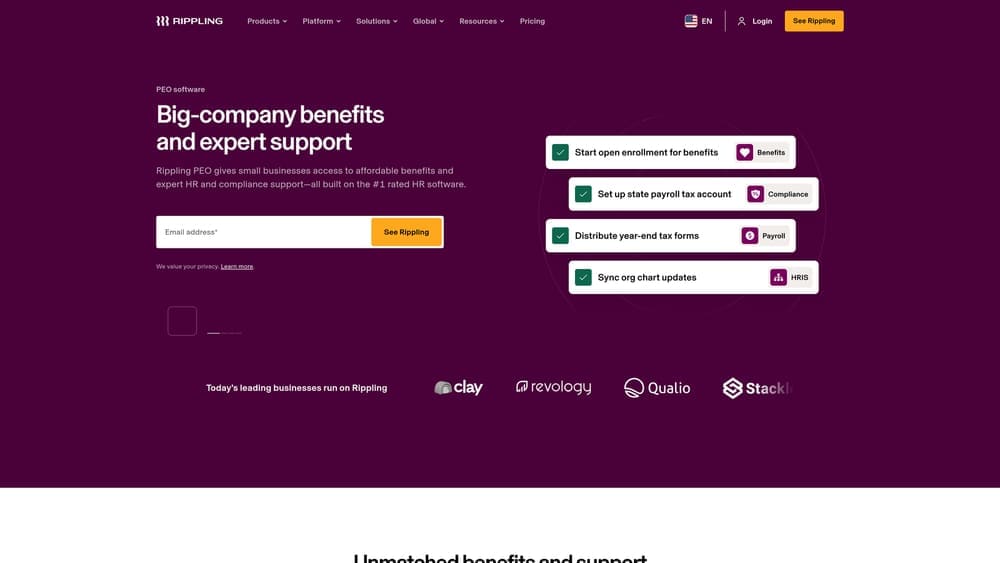
Rippling PEO is a unified workforce platform combining PEO services with IT management, automated compliance workflows, and device provisioning for companies with rapid workforce movement.
Where This Tool Shines
The compliance automation is what sets Rippling apart for gig platforms. When a worker’s state changes, their role changes, or their classification changes, Rippling can trigger automated compliance workflows — updating withholding, adjusting policies, and flagging required actions without manual intervention. For platforms that regularly move workers across states or change employment structures, that automation reduces the gap between what should happen and what actually gets done.
The unified HR, IT, and finance platform also matters for tech companies that have accumulated tool sprawl. Consolidating workforce management into a single system reduces the data consistency issues that create compliance blind spots.
Key Features
Automated Compliance Workflows: Triggered automatically by state, role, or employment changes — reducing manual compliance steps and human error.
Unified HR, IT, and Finance: Single platform for workforce management, device provisioning, and payroll — reduces integration complexity.
Rapid Onboarding/Offboarding: High-velocity workforce transitions with automated compliance steps built in.
Custom Policy Automation: Policies adapt based on worker location and classification without requiring manual updates for each change.
Best For
Tech-native gig platforms with high headcount turnover, multi-state operations, and a preference for automation over manual HR processes. Also well-suited for companies that want to consolidate HR and IT management.
Pricing
Custom pricing. Base platform starts around $8/employee/month with PEO services priced additionally. Requires a direct quote for full PEO pricing.
6. TriNet
Best for: Gig platforms operating in heavily regulated sectors like fintech, healthcare, or legal services.
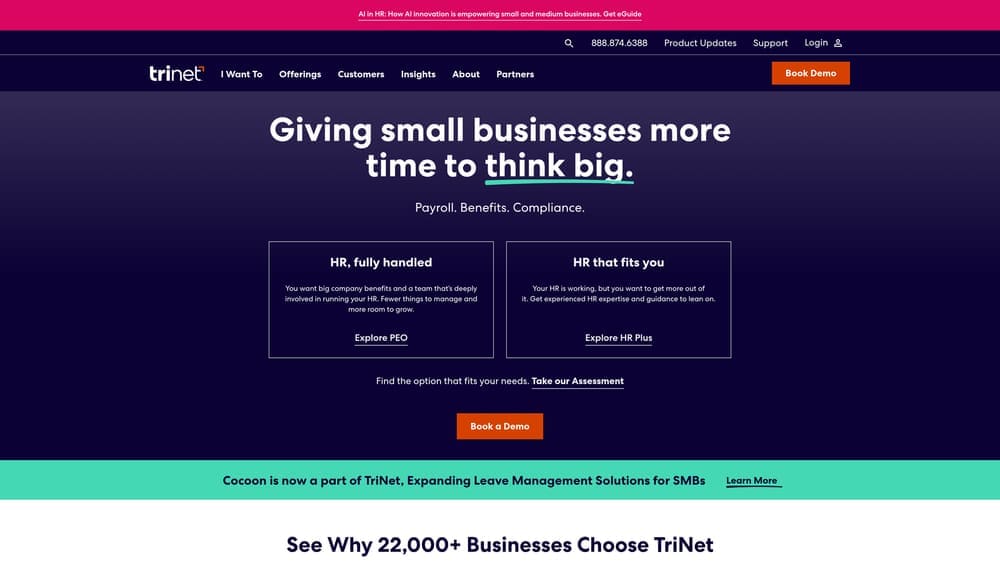
TriNet is a PEO with industry-vertical specialization and built-in risk mitigation consulting, suited for platforms where sector-specific compliance adds a layer above standard employment law.
Where This Tool Shines
Most PEOs handle employment law compliance. Fewer of them understand the intersection of employment law and industry-specific regulation. For a gig platform operating in fintech, healthcare, or any sector with its own regulatory overlay, that gap matters. TriNet’s vertical specialization means their compliance teams understand both dimensions — which reduces the need to bridge between your PEO and your industry compliance counsel.
The risk mitigation consulting that comes with the TriNet relationship is also a practical differentiator. It’s not just reactive compliance support — it’s proactive advisory, which is the posture gig platforms need given how frequently the regulatory environment shifts.
Key Features
Industry-Vertical Compliance Expertise: Specialized knowledge across regulated sectors, not just general employment law coverage.
Risk Mitigation Consulting: Proactive advisory built into the PEO relationship rather than billed separately as needed.
Multi-State Employment Compliance: Proactive regulatory updates across states, with specialists tracking changes relevant to your industry.
Enterprise Benefits Access: Large-group benefits packages that help platforms compete for W-2 talent in specialized fields.
Best For
Gig platforms in regulated industries where employment compliance intersects with sector-specific regulation. Also well-suited for companies that want advisory depth built into the PEO relationship rather than a purely transactional service.
Pricing
Custom pricing based on industry, headcount, and service tier. Not published; requires a direct quote.
7. Deel
Best for: Platforms with significant contractor workforces needing misclassification risk tools and international EOR capabilities.
Deel is a workforce compliance platform originally built for contractor management, now offering EOR and PEO-adjacent services with purpose-built misclassification risk tools for hybrid workforces.
Where This Tool Shines
Deel’s origin as a contractor management platform is actually its biggest advantage for gig economy companies. Most PEOs treat contractor compliance as a secondary concern. Deel built its core product around it. The misclassification risk assessment tools and compliance shields were designed specifically for companies managing large contractor populations — which describes most gig platforms.
The jurisdiction-specific contract generation is also worth highlighting. Automatically generating contracts with the right clauses for each worker’s location reduces the legal exposure that comes from using generic agreements across jurisdictions with different classification standards.
Key Features
Misclassification Risk Assessment: Built-in tools to evaluate and mitigate contractor misclassification exposure across jurisdictions.
EOR in 150+ Countries: Local compliance for international workers without requiring a local entity in each country.
Automated Jurisdiction-Specific Contracts: Contract generation with clauses tailored to each worker’s location and classification.
Worker Classification Analysis: Ongoing analysis tools rather than one-time assessments — useful as regulations change.
Best For
Gig platforms with large contractor workforces, international operations, or significant misclassification exposure. Also a strong fit for platforms that haven’t yet converted contractors to W-2 employees and need to manage that risk in the interim.
Pricing
Contractor management from $49/month per contractor; EOR services from $599/employee/month. Per-worker pricing accommodates variable headcounts.
8. Insperity
Best for: Established gig platforms wanting high-touch compliance advisory and hands-on risk management support.
Insperity is a full-service PEO with dedicated HR specialists, strong workers’ compensation management, and proactive regulatory monitoring for companies that want a relationship-driven approach to compliance.
Where This Tool Shines
There’s a version of PEO that’s essentially software with a compliance wrapper. Then there’s Insperity, which leans heavily into the advisory and relationship side. You get dedicated HR specialists who know your business, not a ticket queue. For gig platforms that have moved past the startup phase and have real operational complexity, that human layer can catch things automated systems miss — particularly around workers’ comp claims and employee relations issues that carry outsized risk.
The proactive regulatory monitoring is also a genuine strength. Rather than waiting for you to ask whether a new state law affects your workforce, Insperity’s team surfaces those updates and translates them into action items.
Key Features
Dedicated HR Specialists: Named specialists with compliance and risk management focus, not shared support queues.
Workers’ Compensation Administration: Claims management and administration built into the PEO relationship with active risk oversight.
Proactive Regulatory Monitoring: Compliance updates surfaced proactively, with guidance on what they mean for your specific workforce.
Performance and Employee Relations Support: Advisory support for the employment issues that create liability if handled incorrectly.
Best For
Established gig platforms with 20 or more W-2 employees that want advisory depth and a hands-on compliance relationship rather than a self-service model. Well-suited for companies where workers’ comp exposure is meaningful.
Pricing
Custom pricing. Typically suited for companies with 5 to 5,000 employees. Requires a direct quote; pricing is not published.
Picking the Right Fit for Your Platform’s Risk Profile
There’s no single right answer here, and any provider that tells you otherwise is selling rather than advising. The right PEO for your platform depends on where your actual risk sits.
If you’re still in the evaluation phase and haven’t committed to a provider, start with PEO Metrics. The comparison data will sharpen your criteria before you ever get on a sales call, and it costs nothing to use.
If your primary exposure is international or contractor-based, Deel and Papaya Global are the two providers most purpose-built for that problem. Deel wins on misclassification tooling; Papaya Global wins on global breadth and unified workforce management.
If you’re a larger domestic platform with significant multi-state W-2 headcount and need enterprise compliance depth, ADP TotalSource and TriNet are the strongest options — with TriNet pulling ahead if you’re in a regulated industry vertical.
For platforms that prioritize automation and tech integration, Rippling is the standout. For pricing transparency and straightforward scaling, Justworks is hard to beat in the mid-market. And if you want high-touch advisory with dedicated specialists rather than a self-service model, Insperity is worth the conversation.
One thing worth saying plainly: a PEO isn’t always the right structure for a gig platform. If your workforce is predominantly contractors, an EOR or ASO arrangement may reduce risk rather than add to it. The co-employment model that defines a PEO can create classification complications if applied to a workforce that isn’t clearly W-2. That’s exactly the kind of nuance a good evaluation process should surface before you sign anything.
Before you sign that PEO renewal, make sure you’re not leaving money on the table. Many platforms overpay because of bundled fees, hidden administrative markups, and contracts that limit flexibility in ways that aren’t obvious until you’re locked in. Don’t auto-renew. Make an informed, confident decision.
