
Running a remote-first company sounds like a cost advantage until you realize your 50-person team is spread across 18 states, each with its own insurance regulations, carrier availability, and compliance requirements. What should be a straightforward benefits strategy turns into a patchwork of plans, administrative overhead, and surprise renewal increases that quietly eat into your margins.
A PEO can help by pooling your distributed employees into larger risk groups for better rates and handling multi-state complexity under one roof. But the keyword is can. Not every PEO is actually built for remote workforces. Some still operate with a regional or local-office mindset that doesn’t translate well to a team scattered across the country or globe.
This list focuses specifically on PEOs and PEO selection tools that address remote workforce benefits cost containment. Not general HR outsourcing. We evaluated each based on multi-state benefits administration capability, pricing transparency, remote-specific plan flexibility, and whether the provider genuinely helps you contain costs or just reshuffles where they come from. If you’re still getting familiar with how PEOs work fundamentally, it’s worth reviewing a foundational PEO guide before diving into provider comparisons.
1. PEO Metrics
Best for: Remote companies that want to compare PEO providers on cost and benefits structure before committing.
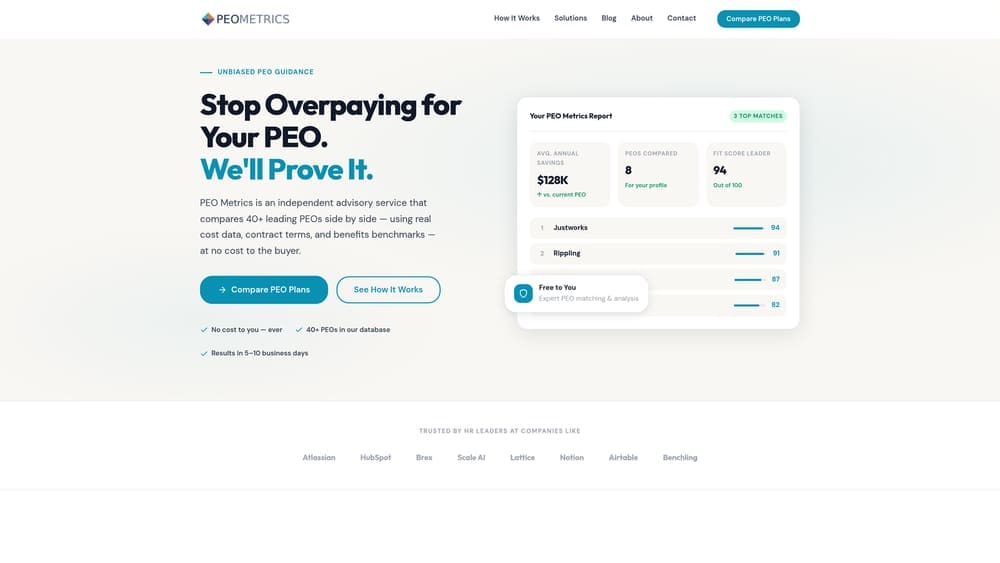
PEO Metrics is an unbiased PEO comparison platform built to help businesses evaluate providers side-by-side on pricing, benefits cost structures, and cost containment capabilities.
Where This Tool Shines
Here’s the honest reality of PEO cost containment: you can’t contain costs if you don’t know what different providers actually charge or how their benefits pooling works for your specific workforce distribution. Most businesses sign with a PEO based on a sales presentation, then spend years wondering if they’re overpaying. PEO Metrics exists to close that information gap before you commit.
For remote companies specifically, the platform surfaces the details that matter most: how a PEO structures benefits across multiple states, where administrative fees are bundled versus itemized, and how renewal rate histories compare across providers. That kind of visibility is genuinely hard to get through normal vendor conversations, where every PEO naturally presents their pricing in the most favorable light.
Key Features
Side-by-Side Provider Comparisons: Detailed pricing breakdowns across multiple PEOs so you can evaluate apples-to-apples rather than relying on each provider’s self-reported value claims.
Benefits Cost Analysis by Workforce Distribution: Tailored analysis that accounts for where your employees actually are, which matters enormously when your team spans high-cost and low-cost states.
Unbiased Guidance: Not affiliated with any single PEO provider, which means the recommendations aren’t shaped by referral fees or preferred-partner arrangements.
Hidden Fee Exposure: Data-driven metrics that surface administrative markups, bundled costs, and contract terms that are easy to miss in standard PEO proposals.
Best For
Remote companies at the evaluation or renewal stage. Particularly valuable if you’re comparing multiple PEO proposals simultaneously, considering switching providers, or concerned you’re overpaying on your current contract. Also useful for HR leaders who need to justify PEO spend to finance or executive leadership with real data.
Pricing
Free comparison tool available. Contact PEO Metrics directly for detailed analysis and custom provider comparisons tailored to your workforce.
2. Justworks
Best for: Small to mid-size remote teams that want predictable, flat-rate PEO pricing with strong health benefits access.
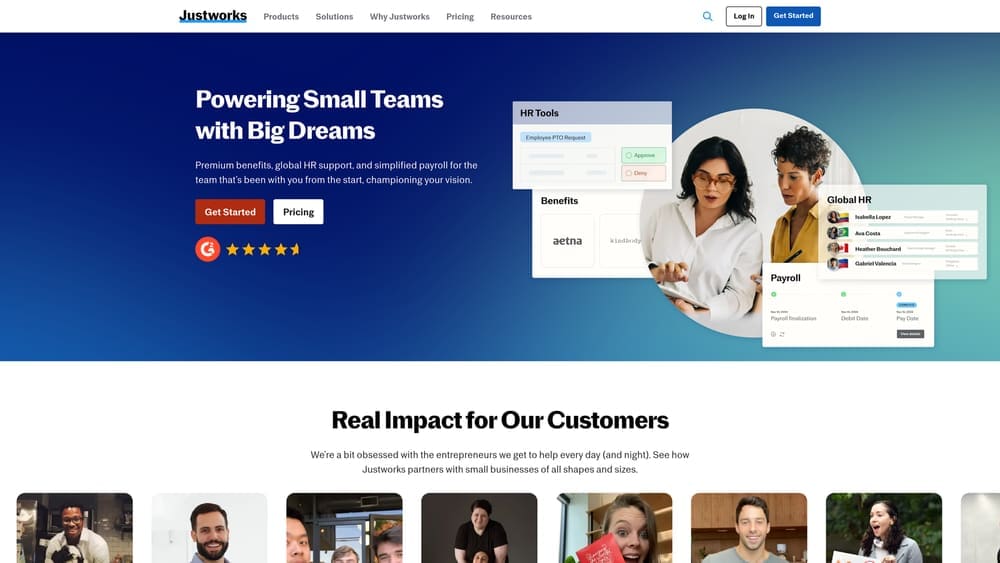
Justworks is a PEO with flat per-employee pricing and access to large-group health insurance plans, designed for simplicity and cost predictability.
Where This Tool Shines
For remote companies, one of the biggest budgeting headaches is benefits cost unpredictability. Justworks addresses this directly with a flat per-employee-per-month structure that makes forecasting straightforward. You know what you’re paying per head, and that number doesn’t shift based on opaque administrative adjustments mid-year.
The large-group health plan access is the real cost containment lever here. Small and mid-size companies typically can’t access Aetna’s large-group rates on their own. Through Justworks, even a 15-person remote team gets pooled into a much larger risk group, which translates to meaningfully better rates than small-group market alternatives.
Key Features
Flat Per-Employee Pricing: No hidden fees or variable admin markups. You see the cost per employee upfront, which simplifies budgeting for distributed teams.
Large-Group Health Plan Access: Access to Aetna and other major carriers at rates typically reserved for much larger companies, regardless of your headcount.
Multi-State Payroll and Compliance: Built-in handling of payroll tax registration and compliance across states, reducing the administrative burden of a distributed workforce.
Simple Distributed Onboarding: Employee onboarding is fully digital and works cleanly regardless of where a new hire is located.
Best For
Remote companies with 10-200 employees who prioritize pricing transparency and want straightforward benefits access without a lot of customization complexity. Works especially well for tech startups and service businesses with distributed teams in major US metros.
Pricing
Starts around $59 per employee per month for the basic PEO plan. Benefits costs are separate and depend on plan selection.
3. Rippling PEO
Best for: Remote companies that want HR, IT, and payroll unified on one platform with strong multi-state compliance automation.
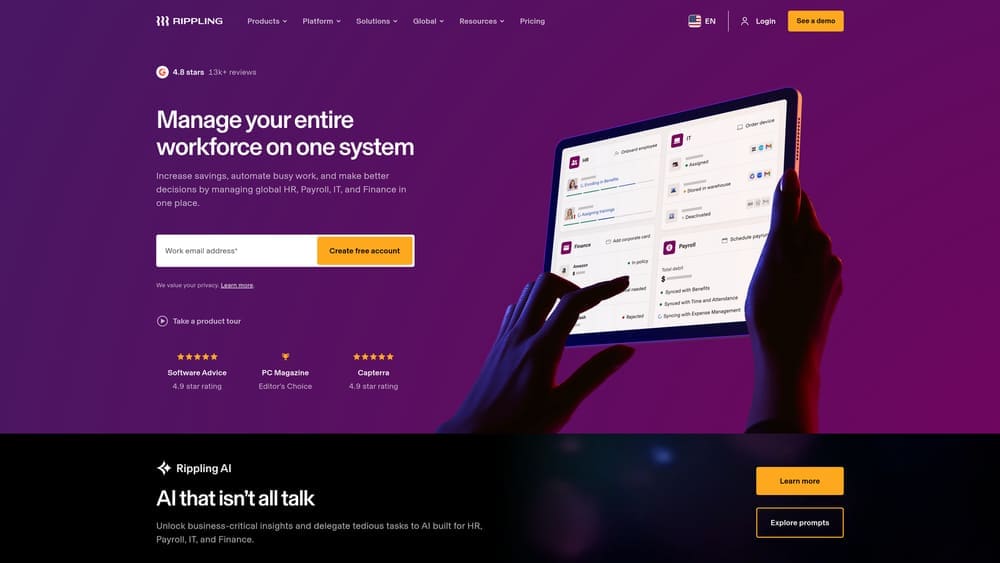
Rippling is a unified HR, IT, and payroll platform with PEO services that automates multi-state compliance and benefits administration.
Where This Tool Shines
Administrative overhead is a hidden cost driver for remote companies that often goes untracked. Every manual state tax registration, every compliance update processed by your HR team, every device provisioning task for a new remote hire adds up. Rippling’s approach is to automate as much of that as possible through a single connected platform.
The IT management layer is genuinely differentiated. Remote companies don’t just have distributed HR complexity; they have distributed technology complexity too. Rippling handles device management alongside payroll and benefits, which means onboarding a new remote hire in a new state involves fewer tools, fewer manual handoffs, and less administrative cost per head.
Key Features
Automated Multi-State Tax Registration: New state registrations trigger automatically when you hire in a new location, removing a common compliance bottleneck for growing remote teams.
Unified HR, IT, and Payroll Platform: Device management, app provisioning, payroll, and benefits all live in one system, reducing tool sprawl and integration costs.
Custom Benefits Enrollment Across States: Automated benefits enrollment that accounts for plan availability by state without requiring manual HR intervention per employee.
Workflow Automation: Customizable workflows that reduce repetitive manual tasks across onboarding, offboarding, and compliance updates.
Best For
Tech-forward remote companies that are scaling headcount across multiple states and want to reduce the per-employee administrative cost of managing a distributed workforce. Particularly strong for companies that already use or would benefit from centralized IT management.
Pricing
Custom pricing. Typically starts around $35 per employee per month plus benefits costs. Final pricing depends on modules selected and headcount.
4. Papaya Global
Best for: Remote companies with both US-based and international employees who need centralized workforce cost visibility.
Papaya Global is a global workforce platform combining PEO-like services with Employer of Record capabilities across 160+ countries.

Where This Tool Shines
Most PEOs are built for domestic US workforces. If your remote team includes contractors or full-time employees in other countries, you’re typically managing US PEO services and international EOR services through completely separate platforms with separate billing, separate compliance tracking, and separate reporting. Papaya consolidates that.
The cost containment value for global remote companies is in that consolidation. When you can see all workforce costs in one dashboard regardless of worker location or classification, it becomes much easier to identify where you’re overspending and where cost optimization is possible.
Key Features
Unified US PEO and International EOR: Single platform for both domestic PEO services and international employment, eliminating the overhead of managing multiple vendors.
Centralized Benefits Cost Dashboard: Cross-location visibility into benefits and workforce costs, including international compensation structures.
Automated Multi-Jurisdiction Compliance: Compliance automation across US states and international jurisdictions, reducing the risk of costly regulatory penalties.
Workforce Cost Analytics: Built-in analytics tools designed specifically for optimizing costs across a distributed, multi-country workforce.
Best For
Remote-first companies with employees or contractors in multiple countries who need a single platform for global workforce management. Less compelling if your team is entirely US-based, where domestic-focused PEOs may offer deeper benefits customization.
Pricing
EOR services start from $599 per employee per month. US PEO pricing varies by scope and headcount. Contact for a detailed quote.
5. TriNet
Best for: Remote companies in specific industries like tech, professional services, or financial services that want benefits plans designed for their workforce demographics.
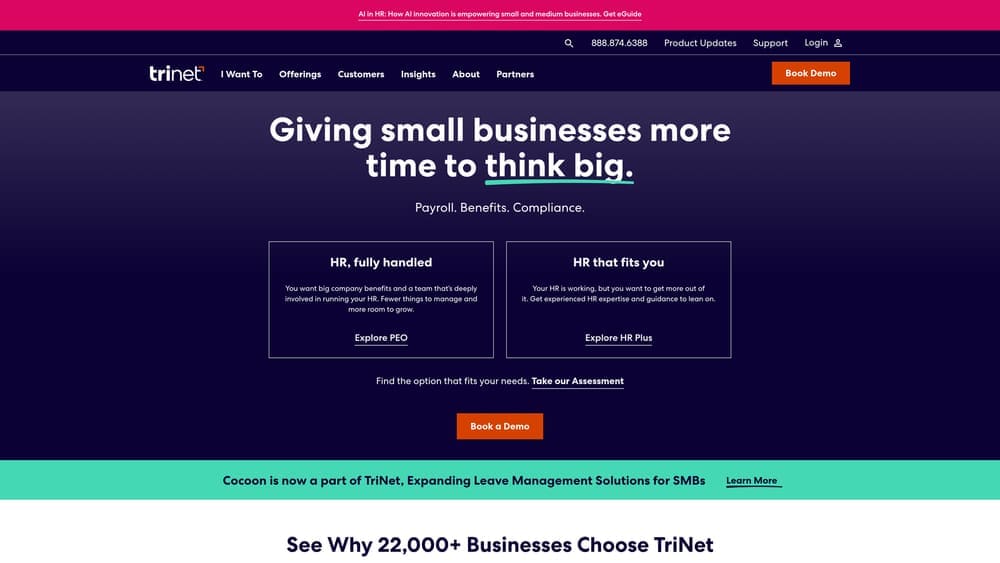
TriNet is a PEO offering industry-vertical benefits plan designs that optimize cost-to-value for remote teams in specific sectors.
Where This Tool Shines
Generic benefits plans often create a cost-value mismatch for remote companies with specific workforce demographics. A remote tech company with a young, healthy team in high-cost-of-living metros has very different benefits optimization opportunities than a professional services firm with a broader age range. TriNet’s industry-specific approach attempts to match plan design to the actual utilization patterns of your workforce type.
The HR consulting component is worth noting. Benefits cost containment isn’t just about picking the right plan at enrollment; it’s about ongoing strategy. TriNet includes HR consulting that helps you think through benefits design decisions rather than just administering whatever you initially selected.
Key Features
Industry-Vertical Benefits Plans: Plan designs tailored to workforce demographics and utilization patterns in specific industries, not one-size-fits-all options.
Multi-State Benefits Administration: Broad carrier network that enables consistent benefits access across states for distributed teams.
Risk Management and Compliance Support: Dedicated compliance support for distributed teams navigating multi-state employment law complexity.
HR Consulting for Benefits Strategy: Included HR advisory support for ongoing benefits cost optimization, not just plan administration.
Best For
Remote companies in tech, professional services, life sciences, financial services, or other verticals where TriNet has built specialized plan designs. Less differentiated for companies in industries outside their core verticals.
Pricing
Custom pricing based on industry, headcount, and benefits selection. Request a quote directly from TriNet for an accurate comparison.
6. Insperity
Best for: Mid-market remote companies with 50+ employees that need enterprise-grade benefits access and dedicated HR support.
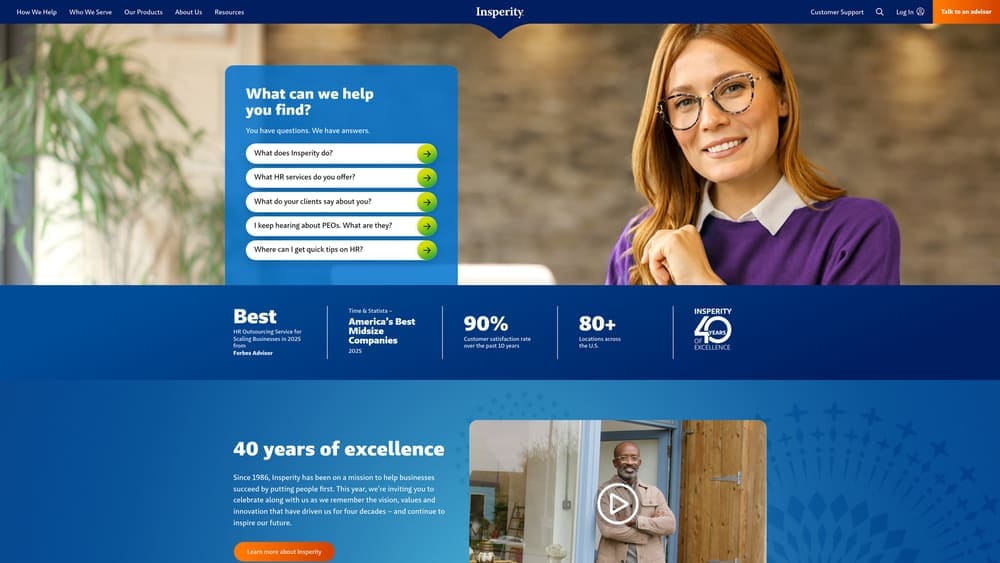
Insperity is an established PEO with a large client base that gives mid-market companies access to enterprise-grade benefits pricing through risk pool aggregation.
Where This Tool Shines
Insperity’s scale is the core value proposition here. A large client base means a large risk pool, and a large risk pool means access to benefits pricing that smaller or newer PEOs simply can’t match. For a remote company with 100-500 employees that’s serious about benefits cost containment, the difference in carrier rates between a large-pool PEO and a smaller one can be substantial over a multi-year horizon.
The dedicated HR specialist model is also meaningful for remote companies that don’t have large internal HR teams. Having an assigned specialist who knows your workforce distribution and benefits history is more valuable than a generic support line when you’re navigating mid-year compliance changes or benefits renewal negotiations.
Key Features
Large Risk Pool Benefits Access: Fortune 500-level benefits pricing made accessible to mid-market companies through aggregated risk pooling across Insperity’s broad client base.
Dedicated HR Specialists: Assigned HR support for benefits cost strategy, not just plan administration. Particularly valuable for remote companies without large internal HR departments.
Comprehensive Multi-State Compliance: Payroll tax management, state compliance, and regulatory updates handled across all employee locations.
Workforce Optimization Tools: Performance management and workforce analytics included alongside core PEO services.
Best For
Remote companies with roughly 50 to 5,000 employees that want a well-established PEO partner with deep benefits infrastructure and dedicated support. Generally not the most cost-effective option for very small remote teams.
Pricing
Custom pricing. Generally suited for companies with 50 to 5,000 employees. Contact Insperity for a workforce-specific quote.
7. Deel
Best for: Remote-first companies that need US PEO services and global contractor or EOR management on a single platform.
Deel is a remote-first workforce platform offering US PEO services alongside global EOR and contractor management, built from the ground up for distributed teams.
Where This Tool Shines
Deel wasn’t adapted for remote workforces after the fact. The platform was built with distributed teams as the core use case, which shows in how it handles cost visibility. Consolidated invoicing across worker types (employees, EOR workers, contractors) in a single dashboard is genuinely useful for remote companies trying to understand total workforce cost rather than piecing it together from multiple systems.
The contractor management capability is a meaningful differentiator for remote companies that use a mix of full-time employees and independent contractors. Many PEOs focus exclusively on W-2 employees and leave the contractor side unmanaged. Deel handles both, which matters for cost containment because misclassification risk on the contractor side can create significant unexpected liability.
Key Features
US PEO Plus Global EOR on One Platform: Single vendor for domestic PEO services and international employment, reducing vendor management overhead.
Built for Remote-First Companies: Platform design and support model built around distributed workforces, not retrofitted from a local-office PEO model.
Consolidated Cost Tracking: Unified invoicing and cost visibility across employees, EOR workers, and contractors in one dashboard.
Automated Multi-State and Multi-Country Compliance: Compliance automation across US states and international jurisdictions with built-in regulatory update management.
Best For
Remote-first companies that employ a mix of US-based employees, international workers, and contractors who need consolidated cost visibility and compliance management across all worker types.
Pricing
US PEO pricing available on request. EOR services start from $599 per employee per month. Contractor management pricing varies by plan.
8. ADP TotalSource
Best for: Remote companies that want data-driven benefits cost benchmarking to identify where they’re overpaying relative to industry and geographic peers.
ADP TotalSource is an enterprise-grade PEO backed by ADP’s extensive payroll data, offering benefits cost benchmarking tools for remote companies serious about ongoing cost monitoring.
Where This Tool Shines
Most PEOs tell you what your benefits cost. ADP TotalSource can tell you whether what you’re paying is competitive relative to similar companies in similar geographies. That benchmarking capability is genuinely useful for remote companies, where workforce distribution across states makes it hard to know if your cost structure is reasonable without external reference points.
ADP’s carrier network is also among the largest available through any PEO, which gives remote companies access to competitive rates across a broader range of plan types and geographies. For distributed teams in states where carrier options are limited, broader network access can make a real difference in plan quality and cost.
Key Features
Benefits Cost Benchmarking: Comparison of your benefits costs against industry peers and geographic equivalents, using ADP’s broad payroll data set to identify overpayment.
Extensive Carrier Network: Access to a wide range of carriers and plan types, supporting competitive rates for remote teams across diverse state locations.
Robust Multi-State Payroll Infrastructure: ADP’s established payroll and compliance infrastructure handles multi-state complexity at scale.
Data Analytics Dashboard: Ongoing cost containment monitoring through analytics tools that surface cost trends and optimization opportunities over time.
Best For
Remote companies with 50 to 1,000+ employees that want a data-driven approach to benefits cost management and value the ability to benchmark their costs against real market comparables. Strong fit for companies that have been with a PEO for several years and want to validate whether their current cost structure is competitive.
Pricing
Custom pricing. Typically suited for companies with 50 to 1,000+ employees. Contact ADP TotalSource for a workforce-specific proposal.
Which PEO Actually Fits Your Remote Workforce
The honest answer is that it depends on variables most PEO sales conversations gloss over. Your workforce distribution, average employee age and health utilization, the specific states you operate in, and whether you have international workers all materially affect which PEO delivers the best cost containment outcome for your situation.
Here’s a practical breakdown. If you’re a small remote team under 50 employees prioritizing pricing transparency, Justworks is worth a close look. If you’re scaling quickly across states and want to reduce administrative overhead through automation, Rippling PEO is strong. For mid-market remote companies that want enterprise benefits access with dedicated support, Insperity is a serious contender. If your team spans multiple countries, Deel or Papaya Global solve the global consolidation problem that domestic-only PEOs can’t. And if you want industry-tailored benefits design, TriNet’s vertical approach is differentiated. For companies serious about ongoing cost benchmarking, ADP TotalSource’s data infrastructure is hard to match.
One thing worth saying plainly: not every remote company benefits from a PEO for cost containment purposes. If your workforce is young, healthy, and concentrated in lower-cost states, you may actually pay more through a pooled PEO rate than you would with a carefully selected small-group plan. The pooling advantage works best when your workforce includes higher-risk profiles that benefit from being averaged into a larger, healthier group.
This is exactly why comparison comes before commitment. Before you sign a PEO contract or auto-renew an existing one, you need to see what different providers actually charge for your specific workforce distribution and understand how their benefits pooling works for your demographics. Don’t auto-renew. Make an informed, confident decision.
