
You sign with a PEO, and somewhere in the sales conversation, you hear it: compliance is handled. Payroll taxes, benefits filings, workers’ comp — all of it, managed by professionals who do this every day. For a business owner juggling operations, customers, and growth, that’s a genuinely appealing thing to hear.
Then, a year or two in, something breaks. A state paid leave law changed and nobody flagged it. A misclassification issue surfaces during an audit. An employee handbook clause conflicts with a new local ordinance. The PEO didn’t catch it. And when the penalty notice arrives, it’s addressed to you — not them.
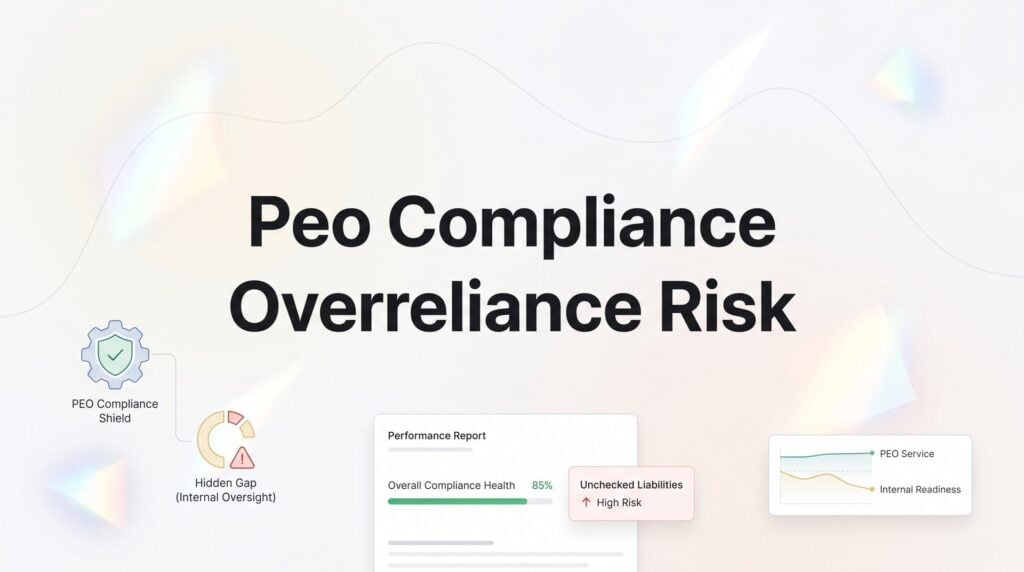
This is the core tension in every PEO relationship: PEOs share employment responsibilities, but they don’t absorb all legal liability. The co-employment model splits duties in ways that aren’t always obvious when you’re signing the agreement. Treating your PEO as a full compliance department — rather than a compliance partner with a defined scope — is one of the most common and expensive mistakes businesses make.
This article breaks down where that overreliance tends to show up, what it actually costs when things go wrong, and how to build a minimal internal oversight process that keeps you protected without duplicating work you’re already paying for.
The Compliance Handoff That Never Fully Happens
Here’s what most PEOs genuinely do well on the compliance front: payroll tax filings, ACA reporting, COBRA administration, and workers’ compensation management. These are the functions that sit squarely within the co-employment structure, where the PEO acts as employer of record for tax purposes and has both the systems and the incentive to get them right.
What often gets glossed over is everything else. Workplace safety compliance sits with you, the worksite employer. Hiring practices, including EEOC obligations and background check compliance, sit with you. Industry-specific regulations — HIPAA, FINRA, OSHA construction standards — sit almost entirely with you. Operational compliance across your specific locations sits with you.
This split isn’t a PEO failure. It’s how co-employment actually works. The problem is that most business owners don’t learn where the line is until they’re standing on the wrong side of it. Understanding exactly what PEO HR compliance services actually cover is the first step toward closing that knowledge gap.
The legal reality makes this even more pointed. Regulatory agencies don’t necessarily care about your service agreement. OSHA, the DOL, and state labor boards typically look to the worksite employer first. The fact that a PEO is involved in your employment structure doesn’t shield you from direct liability. If an OSHA inspector shows up at your job site, the PEO’s name on the payroll records isn’t going to redirect that conversation.
The language in PEO service agreements often makes this murkier than it needs to be. Phrases like “compliance support,” “compliance guidance,” and “regulatory assistance” appear frequently in these contracts. Business owners read them and reasonably conclude that compliance is being managed. What those phrases actually mean, legally, is that the PEO will help — not that they’re assuming responsibility. “Compliance support” and “compliance guarantee” are not the same thing, and the gap between them is where liability lives.
NAPEO, the National Association of Professional Employer Organizations, is explicit in its own materials: PEOs help clients navigate compliance, but they do not assume all compliance liability. That’s not buried fine print — it’s a structural feature of the model. The businesses that understand this upfront are the ones that build the right oversight processes. The ones that don’t often find out the hard way.
Where Overreliance Actually Shows Up
Overreliance doesn’t usually look like negligence. It looks like reasonable assumptions that turn out to be wrong. Here are the three places it shows up most often.
State and local employment law changes: The pace of state and local employment legislation has accelerated considerably in recent years. Paid leave laws, wage transparency requirements, predictive scheduling rules, ban-the-box ordinances — these are being enacted and amended constantly across dozens of jurisdictions. A PEO operating with clients in 40 states is managing an enormous volume of regulatory change. The question is whether they’re proactively surfacing every relevant change to every relevant client, or whether they’re providing general updates and expecting clients to connect the dots for their specific locations.
Many PEOs lean toward the latter. They may publish compliance newsletters, maintain resource libraries, or provide alerts on major federal changes. But granular, location-specific flagging — “your Denver office is now subject to this new scheduling ordinance” — is not standard practice across the industry. Businesses with operations in multiple cities or states should conduct a state employment law risk review rather than assuming their PEO is tracking every local ordinance that affects them.
Worker classification and exemption status: This is one of the most significant overreliance risks, and it’s surprisingly common. PEOs process payroll based on how you classify your workers. If you tell them someone is an independent contractor, they process accordingly. If you classify a role as exempt, they apply that exemption. Most PEOs are not auditing those classifications unless you’ve specifically contracted for that service.
The IRS has detailed guidelines around employee versus independent contractor classification, and the responsibility for getting that right sits with the client company. Same with FLSA exemption status. When a misclassification audit surfaces, the agency isn’t looking at the PEO — they’re looking at the employer who made the classification decision. Many business owners are genuinely surprised to learn this.
Industry-specific compliance gaps: If you’re in healthcare, construction, financial services, or any other regulated industry, a meaningful portion of your compliance obligations almost certainly falls outside your PEO’s scope. HIPAA privacy requirements, OSHA construction standards, FINRA licensing obligations — these are yours to manage regardless of how your employment structure is set up. PEOs aren’t typically staffed to advise on industry-specific regulatory frameworks, and most service agreements explicitly carve these out.
The risk here is that the general sense of “compliance is handled” bleeds into areas where it was never handled at all. An HR leader who’s new to the organization might not know where the PEO’s scope ends and assume the coverage is broader than it is. That assumption can sit unexamined for years.
What the Exposure Actually Looks Like
Let’s talk about what happens when one of these gaps becomes a real problem.
Misclassification penalties can be significant. Back taxes, interest, and penalties from an IRS or DOL audit can reach amounts that meaningfully affect a small or mid-sized business. State-level wage-and-hour violations carry their own penalty structures, and some states are aggressive enforcers. These costs land on the client company. The PEO may provide some support during the process, but they’re not absorbing the financial exposure.
The timing often makes it worse. Compliance failures have a way of surfacing at the worst possible moments. Due diligence in a funding round or acquisition process is a common trigger — buyers and investors do employment audits, and misclassification issues or handbook violations that were sitting dormant suddenly become deal-level problems. This is especially critical for venture-backed startups where compliance gaps can derail an entire transaction.
There’s also the remediation cost that most people don’t think about in advance. Unwinding a compliance failure that was assumed to be covered typically requires outside employment counsel, back-pay calculations across potentially years of payroll data, retroactive state filings, and sometimes renegotiated settlement terms with affected employees. The legal fees alone for a mid-sized misclassification case can run well into five figures. The total cost almost always dwarfs what proactive oversight would have required.
One more thing worth naming: the relationship with your PEO often gets complicated after a compliance failure. If you were operating under the assumption that the PEO was managing something they weren’t, that conversation is uncomfortable. PEOs will generally point to the service agreement. If the agreement says “compliance guidance” and you interpreted that as “compliance management,” you’re in a difficult position — legally and practically.
None of this is meant to be alarmist. PEOs provide real compliance value. The point is that the value has a scope, and operating outside that scope without knowing it is where the real exposure lives.
Building a Lightweight Internal Compliance Function
The goal here isn’t to build a compliance department inside your company. It’s to build just enough internal infrastructure to catch what your PEO isn’t covering — without duplicating the work you’re already paying them to do.
Start with your service agreement. Pull it out, read it carefully, and go line by line through the compliance-related sections. Identify three categories: what’s explicitly covered, what’s described as advisory or “best effort” support, and what’s not mentioned at all. That third category is your responsibility map. Tracking the compliance reporting requirements your business is subject to will help you build your internal checklist around the gaps, not around the things your PEO is already handling well.
Designate a single internal owner for the PEO compliance relationship. This doesn’t need to be a dedicated compliance role — it can be your HR manager, your COO, or even you as the owner in a smaller company. The point is that someone has explicit ownership of the compliance interface with the PEO, rather than it being diffuse and untracked. That person should know what the PEO covers, what they don’t, and where to escalate questions.
Run a quarterly state law review for every jurisdiction where you have employees. This doesn’t have to be exhaustive. A focused 30-minute review of major employment law changes in your operating states — using your state’s labor department website or a service like Fisher Phillips’ employment law tracker — will catch most of what matters. Flag anything that might affect your operations and bring it to your PEO rep to confirm whether they’re tracking it or whether it falls to you.
Schedule semi-annual compliance check-ins with your PEO. Not a general account review — a specific compliance-focused conversation where you bring a list of regulatory changes you’ve identified and ask them to confirm what they’re handling versus what’s your responsibility. Good PEO reps will engage with this seriously. If yours can’t or won’t, that’s useful information about whether you have the right partner.
Finally, do an annual worker classification review. Look at every independent contractor relationship and every exempt employee classification. Ask whether the classification would hold up under IRS or DOL scrutiny. This is a few hours of work annually that can prevent a significant amount of exposure. Your PEO isn’t doing this for you — it needs to be on your calendar.
When the PEO’s Compliance Support Isn’t Enough
There are situations where the gap between what your PEO covers and what your actual regulatory exposure looks like becomes too large to bridge with internal oversight alone. Recognizing those situations early matters.
Multi-state expansion into heavily regulated states is a common trigger. California, New York, Illinois, and Washington each have employment law frameworks that go well beyond federal baseline requirements. If you’re growing into these states and your PEO doesn’t have deep, proactive compliance infrastructure for those specific jurisdictions, you’re taking on real risk. Businesses operating across many locations face compounding challenges, which is why multi-location compliance risk management deserves dedicated attention beyond what a standard PEO relationship provides.
Headcount growth that triggers new federal thresholds is another signal. FMLA coverage kicks in at 50 employees. EEO-1 reporting requirements apply at 100. ADA obligations expand at various thresholds. If you’re growing through these levels, your compliance obligations are changing in ways your PEO may or may not be proactively flagging for you.
Industry-specific licensing or reporting requirements that your PEO has never addressed are a clear indicator that supplemental infrastructure is needed. This doesn’t automatically mean switching PEOs. Options include layering in a co-sourcing model with external employment counsel, using an outside payroll auditor to run periodic classification reviews, or carving out specific compliance functions to be handled separately from your PEO relationship.
A practical way to think about this: if you map your total regulatory exposure and your PEO’s coverage addresses less than roughly 60-70% of it, you need supplemental infrastructure. Understanding how co-employment actually protects your business helps you identify exactly where the remaining gaps sit and what additional resources you need to fill them.
Not all PEOs handle compliance support equally, and this is one of the most important dimensions to evaluate when selecting or renewing a provider. Some PEOs have dedicated compliance teams, state-specific advisory resources, and proactive client communication processes. Others provide general guidance and expect clients to manage the specifics. The difference matters enormously, and it’s rarely obvious from a sales conversation.
The Bottom Line on PEO Compliance
PEOs are genuinely useful for compliance support. Payroll tax accuracy, benefits administration, workers’ comp management — these are areas where a good PEO adds real value and reduces real risk. That’s worth paying for.
But they’re not a compliance department replacement. The businesses that get the most from their PEO relationship are the ones that understand exactly where the PEO’s responsibility ends and theirs begins — and who have built a minimal internal process to cover the gap.
Start with your service agreement. Map your actual regulatory exposure. Build a lightweight internal oversight cadence. And if you’re approaching a renewal, take the time to evaluate whether your current PEO’s compliance support actually matches your needs — or whether you’ve been assuming coverage that was never there.
Not all PEOs handle compliance equally. Some have significantly deeper infrastructure, more proactive client communication, and clearer contractual language around what they cover. Comparing providers on these dimensions — not just on price — is one of the highest-value things you can do before signing another multi-year agreement.
Don’t auto-renew. Make an informed, confident decision. PEO Metrics gives you a clear, side-by-side breakdown of pricing, services, and contract terms so you can see exactly what you’re paying for — including how different providers approach compliance support — and choose the option that actually fits your business.
