
Restoration companies deal with a unique blend of HR headaches that most industries never face. Your crews might be doing water mitigation one day and mold remediation the next, each job carrying different exposure risks, certification requirements, and workers’ comp classification codes. Add in emergency callouts, fluctuating headcounts tied to storm seasons, and OSHA scrutiny around lead and asbestos abatement, and managing HR in-house starts eating into the time you should be spending on actual restoration work.
A PEO can take that weight off by handling payroll, benefits, compliance, and, critically, workers’ comp for high-risk trade classifications. But not every PEO is built for this. Many won’t even quote restoration contractors, and the ones that will vary wildly in how they handle your specific risk profile. Here are the providers worth evaluating if you run a restoration business.
1. PEO Metrics
Best for: Restoration owners who want to compare multiple PEOs before committing to any one provider.
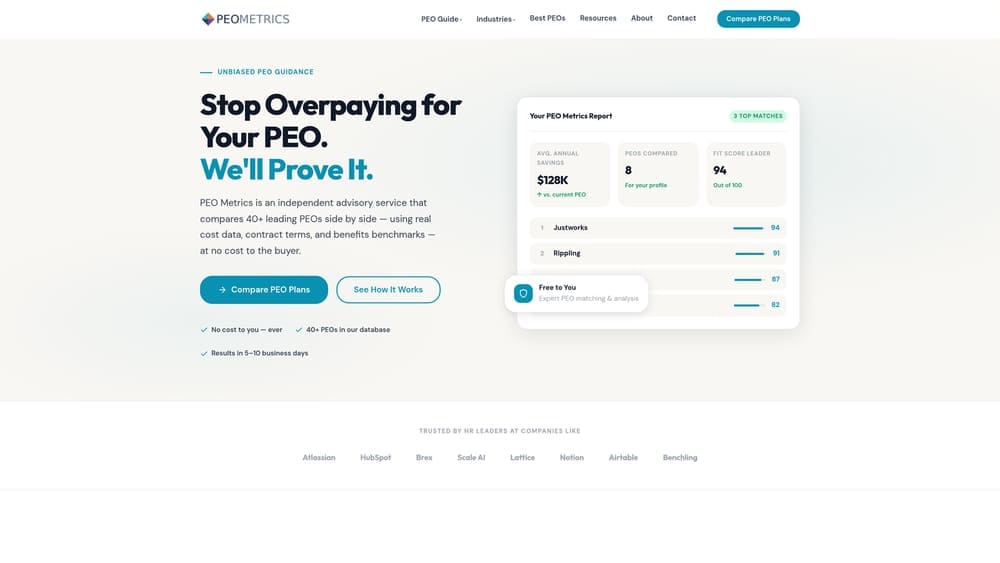
PEO Metrics is an unbiased comparison service that helps restoration company owners evaluate and compare multiple PEO providers side by side using real pricing and coverage data.
Where This Tool Shines
The biggest problem restoration owners face when shopping for a PEO isn’t the paperwork. It’s that many PEOs won’t quote them at all. The risk profile is too complex, the workers’ comp classifications too varied, and the seasonal headcount swings too unpredictable for providers who prefer clean, stable accounts. PEO Metrics is designed specifically for situations like this, where you need to quickly identify which providers will actually work with your business and what they’ll charge.
Rather than spending weeks calling PEO sales reps and sitting through demos, you can use PEO Metrics to see a structured, side-by-side breakdown of pricing, services, and contract terms. For a restoration owner evaluating a narrow field of willing providers, that kind of clarity is genuinely useful before you ever pick up the phone.
Key Features
Side-by-Side Provider Comparisons: Real pricing and service data across multiple PEO providers in a structured format that makes actual comparison possible.
High-Risk Industry Filters: Filters for industry-specific needs like high-risk workers’ comp classifications help narrow results to providers who will realistically quote you.
Unbiased Guidance: PEO Metrics is not affiliated with any single PEO provider, so the comparisons aren’t shaped by referral incentives or commission structures.
Risk Profile Matching: Helps restoration owners identify which PEOs actually accept their risk profile rather than discovering that mid-negotiation.
Best For
Any restoration business owner who’s about to start the PEO shopping process or is coming up on a contract renewal. Particularly useful if you’ve been declined by PEOs before or suspect you’re overpaying on your current contract without a clear benchmark to compare against.
Pricing
Free comparison service. There’s no cost to the business owner to use PEO Metrics, which makes it a logical first stop before committing to any provider.
2. Insperity
Best for: Mid-size restoration companies that need robust benefits packages and dedicated HR support teams.
Insperity is a full-service PEO with one of the stronger HR support infrastructures in the market, built for companies that have grown past the point where a single HR generalist can manage everything.
Where This Tool Shines
Insperity’s strength is its service depth. You get dedicated HR service teams rather than a general support queue, which matters a lot when you’re dealing with a complex issue like a workers’ comp audit or a compliance question tied to a specific job classification. For restoration companies that have scaled to 50 or more employees, that direct relationship with a knowledgeable team is worth a lot.
Their benefits packages are also genuinely competitive. If you’re trying to retain skilled technicians in a tight labor market, being able to offer health coverage that rivals what a much larger employer provides is a real recruitment advantage.
Key Features
Dedicated HR Service Teams: Field-based workforces get support from teams experienced with trade and labor-intensive industries, not just office environments.
Comprehensive Benefits: Access to health, dental, vision, and retirement plans at large-group rates that smaller restoration companies couldn’t access independently.
Workers’ Comp Administration: Risk management support alongside workers’ comp handling, which is important when your classification codes span multiple risk tiers.
Performance and Development Tools: Built-in tools for employee reviews and development, useful for building retention in a high-turnover industry.
Best For
Restoration companies in the 50 to 150 employee range that have outgrown basic payroll services and need a full HR function without building an internal department. Less suited for smaller operators or companies with highly variable headcounts.
Pricing
Custom pricing based on headcount and services selected. Insperity generally works best for companies with at least 50 employees, and pricing reflects that service level.
3. ADP TotalSource
Best for: Restoration companies operating across multiple states or expanding into new markets.
ADP TotalSource is a national PEO backed by ADP’s compliance infrastructure, well-positioned for restoration businesses that don’t stay within one state’s borders.
Where This Tool Shines
Multi-state compliance is genuinely complicated. Employment law, workers’ comp requirements, tax filings, and even onboarding paperwork differ state by state, and restoration companies that chase storm events often find themselves operating in three or four states in a single season. ADP TotalSource handles that complexity at scale, with compliance alerts that flag state-specific changes so you’re not caught off guard.
The technology platform is also worth noting. Mobile access for field crews matters when your workforce isn’t sitting at a desk, and ADP’s platform is mature enough to handle the operational demands of a distributed restoration team.
Key Features
Multi-State Payroll and Tax Compliance: Handles payroll filings, tax withholding, and compliance requirements across multiple states without manual tracking on your end.
Broad Workers’ Comp Coverage: Large-scale workers’ comp programs with classification coverage that can accommodate the range of work restoration companies perform.
Mobile-Accessible HR Platform: Field crews can access onboarding documents, time tracking, and HR tools from the job site.
Compliance Alerts: Proactive notifications for state-specific employment law changes, which matters when you’re operating across jurisdictions.
Best For
Restoration companies with 25 or more employees that operate in multiple states or have plans to expand. Also a strong fit for companies that value technology integration and want a single platform across all HR functions.
Pricing
Custom pricing; generally targets companies with 25 or more employees. Pricing reflects the breadth of compliance infrastructure included in the service.
4. Paychex PEO
Best for: Smaller restoration companies that want to start with core services and scale up as they grow.
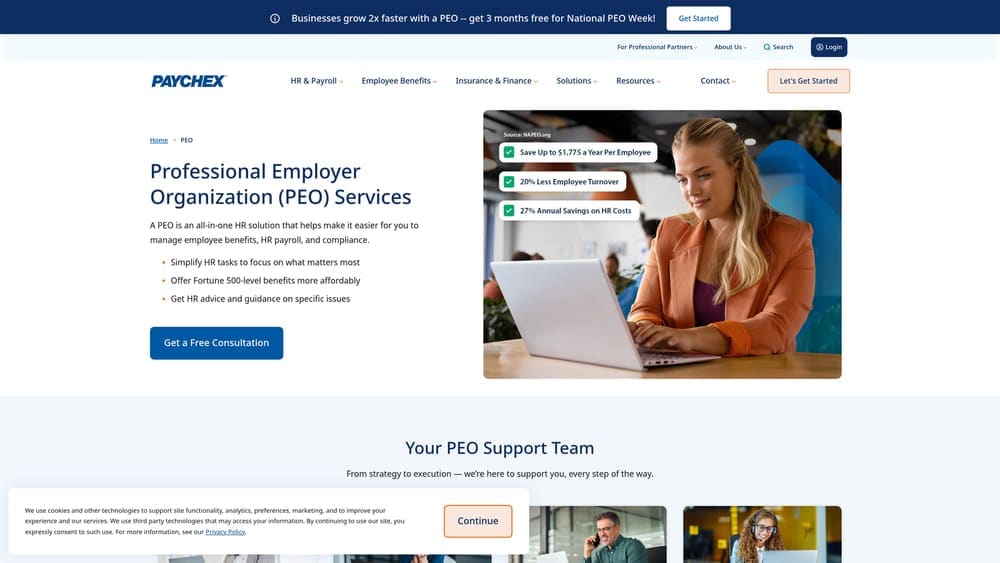
Paychex PEO is a flexible option that lets you start with what you need and add services over time, with solid workers’ comp administration suited for trade-based businesses.
Where This Tool Shines
Most PEOs want you to commit to their full service bundle upfront. Paychex is more flexible about letting smaller companies start with payroll and workers’ comp, then layer in benefits and HR services as the business grows. For a restoration company that’s still figuring out what it needs from a PEO, that incremental approach reduces risk.
The pay-as-you-go workers’ comp option is also genuinely useful for restoration businesses. Rather than paying a large annual premium upfront and reconciling at year end, you pay based on actual payroll each period. During slow seasons, that improves cash flow in a meaningful way.
Key Features
Scalable Service Model: Start with payroll and add PEO services incrementally rather than committing to a full bundle from day one.
Pay-As-You-Go Workers’ Comp: Workers’ comp premiums calculated and collected each payroll cycle, which helps cash flow during seasonal slowdowns.
Onboarding Workflows: HR technology with onboarding tools suited for high-turnover environments where you’re frequently bringing on new field staff.
OSHA Safety Resources: Compliance and safety resources for regulated industries, useful for restoration companies navigating hazardous materials requirements.
Best For
Smaller restoration companies with as few as 10 employees, or businesses that want flexibility in how they engage with PEO services rather than a fixed bundle. Also a good fit if cash flow management is a priority during off-season periods.
Pricing
Custom pricing; flexible engagement structure for companies as small as 10 employees. Pricing scales with the services you actually use.
5. TriNet
Best for: Smaller restoration firms that need access to large-group health insurance rates and industry-specific compliance support.
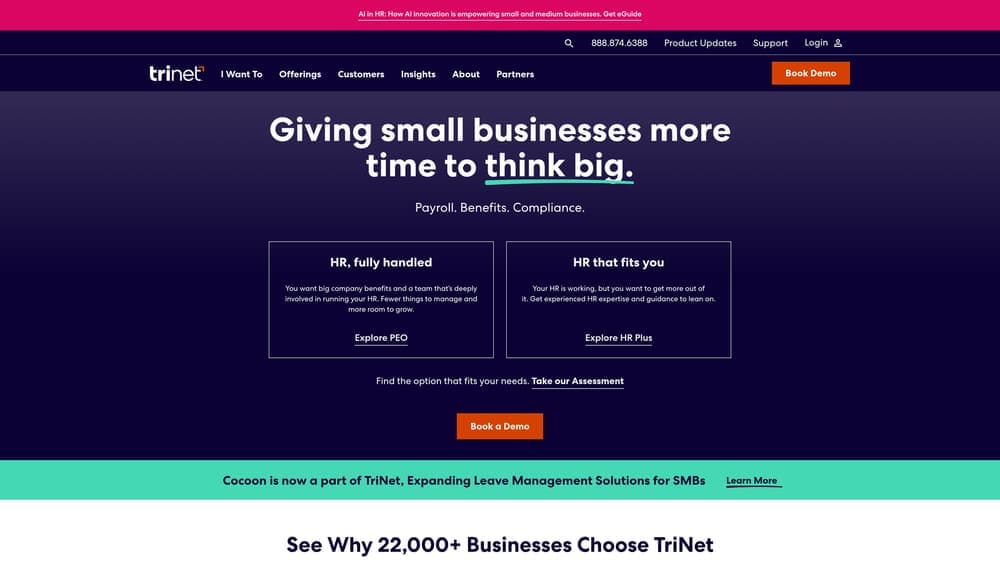
TriNet is a PEO known for organizing its service teams around specific industries, giving clients access to HR professionals who understand the compliance context of their particular sector.
Where This Tool Shines
TriNet’s industry-grouped service model means you’re not explaining what restoration work involves to a generalist who’s never heard of an IICRC certification. The service teams have relevant context, which makes compliance conversations faster and more useful. For a restoration owner dealing with a specific regulatory question, that familiarity matters.
The benefits procurement is also a real differentiator for smaller companies. If you’re running a 15-person restoration crew, you normally can’t access the same health plan rates as a 500-person employer. TriNet pools employees across its client base to negotiate large-group rates, which can make a meaningful difference in what you’re able to offer technicians.
Key Features
Industry-Grouped Service Teams: HR professionals organized by industry vertical, with relevant compliance knowledge rather than generic HR generalist support.
Large-Group Benefits Access: Health, dental, and vision plans at rates smaller companies couldn’t negotiate independently.
Risk Mitigation Consulting: Workplace safety program support that goes beyond basic compliance documentation.
Cloud-Based HR Platform: Real-time reporting and HR management accessible from anywhere, useful for field-based operations.
Best For
Restoration companies in the 5 to 100 employee range that prioritize benefits quality and want HR support from people who understand their industry. Less ideal if your primary need is handling highly variable seasonal headcounts at speed.
Pricing
Custom pricing; works with companies from 5 to 500 employees. Pricing varies based on employee count and benefits selections.
6. Oasis (a Paychex Company)
Best for: Restoration companies in the Southeast and Gulf Coast dealing with disaster-driven workforce surges.
Oasis is a PEO with strong regional presence in high-disaster-frequency markets, with experience handling the rapid workforce scaling that storm restoration events demand.
Where This Tool Shines
Most PEOs are designed for stable headcounts. Oasis has experience with the opposite scenario: a company that goes from 20 employees to 60 in two weeks after a major hurricane, then scales back down three months later. That kind of rapid onboarding and coverage extension capability is genuinely rare and genuinely valuable for restoration businesses in storm-prone regions.
The dedicated service rep model also stands out. Many national PEOs route support through call centers, which works fine for routine questions but falls apart when you need a fast answer during a chaotic post-storm surge. Having a direct contact who knows your account is worth more than it might seem until the moment you actually need it.
Key Features
Regional Expertise: Deep familiarity with high-disaster-frequency markets in the Southeast and Gulf Coast, including the regulatory and workforce dynamics specific to those areas.
Rapid Onboarding: Capabilities for quickly onboarding seasonal and emergency hires during surge periods without administrative bottlenecks.
Flexible Workers’ Comp: Programs that accommodate significant fluctuations in headcount rather than penalizing you for seasonal variation.
Dedicated Service Reps: Direct account support rather than a general call center, which matters when timing is critical.
Best For
Small to mid-size restoration companies in the Southeast, Gulf Coast, or other high-storm-frequency regions where rapid workforce scaling is a regular operational reality rather than an occasional exception.
Pricing
Custom pricing; works with small to mid-size businesses. Regional focus means pricing and service structures are calibrated to the markets they know best.
7. CoAdvantage
Best for: Smaller owner-operated restoration companies that larger PEOs may decline to quote.
CoAdvantage is a mid-market PEO offering more personalized service and greater flexibility on high-risk trade classifications than many of the national providers on this list.
Where This Tool Shines
Here’s the practical reality: if you run a smaller restoration company, several of the larger PEOs on this list may decline to quote you. Either your headcount is too small, your workers’ comp classifications are too complex, or both. CoAdvantage takes a more flexible approach to underwriting, which means they’re more likely to work with a 10-person restoration crew doing mold remediation than a provider that only wants clean, low-risk accounts.
The service model is also more direct. Rather than navigating tiered support structures, you get access to the people handling your account without as many layers in between. For a small business owner who doesn’t have an HR department, that accessibility makes a real operational difference.
Key Features
Flexible Underwriting: More willingness to work with high-risk trade classifications that larger PEOs often decline, including complex restoration work categories.
Direct Service Access: Less tiered support structure means faster answers and a more direct relationship with the people managing your account.
Bundled Simplicity: Payroll, benefits, and workers’ comp handled together without requiring you to coordinate between separate vendors.
Small Company Accommodation: Willingness to work with headcounts as small as five employees, filling a gap that larger PEOs leave open.
Best For
Owner-operated restoration companies with 5 to 30 employees, particularly those who have been declined by larger PEOs or want a more hands-on service relationship than a national provider typically offers.
Pricing
Custom pricing; accommodates companies as small as five employees. Pricing tends to be competitive for the small-company segment given the more flexible engagement model.
Picking the Right PEO When Every Job Is Different
Restoration work doesn’t fit neatly into the boxes most PEOs are designed around. Your workers’ comp classifications shift depending on what the crew is doing that week. Your headcount can double in a matter of days after a major storm event. Your compliance obligations around hazardous materials are more specific than what most PEOs encounter in their typical client base. That combination of factors means the PEO selection process is genuinely harder for restoration companies than it is for most industries.
The providers on this list represent a range of approaches. If you’re a smaller owner-operated shop, CoAdvantage and Paychex PEO are worth looking at first because they’re more likely to quote you and work with your specific situation. If you’re in the Southeast and deal with regular storm-driven surges, Oasis has relevant regional experience that a national provider may not match. If you’ve scaled past 50 employees and need serious HR infrastructure, Insperity or ADP TotalSource make more sense. And if benefits quality is your primary concern for retention, TriNet’s large-group access is worth exploring.
Before any of that, though, it’s worth running your situation through a comparison tool first. The PEO market for restoration contractors is narrower than most business owners expect, and the pricing variation between providers for the same risk profile can be significant. Knowing what a fair deal looks like before you sit down with a sales rep changes the entire negotiation.
Before you sign that PEO renewal, make sure you’re not leaving money on the table. Many restoration businesses unknowingly overpay because of bundled fees, hidden administrative markups, and contracts designed to limit flexibility. Don’t auto-renew. Make an informed, confident decision.
