
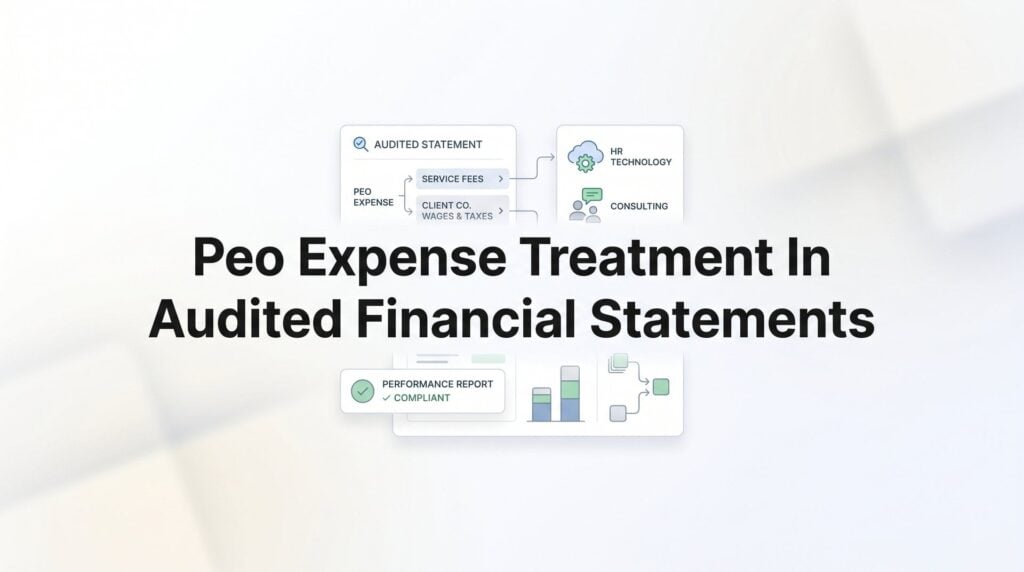
Your auditor flags it in the first meeting. You’re using a PEO, and somewhere between the engagement letter and the fieldwork kickoff, someone asks: “How are you booking your PEO invoices?” If you say “one line item, PEO expense,” you’re about to have a longer conversation than you expected.
This comes up constantly with businesses going through their first formal audit, or switching audit firms, while running payroll through a professional employer organization. It’s not that using a PEO creates an accounting problem — it doesn’t. But the co-employment structure introduces complexity that a lot of businesses haven’t thought through, and their general ledger reflects that.
Getting this wrong doesn’t just create a comment in the management letter. It can delay your audit opinion, force restatements, generate follow-up questions from lenders reviewing your financials, and add real cost in audit fees. This article covers the specific accounting and audit issues tied to PEO expense treatment so you can get ahead of them before audit season arrives. This is a narrow, practical topic — if you’re looking for a broader overview of PEO service agreements or co-employment risk, those are separate conversations worth having.
Why Auditors Don’t Just Accept a Lump-Sum PEO Invoice
The co-employment structure is what makes PEO accounting different from regular payroll. In a standard employment arrangement, your company is the employer of record, files payroll taxes under your FEIN, and the connection between wages paid and expenses recorded is straightforward. With a PEO, the PEO is typically the employer of record for tax purposes. Payroll taxes, workers’ comp premiums, and often benefits flow through the PEO’s FEIN and infrastructure — not yours.
From an auditor’s perspective, this immediately raises a question: who holds the obligation, and who remits the payment? These are not always the same entity in a co-employment model. Your company directs the work, controls the employees’ day-to-day activities, and bears the economic burden of labor costs. But the PEO handles the administrative execution — filing Form 941, remitting unemployment taxes, holding the workers’ comp master policy. Understanding how co-employment affects your books is essential context for this entire discussion.
This distinction matters because of how GAAP handles principal versus agent reporting. Under the principles established in ASC 606 (and applied by analogy to expense recognition), a company acting as the principal reports the gross amount of the transaction — not just the net fee it pays to a service provider. Since your company controls the employees and directs their work, you are the principal. That means wages, employer taxes, and benefits should appear on your income statement as your own expenses, even though the PEO is the one cutting the checks and filing the returns.
The practical problem is that most PEO invoices arrive as a single number — or at best a loosely formatted summary — and many businesses simply book that number to a single account labeled something like “PEO services” or “outsourced payroll.” That works fine for internal cash management. It doesn’t hold up under audit scrutiny.
Auditors need to understand what’s inside that invoice. They need to verify that wages are recorded as wages, not buried in a service fee. They need to confirm that tax obligations are properly reflected. And they need to assess whether the financial statements fairly present your labor cost structure. A lump-sum booking makes all of that harder, and auditors will ask you to reclassify — often mid-fieldwork, which is not the ideal time to be rebuilding your chart of accounts logic.
Breaking Down the PEO Invoice: GL Mapping That Actually Works
A typical PEO invoice contains several distinct cost components, and each one belongs in a different place on your general ledger. Understanding this mapping before your audit begins is the single most practical thing you can do to reduce audit friction. Many businesses struggle with PEO expense visibility challenges that make this mapping harder than it should be.
Gross wages: This is the largest component and should map to your salaries and wages expense accounts, broken out by department or cost center if your financials are structured that way. This is your employees’ compensation — it belongs in the same place it would if you were running payroll directly.
Employer-side payroll taxes: FICA (employer portion), FUTA, and state unemployment taxes should go to a payroll tax expense account. These are distinct from wages and auditors will look for them separately, particularly when reconciling to tax filings.
Employee benefits: Health insurance premiums, dental, vision, life insurance, and any other benefits the PEO administers should map to an employee benefits expense account. If your company subsidizes a portion and employees pay the rest through payroll deductions, only your company’s portion belongs here. For a deeper dive, see this guide on how to track and account for benefits expenses under a PEO arrangement.
Workers’ compensation: This should go to insurance expense or a dedicated workers’ comp line, not folded into benefits. The reason this matters is the audit trail — workers’ comp under a PEO master policy requires separate verification, and having it in a distinct GL account makes that easier.
PEO administrative fee: The service fee the PEO charges for managing the arrangement — typically expressed as a per-employee-per-month fee or a percentage of payroll — belongs in professional services, management fees, or administrative expenses. This is the only portion that’s truly a “fee for service” rather than a pass-through labor cost.
The timing issue is worth flagging separately. PEO invoices cover pay periods, and pay periods rarely align with your fiscal month-end or year-end. If your December 31 year-end falls in the middle of a pay period, you have an accrual. Auditors will test for proper cutoff — meaning they’ll verify that expenses are recorded in the period they were incurred, not just when the invoice arrived. If you’re not already accruing the stub period at month-end, that’s an adjustment your auditor will almost certainly propose, and it’s cleaner to handle it proactively.
What Your Auditor Will Actually Request
Audit evidence for PEO-related expenses is more involved than for standard payroll, and it’s worth understanding what’s coming before the request list lands in your inbox.
The fundamental challenge is verification of tax remittance. When you run payroll internally, your auditor can tie your Form 941 filings to your payroll records and your FEIN appears throughout. With a PEO, your FEIN likely doesn’t appear on the 941 at all — the PEO files under its own FEIN, often on a consolidated basis across many clients. Your auditor can’t simply pull your 941 and confirm compliance. That verification gap has to be addressed through other means. This is one reason why understanding the difference between a CPEO vs PEO matters — certified PEOs carry different tax liability implications.
The primary tool is the SOC 1 Type II report. Under AU-C Section 402, auditors have specific responsibilities when their client uses a service organization — and a PEO qualifies as one. A SOC 1 Type II report (issued under SSAE 18) provides your auditor with an assessment of the PEO’s internal controls over financial reporting, including payroll processing, tax remittance, and benefits administration. It covers a defined period, typically 12 months, and includes testing of whether those controls actually operated effectively.
Most large, established PEOs maintain SOC 1 Type II reports. If your PEO doesn’t have one, that’s a meaningful red flag — both for audit purposes and as a signal about the organization’s operational maturity. The absence of a SOC 1 forces your auditor into alternative procedures: direct confirmation requests, expanded transaction testing, and additional documentation requests that take more time and cost you more in audit fees. Verifying PEO financial disclosure requirements before signing can help you avoid this situation entirely.
Workers’ compensation adds another layer. Because the PEO holds the master policy and allocates premiums across its client base, your auditor needs to verify several things: that your worksite employees are covered, that the classification codes assigned to your employees are appropriate for your industry, and that the expense recorded on your books matches the actual premium allocation you received from the PEO. If your PEO doesn’t provide a clear written allocation statement, getting this documentation together mid-audit is painful.
Expect your auditor to also request the actual PEO service agreement, quarterly invoices, and potentially a direct confirmation letter from the PEO. Some audit firms have standard PEO confirmation templates. Others will draft one specific to your engagement. Either way, your PEO needs to respond promptly — and not all of them are equally cooperative with audit requests.
Financial Statement Presentation and What Goes in the Notes
Beyond the income statement classification, auditors will have views on disclosure — what appears in the notes to the financial statements to give readers adequate context about your co-employment arrangement. For a comprehensive walkthrough of this topic, see our guide on PEO financial statement presentation.
At a minimum, most auditors will expect a note that describes the arrangement: that the company uses a PEO for payroll administration and HR services, that the PEO is the employer of record for tax purposes, and that the company retains operational control over its employees. This isn’t boilerplate for its own sake — it’s meaningful context for lenders, investors, and any other party relying on your financials.
Concentration risk is a disclosure consideration that often gets overlooked. If a substantial portion of your workforce runs through a single PEO, that’s a dependency worth disclosing. What happens to your payroll operations if that PEO experiences a service disruption, financial distress, or terminates your contract? Auditors and sophisticated lenders will ask about this, and having a clear disclosure in place is better than explaining it reactively during due diligence.
The financial ratio implications are also real. How you classify PEO expenses affects your labor cost reporting, your SG&A breakdown, and any metrics tied to headcount-adjusted costs. If you’ve been booking everything to a single PEO expense line, your historical financials may show labor costs that appear artificially low relative to revenue — because wages were buried in what looks like a vendor fee. During M&A due diligence, this inconsistency will surface, and it creates unnecessary complexity at exactly the wrong time. Consistent, disaggregated classification from the start keeps your financials comparable year-over-year and readable to outside parties.
The Mistakes That Actually Delay Audits
A few specific errors come up repeatedly in PEO audit situations. They’re all preventable, and they’re all more disruptive than they need to be.
Booking the entire invoice to a single account. This is the most common issue by far. It seems harmless — the cash flow is the same, the total expense is the same — but it fails GAAP presentation requirements and forces reclassification during fieldwork. When reclassification happens mid-audit, it can affect account balances that have already been tested, which means additional procedures and extended timelines. Set up disaggregated GL coding from the moment you onboard with a PEO. It takes an hour to do correctly and saves days of audit time.
Not having the SOC 1 report before the audit starts. Auditors request this early. If you have to go back to your PEO to request it, and the PEO’s response time is slow, you’re burning days of your audit window waiting on a document that should have been in hand before fieldwork began. Request the most recent SOC 1 Type II report as part of your pre-audit preparation, not as a reaction to an auditor request.
Failing to reconcile PEO-reported wages to W-2s at year-end. Under a PEO arrangement, W-2s are typically issued under the PEO’s FEIN, not yours. That means your employees’ W-2s reference the PEO as the employer, and the wage amounts on those W-2s need to reconcile to what you recorded as wage expense. If there are discrepancies — timing differences, misclassified compensation, anything — auditors will find them and investigate. A year-end reconciliation of PEO-reported payroll to your GL wage accounts is essential, and it’s something many businesses skip because they assume the PEO handled it.
None of these mistakes are catastrophic on their own. But together, or even individually, they add real time and cost to your audit engagement. And if they surface during a lender review or acquisition process rather than a routine audit, the stakes are higher. Running a thorough financial due diligence review of your PEO contract can help you identify these risks before they become audit problems.
A Pre-Audit Checklist for PEO Clients
If your audit is coming up, here’s a practical checklist to work through before fieldwork begins.
1. Request the SOC 1 Type II report from your PEO. Make sure it covers the period relevant to your audit year. If your PEO doesn’t have one, flag this to your auditor immediately so they can plan alternative procedures — and consider what that means for your PEO relationship going forward.
2. Review your GL coding for PEO invoices. Confirm that wages, employer taxes, benefits, workers’ comp, and admin fees are mapped to separate accounts. If they’re not, reclassify before the audit begins rather than during it.
3. Reconcile quarterly payroll tax filings. Even though the PEO files under its own FEIN, you should have access to reports showing what was filed on behalf of your worksite employees. Reconcile these to your GL records for each quarter.
4. Document the co-employment arrangement in a memo. A simple written summary of the PEO relationship — who files what, under which FEIN, how benefits are administered, how workers’ comp is structured — gives your auditor a clear starting point and reduces back-and-forth during fieldwork.
5. Confirm year-end accruals for stub periods. Identify any pay periods that straddle December 31 (or your fiscal year-end) and ensure the appropriate accrual is recorded. Get the exact payroll amounts from your PEO if needed — don’t estimate.
6. Obtain the workers’ comp premium allocation statement. Confirm the amount allocated to your company for the audit year and verify it matches what’s recorded on your books. Our guide on workers’ comp accounting through your PEO covers the verification process in detail.
The broader point here is that your choice of PEO has a real impact on how much of this is easy versus painful. PEOs that provide itemized invoicing, maintain current SOC 1 reports, respond promptly to audit confirmation requests, and offer clear year-end reporting packages make this entire process manageable. PEOs that don’t create friction at every step. The difference in audit fees between a well-supported PEO relationship and a poorly documented one can be significant — and that’s a cost that rarely shows up in the original PEO expense benchmarking comparison.
The Bottom Line on PEO Expense Treatment
PEO expense treatment in audited financial statements isn’t a theoretical accounting question. It has direct consequences: audit timeline, audit cost, lender confidence, and the quality of your financial statements for any purpose — whether that’s a bank covenant review, an investor update, or an M&A process.
The businesses that handle this well aren’t doing anything complicated. They set up proper GL coding from the start, they maintain documentation of the co-employment arrangement, and they choose PEO providers that make audit support straightforward rather than adversarial.
If you’re currently evaluating PEO providers — or reconsidering your current one — audit readiness should be on your evaluation criteria alongside pricing, benefits options, and service quality. A PEO that can’t produce a SOC 1 report, doesn’t provide itemized invoicing, or is slow to respond to audit confirmation requests is going to cost you more than its admin fee suggests.
Before you sign that PEO renewal, make sure you’re not leaving money on the table. Many businesses unknowingly overpay because of bundled fees, hidden administrative markups, and contracts designed to limit flexibility. PEO Metrics gives you a clear, side-by-side breakdown of pricing, services, and contract terms so you can see exactly what you’re paying for and choose the option that truly fits your business. Don’t auto-renew. Make an informed, confident decision.
