
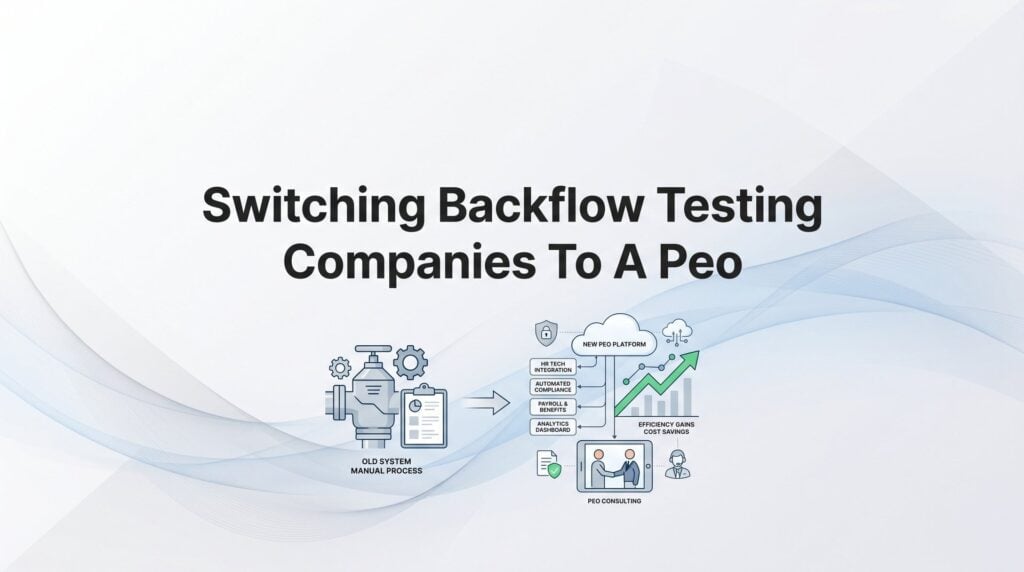
Backflow testing companies occupy a strange operational middle ground. You’re managing certified technicians with state or municipal credentials, navigating compliance deadlines tied to municipal cross-connection control programs, absorbing seasonal demand swings, and carrying a workers’ comp exposure that general business insurers treat with caution. At some point, the administrative weight — payroll, benefits, certificate tracking, insurance renewals — starts pulling you away from the work that actually grows the business.
That’s usually when a PEO enters the conversation.
But switching to a PEO isn’t a simple vendor swap. Backflow testing has specific operational wrinkles that make the transition more complicated than it is for, say, a software company or a staffing agency. Your workers’ comp classification codes, your technicians’ certifications, your municipal reporting obligations — all of these need to survive the transition without a hiccup. One administrative gap at the wrong moment can cost you a contract or leave your field crews without coverage.
This guide walks through the actual steps of moving your backflow testing operation onto a PEO, with specific attention to the things that trip up specialty trade contractors. We’ll cover what to audit before you start, how to find PEOs that actually understand your risk profile, how to evaluate pricing honestly, and how to execute the switch without disrupting your crews or your compliance standing.
If you’re still getting familiar with the co-employment model itself, start with a broader guide to PEOs for construction and trades before diving in here. This article assumes you understand the basics and want to know how to execute the transition for a backflow testing operation specifically.
Step 1: Audit Your Current HR, Payroll, and Compliance Stack
Before you talk to a single PEO, you need to know exactly what you’re working with. This step isn’t glamorous, but skipping it is the most common reason business owners end up with a PEO that doesn’t fit — or can’t accurately evaluate whether a PEO saves them money at all.
Start by inventorying every HR function you currently handle, whether in-house or outsourced: payroll processing, workers’ comp policy management, benefits administration, tax filings, and certification or license tracking for your technicians. Write it down. Who handles each function, how long does it take, and what does it cost?
The most important number to document is your current workers’ comp situation. Backflow testing work typically falls under NCCI classification code 5183 (plumbing) or sometimes 5185, depending on your state and the specific scope of your operations. These are moderate-to-high risk classifications, which means your workers’ comp premium is likely one of your largest HR-related costs. Your experience modification rate (EMR) sits on top of that. If your EMR is above 1.0, your premiums are already elevated — and that number will matter enormously to any PEO you approach. Pull your current EMR from your workers’ comp carrier and document it clearly.
Next, list your state and municipal compliance obligations specific to backflow testing. This varies more than people expect. Texas, for example, requires TCEQ-approved certification for backflow prevention assembly testers. California often requires county-level certification. Many municipal cross-connection control programs require proof of current tester certification at the time of service — not just on file somewhere, but actively presented. Any disruption to your certification tracking during a PEO transition can directly threaten your ability to fulfill contracts.
Document all of it: certification types, renewal dates, continuing education requirements, and any municipal reporting your jurisdiction requires from your company as a backflow testing provider.
Finally, be honest about where your actual pain points are. There’s a difference between what’s broken and what’s merely annoying. If your’re looking for a structured way to quantify these costs, cost accounting methods to compare internal HR vs PEO expenses can help you build a rigorous baseline. If you’re struggling with workers’ comp costs, can’t offer competitive benefits to retain certified technicians, and your admin burden is genuinely pulling you away from operations — that’s a stronger case for a PEO.
Success indicator: You have a written inventory of every HR and compliance function, who currently handles it, what it costs in dollars and time, and where the real gaps are. This document becomes your baseline for every comparison you’ll make in the steps ahead.
Step 2: Find PEOs That Actually Work With Specialty Trade Contractors
Here’s something that surprises a lot of trade contractors: not all PEOs will take you. Many PEOs avoid specialty trades entirely because of the workers’ comp risk profile. A PEO that primarily serves tech companies, marketing agencies, or professional services firms may not have the infrastructure — or the appetite — to handle a backflow testing company with field crews and a moderate-to-high risk classification code.
Start your search by filtering for PEOs with demonstrated experience in plumbing, construction trades, or field service companies. This isn’t just about comfort — it’s about whether their master workers’ comp policy actually covers your classification codes. If a PEO’s master policy doesn’t include NCCI 5183 or your state’s equivalent, you either won’t get coverage or you’ll end up with a separate workers’ comp arrangement that undermines one of the main reasons to use a PEO in the first place. The process is similar to what plumbing companies face when switching to a PEO, given the overlapping classification codes.
When you’re in early conversations with a PEO, ask directly: “Do you cover workers’ comp for NCCI code 5183?” and “Do you have other plumbing or cross-connection control contractors on your roster?” Their answer — and how quickly they can answer it — tells you a lot. If they need to go check with their insurance team before they can respond, that’s a signal they don’t work with trade contractors regularly.
Ask about their familiarity with your state’s regulatory environment. Backflow testing compliance isn’t uniform across states. A PEO that handles plumbing contractors in Texas understands TCEQ certification requirements. One that’s never dealt with California county-level certification programs may not understand the compliance tracking nuances your operation requires. For a broader look at best PEO companies for small and mid-sized businesses, you can compare providers side by side to narrow your shortlist.
It’s also worth checking whether the PEO is a Certified PEO (CPEO) under IRS designation. CPEO status provides specific tax liability protections for the client business, and it’s particularly relevant if you’ve had any payroll tax complications in the past or if you’re concerned about tax liability during the co-employment transition. Not every good PEO is a CPEO, but it’s worth understanding the distinction before you sign anything.
Ask each PEO for references from specialty trade or plumbing contractors specifically. General business references from their marketing or retail clients don’t tell you much about how they’ll handle your risk profile, your seasonal payroll patterns, or your certification tracking needs.
Red flag to watch for: If a PEO representative can’t speak specifically to your classification codes, your state’s cross-connection control regulatory framework, or the workers’ comp coverage details for field operations — they’re not the right fit. Move on.
Step 3: Compare Pricing Against Your Real Cost Baseline
This is where a lot of business owners make a mistake. They get three PEO proposals, compare the quotes against each other, and pick the cheapest one. That’s the wrong approach. The only meaningful comparison is each PEO proposal against your current true cost of operations — the baseline you built in Step 1.
To build that baseline accurately, add up everything: payroll processing fees, your current workers’ comp premiums (factoring in your EMR), benefits costs per employee, the dollar value of the administrative time you or your staff spend on HR tasks, and any compliance penalties or near-misses you’ve absorbed. That total is what you’re actually paying today, even if it doesn’t appear as a single line item anywhere.
When you receive PEO proposals, pay close attention to the pricing model. PEOs typically price as either a flat per-employee-per-month (PEPM) rate or as a percentage of gross payroll. For backflow testing companies, this distinction matters more than it does for businesses with stable year-round payroll. Backflow testing is seasonal in most U.S. markets — demand typically peaks from spring through early fall when municipal testing mandates are active. During those months, your payroll is higher due to overtime and increased crew hours. If you’re on a percentage-of-payroll model, your PEO fees spike exactly when your payroll spikes. That’s a cash flow consideration worth modeling out before you commit.
Also look carefully at how workers’ comp is structured within the PEO’s offering. Some PEOs bundle workers’ comp into their master policy with pay-as-you-go billing, which eliminates the large upfront deposit that traditional annual workers’ comp policies require. Understanding how to track and verify workers’ comp accounting through your PEO will help you evaluate whether the bundled approach actually saves you money over a full year.
Get at least three proposals. Run each one against your baseline, not against each other. A PEO that comes in cheaper than the other two quotes might still cost you more than your current setup if the comparison isn’t apples-to-apples. Conversely, a PEO that looks more expensive on paper might deliver enough workers’ comp savings (especially if your current EMR is elevated) to come out ahead over a full year.
Success indicator: You can clearly state, on a per-employee annualized basis, whether each PEO proposal saves or costs you money compared to what you’re paying today. If you can’t make that statement confidently, you don’t have enough information yet.
Step 4: Negotiate the Service Agreement With Trade-Specific Protections
The PEO service agreement is where the details that matter most to a backflow testing company tend to get buried. Don’t sign a standard agreement without reviewing it against your specific operational reality. If you want a thorough breakdown of PEO contract terms in general, a dedicated guide to PEO service agreements covers the full landscape — but here are the issues most relevant to specialty trade contractors.
First, confirm that the PEO’s workers’ comp coverage explicitly includes your field operations. Backflow testing involves more than showing up to a building and running a test. Your technicians may enter confined spaces, work with pressurized water systems, and sometimes operate adjacent to roadways or in active traffic zones. Review the policy exclusions carefully. Some PEO master policies have language that can be interpreted to exclude certain confined space work or roadway-adjacent operations. The advanced workers’ comp structuring for plumbing companies covers many of the same exclusion risks that apply to backflow testing operations.
Negotiate data portability terms explicitly. If you ever leave the PEO, you need clean, exportable records of all payroll history, certification tracking data, and workers’ comp claims history. This matters more for backflow companies than for most businesses because your certification records and claims history follow you. Some PEOs make data exports unnecessarily difficult or charge fees for them. Get the terms in writing before you’re in the position of needing them.
Clarify who holds employer-of-record status for state licensing and certification purposes. In a co-employment arrangement, the PEO becomes the employer of record for many purposes — but your backflow testing business licenses and your technicians’ certifications must remain under your company’s entity. Understanding the distinction between a CPEO vs PEO is particularly relevant here, since CPEO status affects how tax liability and employer-of-record responsibilities are allocated. Confirm with the PEO and, if necessary, with your state licensing board that your licenses remain intact and properly attributed to your business through the transition.
Finally, understand the termination clause fully. What’s the required notice period? Are there early termination fees? Most importantly: what happens to your workers’ comp coverage on the day you exit the PEO? You need a clear answer on how your coverage transitions out, because a gap — even a short one — is unacceptable when you have field crews working with pressurized systems.
Step 5: Execute the Transition Without Disrupting Crews or Compliance
Timing matters more than most people realize. Don’t start a PEO transition in the middle of your peak season. For most backflow testing companies, the busiest period runs from spring through early fall. That’s exactly the wrong time to be migrating payroll systems, enrolling employees in new benefits, and sorting out workers’ comp coverage transfers. Aim for a transition start in late fall or early winter, aligned with a natural payroll cycle break — ideally the beginning of a new quarter.
Migrate employee records in phases rather than all at once. Start with personal and payroll data, verify accuracy, then move to benefits enrollment, then workers’ comp. A comprehensive PEO transition guide walks through the phased migration approach in detail, and the same principles apply to backflow testing operations with the added layer of certification data.
Talk to your technicians directly before the transition happens. Co-employment is a concept that confuses most employees who’ve never encountered it. They’ll have questions: Who’s my employer now? Do my certifications still belong to me? Does my job change? The answer to most of these is no — their certifications, their job duties, and who they report to day-to-day don’t change. What changes is who processes their paycheck and manages their benefits enrollment. Explain it plainly. Employees who understand what’s happening are far less likely to create friction or confusion during the transition.
The workers’ comp transition requires particular care. Confirm the exact date your existing policy terminates and the exact date the PEO’s master policy picks up your employees. Get both dates in writing from both carriers. A one-day gap in coverage for field crews is not acceptable — not from a legal standpoint and not from a practical risk management standpoint. This is non-negotiable.
If the PEO offers certification and license tracking as part of their HR platform, migrate your technician certification data into their system and verify it’s accurate before your old system goes dark. If the PEO doesn’t offer this capability, confirm your internal process for maintaining it separately. Municipal cross-connection control programs often require proof of current certification at the time of testing — not just on annual audit. An administrative lapse in certification tracking during a transition can cost you a contract you’ve held for years.
Success indicator: Your first payroll cycle under the PEO runs cleanly, your employees have access to benefits, and your workers’ comp coverage is confirmed in writing with no gap between the old policy and the new one.
Step 6: Verify the Setup During the First 90 Days
Going live with a PEO isn’t the finish line. The first 90 days are where problems surface, and catching them early is far easier than unwinding them after they’ve compounded across multiple payroll cycles.
Run a parallel check on your first two payroll cycles. Compare the PEO’s output against what your old system would have produced. Look specifically at tax withholding accuracy, overtime calculations (which matter for backflow companies with seasonal peak hours), and workers’ comp premium allocations by classification code. Errors in any of these are easier to correct in the first cycle than after three months of compounding.
Verify that all state and local tax registrations transferred correctly. Backflow testing companies often hold contracts across multiple municipalities, and each jurisdiction may have its own tax registration requirements. The PEO needs to have each of these set up accurately in their system. This is worth a dedicated check rather than assuming it was handled during onboarding.
Confirm that your employees can access their benefits and that claims are being processed correctly. Benefits enrollment confusion is one of the most common early complaints after a PEO transition, and it’s worth proactively checking rather than waiting for employees to flag issues. Understanding why PEOs fail companies can help you identify early warning signs during this critical verification window.
Check that your EMR is being reported accurately under the PEO’s master policy. An incorrectly reported EMR can inflate your costs or, in the other direction, understate your risk exposure in a way that creates problems later. Ask the PEO specifically how your EMR is reflected in your workers’ comp billing and get confirmation in writing.
Schedule a formal 90-day review with your PEO account manager. Go in with a list of what’s working and what isn’t. If there are unresolved issues at day 90, address them directly. You have more leverage to renegotiate terms or push for corrections before you’re deeply entrenched than you will at month twelve.
Success indicator: Two clean payroll cycles, confirmed employee benefits access, verified tax registrations across all operating jurisdictions, and a written confirmation of your accurate EMR reporting under the PEO’s policy.
Putting It All Together
Switching a backflow testing company to a PEO is a real operational project, not a casual vendor change. The transition touches your workers’ comp exposure, your employees’ benefits, your certification compliance, and your cash flow — often at the same time. The companies that handle it well treat it like a project with defined steps, clear success criteria, and deliberate timing.
Before you pull the trigger, run through this checklist:
Complete HR and compliance audit with true cost baseline: You know exactly what you’re paying today and where the real pain points are.
At least three PEO proposals from providers with trade contractor experience: Not general business PEOs — ones that can speak specifically to your classification codes and your state’s regulatory environment.
Annualized cost comparison against your current setup: Not PEO vs. PEO, but PEO vs. your actual baseline.
Service agreement reviewed with trade-specific protections: Field operations coverage confirmed, data portability negotiated, licensing status clarified, termination clause understood.
Transition timeline aligned with payroll cycle and slow season: Late fall or early winter start, phased migration, employees briefed in advance.
Zero-gap workers’ comp coverage confirmed in writing: Exact termination date of old policy, exact effective date of PEO master policy, both from the respective carriers.
90-day verification plan in place: Parallel payroll checks, tax registration audit, benefits access confirmation, EMR verification, formal review meeting scheduled.
If you want help finding PEO providers that actually work with specialty trade contractors like backflow testing companies, PEO Metrics provides side-by-side comparisons with the pricing and coverage detail you need to make this decision clearly. Many businesses end up overpaying because of bundled fees, hidden administrative markups, and contracts designed to limit flexibility — often without realizing it until renewal. Don’t auto-renew. Make an informed, confident decision.
