
Restoration work doesn’t run on a predictable schedule. A single hurricane season or wildfire event can triple your headcount overnight, send crews across state lines, and expose your business to workers’ comp claims that would make a standard insurer wince. Then the storm passes, and you’re back to a skeleton crew.
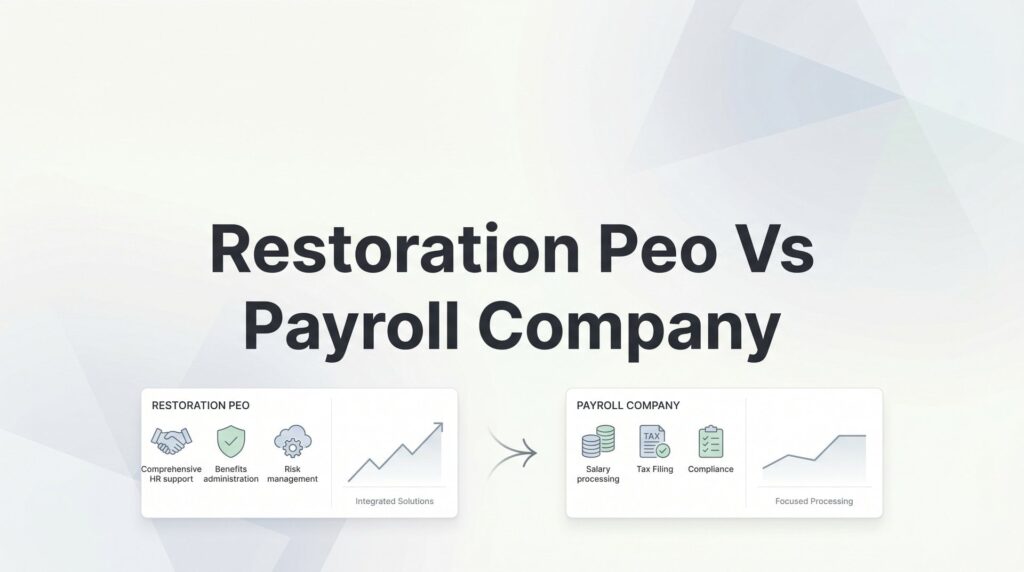
That operational reality is exactly why the PEO vs. payroll company question matters so much for restoration businesses. A basic payroll platform handles paychecks and tax filings. A PEO does that plus co-employment, benefits, and risk management, which can meaningfully change your workers’ comp costs when you’re running crews doing mold remediation, demolition, or working at heights. But PEOs also come with admin fees and co-employment structures that don’t always make sense for smaller operations.
This list covers both PEOs and payroll-focused platforms so you can compare them honestly. If you’re newer to the PEO model itself, the PEO Metrics foundational guide is worth reading first. For broader context on how this applies to trades businesses, the construction PEO hub covers overlapping terrain. Here are the top solutions worth evaluating for restoration companies in 2026.
1. PEO Metrics
Best for: Restoration businesses that want to compare PEO quotes against payroll-only costs before committing.
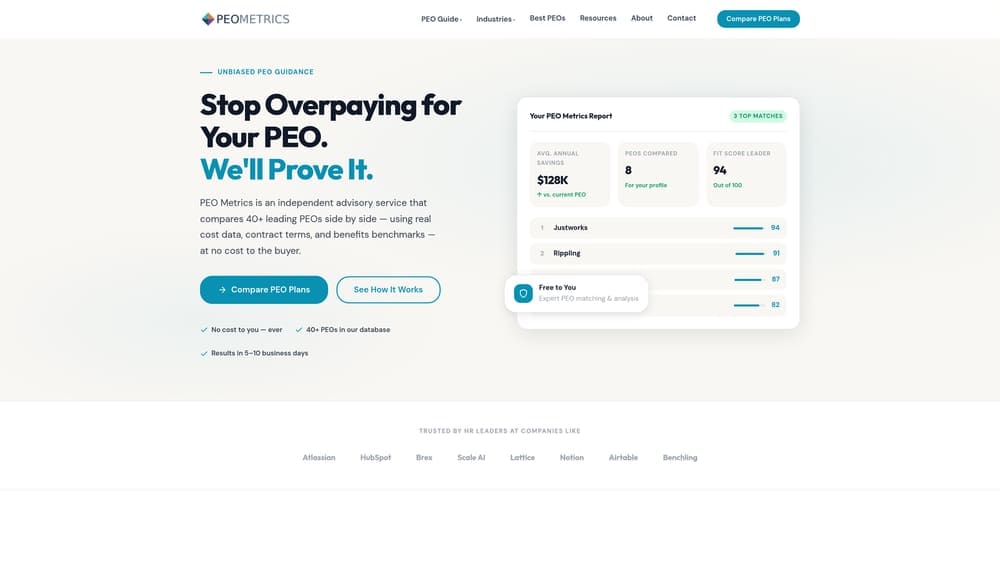
PEO Metrics is an unbiased comparison platform that helps restoration businesses benchmark multiple PEO providers against each other and against standalone payroll options using real pricing data.
Where This Tool Shines
The restoration industry has a specific problem with PEO pricing: bundled fees make it nearly impossible to know whether you’re getting a good deal or getting taken. Workers’ comp rates, admin markups, and benefits costs get folded together in ways that obscure the actual cost per employee. PEO Metrics breaks that apart.
For restoration companies evaluating whether a PEO actually saves money on workers’ comp, or whether a leaner payroll-only setup makes more sense for a 6-person crew, having side-by-side data changes the entire conversation. You’re not just taking a sales rep’s word for it.
Key Features
Side-by-Side Provider Comparisons: Compare multiple PEO providers on the same metrics so pricing differences are immediately visible.
Transparent Cost Breakdowns: Surfaces hidden admin fees and markup structures that bundled PEO quotes typically obscure.
Workers’ Comp Rate Analysis: Evaluates how different PEOs price high-hazard classifications relevant to restoration trades.
PEO vs. Payroll Fit Assessment: Helps determine whether your headcount, risk profile, and benefits needs actually justify PEO co-employment.
Best For
Any restoration business currently evaluating PEO providers, considering switching from one PEO to another, or trying to decide whether a PEO or standalone payroll solution is the right fit. Especially valuable for mid-size firms (15 to 100 employees) where the cost differences between options are most significant.
Pricing
Free comparison service. There’s no cost to use the platform when evaluating PEO providers.
2. ADP TotalSource
Best for: Mid-size restoration companies that need enterprise-level benefits and workers’ comp risk pooling.
ADP TotalSource is a full-service PEO offering co-employment, workers’ comp administration, benefits access, and HR compliance support backed by ADP’s scale.
Where This Tool Shines
ADP’s risk pool is one of the largest in the PEO industry, which matters when your crews carry high-hazard workers’ comp classifications. Restoration work, particularly demolition, mold remediation, and structural drying, carries classifications that are expensive to insure independently. Access to a large shared risk pool can meaningfully reduce what you’re paying per $100 of payroll.
The dedicated HR business partner model also helps when you’re scaling up fast during a disaster response and need someone who can handle onboarding compliance, state registrations, and benefits enrollment without you managing every detail.
Key Features
Large Workers’ Comp Risk Pool: High-hazard trade classifications benefit from being pooled with a large employer base, which can reduce rates for smaller firms.
Multi-State Payroll and Tax Compliance: Handles payroll across multiple states, which matters when jobs cross state lines after major weather events.
Dedicated HR Business Partner: Assigned HR support rather than a generic help desk, useful during rapid headcount changes.
Enterprise Benefits Access: Mid-size restoration companies can offer health, dental, and vision plans that would otherwise be unavailable at their headcount.
Best For
Restoration companies with 20 to 200 employees that need robust workers’ comp management, multi-state compliance, and want to offer competitive benefits to retain skilled IICRC-certified technicians.
Pricing
Custom pricing based on headcount and services selected. Typically structured as a percentage of payroll. Contact ADP directly for a quote.
3. Paychex PEO
Best for: Restoration businesses that want PEO services now but may want to transition to standalone payroll later without switching vendors.
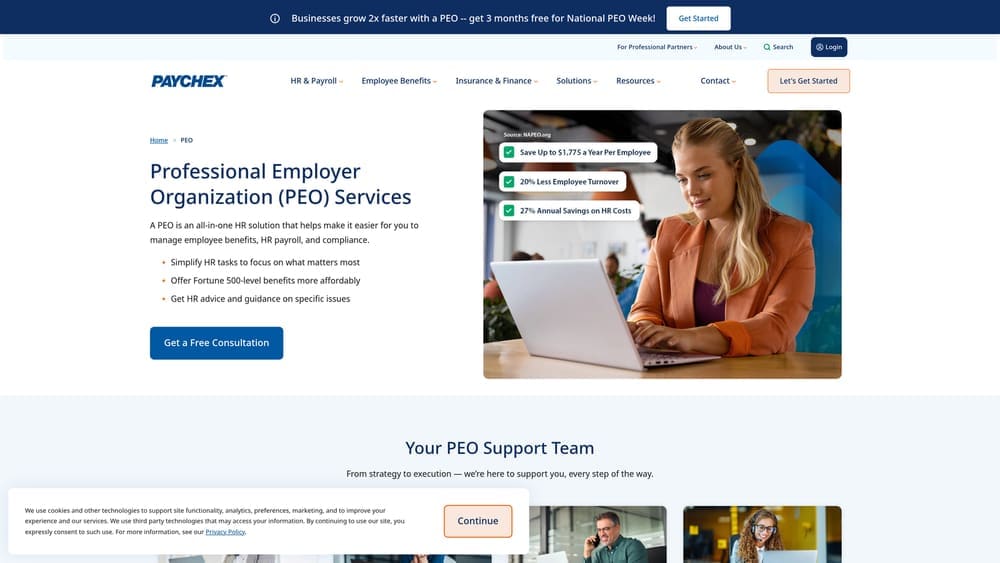
Paychex PEO offers co-employment through its PEO structure with a built-in path to transition to Paychex Flex if your business outgrows or no longer needs the PEO model.
Where This Tool Shines
The flexibility angle here is genuinely useful for restoration companies. Your workforce profile can shift dramatically depending on whether you’re in a growth phase, handling a large government-funded disaster recovery contract, or pulling back after a slow season. Not being locked into PEO co-employment permanently, while still keeping your payroll data and HR history on the same platform, reduces switching friction.
The pay-as-you-go workers’ comp option also helps with cash flow. Rather than paying a large upfront premium, you pay workers’ comp as payroll runs, which is easier to manage when your payroll fluctuates week to week with seasonal crews.
Key Features
PEO-to-Payroll Transition Path: Move from co-employment to standalone payroll through Paychex Flex without changing vendors or losing historical data.
Pay-As-You-Go Workers’ Comp: Workers’ comp premiums calculated and paid with each payroll run, reducing large upfront deposits.
HR Compliance and Onboarding Tools: Built-in tools for new hire paperwork, I-9 verification, and compliance documentation.
Scalable Structure: Designed to work for smaller crews and scale into mid-market without requiring a platform change.
Best For
Restoration companies that are growing but uncertain about long-term headcount, or businesses that want the option to exit the PEO model without the disruption of a full vendor switch.
Pricing
Custom pricing based on employee count and selected services. Contact Paychex for a quote specific to your business size and location.
4. Gusto
Best for: Small restoration crews that need clean, affordable payroll with 1099 contractor support and no PEO complexity.
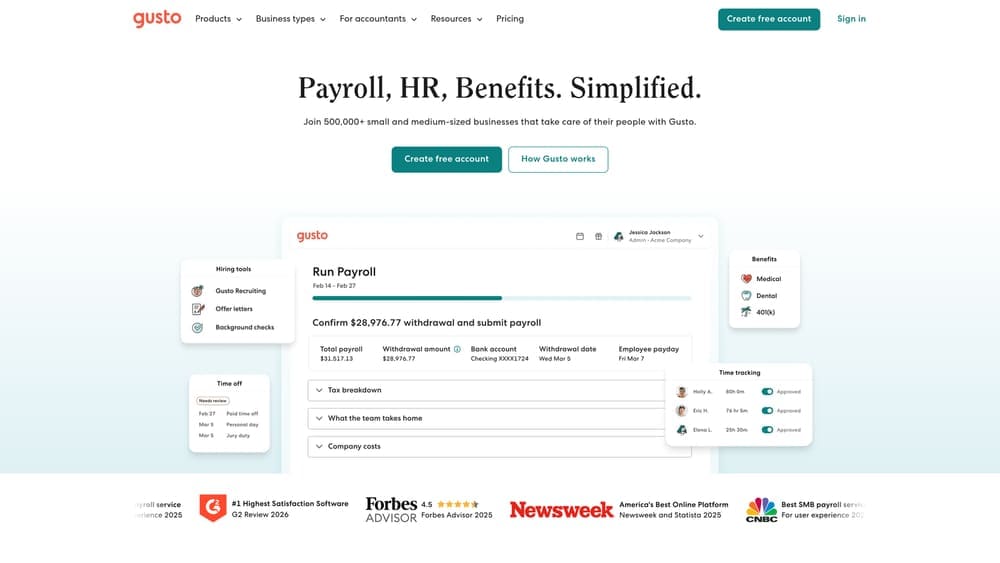
Gusto is a modern payroll and HR platform built for small businesses, handling W-2 payroll, contractor payments, and basic benefits administration in a straightforward interface.
Where This Tool Shines
Many smaller restoration operations run a hybrid workforce: a few core W-2 employees and a rotating cast of 1099 subcontractors for surge work. Gusto handles both cleanly on one platform, which is more than some payroll tools manage without workarounds.
The transparent, predictable pricing also makes budgeting easier for businesses that don’t want to negotiate custom contracts. What you see on the pricing page is largely what you pay, which is refreshing compared to the opacity common in PEO pricing.
Key Features
Automatic Tax Filings: Federal, state, and local payroll tax calculations and filings handled automatically.
1099 Contractor Payments: Pay contractors alongside W-2 employees and generate 1099 forms at year-end without a separate system.
Basic Benefits Administration: Offers health insurance options in many states, though coverage and carrier availability vary by location.
Transparent Per-Employee Pricing: Flat-rate structure with no hidden negotiation required.
Best For
Restoration businesses with under 15 employees, especially those with a mix of W-2 staff and 1099 subcontractors, that want payroll handled without the overhead of a full PEO relationship.
Pricing
Simple plan starts at $40/month base plus $6 per person per month. Higher tiers with more HR features are available at increased per-employee rates.
5. TriNet
Best for: Restoration companies that want industry-specific PEO groupings and access to large-group health insurance.
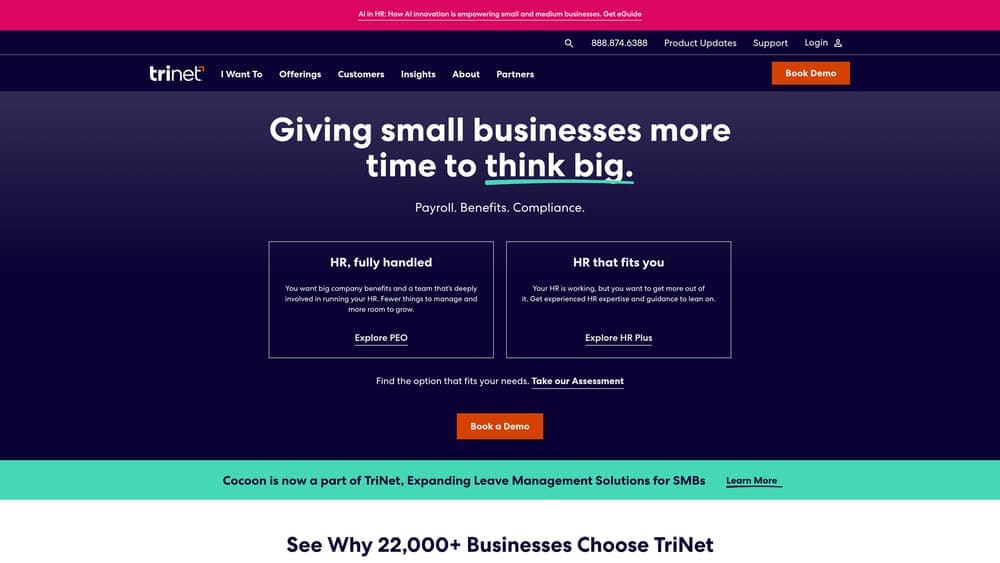
TriNet is a PEO provider that organizes clients by industry vertical, offering tailored benefits packages, HR expertise, and risk management for small and mid-size businesses.
Where This Tool Shines
TriNet’s vertical approach means your benefits and risk pooling are grouped with businesses that have similar workforce profiles rather than being lumped in with white-collar office workers. For restoration companies, that distinction can affect both benefits relevance and how risk classifications are handled within the pool.
The access to large-group health insurance plans is also a real retention lever. Skilled water damage and fire restoration technicians with IICRC certifications have options. Offering competitive health coverage through a PEO’s group plan is often the difference between keeping experienced people and losing them to larger contractors.
Key Features
Industry-Specific Groupings: Clients grouped by industry for more relevant benefits packages and risk pool alignment.
Large-Group Health Insurance Access: Small and mid-size businesses access health plans typically reserved for much larger employers.
HR Platform with Compliance Guidance: Built-in compliance tools covering multi-state employment law and HR best practices.
Workers’ Comp Administration: Includes claims management, which matters when high-hazard claims are more likely in restoration work.
Best For
Mid-size restoration companies (roughly 20 to 150 employees) that prioritize benefits quality and want an HR platform with industry-relevant groupings rather than a one-size-fits-all PEO structure.
Pricing
Custom per-employee-per-month pricing. Contact TriNet for a quote based on your headcount, location, and selected services.
6. Rippling
Best for: Tech-forward restoration companies that want payroll, HR, and IT management unified on one platform with an optional PEO add-on.
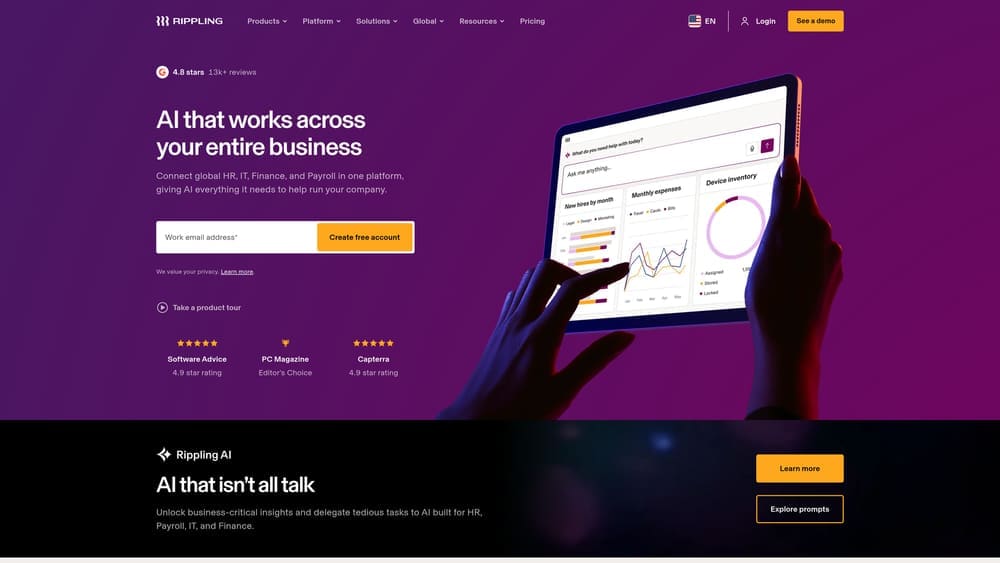
Rippling is a unified workforce platform that combines payroll, HR, IT, and benefits management, with an optional PEO layer for businesses that want co-employment benefits.
Where This Tool Shines
Rippling’s automation depth is genuinely impressive for onboarding and offboarding. If you’re regularly cycling crews in and out as jobs start and end, the ability to automate new hire paperwork, device provisioning, system access, and payroll enrollment in a single workflow saves real time. That matters when you’re spinning up a team quickly after a major storm event.
The optional PEO add-on is worth noting because it means you can start with payroll-only and layer in co-employment later without switching platforms. That flexibility is useful for restoration companies that aren’t sure yet whether the PEO model makes financial sense for their current size.
Key Features
Unified Payroll and HR: Payroll tightly integrated with HR, IT, and device management in a single system.
Automation-Heavy Onboarding: Automates new hire and offboarding workflows across HR, IT, and payroll simultaneously.
Optional PEO Add-On: Co-employment benefits available as an add-on rather than a mandatory structure.
Multi-State Payroll Compliance: Automatic compliance updates as your crews operate across state lines.
Best For
Restoration businesses with a more tech-forward operations style that want an all-in-one platform and value automation for high-frequency onboarding and offboarding cycles.
Pricing
Core platform starts at $8 per person per month. PEO pricing is custom and requires a separate quote from Rippling’s sales team.
7. Justworks
Best for: Small restoration businesses that want PEO services with flat, predictable pricing and no hidden fees.
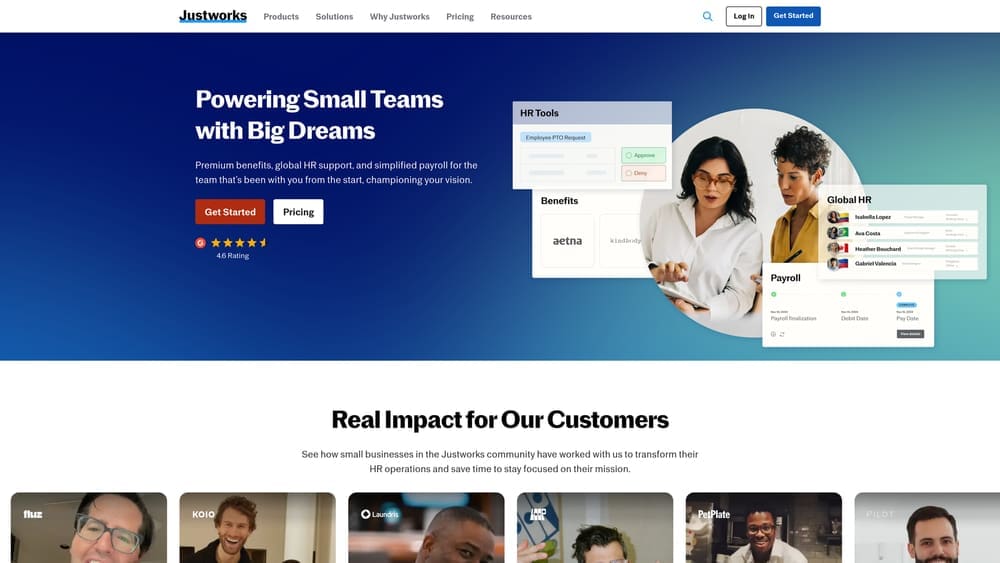
Justworks is a PEO platform known for transparent flat-rate pricing, offering payroll, benefits, HR tools, and compliance support without the opaque bundling common in larger PEO contracts.
Where This Tool Shines
Pricing transparency is Justworks’ clearest differentiator in the PEO space. Most PEOs make it difficult to know what you’re actually paying per employee once admin fees, benefits markups, and workers’ comp charges are combined. Justworks publishes its rates, which makes budgeting straightforward and removes the negotiation dynamic that can favor larger businesses.
For restoration companies on the smaller end that still want access to group health insurance and multi-state compliance support, Justworks offers a more accessible entry point into PEO co-employment than some of the larger enterprise-focused providers.
Key Features
Flat Per-Employee Pricing: Published, predictable rates with no hidden admin fees layered on top.
Large-Group Health, Dental, and Vision: Access to competitive group plans through the PEO’s employer-of-record status.
Multi-State Compliance Tools: Built-in compliance support for businesses operating across state lines.
Simple Onboarding and PTO Management: Clean HR tools that don’t require extensive configuration or HR expertise to use.
Best For
Smaller restoration companies (10 to 50 employees) that want PEO co-employment benefits and benefits access without custom pricing negotiations or opaque fee structures.
Pricing
Basic plan starts at $59 per employee per month. Plus plan with full benefits access starts at $109 per employee per month.
8. SurePayroll
Best for: Very small restoration operations that need simple, affordable payroll processing with minimal overhead.
SurePayroll is a budget-friendly online payroll service from Paychex designed for very small businesses, handling paycheck processing and tax filings with minimal complexity.
Where This Tool Shines
Not every restoration business needs a PEO or even a full-featured payroll platform. A solo operator with two or three employees doing water damage mitigation locally doesn’t need co-employment, group health insurance, or an HR business partner. They need payroll done correctly and cheaply. SurePayroll fills that role without overcomplicating it.
The optional workers’ comp integration is a useful add-on for restoration work where coverage is required but the business isn’t large enough to benefit from a PEO’s risk pool. It’s not a replacement for a PEO’s risk pooling advantages, but it keeps coverage accessible at a small-business price point.
Key Features
Automatic Tax Calculations and Filings: Federal, state, and local payroll taxes calculated, deposited, and filed automatically.
Two-Day and Next-Day Direct Deposit: Fast payroll processing options for businesses that need flexibility in pay timing.
Mobile Payroll Processing: Run payroll from a phone, which is practical for owner-operators managing jobs in the field.
Optional Workers’ Comp Integration: Add workers’ comp coverage through the platform without managing a separate policy independently.
Best For
Very small restoration businesses with under 10 employees that need basic payroll processing handled correctly at a low monthly cost, without the complexity or expense of a PEO relationship.
Pricing
Starts at $19.99 per month base plus $4 per employee per month. One of the more affordable payroll options on this list.
Which Path Makes Sense for Your Crew
The honest answer is that the right choice depends heavily on where your restoration business sits right now, not where you hope it will be in three years.
If you’re running a small crew of under 10 people and your primary need is getting payroll processed correctly, SurePayroll or Gusto will handle that at a fraction of the cost of a PEO. The admin fees and co-employment structure of a PEO simply don’t pencil out at that headcount for most restoration operations.
If you’re in the 15 to 100 employee range, the calculus changes. Workers’ comp is likely one of your largest labor costs given the hazard classifications involved in restoration work. Access to a PEO’s risk pool, combined with group health benefits that help you retain certified technicians, is where PEOs like ADP TotalSource, TriNet, or Paychex PEO tend to deliver real value. Multi-state compliance also becomes a genuine operational burden at this size, and a PEO handles that automatically.
If you’re taking FEMA or government-funded disaster recovery contracts with certified payroll requirements, that’s a separate conversation. Not all platforms on this list handle certified payroll natively, and that gap matters before you sign a government contract.
Before you commit to any of these options or auto-renew a contract you’ve been on for years, it’s worth running a real comparison. Many restoration businesses overpay because bundled PEO fees make it hard to see what they’re actually getting charged. Don’t auto-renew. Make an informed, confident decision.
Before you sign that PEO renewal, make sure you’re not leaving money on the table.
Many businesses unknowingly overpay because of bundled fees, hidden administrative markups, and contracts designed to limit flexibility. We give you a clear, side-by-side breakdown of pricing, services, and contract terms—so you can see exactly what you’re paying for and choose the option that truly fits your business.
