

At 100 employees, you’re at an inflection point that most HR leaders recognize the moment they’re in it. You’re too large to manage HR on spreadsheets and gut instinct, and too small to absorb the cost of a PEO that prices like it owns you. The good news: this headcount sits squarely in the sweet spot that most major PEOs compete hard for, which means you have real negotiating leverage if you know how to use it.
The bad news is that fee structures, contract terms, and benefit quality vary widely enough that picking the wrong provider can cost a 100-person company tens of thousands of dollars per year in unnecessary markup. Fee escalators buried in multi-year contracts, workers comp deposit requirements, and administrative fee structures tied to payroll percentage rather than a flat rate are the details that bite buyers who skip the comparison step.
This list covers eight PEOs that genuinely serve companies at this size, ranked by how well they fit different buyer profiles. We explain where each one falls short, because no single PEO is right for every 100-person company. If you want a side-by-side comparison built around your specific headcount, industry, and state footprint, PEO Metrics runs that analysis free of charge.
1. PEO Metrics
Best for: Any 100-employee company that wants a data-driven comparison before signing with any PEO.
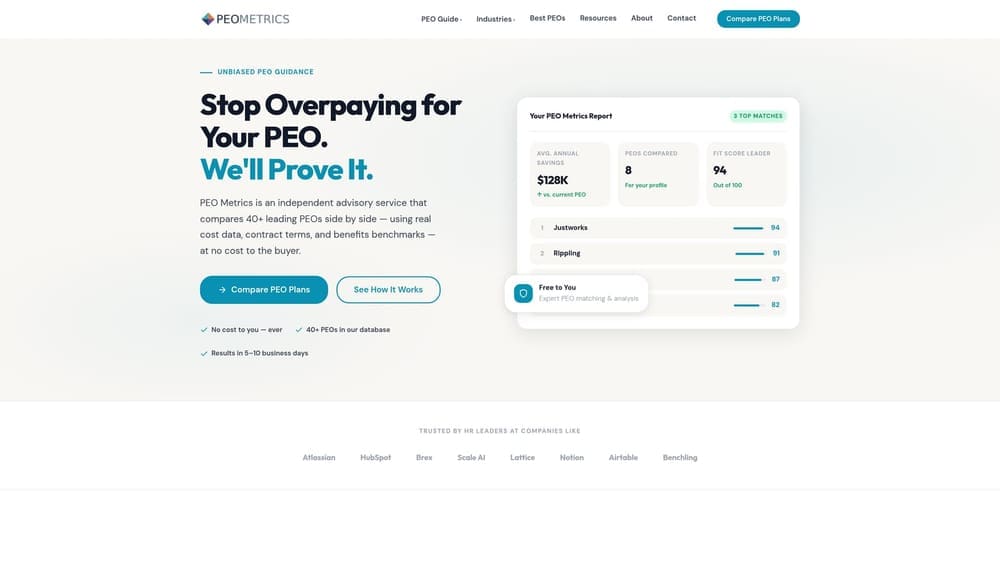
PEO Metrics is an independent advisory service that compares 40+ PEOs side by side on cost data, contract terms, and benefits benchmarks, free to the buyer.
Where This Tool Shines
The most common mistake buyers at 100 employees make is picking a PEO based on a sales pitch rather than a structured comparison. A PEO’s sales rep will always present their pricing as competitive. Without a benchmark, you have no way to know if that’s true. PEO Metrics exists to close that gap.
The service uses a 12-dimension methodology built specifically for companies with 10 to 2,000 employees. You complete an intake in roughly eight minutes, and a report comes back in 5 to 10 business days showing how the relevant PEOs compare on your actual headcount, industry, and state footprint. Since 2019, PEO Metrics has matched 850+ companies and benchmarked $2.1B in PEO spend, which means the cost data behind each comparison is grounded in real contracts, not published rate cards.
Key Features
40+ PEO Comparisons: Side-by-side analysis of cost data, contract terms, and benefits benchmarks across the full market, not just a handful of preferred vendors.
12-Dimension Methodology: Structured evaluation framework built for companies with 10 to 2,000 employees, covering pricing, compliance, benefits quality, service model, and contract risk.
$2.1B Benchmarked: Cost data drawn from 850+ real company matches since 2019, giving the comparisons actual market grounding.
5-10 Business Day Turnaround: Report delivered after an approximately eight-minute intake, with no prolonged sales process on the buyer’s end.
Fully Independent: No vendor affiliation, no commission from PEOs. The analysis is built for the buyer, not for whichever PEO pays the highest referral fee.
Best For
Any company approaching a first PEO decision or a renewal negotiation at 100 employees. This is especially useful for HR Directors, CFOs, and COOs who need a defensible comparison to bring to leadership before committing to a multi-year contract. It’s also the right starting point if your current PEO just sent a renewal quote and you want to know whether the number is reasonable.
Pricing
100% free to the buyer. PEO Metrics does not charge companies for the comparison service. There is no catch and no vendor-side commission structure that compromises the analysis.
2. Insperity
Best for: Companies that want deep HR consulting support and are willing to pay for it.
Insperity is one of the largest full-service PEOs in the US, known for a substantial HR consulting bench and strong access to major health insurance carriers.
Where This Tool Shines
If your 100-person company is going through rapid growth, leadership transitions, or has complex HR needs that go beyond payroll and benefits administration, Insperity’s depth of support is a genuine differentiator. The dedicated support teams are among the more attentive in the market at this headcount, and the benefits carrier access tends to produce competitive health insurance options that can help with talent retention.
The honest caveat: Insperity’s pricing sits at the high end of the PEO market. Companies that don’t actively use the HR consulting capacity often find they’re paying for bench strength they never tap. At 100 employees, you have enough scale to negotiate on the administrative fee rate, and you should. Ask specifically whether the fee is a flat PEPM or a percentage of payroll, because a percentage-of-payroll structure means your PEO costs climb automatically every time you give raises.
Key Features
Dedicated HR Consulting Teams: Assigned HR specialists who provide ongoing support beyond standard payroll and benefits administration.
Strong Carrier Access: Relationships with major health insurance carriers that can produce competitive group rates for a 100-person workforce.
Risk Management and Workers Comp: Comprehensive coverage options with risk management services built into the service model.
Performance Management Tools: Recruiting and performance management capabilities included in the platform, not priced as add-ons.
HR Technology Platform: Integrated system covering payroll, benefits, compliance, and employee self-service.
Best For
Companies with complex HR needs, high employee relations activity, or leadership that wants a hands-on PEO partner rather than a self-service platform. Less suited for cost-sensitive buyers who primarily need payroll and benefits administration without intensive consulting support.
Pricing
Custom pricing only. No published rates. Requires a quote. Pricing is typically at the high end of the PEO market, and the administrative fee structure varies. Always confirm whether fees are flat PEPM or percentage of payroll before signing.
3. ADP TotalSource
Best for: Multi-state employers and companies with existing ADP payroll histories.
ADP TotalSource is the PEO arm of ADP, built on ADP’s compliance infrastructure and carrier network.
Where This Tool Shines
No PEO has a broader multi-state compliance footprint than ADP TotalSource. If your 100-person company operates across multiple states, the compliance infrastructure here is genuinely best-in-class. Companies that have run payroll on ADP for years also benefit from a cleaner data migration path than switching to an entirely new system.
The limitation worth naming directly: at 100 employees, ADP TotalSource’s service model can feel transactional. Account management quality varies significantly by region, and buyers who need hands-on HR consulting support often find the experience less attentive than what smaller or more specialized PEOs provide. If your primary need is compliance coverage and payroll reliability across states, this is a strong fit. If you want a PEO partner who will proactively call you about an HR issue, look elsewhere.
Key Features
Multi-State Compliance Infrastructure: The broadest state-by-state compliance coverage in the PEO market, built on ADP’s regulatory monitoring systems.
ADP Payroll Integration: Smooth transition for companies with existing ADP payroll histories, preserving data continuity.
CPEO Certification: IRS-certified PEO status, which matters for federal tax credit strategies and wage base reset questions.
Large Carrier Network: Access to ADP’s carrier relationships for health and ancillary benefits.
Dedicated Compliance Support: Compliance specialists available for regulatory questions across states.
Best For
Multi-state employers who prioritize compliance reliability over high-touch HR consulting. Also a natural fit for companies already running on ADP payroll who want to minimize platform disruption during a PEO transition.
Pricing
Custom pricing only. No published rates. Requires a quote. Ask upfront whether the administrative fee is a flat PEPM or a percentage of payroll, and request the escalator cap before signing any multi-year agreement.
4. TriNet
Best for: Tech, financial services, life sciences, and nonprofit companies that match TriNet’s industry verticals.
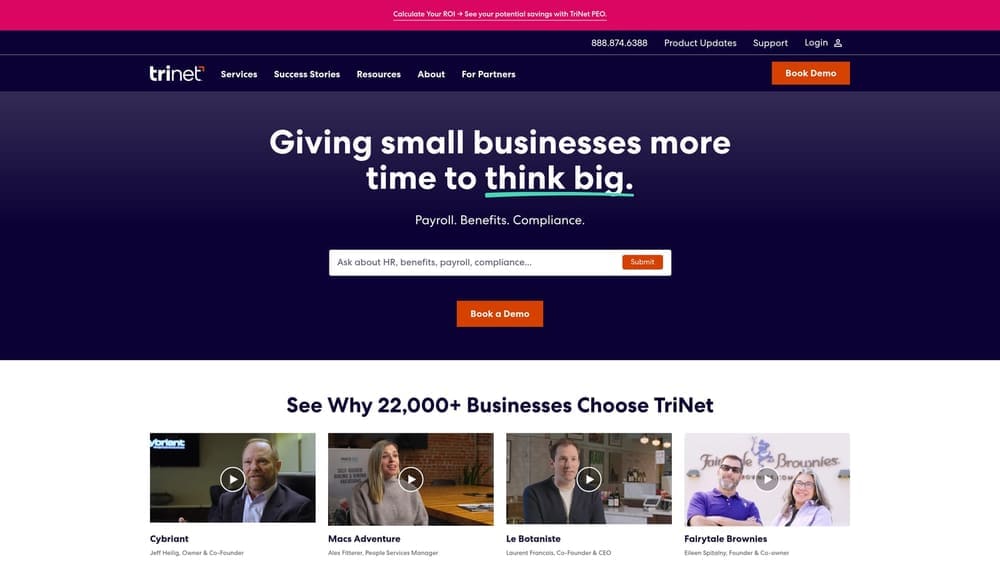
TriNet structures its HR packages around specific industries, which is a genuine differentiator when the fit is right and a weakness when it isn’t.
Where This Tool Shines
If your 100-person company is a venture-backed tech firm, a financial services company, or a life sciences organization, TriNet’s industry-specific benefits packages and HR templates are well-tailored to your talent profile. The benefits packages are designed to compete for white-collar talent, and the HR support teams have domain familiarity with the regulatory and compensation questions common in those verticals.
The honest limitation: TriNet’s pricing has historically been less transparent than peers like Justworks, and companies outside TriNet’s target verticals often find the fit weaker than the sales process suggests. TriNet has also gone through platform transitions in recent years that some buyers found disruptive. If your company doesn’t map cleanly to one of their industry verticals, the industry-specific value proposition largely disappears.
Key Features
Industry-Specific HR Bundles: Pre-built HR packages tailored to tech, financial services, life sciences, and nonprofits, covering benefits design and compliance requirements specific to those industries.
Competitive White-Collar Benefits: Benefits packages designed to attract and retain professional talent in competitive hiring markets.
CPEO Certification: IRS-certified status for relevant tax treatment questions.
Integrated HR Platform: Payroll, benefits, and compliance tools in a single system with employee self-service.
Industry-Specific HR Expertise: Support teams with domain knowledge in target verticals, not generic HR generalists.
Best For
Companies in TriNet’s core industry verticals that need competitive benefits to attract professional talent. A weaker fit for companies in industries outside those verticals, or for buyers who prioritize pricing transparency over industry specialization.
Pricing
Custom pricing only. No published rates. Requires a quote. Pricing transparency has historically been a limitation; push for a detailed fee breakdown before moving forward.
5. Justworks
Best for: Companies that want predictable, transparent PEO pricing and a clean self-service platform.
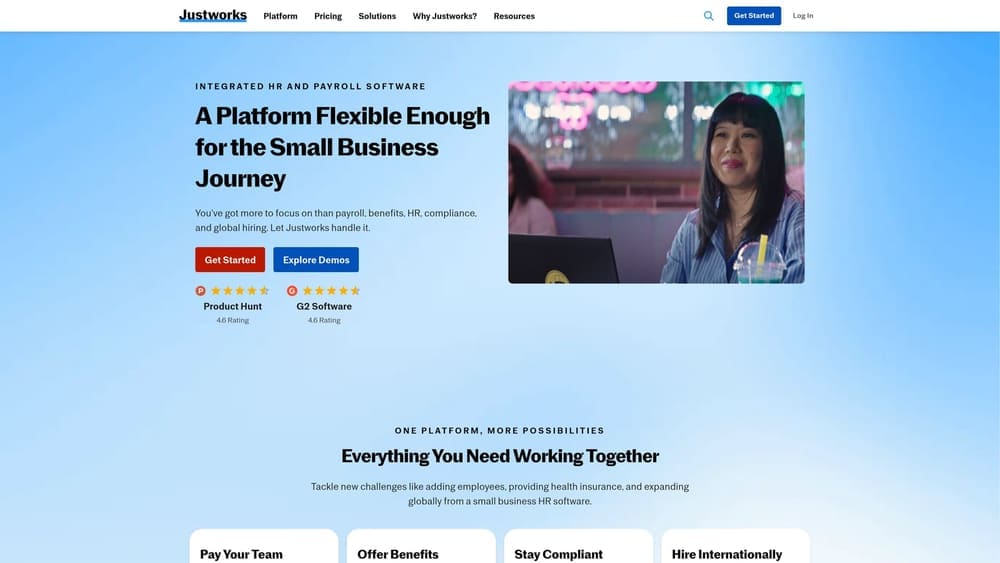
Justworks is one of the few PEOs that publishes flat PEPM pricing on its website, which makes it genuinely unusual in a market where most competitors require a quote to reveal anything.
Where This Tool Shines
Pricing transparency is Justworks’ clearest differentiator. At 100 employees, being able to model your PEO cost before talking to a sales rep is a meaningful advantage, both for internal budget planning and for benchmarking against quotes from other providers. The platform itself is clean and intuitive, which reduces the friction of onboarding employees and managing day-to-day HR tasks without heavy IT support.
The limitation to name clearly: Justworks’ HR consulting depth is lighter than Insperity or ADP TotalSource. Companies that need intensive HR support beyond payroll, benefits administration, and compliance tooling may find the service model thin as they scale. It’s a strong fit for companies where HR operations are relatively straightforward and the primary need is cost-effective access to large-group benefits rates with a predictable fee structure.
Key Features
Published Flat PEPM Pricing: Pricing visible on the website before any sales conversation, which is rare in the PEO market and valuable for budgeting.
Clean Self-Service Platform: Intuitive HR and payroll interface that employees and administrators can navigate without significant training.
CPEO Certification: IRS-certified PEO status, relevant for federal tax credit and wage base reset considerations.
Large-Group Health Insurance Access: Benefits purchasing power from the aggregated employee pool, which can produce better rates than a 100-person company could access independently.
Straightforward Onboarding: Simplified implementation process relative to larger, more complex PEO platforms.
Best For
Cost-conscious buyers who want predictable fees and a self-service HR platform. Also a good fit for companies that have already outgrown basic payroll software and need benefits access but don’t require intensive HR consulting support.
Pricing
Published PEPM pricing on their website. One of the only PEOs in the market with transparent public rates. Confirm whether the published rate includes all components or whether workers comp and certain benefits administration fees are separate.
Before you go deeper into individual vendor quotes, it’s worth having a benchmark in hand. Compare PEO Plans through PEO Metrics to see how these providers stack up against each other on your specific headcount and state footprint, free of charge.
6. Rippling
Best for: Tech-forward and remote-first companies that want HR, IT, and payroll in one platform.
Rippling is a workforce management platform that offers a PEO service layer alongside HR, IT device management, and payroll in a single system.
Where This Tool Shines
The combination of HR and IT management in one platform is genuinely differentiated. For a 100-person company with a distributed workforce, the ability to onboard an employee, provision their laptop, assign software access, and enroll them in benefits inside the same system is a real operational improvement over cobbling together separate tools. Rippling’s automation of onboarding and offboarding workflows is particularly strong.
The honest caveat: Rippling’s PEO service layer is newer than its core HR and IT platform. Buyers who want deep HR consulting support should evaluate carefully whether the PEO offering matches the depth of dedicated PEOs like Insperity or ADP TotalSource. Rippling’s modular pricing structure also means costs can add up quickly as features are layered on, so model the full-feature cost before comparing it against flat-fee alternatives.
Key Features
HR and IT in One Platform: Combines PEO services with IT device management and app provisioning, which no traditional PEO offers.
Modular Architecture: Companies can add or remove features, which provides flexibility but requires careful cost modeling.
Automated Workflows: Onboarding and offboarding automation that reduces manual HR tasks significantly for distributed teams.
Global Workforce Capabilities: Tools for managing international employees alongside domestic PEO-covered workers.
Remote-First Fit: Platform design optimized for companies with no central office or with employees across many states and countries.
Best For
Tech-forward companies with distributed or remote-first workforces where IT management and HR administration overlap significantly. Less suited for companies that need deep HR consulting support or prefer a simple, single-fee pricing structure.
Pricing
Modular pricing with a base platform cost plus per-feature add-ons. Full PEO service layer requires a quote. Model the complete feature set before comparing against PEPM-based competitors to avoid underestimating total cost.
7. Oasis, a Paychex Company
Best for: Mid-market buyers who want Paychex’s carrier network at pricing positioned below the top-tier national PEOs.
Oasis is the PEO brand under Paychex, operating with Paychex’s carrier relationships and compliance infrastructure behind it.
Where This Tool Shines
Paychex’s scale gives Oasis access to a broad benefits carrier network, which can translate to competitive health insurance options for a 100-person company. Pricing is typically positioned in the mid-market range relative to Insperity and ADP TotalSource, which can make it an attractive middle-ground option for buyers who want national PEO infrastructure without top-tier pricing. For companies already running on Paychex payroll, the integration path is smoother than switching platforms entirely.
The limitation worth flagging: Oasis has gone through platform transitions since the Paychex acquisition, and buyer feedback on service model consistency has been mixed. Some buyers have found the experience more variable than they expected from a national provider. Ask specifically about account management structure and escalation paths before signing, and confirm how the platform has stabilized since the integration.
Key Features
Paychex Carrier Network: Access to Paychex’s established carrier relationships for health and ancillary benefits, providing competitive options for mid-size companies.
Mid-Market Pricing Position: Generally priced below Insperity and ADP TotalSource, making it a viable option for cost-conscious buyers who still want national infrastructure.
Paychex Payroll Integration: Streamlined transition for existing Paychex customers.
Workers Comp and Risk Management: Full risk management services included in the PEO offering.
HR Support and Benefits Administration: Standard PEO service model covering compliance, HR support, and benefits management.
Best For
Companies seeking mid-market pricing with national carrier access, particularly existing Paychex customers. Buyers who prioritize service consistency and a highly attentive account management experience may want to probe that dimension carefully before committing.
Pricing
Custom pricing only. No published rates. Requires a quote. Confirm the administrative fee structure and ask about any transition costs if you’re moving from a different platform.
8. Resourcing Edge
Best for: Companies that prioritize dedicated, responsive account management over the broadest possible carrier network.
Resourcing Edge is a regional PEO with a reputation for a smaller client-to-account-manager ratio and a more hands-on service relationship than national providers typically deliver.
Where This Tool Shines
The most common service complaint buyers have about large national PEOs is that account management becomes reactive rather than proactive. You submit a ticket and wait. Resourcing Edge’s smaller book of business per account manager is a structural answer to that problem. For a 100-person company where the HR team is lean, having a PEO contact who actually knows your account and responds quickly has real operational value.
The honest limitation: geographic coverage and carrier network depth are narrower than national PEOs. For companies operating across many states, the compliance infrastructure and carrier access may not match what ADP TotalSource or Insperity can provide. Resourcing Edge is a strong option for single-state or limited-geography employers who value service quality over maximum network breadth.
Key Features
Lower Client-to-Manager Ratio: Smaller account portfolios per manager than national PEOs, which typically translates to faster response times and more personalized service.
Dedicated HR Support: Assigned HR specialists with ongoing familiarity with your account rather than a rotating support queue.
Full-Service PEO: Complete payroll, benefits, compliance, and HR administration, not a partial-service model.
Personalized Onboarding: Implementation process with direct account team involvement, not a self-guided setup.
Best For
Single-state or limited-geography employers who have had poor service experiences with large national PEOs and want a more attentive partner. Less suited for multi-state employers who need the broadest possible compliance and carrier infrastructure.
Pricing
Custom pricing only. No published rates. Requires a quote. As a regional provider, pricing may be competitive relative to national PEOs, but compare carefully on total cost including benefits quality and carrier access.
Which PEO Fits Your Situation at 100 Employees
The right PEO at 100 employees depends on what’s actually driving the decision. Here’s how to think through the profiles above.
If you’re a first-time buyer who wants to understand the market before talking to any sales rep, start with PEO Metrics. The comparison report gives you a benchmark built around your headcount, industry, and states before you’re in a negotiation with a vendor who controls all the information.
If deep HR consulting support is your primary need and budget is secondary, Insperity is the strongest option. Negotiate hard on the administrative fee structure and confirm whether it’s flat PEPM or percentage of payroll.
If multi-state compliance coverage is the priority, ADP TotalSource has the broadest infrastructure. If you’re already on ADP payroll, the transition case is even clearer. Just go in with realistic expectations about service attentiveness.
If your company is in tech, financial services, life sciences, or nonprofits and benefits competitiveness for white-collar talent is the key lever, TriNet is worth evaluating. Push for pricing transparency early in the process.
If you want predictable costs and a clean platform without intensive HR consulting, Justworks’ published pricing and self-service model make it the most budget-transparent option in the market.
If your workforce is distributed and you want HR and IT management unified, Rippling’s platform is genuinely differentiated. Model the full modular cost carefully before comparing it against simpler alternatives.
If you’re an existing Paychex customer or want mid-market pricing with national carrier access, Oasis is worth including in your quote process. Ask specifically about service model consistency since the Paychex integration.
If service responsiveness is the thing your current PEO is failing at and your geography is limited, Resourcing Edge’s account management model addresses that problem directly.
Whatever your situation, don’t auto-renew without a comparison. At 100 employees, you have enough leverage to get competitive quotes from multiple providers. The only thing that prevents most buyers from using that leverage is not knowing what the market looks like. Don’t auto-renew. Make an informed, confident decision.
Before you sign that PEO renewal, make sure you’re not leaving money on the table.
Many businesses unknowingly overpay because of bundled fees, hidden administrative markups, and contracts designed to limit flexibility. We give you a clear, side-by-side breakdown of pricing, services, and contract terms—so you can see exactly what you’re paying for and choose the option that truly fits your business.
