

When headcount is climbing fast, the HR infrastructure that worked at 20 employees starts showing cracks at 50. Payroll errors, compliance gaps, and benefits packages that can’t compete with larger employers all surface at the worst possible time, usually when you’re too busy hiring to fix them properly.
A professional employer organization can absorb a lot of that pressure. But not every PEO is built for growth. Some are optimized for stability, not scale. Others carry minimums you’ll outgrow, or contracts with exit friction that punishes you for succeeding.
This guide focuses on PEOs that are genuinely suited to companies adding headcount quickly: platforms with flexible pricing structures, strong multi-state compliance coverage, scalable benefits, and onboarding processes that don’t require six weeks of implementation. PEO Metrics is listed first because it helps you compare the providers below before you commit. The remaining seven are ordered by how well they fit specific growth profiles, not by revenue or brand recognition.
This is informational guidance, not legal or benefits advice.
1. PEO Metrics
Best for: Companies that want to compare PEO providers side-by-side before signing anything.
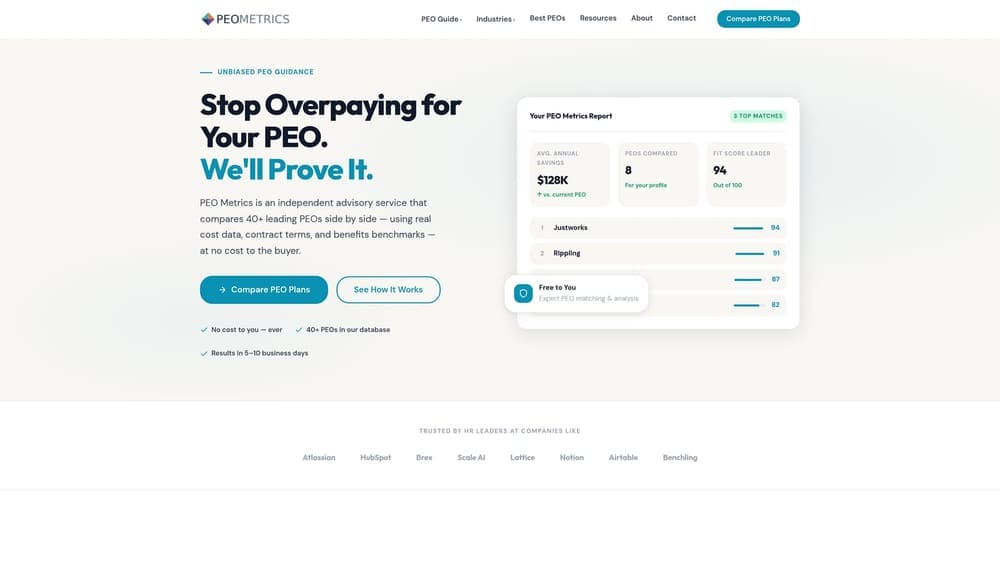
PEO Metrics is a structured comparison service that helps companies evaluate and select PEO providers with detailed pricing analysis and provider metrics designed to prevent costly mismatches during critical growth phases.
Where This Tool Shines
Most companies choose a PEO the same way they choose a vendor at a trade show: they talk to whoever shows up first, get a quote they can’t fully interpret, and sign before they’ve seen what else is out there. During a growth phase, that approach is especially risky because the contract you sign at 35 employees will still govern your HR setup at 120.
PEO Metrics addresses the comparison gap directly. Rather than evaluating a single quote in isolation, you can see how pricing structures, contract terms, and service models stack up across providers. That’s particularly useful when you’re weighing a flat PEPM model against a percentage-of-payroll structure, and the difference in cost becomes material as your average salary rises.
Key Features
Side-by-Side Provider Comparisons: Structured breakdowns across multiple PEO providers, covering pricing, benefits access, compliance coverage, and contract mechanics in a single view.
Pricing Analysis: Identifies where quotes may be scoped incorrectly, where costs are likely to rise at renewal, and what fee structures mean in practice as headcount grows.
Contract and Exit Term Review: Guidance on notice windows, renewal mechanics, and exit provisions before you sign, not after you need to leave.
Multi-Provider Coverage: Covers PEO providers across industries and company sizes, so the comparison reflects your specific growth profile rather than a generic SMB template.
Decision Support for Pre-Signing: Designed for companies that want to make an informed decision before committing to a multi-year agreement, not a tool for post-signing damage control.
Best For
HR leaders, COOs, and founders who are actively evaluating PEO providers and want to understand what they’re actually comparing before they sign. Particularly useful if you’ve received quotes from multiple providers and aren’t sure how to read the differences, or if you’ve had a bad PEO experience before and want to avoid repeating it.
Pricing
[CONFIRM: PEOMetrics pricing or free-to-use model. Do not publish without verification.]
2. Rippling
Best for: Tech-forward companies scaling fast and managing a distributed, remote-first workforce.
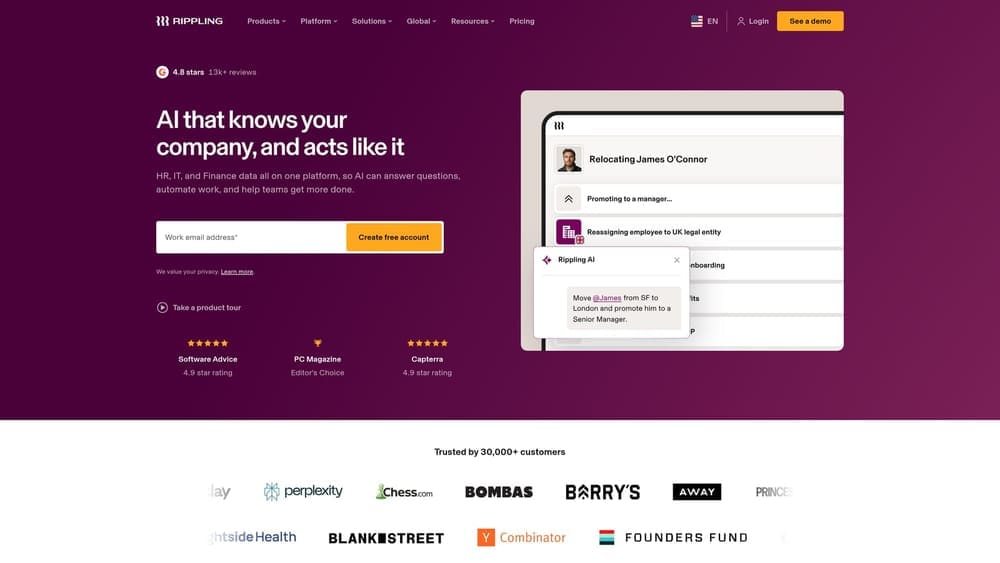
Rippling is a modular workforce platform that includes PEO services alongside HR, IT, and finance tools, built for companies that want a single system to manage a rapidly expanding workforce.
Where This Tool Shines
Most PEOs handle HR and payroll. Rippling handles HR, payroll, device management, app provisioning, and expense management in one platform. For a company that’s onboarding ten people a month across multiple states, that consolidation reduces the coordination overhead that typically falls on a stretched HR team or office manager.
The multi-state compliance automation is a genuine differentiator. As you hire in new states, Rippling handles the state registration, tax setup, and compliance requirements without requiring you to manage each state manually. That matters when you’re moving fast and don’t have a compliance specialist on staff.
Key Features
Unified HR, IT, and Payroll: One platform covers employee records, payroll, device management, and app access, reducing the number of systems a growing team has to manage simultaneously.
Automated Multi-State Compliance: State-specific tax registration, wage law updates, and compliance requirements are handled automatically as you expand geographically.
Device Management with HR Onboarding: Relevant for remote-first companies where equipment provisioning and system access are part of every new hire workflow.
Modular Pricing: You add capabilities as you need them rather than paying for a full suite from day one.
API Integrations: Connects with recruiting, finance, and productivity tools, which reduces duplicate data entry during periods of rapid hiring.
Best For
Growth-stage technology companies, remote-first organizations, and businesses expanding into multiple states quickly. Less suited to companies with complex hourly or shift-based workforces, where other platforms have deeper payroll infrastructure for those scenarios.
Pricing
[CONFIRM: current Rippling PEO pricing from primary source with as-of date. Rippling uses modular pricing; hard figures require verification before publication.]
3. TriNet
Best for: Growth-stage companies in specialized industries competing for technical or professional talent.
TriNet is an established PEO offering industry-specific HR solutions and access to large-group benefits pools, with particular strength for growth-stage companies where benefits quality affects recruiting.
Where This Tool Shines
TriNet’s industry-specific packaging is what separates it from general-purpose PEOs. If you’re a life sciences company, a fintech, or a professional services firm, you’re not getting a generic SMB benefits package. You’re getting HR infrastructure and carrier relationships that reflect what your candidates actually expect.
Access to large-group benefits is meaningful for companies that are too small to negotiate directly with carriers. A 40-person company on a TriNet plan is buying benefits through a much larger purchasing pool, which can close the gap between what you can offer and what a 500-person competitor can offer. That gap matters when you’re recruiting senior engineers or licensed professionals.
Key Features
Industry-Specific HR Packages: Tailored solutions for sectors including technology, financial services, life sciences, and professional services, rather than one-size-fits-all templates.
Large-Group Benefits Access: Smaller companies access health and benefits plans through TriNet’s purchasing pool, improving what they can offer candidates without the headcount to negotiate independently.
Dedicated HR Support: HR guidance available alongside self-service tools, relevant for growth-stage companies without a full internal HR function.
Multi-State Payroll and Compliance: Handles state-specific payroll tax, leave law, and regulatory requirements across multiple jurisdictions.
Established Carrier Relationships: Broad vendor and carrier network built over years in the market, which affects plan availability and renewal stability.
Best For
Growth-stage companies in technology, financial services, life sciences, or professional services where benefits quality is a direct recruiting variable. Also a reasonable fit for companies that want industry-specific HR guidance rather than a generic service model.
Pricing
[CONFIRM: current TriNet pricing model from primary source with as-of date. TriNet pricing varies by plan and employee count.]
4. Justworks
Best for: Companies that want predictable HR costs as headcount fluctuates month to month.
Justworks is a PEO known for transparent, flat per-employee-per-month pricing that makes HR costs predictable even when headcount is changing quickly.
Where This Tool Shines
The pricing model is the story here. Most PEOs price as a percentage of payroll, which means your HR costs rise automatically as your average salary increases, even if the actual service you’re receiving doesn’t change. Justworks uses flat PEPM pricing, so your cost per employee stays consistent regardless of whether you’re hiring junior coordinators or senior engineers. For a company in a growth phase where salary mix is shifting, that distinction can be material.
The platform itself is clean and straightforward. Onboarding a new employee doesn’t require a support ticket. The self-service experience is built around the assumption that your HR team is small and your employees are capable of managing their own information, which is usually accurate at the growth stage.
Key Features
Flat PEPM Pricing: Per-employee-per-month fees don’t increase as salaries rise, which avoids the cost creep that affects percentage-of-payroll models during senior hiring phases.
Transparent Pricing Page: Justworks publishes pricing publicly, making it easier to compare against other providers without going through a full sales process first.
Self-Service Platform: Clean interface with straightforward onboarding, designed for small HR teams and employee self-management.
Competitive Benefits Access: Health benefits through large-group purchasing, which improves plan options relative to what a small company could access independently.
CPEO and ESAC Status: [CONFIRM current CPEO certification and ESAC accreditation status before publication. These affect tax liability allocation and financial assurance standards.]
Best For
Companies between roughly 5 and 200 employees that want pricing they can actually model in a spreadsheet. Particularly useful if your hiring is salary-heavy and you want to avoid the compounding cost effect of percentage-of-payroll pricing as compensation levels rise.
Pricing
[CONFIRM: current Justworks pricing tiers from justworks.com pricing page with as-of date. Justworks publishes pricing publicly; verify current figures before publication.]
5. ADP TotalSource
Best for: Companies that need deep compliance infrastructure and have complex payroll requirements.
ADP TotalSource is the PEO offering from ADP, combining extensive compliance infrastructure with the payroll processing scale of one of the largest HR technology providers in the market.
Where This Tool Shines
ADP’s scale translates into compliance depth that smaller PEOs can’t easily replicate. Multi-state tax registration, workers’ compensation program management, and regulatory updates across dozens of jurisdictions are areas where ADP has invested heavily over decades. For a company scaling into states with complex employment law environments, that infrastructure matters.
The workers’ comp program management is worth calling out specifically. Companies in higher-risk industries or those with mixed workforces often find that workers’ comp is where their PEO relationship either pays off or falls apart. ADP TotalSource’s established carrier relationships and claims management infrastructure can stabilize that exposure during growth phases when classification and coverage questions are most likely to surface.
Key Features
Multi-State Tax and Regulatory Compliance: Extensive coverage across state-specific payroll tax, employment law updates, and regulatory filing requirements.
Workers’ Compensation Program Management: Established carrier relationships and claims handling, relevant for companies in higher-risk industries or with variable workforce compositions.
ADP Ecosystem Integration: Connects with ADP’s broader payroll, workforce management, and time-tracking tools for companies already in the ADP environment.
Dedicated HR Business Partner: Assigned HR support for growing companies, not just access to a general support queue.
Benefits Administration at Scale: Carrier relationships built on ADP’s total client base, which affects plan availability and pricing access.
Best For
Mid-market companies scaling past 50 employees, businesses in industries with complex workers’ comp exposure, and organizations already using ADP products that want to consolidate into a single vendor relationship. Also a practical fit for companies expanding into multiple states simultaneously.
Pricing
[CONFIRM: ADP TotalSource pricing model from primary source with as-of date. ADP does not typically publish PEO pricing publicly; quotes are customized.]
6. Insperity
Best for: Companies scaling past 50 employees without a full internal HR team in place.
Insperity is a large PEO that pairs its technology platform with assigned HR specialists, making it a practical option for companies that are growing faster than their HR capacity can keep up with.
Where This Tool Shines
The dedicated HR specialist model is Insperity’s defining characteristic. You’re not calling a general support line and explaining your situation from scratch each time. You have an assigned HR professional who knows your account, your workforce composition, and your history. For a company that’s adding 20 employees a quarter and dealing with a new state registration, a workers’ comp question, and a benefits enrollment question simultaneously, that continuity is worth a lot.
Insperity also covers a broader range of HR services than many competitors. Performance management tools, training resources, and workforce optimization support are included alongside the standard payroll and benefits administration. That matters for companies that want to build HR infrastructure, not just outsource payroll.
Key Features
Dedicated HR Specialist: An assigned HR professional for each client account, providing continuity rather than routing every question through a general support queue.
Comprehensive Benefits Administration: Health, dental, vision, and retirement plan administration handled through Insperity’s carrier relationships.
Workforce Optimization Tools: Performance management, training resources, and HR analytics included alongside core payroll and compliance services.
Risk Management and Workers’ Comp: Claims management and workers’ compensation support for companies with exposure in those areas.
Scalable Service Model: Serves companies from small through mid-market, which reduces the risk of outgrowing the platform during a sustained growth phase.
Best For
Companies between roughly 5 and 150 employees that are growing faster than their internal HR capacity and need substantive HR support, not just a self-service platform. Particularly useful for businesses where the founder or COO is currently handling HR decisions that should belong to a dedicated function.
Pricing
[CONFIRM: Insperity pricing model from primary source with as-of date. Insperity pricing is customized by account; verify current model before publication.]
7. Paychex PEO
Best for: Companies in traditional industries with complex payroll scenarios including hourly, salaried, and mixed workforces.
Paychex PEO is the co-employment service from Paychex, combining broad payroll infrastructure with HR and benefits administration, with particular strength in industries where payroll complexity goes beyond salaried employees.
Where This Tool Shines
Most PEOs are built around the assumption that your workforce is primarily salaried. Paychex has deep infrastructure for the messier payroll scenarios: hourly employees with variable schedules, tipped workers, shift differentials, and mixed classifications. For a company in retail, healthcare support, hospitality, or light manufacturing, that matters more than a clean self-service interface.
The compliance coverage across traditional industries is also a differentiator. Paychex has established regulatory relationships in sectors where employment law is more complex and enforcement is more active. Growing companies in those industries often find that general-purpose PEOs underestimate the compliance requirements specific to their workforce type.
Key Features
Complex Payroll Handling: Infrastructure for hourly, salaried, tipped, and mixed-classification workforces, not just straightforward salaried payroll.
Broad Industry Coverage: Established presence in retail, healthcare support, light manufacturing, and other traditional industries with specific compliance requirements.
Multi-State Compliance: State-specific payroll tax, leave law, and regulatory filing support across multiple jurisdictions.
Paychex Ecosystem Integration: HR administration tools connect with Paychex’s existing payroll, time-tracking, and scheduling infrastructure.
Group Benefits Access: Health and ancillary benefits through Paychex’s carrier network, available to co-employment clients regardless of headcount.
Best For
Companies in traditional industries with complex payroll scenarios, businesses already using Paychex for payroll that want to add co-employment benefits, and organizations where hourly workforce management is a core operational requirement rather than an edge case.
Pricing
[CONFIRM: Paychex PEO pricing model from primary source with as-of date. Paychex pricing is typically customized; verify current model before publication.]
8. Sequoia One
Best for: Venture-backed startups competing for technical talent in the seed-through-Series C range.
Sequoia One is a PEO built specifically for the venture-backed startup environment, with benefits packages and HR infrastructure designed around the expectations of high-growth technology and life sciences companies.
[CRITICAL FLAG: The Research Specialist must verify Sequoia One’s current operating name, ownership structure, and whether the product continues under this name before this section is published. Sequoia One underwent acquisition activity; confirm current status from a primary source with an as-of date. If unverifiable, this section should be replaced with a confirmed alternative provider.]
Where This Tool Shines
The venture-backed startup environment has specific HR requirements that general-purpose PEOs aren’t always equipped to handle. Equity compensation administration, benefits packages that can compete with late-stage companies for engineering talent, and HR infrastructure that doesn’t slow down a team moving at startup pace are all areas where a startup-focused PEO can outperform a general market provider.
Sequoia One’s focus on the seed-through-Series C profile means the platform and service model are calibrated for companies at the growth inflection point, not companies that have already stabilized. That’s a meaningful distinction when you’re scaling from 15 to 80 employees in 18 months and need HR infrastructure that can keep up.
Key Features
Startup-Competitive Benefits: Benefits packages designed to match or approach what larger employers offer, which directly affects recruiting in competitive technical talent markets.
Equity-Aware HR Administration: HR infrastructure built around the startup environment, including support for equity compensation structures common in VC-backed companies.
Multi-State Compliance for Fast Scalers: Compliance support for companies expanding into new states quickly, which is a common pattern in the seed-through-Series C growth phase.
Startup Ecosystem Integration: Connects with tools common in the startup environment, reducing friction during onboarding and ongoing administration.
Growth-Phase Focus: Service model and pricing calibrated for companies in the 10-to-150 employee range rather than established mid-market businesses.
Best For
Venture-backed technology and life sciences startups that are growing quickly and need benefits packages that can compete with larger employers for technical talent. Less suited to bootstrapped companies or those in traditional industries where the startup-specific features aren’t relevant to the workforce profile.
Pricing
[CONFIRM: Sequoia One current pricing from primary source with as-of date, contingent on verification of current operating status.]
Choosing the Right PEO for Your Growth Stage
Fast growth puts unusual pressure on every HR decision. The PEO you choose at 30 employees needs to still make sense at 150, and the contract you sign today should not become an obstacle when you need to change course.
The providers above represent genuinely different approaches to the growth problem. Rippling leads with platform consolidation and multi-state automation. TriNet leads with industry-specific benefits access. Justworks leads with pricing transparency. ADP TotalSource and Insperity lead with compliance depth and dedicated HR support. Paychex PEO leads with complex payroll infrastructure. Sequoia One leads with a startup-specific service model. None of them is the right answer for every company.
The right fit depends on your industry, your current state footprint, your headcount today, and how fast you expect it to grow. It also depends on factors that don’t show up in a sales deck: renewal mechanics, exit provisions, what happens to benefits continuity if you switch mid-year, and whether the pricing model compounds against you as your average salary rises.
Before committing to any provider, compare quotes side-by-side and pay close attention to those contract details. The difference between a flat PEPM model and a percentage-of-payroll model can be significant once you’re hiring senior people at scale. Exit windows and notice periods matter too, particularly if you’re signing during a growth phase when your needs could change quickly.
If you’re also thinking through what switching looks like when your current provider isn’t keeping up, or why some PEO relationships fail even when the provider looks credible on paper, those questions are worth working through before you sign. You can find related guidance at switching tech startups to a PEO and why PEOs fail companies.
PEO Metrics provides structured, side-by-side comparisons across providers to help you see exactly what you’re getting and what it will cost as you scale. Many businesses end up overpaying because of bundled fees, hidden administrative markups, and contracts designed to limit flexibility. A clear comparison before you sign is the most straightforward way to avoid that outcome.
Don’t auto-renew. Make an informed, confident decision.
Before you sign that PEO renewal, make sure you’re not leaving money on the table.
Many businesses unknowingly overpay because of bundled fees, hidden administrative markups, and contracts designed to limit flexibility. We give you a clear, side-by-side breakdown of pricing, services, and contract terms—so you can see exactly what you’re paying for and choose the option that truly fits your business.
