

Running a construction company in California means you’re already managing more complexity than most business owners ever face. You’ve got field crews moving between job sites, public works contracts with prevailing wage obligations, workers’ comp premiums that can feel punishing, and a regulatory environment where a payroll error can trigger a Private Attorneys General Act claim before you’ve had a chance to correct it. A professional employer organization can take a significant portion of that administrative weight off your plate, but only if it actually understands the construction industry and California’s specific rules.
The challenge is that most PEOs are built for office-based businesses. Fewer have genuine depth in certified payroll reporting, DIR contractor registration compliance, or construction workers’ comp class codes. Choosing the wrong one doesn’t just waste money; it can create audit exposure and compliance gaps that are worse than going it alone.
The options below represent a range of approaches worth evaluating, from a comparison tool that helps you vet providers before you commit, to full-service PEOs with California infrastructure, to a workers’ comp-focused carrier with PEO relationships. Selection criteria include workers’ comp handling, California compliance depth, payroll capabilities for hourly and prevailing-wage workforces, and pricing transparency. This is informational guidance, not individualized legal or tax advice.
1. PEO Metrics
Best for: Construction companies that want to compare PEO providers side by side before signing anything.
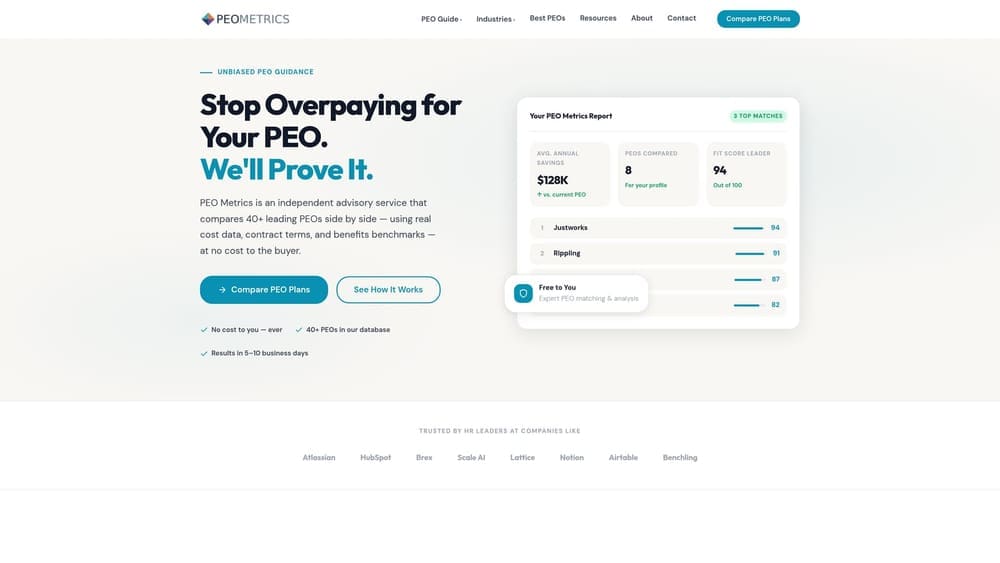
PEO Metrics is a PEO comparison and advisory service, not a PEO itself, designed to help businesses evaluate providers with detailed metrics and pricing analysis before making a commitment.
Where This Tool Shines
If you’re a California contractor who hasn’t yet selected a PEO, or who suspects you might be overpaying on your current arrangement, this is the logical starting point. PEO Metrics helps you understand what different providers actually offer for construction-specific needs, including how they handle workers’ comp class codes, California compliance, and prevailing wage payroll, before you’re locked into a contract.
The value here is in the comparison layer. Most contractors evaluate PEOs one at a time, which makes it hard to spot bundled fees, administrative markups, or contract terms that limit flexibility. A structured side-by-side view changes that dynamic. For companies weighing whether their current PEO is still the right fit, this kind of analysis can surface overpayment risk that wouldn’t otherwise be visible.
Key Features
Side-by-Side Provider Comparisons: Evaluate multiple PEOs against each other using detailed pricing and service metrics rather than relying on each vendor’s own sales materials.
Construction Industry Focus: Guidance that accounts for construction-specific needs, including California compliance considerations, when assessing which providers are a realistic fit.
Overpayment Risk Identification: Helps identify where bundled fees or contract structures may be costing more than necessary before you sign or renew.
No Obligation to Any Single Provider: You’re not steered toward one outcome; the goal is an informed decision, not a predetermined one.
California-Specific Evaluation Criteria: Coverage of California compliance factors in the provider evaluation process, relevant for contractors navigating DIR registration, PAGA exposure, and state-specific payroll requirements.
Best For
Construction companies in California that are evaluating PEOs for the first time, preparing to renew an existing contract, or concerned they may be overpaying. Also useful for HR leads who need to present a structured vendor comparison to ownership before a final decision.
Pricing
Contact PEO Metrics for details. Note that PEO Metrics may receive vendor placement fees from providers in its network.
2. Insperity
Best for: Mid-size construction firms that want a full-service PEO with dedicated HR support and access to large-group benefits.
Insperity is a publicly traded, full-service PEO with a national footprint and dedicated HR specialists assigned per account.
Where This Tool Shines
Insperity’s model is built around dedicated service relationships rather than a call-center support structure. For a construction company with a mix of field employees and office staff, having an assigned HR specialist who knows your account can make a meaningful difference when you’re navigating a workers’ comp claim or a California wage-and-hour question.
The benefits access is another practical advantage. Smaller contractors often can’t offer competitive health insurance because they don’t have the headcount to access large-group rates. Under Insperity’s co-employment model, your employees join a much larger pool, which can open benefit options that would otherwise be out of reach. Their risk management and safety program support is also relevant for field-based workforces where incident rates directly affect workers’ comp costs.
Key Features
Dedicated HR Specialists: Each account gets an assigned HR specialist rather than a rotating support queue, which matters for complex construction workforce situations.
Large-Group Benefits Access: Employees join Insperity’s benefits pool, making competitive health and ancillary benefits available to smaller contractors.
California Payroll Tax Compliance: Payroll processing with support for California-specific tax requirements, including SDI handling under co-employment.
Workers’ Comp Under PEO Master Policy: Employees are covered under Insperity’s master workers’ comp policy, which can affect class code placement and rates.
Risk Management and Safety Support: Resources to support safety program development, relevant for construction sites where OSHA compliance and incident prevention affect both safety and insurance costs.
Best For
Construction companies with roughly 10 to 150 employees that want a full-service relationship with a stable, established PEO and value direct HR specialist access over self-service tools. Less suited to very small contractors or those with highly specialized prevailing wage reporting needs that require deep public works expertise.
Pricing
Insperity does not publish pricing publicly. Pricing is typically structured as a per-employee-per-month fee. Contact Insperity directly for a construction-specific quote.
3. TriNet
Best for: Construction-adjacent businesses and mixed-workforce companies that need industry-tailored HR plans with a broad benefits marketplace.
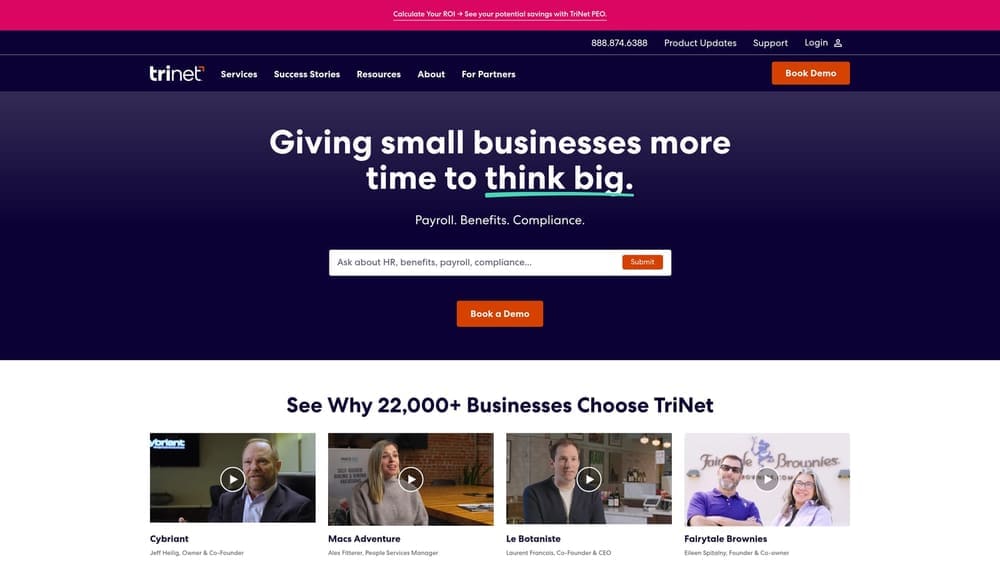
TriNet is a publicly traded PEO known for industry-specific HR plans and a broad benefits marketplace, serving companies with varied workforce compositions.
Where This Tool Shines
TriNet’s industry-tailored approach means they organize HR services around the realities of specific sectors rather than offering a one-size-fits-all package. For construction companies that also employ project managers, estimators, and administrative staff alongside field crews, this kind of workforce flexibility can be useful. The benefits marketplace gives employees more carrier choices than a single-carrier arrangement typically allows.
California compliance handling is a relevant strength here. TriNet has infrastructure to support California payroll tax obligations, which for construction companies includes not just standard withholding but also SDI contributions and the kind of pay stub detail California law requires. Their self-service platform gives field supervisors and employees direct access to HR tools without routing everything through a central office contact.
Key Features
Industry-Specific HR Plans: HR service structures designed around sector-specific workforce profiles, which can accommodate the mix of hourly field workers and salaried staff common in construction.
Broad Benefits Marketplace: Multiple carrier options rather than a single benefits package, giving employees more meaningful choices.
California Payroll Tax and Compliance Handling: Support for California-specific payroll requirements including SDI and the detailed pay stub requirements under California Labor Code.
Self-Service HR Platform: Employee and manager-facing tools for time tracking, document access, and HR requests without requiring constant HR department involvement.
Dedicated Customer Support: Assigned support teams rather than anonymous call routing, though the structure differs from Insperity’s dedicated-specialist model.
Best For
Construction companies with mixed office and field workforces, particularly those where benefits competitiveness is a priority for recruiting salaried project staff. May be less suited to contractors whose primary need is deep prevailing wage or certified payroll expertise.
Pricing
TriNet does not publish pricing publicly. Pricing follows a per-employee-per-month model. Contact TriNet directly for a quote tailored to your workforce composition.
4. Paychex PEO
Best for: Construction companies already using Paychex payroll that want to add co-employment HR services on a familiar platform.
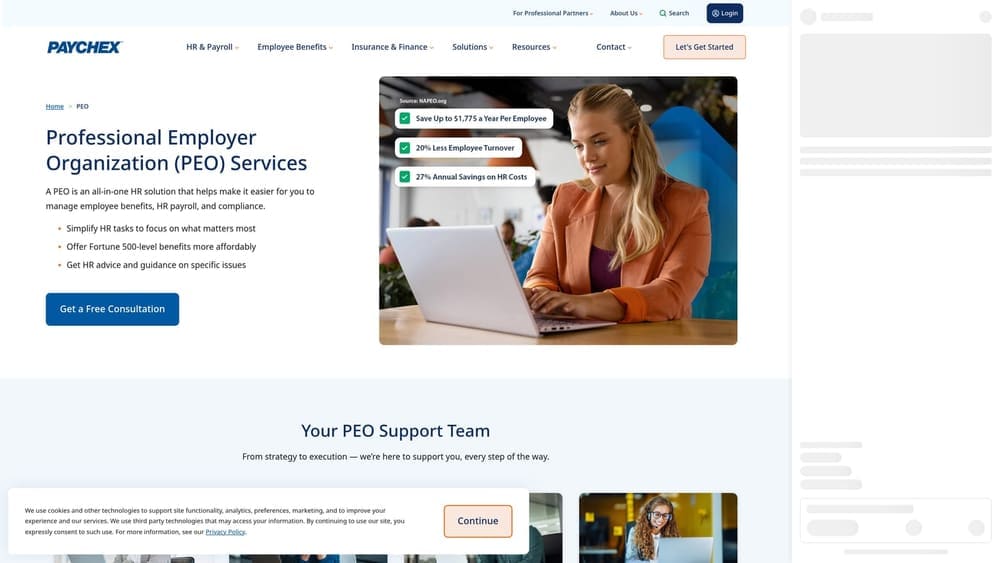
Paychex PEO combines Paychex’s widely used payroll technology with co-employment HR services, giving contractors an integrated platform with added compliance support.
Where This Tool Shines
If your company is already running payroll through Paychex, the PEO transition involves less disruption than switching platforms entirely. The integrated structure means payroll data, HR records, and benefits administration live in the same system, which reduces the friction of managing separate vendors for each function. For construction companies with variable crew sizes, having payroll and HR on one platform simplifies onboarding and offboarding as project staffing changes.
Paychex has a broad California presence and handles California-specific payroll tax requirements as part of their standard service. Workers’ comp administration under the PEO master policy is included, which can be relevant for smaller contractors who currently carry coverage through the assigned risk pool and are looking for a path to better rates.
Key Features
Integrated Payroll and PEO Platform: Payroll processing and HR co-employment services on a single system, reducing vendor fragmentation for contractors managing multiple functions.
California Payroll Tax Handling: Support for California-specific requirements including SDI, local taxes, and the detailed pay stub requirements that California law mandates.
Workers’ Comp Under PEO Master Policy: Employees covered under the Paychex PEO master workers’ comp policy, with potential rate implications for contractors currently in high-cost coverage arrangements.
HR Support and Compliance Assistance: Access to HR guidance and employee handbook development, useful for smaller contractors without in-house HR staff.
Benefits Access: Health insurance and ancillary benefits through the Paychex benefits offerings, extending group coverage access to smaller workforces.
Best For
Small to mid-size construction companies, particularly those already in the Paychex ecosystem, that want to add co-employment HR services without a full platform migration. Also relevant for contractors looking to move off the assigned risk pool for workers’ comp.
Pricing
Paychex does not publish PEO pricing publicly. Contact Paychex directly for a construction-specific quote that accounts for your workforce size and payroll structure.
5. ADP TotalSource
Best for: Larger California construction operations that need enterprise-grade HR infrastructure and the federal tax protections that come with IRS CPEO certification.
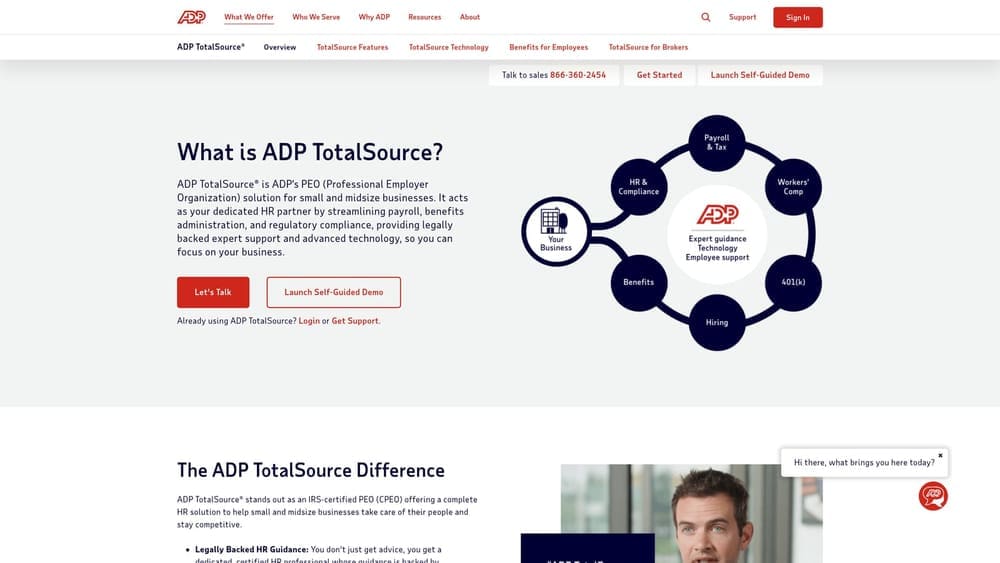
ADP TotalSource is ADP’s full-service PEO product, certified by the IRS as a Certified Professional Employer Organization (CPEO), offering broad compliance infrastructure and technology integrations.
Where This Tool Shines
The CPEO certification is a meaningful differentiator for construction companies that are considering switching PEOs mid-year or that want the federal tax protections the designation provides. Under a standard PEO arrangement, switching providers mid-year can create complications with FUTA wage base calculations. A CPEO-certified provider eliminates that issue, which matters for contractors whose project timelines don’t align neatly with calendar year boundaries.
ADP TotalSource’s compliance infrastructure is built for scale, and for larger California contractors managing multiple job sites, multiple classifications, and complex payroll runs, that depth is useful. California-specific compliance support is part of the offering, and ADP’s technology platform supports integrations with other business systems that construction companies often rely on for project management and accounting.
Key Features
IRS CPEO Certification: Provides federal tax protections for eligible clients, including the ability to reset the FUTA wage base mid-year when switching PEO providers, a relevant consideration for construction companies with irregular contract cycles.
California Compliance Support: Infrastructure to handle California-specific requirements including payroll tax, SDI, and California Labor Code compliance obligations.
HR Technology Platform with Integrations: ADP’s platform supports integrations with third-party business tools, useful for construction companies running project management or accounting software alongside HR functions.
Workers’ Comp and Risk Management: Workers’ comp administration under the PEO master policy, combined with risk management resources relevant to field-based workforces.
Benefits Administration: Access to large-group benefits rates through the co-employment structure, with administration handled through the ADP platform.
Best For
California construction companies with larger employee counts, complex payroll structures, or a specific need for CPEO certification protections. May be more than necessary for very small contractors, where the pricing structure relative to headcount may not be cost-effective.
Pricing
ADP TotalSource does not publish pricing publicly. Pricing is typically structured as either a percentage of payroll or a per-employee fee. Contact ADP directly for a quote specific to your operation.
6. Oasis (a Paychex Company)
Best for: Smaller construction and specialty trade contractors looking for a lower-overhead entry into co-employment with flexible service tiers.
Oasis operates under the Paychex umbrella and offers PEO services with flexible service tiers suited to smaller employers who may not need the full scope of a large-enterprise PEO.
Where This Tool Shines
Oasis was built with smaller employers in mind, and that orientation shows in its service tier structure. For specialty trade contractors, electrical subcontractors, or small general contractors that don’t have the headcount to justify a premium full-service PEO, Oasis offers a way to access co-employment benefits without paying for services they won’t use. The Paychex backing provides infrastructure and stability that a standalone smaller PEO might not offer.
California payroll tax compliance and workers’ comp under a master policy are both part of the Oasis offering. For small contractors currently managing workers’ comp independently at high individual rates, the master policy access can be a practical driver for evaluating this option. Note that because Oasis has been integrating into the Paychex structure, buyers should confirm the current product configuration directly before drawing conclusions about service scope.
Key Features
Flexible Service Tiers: Service options designed for smaller employers, allowing contractors to access co-employment benefits without the overhead structure of large-enterprise PEOs.
California Payroll Tax Compliance: Payroll processing with handling for California-specific tax requirements relevant to construction workforces.
Workers’ Comp Under Master Policy: Coverage under a PEO master workers’ comp policy, potentially relevant for small contractors paying high individual market rates.
HR Support and Compliance Guidance: Access to HR resources and compliance guidance, useful for contractors without dedicated in-house HR staff.
Paychex Infrastructure Backing: Operating under Paychex provides access to broader technology and administrative resources than a standalone small PEO would typically offer.
Best For
Small construction and specialty trade contractors, particularly those with fewer than 25 employees, who want the core benefits of co-employment without the cost structure of a full-service enterprise PEO. Confirm current product structure with Oasis directly given the ongoing Paychex integration.
Pricing
Oasis does not publish pricing publicly. Contact Oasis directly for a quote. Confirm current pricing structure given the Paychex integration, as product offerings may have evolved.
7. Justworks
Best for: Smaller construction-adjacent businesses or light commercial contractors that prioritize pricing transparency and a clean self-service HR platform.
Justworks is a PEO known for publishing flat-rate per-employee pricing on its website, making it one of the more transparent options in a market where most competitors require a sales call to get any number at all.
Where This Tool Shines
For a construction company owner who has spent time trying to extract pricing from PEO sales teams, Justworks’ approach is a genuine differentiator. Published pricing means you can do preliminary budget math before committing to a sales conversation, and flat-rate per-employee fees are easier to forecast than percentage-of-payroll models when your crew size fluctuates seasonally.
The platform itself is designed for ease of use rather than maximum configuration depth. Employees can access pay stubs, benefits information, and HR documents through a clean interface without needing IT support to navigate it. California payroll tax handling is included, and 24/7 customer support access is available. The honest caveat for construction companies is that Justworks is not built around construction-specific complexity. Prevailing wage reporting, DIR compliance, and certified payroll are not areas where Justworks has documented specialization, so it’s better suited to lighter-risk construction-adjacent businesses than to contractors with active public works contracts.
Key Features
Transparent Published Pricing: Flat-rate per-employee pricing tiers published on the Justworks website, allowing preliminary cost evaluation without a sales conversation.
Self-Service HR and Payroll Platform: A clean, employee-facing interface for pay stubs, benefits, and HR documents that requires minimal training to use.
Benefits Access: Health insurance and ancillary benefits available through the PEO co-employment structure.
California Payroll Tax Handling: Standard California payroll tax compliance, including SDI, handled through the platform.
24/7 Customer Support: Around-the-clock support access, which can matter for contractors managing payroll questions outside standard business hours.
Best For
Small construction-adjacent businesses, design-build firms with primarily office-based staff, or light commercial contractors without prevailing wage obligations. Less suited to contractors with active public works contracts requiring certified payroll or DIR compliance support.
Pricing
Justworks publishes pricing tiers on their website. Visit justworks.com for current rates, as pricing may be updated periodically.
8. Employers Holdings
Best for: Small California construction contractors whose primary driver is workers’ comp cost and coverage access rather than full-service HR.
Employers Holdings is primarily a workers’ compensation insurance carrier with California market presence and experience with construction class codes, and has PEO relationships that may bundle HR services with coverage.
Where This Tool Shines
For a small contractor whose biggest pain point is workers’ comp, not payroll technology or benefits administration, Employers Holdings represents a different kind of entry point. Their core business is workers’ comp insurance, and their experience with construction class codes and small business risk profiles in California is relevant for contractors who have struggled to find coverage at reasonable rates in the standard market.
The PEO relationship angle is worth understanding carefully. Employers Holdings’ primary model is insurance carrier, not full-service PEO. Any HR services bundled with coverage through a PEO relationship are likely sourced through a partner arrangement rather than built in-house. Before treating this as a full-service PEO option, confirm directly with Employers Holdings what the current product structure actually includes. For contractors primarily motivated by workers’ comp access, it may still be worth a conversation; just go in with clear expectations about what you’re evaluating.
Key Features
Construction Class Code Experience: Workers’ comp carrier with familiarity in construction class codes, relevant for contractors whose risk profile makes standard market placement difficult.
California Market Presence: Active in the California workers’ comp market, with the regulatory familiarity that entails for construction-specific risk categories.
Small Business Focus: Risk appetite and service model oriented toward smaller employers, which aligns with the reality of most specialty trade and small general contracting businesses.
PEO Relationships: Potential to bundle HR services with workers’ comp coverage through partner PEO arrangements, though the structure of these relationships should be confirmed directly.
Risk Management Resources: Safety and risk management support relevant to field-based workforces where incident prevention directly affects premium costs.
Best For
Small California construction contractors whose immediate need is workers’ comp coverage access and cost management, and for whom full-service HR is a secondary consideration. Verify the current product structure directly before making any decisions based on this listing.
Pricing
Contact Employers Holdings directly for pricing. Given that their primary model is insurance carrier rather than full-service PEO, pricing structures will differ from the per-employee or payroll-percentage models typical of full-service PEOs.
California Construction PEO Compliance: What to Verify Before You Sign
California’s employment law environment adds a layer of due diligence to PEO selection that doesn’t apply in most other states. Before committing to any provider on this list, run through the following questions specific to California construction compliance.
DIR Contractor Registration
California requires contractors working on public works projects to register annually with the Department of Industrial Relations (DIR). Confirm whether the PEO you’re evaluating has experience supporting clients through DIR registration compliance and whether their payroll system can generate certified payroll reports in the format DIR requires (including the electronic reporting format mandated for most public works projects).
Prevailing Wage Administration
Prevailing wage rates on California public works projects are job-specific and change periodically. Ask each PEO directly how they handle prevailing wage determinations, which party is responsible for applying the correct rate by craft and classification, and how they manage rate changes mid-project. Not every PEO has built this into their standard payroll workflow.
PAGA Exposure
California’s Private Attorneys General Act allows employees to bring labor code violations on behalf of the state, with penalties that accrue per violation per pay period. For construction employers, the most common triggers are pay stub deficiencies (missing information required under California Labor Code Section 226), late final paychecks, and meal and rest period violations. Ask each PEO to walk you through exactly how their system generates California-compliant pay stubs, what their process is for final paycheck timing when a field employee is terminated, and how they document meal and rest period compliance for hourly workers.
Workers’ Comp Class Code Placement
Workers’ comp premiums in construction are highly sensitive to class code assignment. Under a PEO master policy, the PEO controls class code placement. Ask each vendor to confirm in writing which class codes they assign to your specific trades and how they handle mixed-trade workforces. A misclassified class code can mean paying a higher rate than your actual work warrants — or creating audit exposure if a claim arises under a mismatched code.
California SDI and Payroll Tax Handling
California’s State Disability Insurance (SDI) has specific contribution and reporting requirements that apply under the co-employment structure. Confirm that payroll tax filings under the co-employment arrangement include accurate SDI reporting and that the PEO handles Employment Training Tax (ETT) and California Unemployment Insurance (UI) obligations as part of the standard service.
PAGA Safe Harbor and Handbook Compliance
California employment law requires specific language in employee handbooks covering meal and rest periods, paid sick leave, and harassment prevention. Some PEOs include California-specific handbook templates as part of their service; others provide generic national templates that need significant modification before they’re appropriate for California employees. Ask for a sample California employee handbook — or at minimum confirm that their template includes the required California-specific provisions — before treating handbook support as a compliance feature.
Choosing the Right Fit for Your Operation
There’s no single right answer here, and the best choice depends on what’s actually driving your decision. If you want to evaluate construction PEOs beyond California, the best PEOs for construction companies guide covers national options across a wider range of provider types. A few quick-reference pointers based on common situations:
If you haven’t chosen a PEO yet and want to compare options before committing: Start with PEO Metrics. Getting a structured side-by-side view before you’re in a sales process will give you a better baseline for evaluating what any individual provider is actually offering.
If workers’ comp cost is your primary concern: Paychex PEO, Oasis, or Employers Holdings are worth prioritizing in your conversations. Understanding how each handles class code placement under the master policy is a key question to ask. The topic of workers’ comp class code restructuring under a PEO is worth understanding before those conversations.
If you have active public works contracts with prevailing wage obligations: Ask every provider on this list specifically how they handle certified payroll reporting and DIR compliance. Not all of them do, and the gap matters.
If you’re a larger operation and CPEO certification matters to you: ADP TotalSource is the option on this list with that designation.
If pricing transparency is a priority and your workforce is relatively straightforward: Justworks is the only provider here that publishes its rates publicly.
Before you sign a PEO renewal, make sure you’re not leaving money on the table. Many businesses unknowingly overpay because of bundled fees, hidden administrative markups, and contracts designed to limit flexibility. A clear, side-by-side breakdown of pricing, services, and contract terms lets you see exactly what you’re paying for and choose the option that truly fits your business. Don’t auto-renew. Make an informed, confident decision.
