

Your renewal quote came back higher than last year, and the rep’s explanation was vague. Or you’re pricing a PEO for the first time and every vendor is quoting you the same generic package without once mentioning your forklift operators, your experience modification rate, or the fact that you run distribution centers in three states.
That’s the problem with most PEO evaluations in distribution: the marketing is built for tech companies and professional services firms. The workers’ comp complexity that defines your cost structure, the SUTA exposure from high turnover, the payroll variability during peak season, these rarely come up until you’re already mid-contract.
This guide is built differently. We evaluated eight PEOs against the criteria that actually matter for distribution operations: workers’ comp program structure, multi-state SUTA management, benefits competitiveness for hourly workers, payroll flexibility for variable schedules, and contract terms that don’t trap you at renewal. Whether you’re buying for the first time or benchmarking a current provider, here’s what the distribution-specific landscape actually looks like.
1. PEO Metrics
Best for: Distribution companies that want an unbiased, side-by-side comparison before committing to any provider.
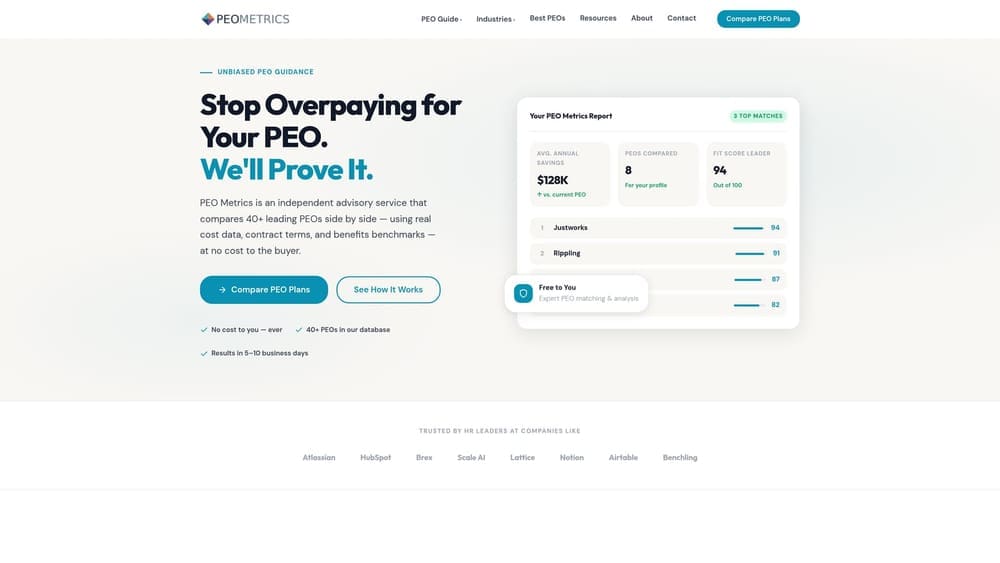
PEO Metrics is an independent PEO advisory service that compares 40+ PEOs on cost, contract terms, and benefits benchmarks, always free to the buyer.
Where This Tool Shines
Most distribution companies walk into PEO evaluations without a baseline. A vendor quotes you a PEPM rate, and you have no way to know if it reflects your workers’ comp class codes accurately, whether the admin fee is flat or percentage-based, or how the contract handles renewal escalators. PEO Metrics fixes that before you sign anything.
The 12-dimension methodology covers the variables that matter specifically for distribution: workers’ comp program structure, SUTA management, benefits access for hourly workforces, and contract flexibility. You get a side-by-side report tailored to your actual workforce profile, not a generic comparison built for a software company’s headcount.
Key Features
12-Dimension Methodology: Compares 40+ PEOs across cost, contract terms, benefits, workers’ comp structure, and compliance support, not just headline pricing.
Workers’ Comp Profile Matching: Analysis accounts for your specific class codes and loss history, which is the single biggest cost variable for warehouse and distribution workforces.
Side-by-Side Reporting: Delivers a clear comparison tailored to your workforce profile, including hourly workers, drivers, and multi-state operations.
Fast Turnaround: Report delivered in 5 to 10 business days after an approximately 8-minute intake process.
Proven Track Record: Has matched 850+ companies since 2019, representing $2.1 billion benchmarked across the database.
Best For
Any distribution company evaluating a PEO for the first time, benchmarking at renewal, or comparing providers after a bad experience. Especially valuable for operations with multi-state distribution centers, mixed workforce profiles, or elevated workers’ comp exposure where a wrong choice is expensive.
Pricing
100% free to the buyer. PEO Metrics does not accept vendor fees or commissions, which is what keeps the analysis genuinely independent.
2. ADP TotalSource
Best for: Mid-to-large distribution companies needing multi-state compliance infrastructure and a master workers’ comp policy.
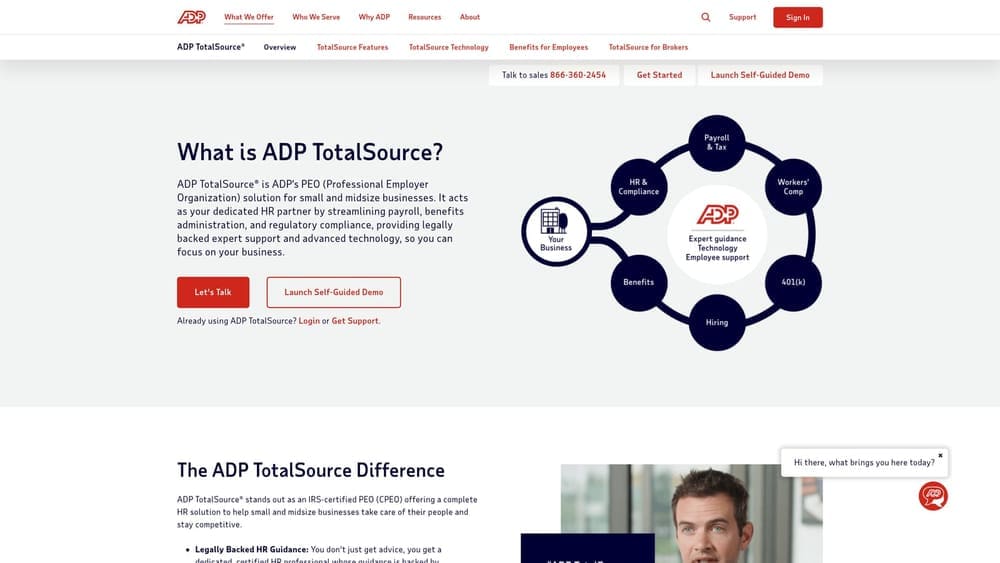
ADP TotalSource is one of the largest PEOs in the US, with a master workers’ comp policy and pay-as-you-go billing that can reduce upfront deposit requirements for high-risk class codes.
Where This Tool Shines
For distribution companies managing material handlers, forklift operators, and drivers across multiple states, ADP TotalSource’s scale matters. The master workers’ comp policy means you’re not shopping for coverage independently, and pay-as-you-go billing ties premiums to actual payroll rather than an annual estimate, which helps when seasonal volume swings make headcount unpredictable.
Their multi-state payroll and tax compliance infrastructure is genuinely strong. If your distribution network spans several states with different wage-and-hour laws and SUTA rates, ADP has the systems to handle the complexity. The compliance support for wage-and-hour issues is particularly relevant for distribution companies managing overtime-heavy schedules.
Key Features
Master Workers’ Comp Policy: Pay-as-you-go structure reduces large upfront deposits, a real advantage for distribution companies with high-risk class codes and variable payroll.
Multi-State Tax Compliance: Broad state coverage with infrastructure built for companies operating distribution centers across multiple jurisdictions.
Full HR Platform: Payroll, time tracking, and benefits administration in one system, with tools suited to variable-schedule workforces.
Wage-and-Hour Compliance Support: Relevant for distribution operations managing overtime, break requirements, and state-specific labor law variations.
Best For
Mid-to-large distribution companies with multi-state operations and meaningful workers’ comp exposure who need a provider with scale and compliance depth. Less ideal for smaller operations that want a high-touch service model.
Pricing
Custom quotes only; not published publicly. Typically structured as PEPM or a percentage of payroll. Pricing is not transparent upfront, and account management quality varies by market, so get everything in writing before signing.
3. Insperity
Best for: Distribution companies competing for warehouse talent in tight labor markets where benefits quality drives retention.
Insperity is a full-service PEO known for competitive benefits packages that help mid-market companies attract and keep hourly workers when the labor market is unforgiving.
Where This Tool Shines
Warehouse turnover is a real cost driver in distribution, and benefits competitiveness is one of the few levers that moves the needle for hourly workers. Insperity’s access to Fortune 500-level benefits plans, including medical, dental, and vision, gives smaller distribution operations buying power they cannot replicate on their own.
The dedicated HR support model is a genuine differentiator. Rather than routing every question through a generic call center, Insperity assigns HR teams that develop familiarity with your operation. For distribution companies where employee relations issues and compliance questions come up frequently, that continuity has real value.
Key Features
Fortune 500-Level Benefits Access: Medical, dental, and vision plans typically unavailable to mid-market employers buying independently, which matters for hourly worker recruitment.
Dedicated HR Support Teams: Assigned HR professionals rather than a rotating call center, providing continuity for companies with ongoing employee relations complexity.
Time-and-Attendance Tools: Payroll and scheduling tools built to handle variable-schedule workforces common in distribution environments.
Employee Relations and Compliance Support: HR guidance on terminations, documentation, and state-specific compliance, relevant for high-turnover warehouse operations.
Best For
Distribution companies in the 50 to 500 employee range that prioritize benefits quality and HR support depth. If your operation has significant workers’ comp claims history or a high mod rate, Insperity may not be the best fit, as they tend to be selective about high-risk accounts and are priced at a premium regardless.
Pricing
Custom quotes; generally positioned at the higher end of the market. Budget accordingly, and benchmark against at least two other providers before accepting a quote.
4. TriNet
Best for: Distribution companies with a meaningful mix of professional, logistics, and hourly staff who need sector-specific compliance support.
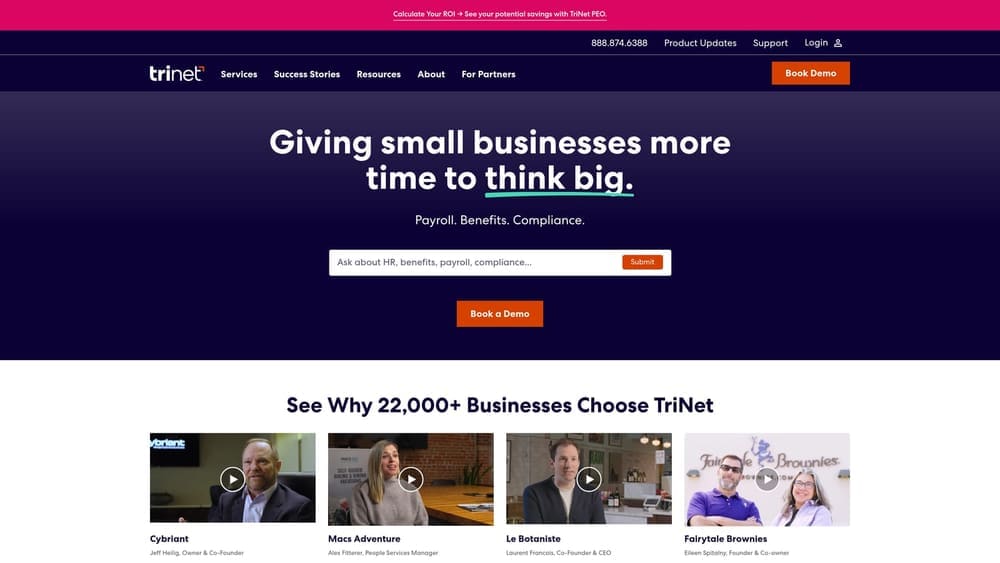
TriNet is a PEO with industry-specific HR packages and solid compliance tooling, built for companies managing diverse workforce profiles across multiple roles and states.
Where This Tool Shines
TriNet’s industry-specific packaging means the HR and compliance support is calibrated to your sector rather than a generic template. For distribution companies with logistics coordinators, procurement staff, and office employees alongside warehouse associates, that matters. The compliance tooling, including employee handbook support and HR guidance, is more developed than many competitors.
Their benefits administration and carrier relationships are solid, and the platform handles multi-state workforces reasonably well. If your distribution operation has grown to include a meaningful professional headcount alongside your hourly workforce, TriNet handles that mixed profile more naturally than PEOs built primarily for blue-collar operations.
Key Features
Industry-Specific HR Packages: Compliance support and HR resources tailored by sector rather than a one-size-fits-all model.
Multi-State Platform: Tools for managing employees across states with varying wage-and-hour and regulatory requirements.
Benefits Administration: Established carrier relationships and benefits administration suited to mixed workforces.
Risk and Compliance Tools: Employee handbook support, HR guidance, and compliance resources relevant for distribution operations with diverse staff profiles.
Best For
Distribution companies with a genuine mix of professional and hourly staff, particularly those where compliance complexity spans multiple roles. Less optimized for predominantly hourly, high-turnover warehouse environments where workers’ comp program depth is the primary concern.
Pricing
Custom quotes; PEPM model. Pricing has historically been less transparent than some competitors, so ask specifically how fees are structured and what triggers a rate change at renewal.
Before you go further in your evaluation, it’s worth getting a structured comparison in hand. Compare PEO Plans through PEO Metrics and see exactly how these providers stack up against your specific workforce profile, class codes, and state footprint.
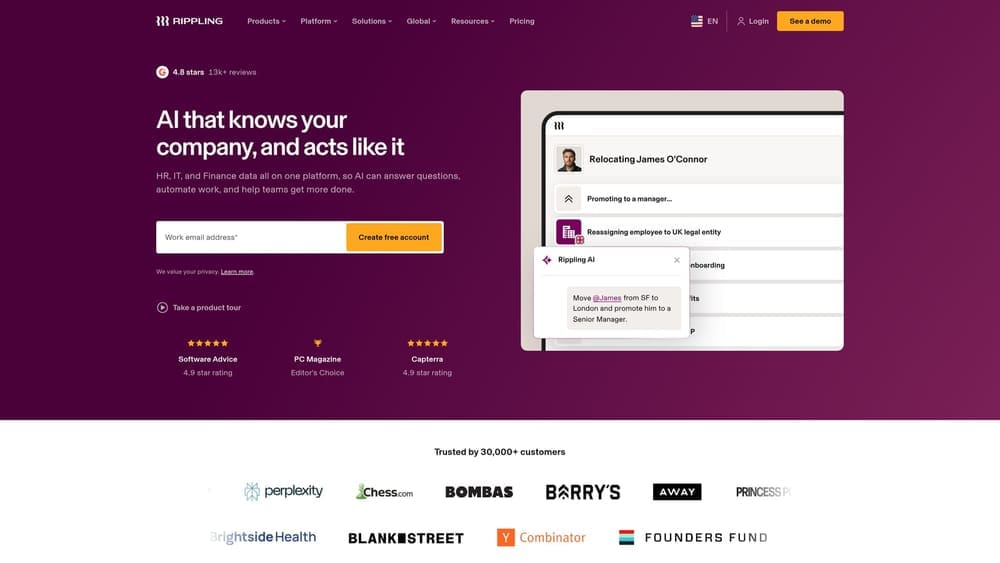
5. Rippling
Best for: Tech-forward distribution operations running WMS or ERP systems that want HR, payroll, and IT management in one platform.
Rippling is a modular HR platform with a PEO offering, built for companies that want HR, payroll, and IT management integrated into a single system.
Where This Tool Shines
If your distribution operation runs a modern warehouse management system and your team is comfortable with technology, Rippling’s integrations are genuinely useful. The platform connects HR, payroll, IT, and finance in one place, and the automation for onboarding and offboarding is well-designed for high-turnover environments where new hires and terminations are frequent.
The modular design means you can add or remove capabilities as your operation evolves, which appeals to companies that want flexibility rather than a fixed bundle. For distribution companies that have already invested in modern software infrastructure, Rippling fits into that ecosystem better than legacy PEOs.
Key Features
Modular Platform: HR, payroll, IT, and finance connected in one system, with the ability to configure the stack to match your operation’s needs.
Third-Party Integrations: Strong connections to WMS, ERP, and other business software common in distribution environments.
Onboarding and Offboarding Automation: Clean workflows for high-turnover environments where processing new hires and separations efficiently is a real operational need.
PEO Co-Employment Layer: Benefits access and compliance support through the co-employment model, available as an add-on to the core platform.
Best For
Distribution companies with a technology-forward culture, lower workers’ comp risk profiles, and a workforce that includes a meaningful share of non-warehouse employees. The PEO program is newer than Rippling’s HR and payroll roots, and the workers’ comp program depth is less mature than legacy providers. High-mod-rate blue-collar operations should look elsewhere first.
Pricing
Modular pricing; PEO layer pricing is available on request. Costs vary depending on which modules you select, so get a full build-out quote that reflects your actual configuration.
6. Justworks
Best for: Smaller distribution operations or first-time PEO buyers who want predictable costs and a straightforward setup.
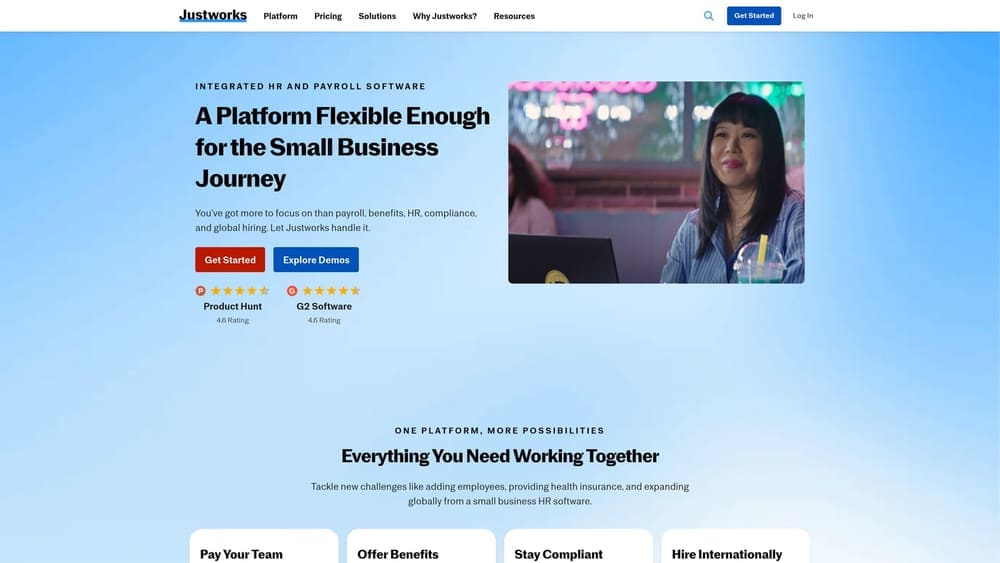
Justworks is a PEO with transparent flat-rate PEPM pricing and a simple onboarding process, designed for companies that want clear costs without complexity.
Where This Tool Shines
Transparent pricing is rare in the PEO market, and Justworks publishes tiered PEPM rates rather than requiring a sales conversation before you see a number. For a first-time buyer trying to understand what a PEO actually costs, that transparency is genuinely valuable. The onboarding process is fast and well-documented, which matters when you’re trying to move quickly.
The included compliance tools and HR support cover the basics well, and benefits access, including medical, dental, vision, and 401(k), is competitive for smaller employers. If your distribution operation is in the early stages of formalizing HR and you want a clean, manageable starting point, Justworks delivers that without overcomplicating the evaluation.
Key Features
Transparent PEPM Pricing: Published tiered rates with no hidden fees, which lets you model costs before engaging sales.
Fast Onboarding: Straightforward setup process suited to companies that need to get moving quickly.
Benefits Access: Medical, dental, vision, and 401(k) included, competitive for smaller employers buying through a co-employment model.
Compliance Tools: HR support and compliance resources included in base pricing, covering the fundamentals for most small distribution operations.
Best For
Smaller distribution companies, generally under 100 employees, buying a PEO for the first time and prioritizing cost clarity. Less suited for complex multi-state distribution networks, high-risk workers’ comp profiles, or operations with significant seasonal volume swings. The benefits network is strongest in coastal markets, which is worth checking against your locations.
Pricing
Published tiered PEPM pricing; check justworks.com for current rates. One of the few PEOs where you can model costs before a sales call.
7. Oasis (a Paychex Company)
Best for: Distribution companies already on Paychex payroll that want to add co-employment benefits without rebuilding their HR stack.
Oasis is a PEO built on Paychex’s payroll processing infrastructure, combining co-employment benefits with deep multi-state payroll and tax compliance capabilities.
Where This Tool Shines
If your distribution company already runs on Paychex, Oasis offers a natural path to co-employment without a full platform migration. The multi-state payroll tax compliance and filing capabilities are a genuine strength, built on Paychex’s established infrastructure rather than a newer system. For companies with distribution centers across several states, that depth in payroll tax handling reduces a real compliance exposure.
The familiarity factor matters operationally. Your payroll team already knows the system, your data is already there, and the transition to co-employment is more straightforward than switching to an entirely new platform. That continuity has real value when you’re managing a complex distribution operation and don’t want to introduce unnecessary change.
Key Features
Paychex Payroll Infrastructure: Built on an established payroll processing system with a long track record in multi-state compliance.
Multi-State Tax Filing: Strong state payroll tax compliance and filing capabilities, relevant for distribution networks spanning multiple jurisdictions.
Co-Employment Benefits: Workers’ comp and benefits access through the co-employment model, layered onto existing payroll capabilities.
Familiar Toolset: Minimal learning curve for teams already using Paychex, reducing transition friction.
Best For
Distribution companies already using Paychex payroll that want to add co-employment benefits and compliance support without switching platforms. Worth knowing: the PEO service layer can feel like an add-on to payroll rather than a fully integrated co-employment model, and service quality varies by region. Ask specifically about your account team and service structure before signing.
Pricing
Custom quotes; contact Oasis directly for distribution-specific pricing. Pricing is not published publicly.
8. Employer Flexible
Best for: Distribution companies in the South and Southwest that want hands-on account management and genuine blue-collar workers’ comp expertise.
Employer Flexible is a regional PEO with dedicated account managers and real expertise in workers’ comp for warehouse and blue-collar workforces.
Where This Tool Shines
Most large PEOs route service questions through a call center where you rarely speak to the same person twice. Employer Flexible’s dedicated account manager model means someone actually knows your operation, your class codes, and your workforce profile. For distribution companies where workers’ comp claims management and HR issues require ongoing attention, that continuity is worth more than it sounds.
Their workers’ comp program is built around blue-collar and warehouse class codes, which is not something you can say about every PEO on this list. If your distribution operation has elevated mod rates or a history of warehouse claims, Employer Flexible’s underwriting familiarity with that risk profile is a genuine advantage over providers who treat warehouse workers as an edge case.
Key Features
Dedicated Account Managers: Named contacts who know your business, not a rotating call center model.
Blue-Collar Workers’ Comp Expertise: Program built around warehouse and blue-collar class codes, with underwriting experience in the risk profiles common to distribution operations.
Hourly Workforce HR Support: HR resources tailored to managing hourly employees, including documentation, compliance, and employee relations guidance.
Competitive Benefits Access: Mid-market benefits access through the co-employment model, competitive for the South and Southwest markets they serve.
Best For
Distribution companies with facilities primarily in the South and Southwest that want high-touch service and workers’ comp expertise for blue-collar workforces. The geographic footprint is the real constraint: if your distribution network includes centers in the Northeast or Pacific Northwest, Employer Flexible is not the right fit for a national operation.
Pricing
Custom quotes; contact Employer Flexible directly for distribution-specific pricing.
Matching the Right PEO to Your Distribution Profile
No single PEO is right for every distribution operation. The right answer depends on your workforce mix, your workers’ comp history, your state footprint, and how much you value service depth versus platform sophistication.
Here’s a practical way to think about it. If you’re a smaller operation buying a PEO for the first time and you want cost clarity before any sales conversation, Justworks gives you published pricing and a clean onboarding path. If you’re a mid-market company where benefits competitiveness is your primary retention lever for warehouse workers, Insperity’s benefits access is hard to match at that price point, though you’ll pay for it. For large, multi-state distribution networks where workers’ comp structure and payroll tax compliance are the primary concerns, ADP TotalSource has the scale and infrastructure to handle the complexity.
Regional operations in the South and Southwest with elevated workers’ comp exposure should take a serious look at Employer Flexible before defaulting to a national provider. The account management model and class-code expertise are genuinely differentiated. And if your operation is tech-forward with a mixed workforce, Rippling’s platform integrations may fit better than a legacy PEO, as long as you’re not carrying significant blue-collar workers’ comp risk.
Before you sign a renewal or commit to a new provider, make sure you have a real benchmark in hand. Many distribution companies overpay because fees are bundled in ways that obscure the true cost per employee, and contracts are written to limit your flexibility at renewal. Don’t auto-renew. Make an informed, confident decision.
Before you sign that PEO renewal, make sure you’re not leaving money on the table.
Many businesses unknowingly overpay because of bundled fees, hidden administrative markups, and contracts designed to limit flexibility. We give you a clear, side-by-side breakdown of pricing, services, and contract terms—so you can see exactly what you’re paying for and choose the option that truly fits your business.
