
Grease trap pumping looks straightforward from the outside. In practice, you’re running a business that touches hazardous waste, confined space entry, heavy vacuum trucks, and DOT compliance — all at once. That combination puts you in a workers’ comp classification that many national PEOs either price aggressively or quietly decline to write.
Add in the reality that most operators are running 10–40 employees, managing CDL driver compliance, and fielding municipal contracts that require rapid certificate of insurance delivery, and suddenly HR administration becomes a genuine operational drag. A PEO can take that off your plate — but only if you find one that actually understands your risk profile and won’t reprice you into oblivion after year one.
This list focuses on PEOs with demonstrated competency in field service, environmental services, or high-risk trades — the categories your business actually falls into. We’ve also put PEO Metrics first, because before you sit through eight sales calls, it’s worth knowing which providers will actually accept your workers’ comp classification in the first place.
1. PEO Metrics
Best for: Grease trap operators who want to compare PEOs side-by-side before committing to any sales process.
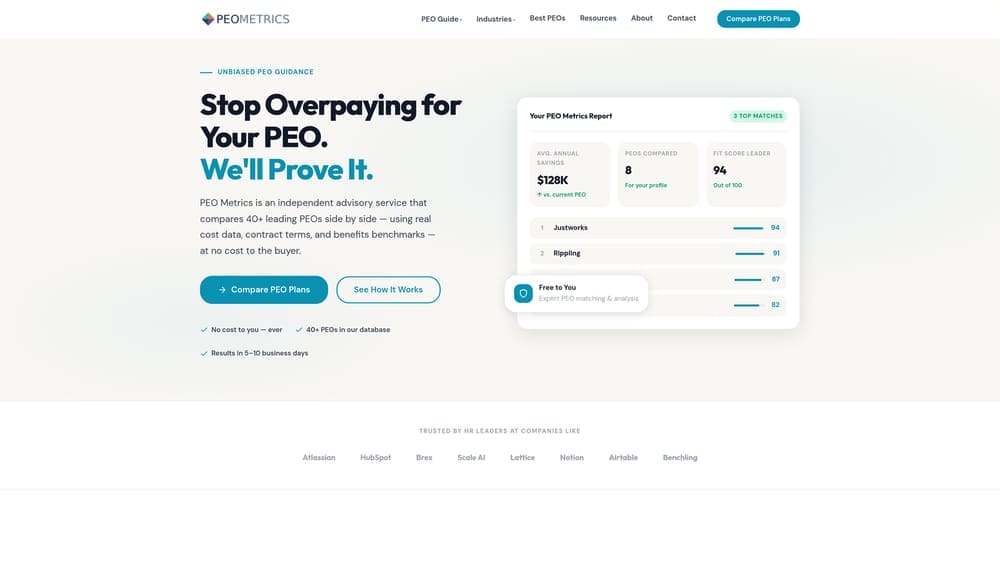
PEO Metrics is a PEO comparison platform — not a PEO itself — built to help businesses evaluate providers using real pricing data and service metrics before sitting through a single sales call.
Where This Tool Shines
The core problem for grease trap operators isn’t just finding a PEO — it’s finding out which PEOs will actually take your workers’ comp classification without repricing you out after the first renewal. Most operators discover this the hard way: three months into a sales process, after sharing payroll data and loss runs, only to get a quote that doesn’t work.
PEO Metrics surfaces that information earlier. The platform is specifically useful for high-risk or hard-to-place industries because it filters for PEOs with experience in your classification category, rather than surfacing the same national names that may not be a fit.
Key Features
Side-by-side PEO comparison: Real pricing data and service metrics presented in a format that makes apples-to-apples evaluation possible.
Unbiased guidance: Not tied to any single provider or referral arrangement — the goal is accurate comparison, not a warm handoff.
High-risk industry filters: Helps identify which PEOs are actually equipped to handle environmental services and field service WC classifications.
WC classification screening: Surfaces which providers will accept your specific risk profile before you waste time on calls.
Transparent methodology: The comparison approach is visible — you’re not working from a black box recommendation.
Best For
Any grease trap pumping operator evaluating PEOs for the first time, switching providers, or coming up on a renewal and wondering if they’re overpaying. Particularly useful if you’ve been declined or aggressively repriced by a national PEO before.
Pricing
Free comparison service. No cost to use the platform and no obligation to any specific provider.
2. Employers Holdings
Best for: Small operators who need specialty workers’ comp coverage in trades and field service — not a traditional full-service PEO.
Employers Holdings is a publicly traded specialty insurer with a focused appetite for small business workers’ comp in trades and elevated-risk field service industries.
Where This Tool Shines
The honest framing here: Employers Holdings operates more as a specialty WC carrier than a full PEO. That distinction matters. If your primary bottleneck is finding workers’ comp coverage that won’t blow up your budget, they’re worth evaluating on that basis. Their underwriting approach is more stable than many national PEOs that bundle WC into their program and adjust aggressively at renewal.
For grease trap operators, the relevant angle is their experience with elevated-risk classifications in environmental services and trades. They’re not trying to write Fortune 500 accounts — their appetite is specifically small business, which means your 15-employee operation isn’t an afterthought.
Key Features
Specialty small business WC focus: Underwriting is built around trades and field service, not adapted from a general commercial program.
Elevated-risk classification experience: Familiarity with the kinds of WC codes that grease trap and environmental services operators fall under.
Stable underwriting approach: Less likely to dramatically reprice at renewal compared to PEOs that treat WC as a loss leader to win the account.
Small account appetite: Designed for businesses that larger carriers and PEOs often deprioritize.
Best For
Operators who’ve been declined or overpriced by national PEOs and need a specialty WC solution first. Also worth considering as a standalone WC carrier if you’re using a payroll-only service and managing HR separately.
Pricing
Custom quotes based on headcount, payroll, and WC classification. No published rate schedule.
3. Oasis (a Paychex Company)
Best for: Operators already in the Paychex ecosystem who want a full PEO layer with local service support.
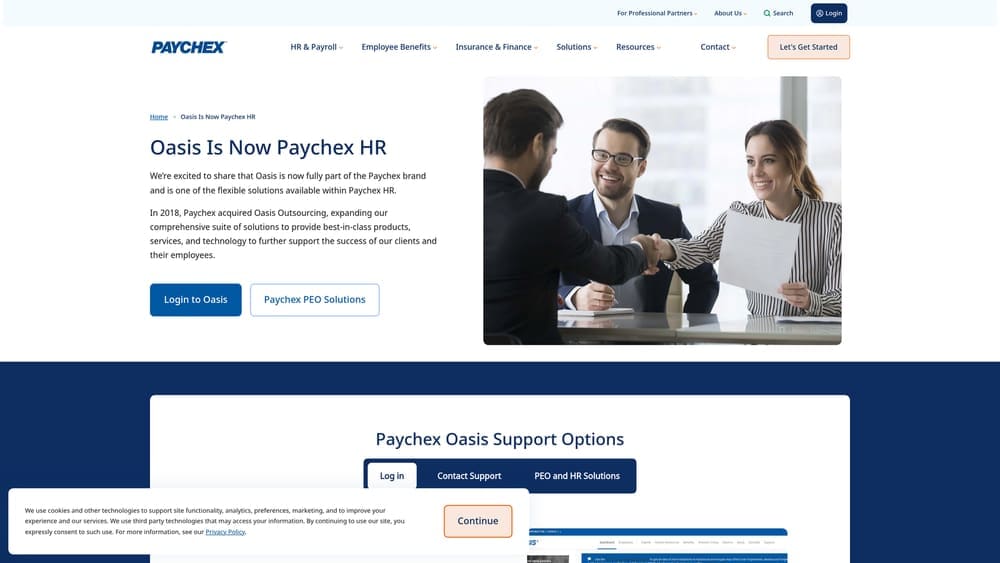
Oasis is the PEO arm of Paychex, offering full-service HR, payroll, and benefits administration with a dedicated HR business partner model and national infrastructure.
Where This Tool Shines
Paychex acquired Oasis in 2018, and the integration gives Oasis clients access to Paychex’s payroll infrastructure while maintaining the dedicated service rep model that Oasis built its reputation on. For grease trap operators who already use Paychex for payroll, moving into the PEO structure is a relatively low-friction transition.
Oasis isn’t specifically built for high-risk trades, but it has the capacity and coverage to serve them. The local rep model is genuinely useful for operators who want a human contact rather than a ticketing system when a compliance issue comes up mid-week.
Key Features
Paychex payroll infrastructure: Stable, well-integrated payroll processing backed by one of the largest payroll providers in the country.
Dedicated HR business partner: Each account gets an assigned HR contact — not a call center rotation.
Benefits access for small crews: Competitive health and benefits options for operators with 10–50 employees.
Nationwide coverage with local presence: Regional rep availability is useful for operators in markets where in-person support matters.
Paychex ecosystem integration: Smooth migration path for businesses already using Paychex tools.
Best For
Grease trap operators with 15–50 employees who want a full-service PEO with human support and are already comfortable with the Paychex platform. Less ideal if your primary concern is specialty WC handling.
Pricing
Custom quote required. Typically structured as a percentage of payroll or per-employee-per-month depending on account size.
4. TriNet
Best for: Operators with 20+ employees who need competitive health benefits to retain CDL drivers and field technicians.
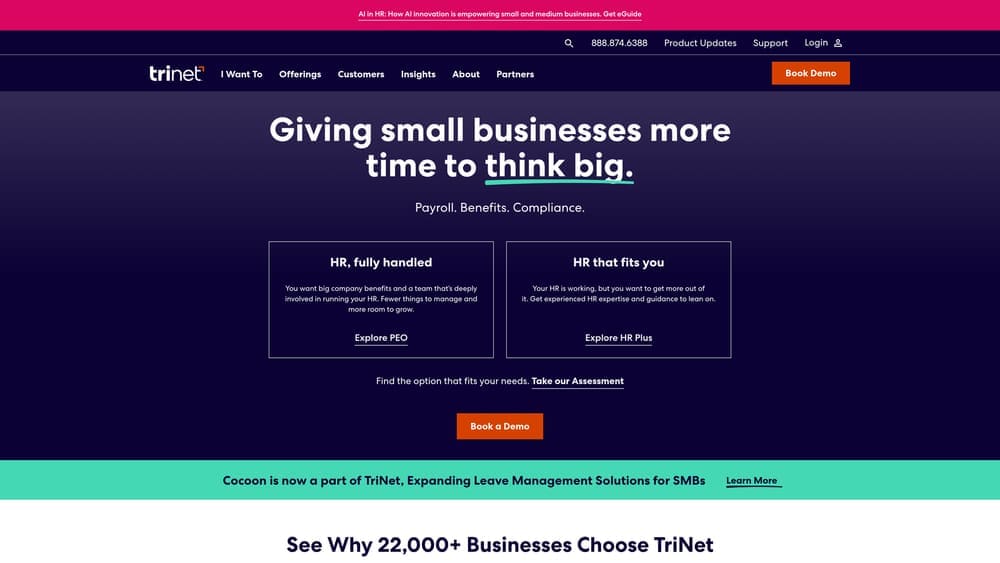
TriNet is a national PEO with an industry-grouped benefits pooling model that can make large-group health coverage accessible to smaller field service businesses.
Where This Tool Shines
TriNet’s strongest differentiator for grease trap operators is benefits access. Competing for CDL drivers in most markets means offering health coverage that’s actually worth having. TriNet’s pooled benefits model groups smaller companies together to access large-group rates — which can meaningfully close the gap between what you can offer and what a larger employer can offer.
TriNet has historically been associated with white-collar industries, but it has expanded into field service and is worth evaluating if benefits quality is your primary retention problem. The compliance tooling is also solid for operators managing employees across multiple states.
Key Features
Industry-grouped benefits pooling: Smaller employers access large-group health rates by pooling with similar businesses.
Multi-state compliance support: Useful for operators with crews working across state lines.
Technology-forward HR platform: Strong self-service interface for both administrators and employees.
Benefits administration depth: Beyond health — 401(k), FSA, dental, vision, and ancillary benefits managed in one place.
Compliance tooling: Regulatory tracking and HR policy support for growing operations.
Best For
Grease trap companies with 20 or more employees where CDL driver retention is a real problem and health benefits quality is a meaningful competitive factor. Less ideal for very small operators or those whose primary need is specialty WC handling.
Pricing
Per-employee-per-month pricing structure. Custom quote required — rates vary by location, headcount, and benefits selections.
5. Insperity
Best for: Operators with 30+ employees who need a genuine HR department replacement, not just payroll processing.
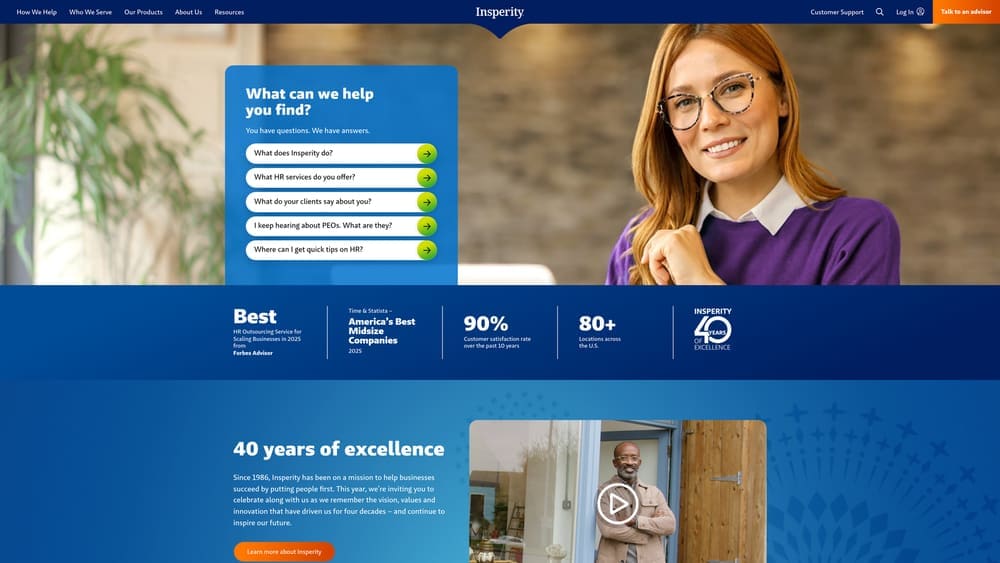
Insperity is one of the largest PEOs in the US, offering comprehensive HR support infrastructure with dedicated service teams and strong compliance tooling.
Where This Tool Shines
Insperity’s value proposition is depth. You’re not getting a software platform with a support ticket — you’re getting an assigned team that handles HR administration, compliance, and employee relations as an ongoing service. For grease trap operators who’ve grown to the point where HR issues are consuming management time, that model is genuinely useful.
The OSHA compliance and safety program support is particularly relevant for this industry. Confined space entry, PPE requirements, and OSHA 300 log management are all areas where having a knowledgeable HR team in your corner reduces risk exposure. Insperity has the infrastructure to support that.
Key Features
Comprehensive HR support team: Dedicated service model rather than a self-service platform.
OSHA compliance and safety programs: Infrastructure for managing safety documentation, incident reporting, and regulatory compliance.
Robust HR technology platform: Full-featured HRIS with payroll, time tracking, and benefits in one system.
Employee relations support: HR expertise available for terminations, disciplinary actions, and policy questions.
Benefits quality: Competitive health and ancillary benefits through their large-group program.
Best For
Grease trap operators with 30 or more employees who need real HR support infrastructure, not just payroll. The service model is more valuable as headcount grows — smaller operators may find the cost doesn’t pencil out.
Pricing
Custom pricing using a percentage of payroll model. Not typically the most price-competitive option for very small accounts.
6. Justworks
Best for: Smaller operators who want transparent, predictable pricing and straightforward HR administration without complexity.
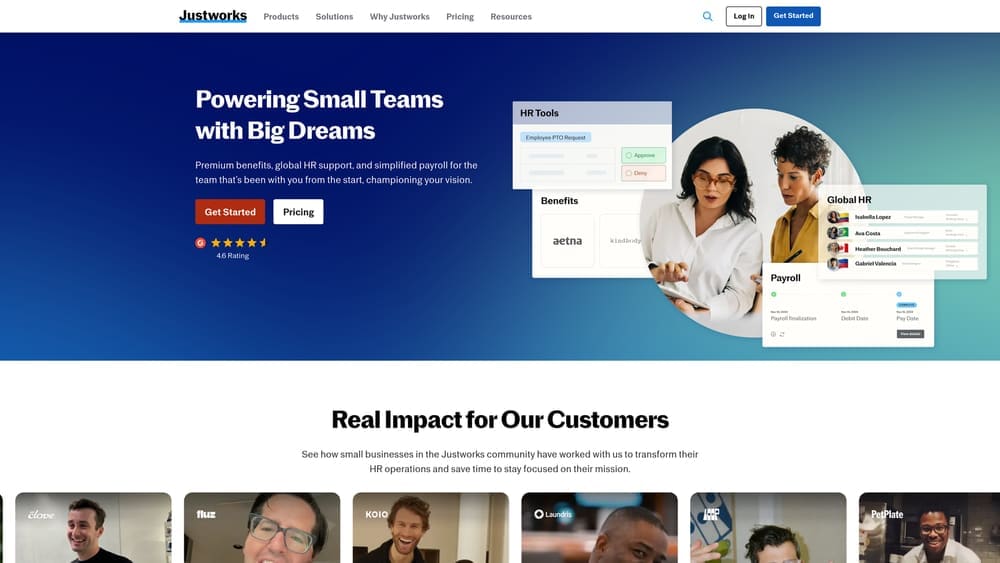
Justworks is a PEO with flat-rate per-employee pricing — a genuine differentiator in an industry where billing opacity is the norm.
Where This Tool Shines
The pricing model is the real story here. Most PEOs charge a percentage of payroll, which means your cost goes up every time you give someone a raise. Justworks charges a flat per-employee-per-month fee, which makes budgeting straightforward and eliminates one of the more frustrating aspects of PEO billing.
For a 10–20 employee grease trap operation that wants to offer decent benefits and get payroll and compliance off the owner’s plate, Justworks works well. The platform is genuinely easy to use. The tradeoff is less depth on high-risk WC handling — if your workers’ comp classification is difficult to place, Justworks may not be the right fit.
Key Features
Flat per-employee pricing: No percentage-of-payroll markup — you know exactly what you’re paying each month.
Clean onboarding and admin interface: One of the more user-friendly PEO platforms available for small teams.
Large-group health benefits access: Competitive health, dental, and vision coverage through their pooled program.
Transparent fee structure: No hidden administrative markups buried in the billing.
Compliance basics covered: Payroll tax filing, new hire reporting, and HR policy support included.
Best For
Smaller grease trap operators (5–25 employees) who want cost predictability and a straightforward HR platform. Not the best choice if specialty WC placement is your primary challenge.
Pricing
Published pricing starting around $59–$99 per employee per month depending on the plan tier selected.
7. ADP TotalSource
Best for: Multi-state operators running commercial vehicle fleets who need strong compliance infrastructure across jurisdictions.
ADP TotalSource is ADP’s full PEO offering, with deep compliance infrastructure and payroll integration particularly relevant for operators managing commercial fleets across multiple states.
Where This Tool Shines
ADP TotalSource’s differentiator for grease trap operators is compliance breadth. If you’re running vacuum trucks across state lines, managing DOT driver qualification files, and dealing with multi-state wage and hour requirements, ADP has the infrastructure to handle that complexity. Most smaller PEOs don’t.
The DOT-adjacent compliance support is worth calling out specifically. Commercial vehicle operators have real obligations around driver qualification files, drug and alcohol consortium enrollment, and hours of service — areas where a PEO’s support can meaningfully reduce administrative burden and risk exposure. ADP TotalSource has more depth here than most alternatives on this list.
Key Features
Multi-state compliance support: Wage and hour, tax, and regulatory compliance across jurisdictions.
DOT-adjacent fleet compliance infrastructure: Support for commercial vehicle operators managing driver files and regulatory requirements.
Deep ADP payroll integration: Seamless connection to ADP’s payroll and time-tracking ecosystem.
Strong HR technology platform: Full-featured HRIS with robust reporting and self-service tools.
Risk and safety support: Compliance resources for OSHA, workers’ comp management, and safety documentation.
Best For
Grease trap operators with 25 or more employees, especially those running multi-state operations or managing a commercial vehicle fleet with DOT compliance obligations. Smaller single-location operators may find the cost structure harder to justify.
Pricing
Custom quote required. Typically structured as a percentage of payroll. Not the most affordable option for small accounts.
8. Resourcing Edge
Best for: Operators who’ve been declined or aggressively repriced by national PEOs due to their workers’ comp classification.
Resourcing Edge is a regional PEO with a reputation for taking on difficult-to-place industries and high workers’ comp risk classifications that larger national providers often decline.
Where This Tool Shines
This is the option worth knowing about if you’ve already been turned down. Grease trap pumping operators sometimes get declined outright by national PEOs — not because they’re poorly run, but because the WC classification triggers automatic filters in the underwriting process. Resourcing Edge has built its model around working with exactly these kinds of accounts.
The personalized service model is also a genuine advantage. You’re not a small account being deprioritized in a large national queue — you’re working with a regional team that has actual familiarity with hazardous trades and field service risk profiles. For operators who’ve felt like an afterthought at larger PEOs, that difference is meaningful.
Key Features
High-risk WC classification experience: Willingness to work with environmental services and hazardous trade classifications that national PEOs often decline.
Small account appetite: Designed to serve operators with 10–30 employees, not just larger accounts.
Full PEO services: Payroll, benefits, HR support, and compliance — not just WC placement.
Personalized regional service: Dedicated service contacts with industry familiarity rather than a national call center model.
Fallback option with real capability: Not a last resort in terms of service quality — a legitimate full-service PEO that happens to accept accounts others won’t.
Best For
Grease trap operators who’ve been declined by national PEOs, are in a difficult WC classification, or simply want a regional provider with genuine experience in hazardous trades. Also worth evaluating as a first call if you’d rather skip the national PEO process entirely.
Pricing
Custom quote required. Rates vary significantly based on risk classification, headcount, and loss history. Expect the process to involve detailed WC documentation.
Which PEO Actually Fits Your Operation
The honest answer is that it depends on where your biggest pain point is.
If workers’ comp placement is the primary obstacle — especially if you’ve been declined or repriced before — start with Resourcing Edge or Employers Holdings. Both have experience with the kinds of classifications that trip up grease trap operators at national PEOs.
If you’re running a multi-state operation with commercial vehicles and DOT obligations, ADP TotalSource has compliance infrastructure that most alternatives on this list can’t match at scale.
If benefits quality is your retention problem and you have 20 or more employees, TriNet or Insperity are worth serious evaluation. Both offer competitive health coverage through pooled programs that can help you compete for CDL drivers.
If you’re a smaller operator (under 25 employees) and want cost predictability above all else, Justworks is the most transparent option on pricing. Just go in knowing it’s not the strongest choice if specialty WC handling is your core need.
And if you’re already in the Paychex ecosystem, Oasis is the path of least resistance for adding a full PEO layer without rebuilding your payroll setup.
Before you commit to any of these, it’s worth doing a side-by-side comparison with real pricing data — not just sales call promises. Many grease trap operators overpay because of bundled fees, hidden administrative markups, and contracts designed to limit flexibility. Don’t auto-renew. Make an informed, confident decision.
Before you sign that PEO renewal, make sure you’re not leaving money on the table.
Many businesses unknowingly overpay because of bundled fees, hidden administrative markups, and contracts designed to limit flexibility. We give you a clear, side-by-side breakdown of pricing, services, and contract terms—so you can see exactly what you’re paying for and choose the option that truly fits your business.
