
Hospitality employers face a specific mix of HR headaches that generalist PEOs sometimes underestimate: seasonal staffing swings between peak and off-season, tipped wage compliance across housekeeping and food service roles, high turnover that strains onboarding systems, and workers’ comp exposure that runs higher than in office-based industries. Not every PEO is built with that reality in mind. This list focuses on providers with a track record serving hotels, restaurants, and hospitality groups, along with one comparison resource to help you evaluate options before you sign anything.
Quick Comparison
- PEO Metrics: best for hospitality HR leaders comparing providers before committing; pricing detailed on the website; the only resource here that puts multiple PEOs side by side instead of pitching one.
- Justworks: best for smaller hospitality operators wanting predictable costs; quote-based, flat per-employee pricing model; the only option built around a flat monthly fee regardless of wage levels.
- TriNet: best for multi-location hospitality groups; quote-based; the only provider here offering industry-tailored HR support tracks.
- Insperity: best for mid-size to larger operators wanting dedicated HR support; quote-based; the only one offering a dedicated HR generalist model rather than self-service.
- ADP TotalSource: best for multi-state hospitality groups; quote-based; the only provider built directly on ADP’s national payroll infrastructure.
- Paychex PEO: best for operators wanting local, in-person support; quote-based; the only one combining a national platform with a local support office network.
- Engage PEO: best for restaurant and hospitality employers; quote-based; the only provider here that positions its business specifically around labor-intensive industries.
- G&A Partners: best for regional chains focused on workers’ comp cost control; quote-based; the only one built around dedicated risk management consulting.
- Group Management Services (GMS): best for independent owner-operators without in-house HR; quote-based; the only bundled service model aimed specifically at owners with no dedicated HR staff.
1. PEO Metrics
PEO Metrics is a comparison service built for hospitality employers who want to see how multiple PEO providers stack up before signing a service agreement, rather than relying on a single vendor’s sales pitch. It’s aimed at HR leaders and owners who know they need a PEO but haven’t yet figured out which pricing model or service scope actually fits a seasonal, hourly workforce.
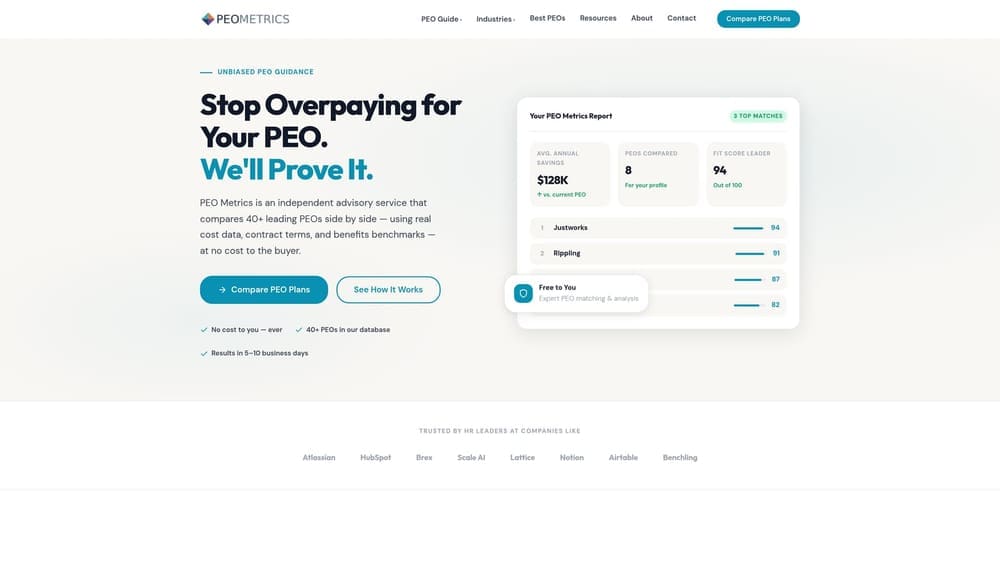
What sets it apart from every other entry on this list is that it isn’t a PEO itself. It doesn’t run your payroll or administer your benefits. Instead, it gives you the data to evaluate the providers that do, using pricing structures and service-level details laid out side by side.
- Compares PEO pricing models and service scope across multiple providers at once, so you’re not evaluating quotes in isolation
- Offers guidance on fee structures that matter most to hospitality employers dealing with seasonal staffing swings
- Takes an unbiased comparison approach rather than steering you toward one preferred vendor
There’s no software to integrate and no platform for your staff to log into, since this is a research and advisory step rather than a payroll or HR system. Setup effort is minimal on your end: you provide details about your workforce and priorities, and the comparison does the rest. It’s typically run by whoever owns the PEO decision internally, an HR director, controller, or owner.
The obvious limitation is that PEO Metrics doesn’t replace a PEO. You still need to select and onboard with one of the providers you compare, and PEO Metrics will not process a paycheck or file a workers’ comp claim. Pricing for the comparison service itself is detailed on the website, since it operates separately from PEO transaction fees.
Best for: Hospitality HR leaders who want to compare PEO options before committing to a provider.
2. Justworks
Justworks is a PEO built around a flat monthly per-employee pricing model, paired with a self-service platform for payroll, benefits enrollment, and compliance support. It tends to appeal to smaller hospitality operators who want to know their PEO cost won’t swing wildly as headcount changes seasonally.
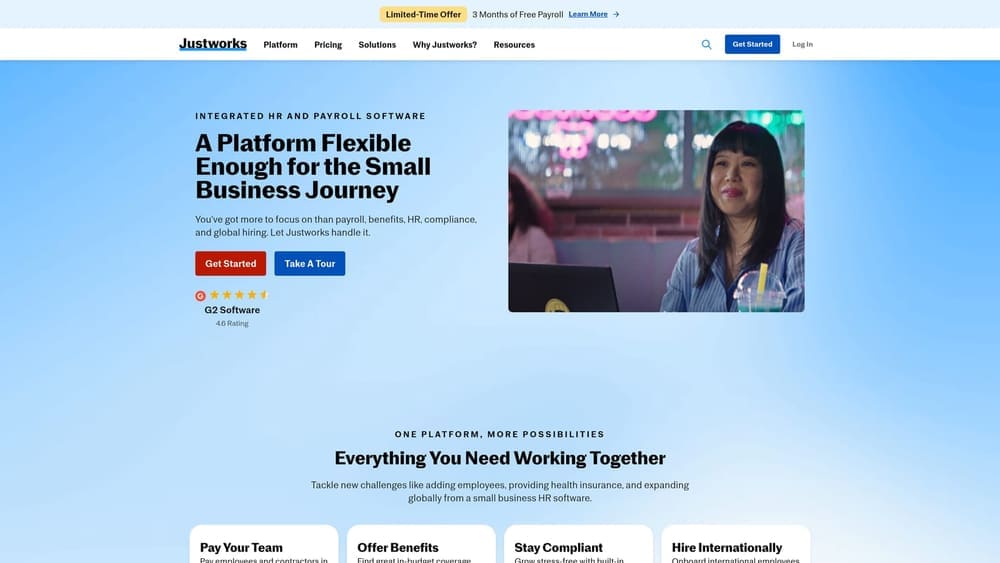
The standout here is pricing predictability. Where percentage-of-payroll models can make a PEO’s cost balloon during a wage increase or a busy season with more overtime, a flat per-employee fee structure gives owners a cleaner number to budget against.
- Charges a flat monthly amount per employee rather than a percentage of payroll, simplifying budget forecasting
- Lets new hires self-enroll in benefits and complete onboarding without heavy HR involvement
- Provides access to health insurance and 401(k) plan options through the PEO’s master plans
Justworks integrates with common accounting and time-tracking software according to the company’s site, and the platform is designed to be run largely by a single HR or finance staffer rather than a full HR department. Setup is on the lighter side compared with providers that emphasize dedicated account teams.
The tradeoff is depth. Justworks doesn’t market itself around hospitality-specific compliance expertise the way some of the providers below do, so if you need heavy hand-holding on tip credit rules or multi-state wage and hour nuances across restaurant locations, you may need to lean more on your own team or outside counsel. Pricing is quote-based, built around that flat per-employee model per company materials.
Best for: Smaller hospitality operators who want simple, predictable per-employee pricing.
3. TriNet
TriNet is a national PEO that organizes its HR support into industry-tailored tracks, alongside access to master health benefit plans. It’s aimed at hospitality groups that want compliance guidance shaped around their specific industry rather than generic HR advice.
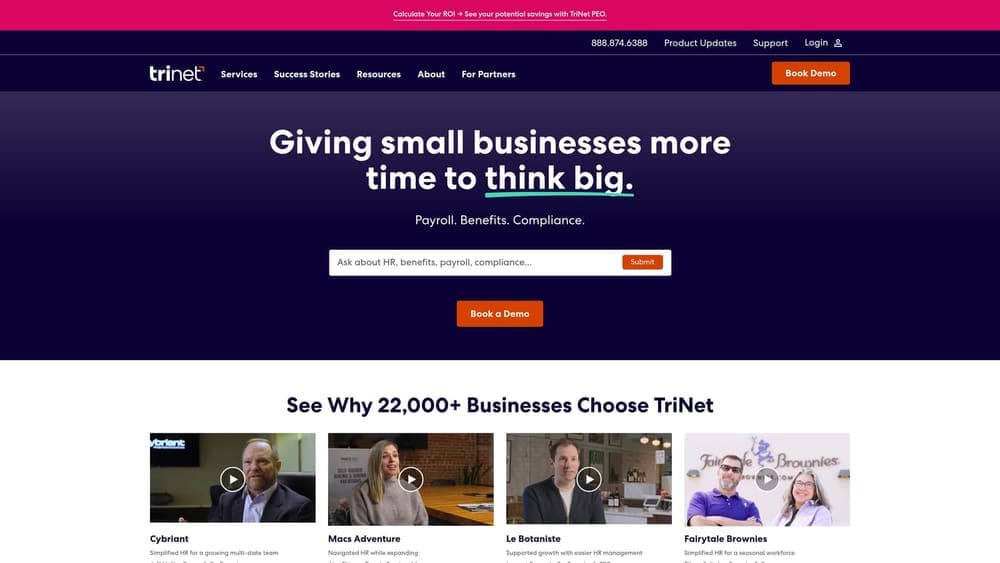
What distinguishes TriNet on this list is that industry-specific structure. Rather than a single generalist service model, TriNet’s tracks are meant to address the particular wage and hour issues that come up in service-industry employment, which matters for hotels and restaurants managing tipped staff and variable shift schedules.
- Organizes HR support into tracks built around specific industries, including service-based employers
- Offers access to master health plans, giving employers more flexibility in benefit design
- Provides compliance support focused on wage and hour rules relevant to hourly workforces
TriNet integrates with common payroll and HR systems per the company’s site. As a larger national organization, it typically assigns account support teams rather than a single point of contact, and onboarding involves a more structured setup process than a purely self-service platform.
The size that gives TriNet its industry-track model also means less flexibility on custom contract terms, particularly for very small operators who might prefer a more negotiable agreement. If you’re a single-location independent restaurant, you may find the structure heavier than you need. Pricing is quote-based per the company.
Best for: Multi-location hospitality groups wanting industry-tailored compliance support.
4. Insperity
Some hospitality employers don’t want a self-service portal. They want a person who knows their business. That’s the case Insperity makes with its dedicated HR generalist support model, layered on top of standard payroll, benefits, and risk management services.
Insperity is built for mid-size to larger hospitality operations with multiple locations and enough complexity that a hands-on HR relationship pays for itself in reduced administrative burden on internal staff.
- Assigns a dedicated HR generalist to work directly with your team rather than routing everything through a general help desk
- Includes performance management tools to help standardize reviews and development across locations
- Provides workers’ compensation claims support, which matters given the injury exposure in housekeeping and kitchen roles
Insperity integrates with common HR and payroll platforms per the company’s site. Because the service model centers on a dedicated generalist relationship, it tends to require more upfront coordination during setup than a fully self-service PEO, and it’s typically managed by an HR director or ownership working closely with the assigned Insperity contact.
That hands-on model is also its main limitation for smaller businesses. A single independent restaurant with a handful of employees may find the level of service more than it needs, and the associated structure may not be the most cost-efficient fit at that scale. Pricing is quote-based per the company.
Best for: Mid-size to larger hospitality companies wanting dedicated HR support across multiple locations.
5. ADP TotalSource
ADP TotalSource is ADP’s PEO offering, built on the same payroll infrastructure that powers ADP’s broader HCM products. For hospitality groups operating across state lines, that infrastructure is the main draw.
Multi-state payroll is genuinely difficult to manage well when you have hourly staff subject to different wage and hour rules from state to state. ADP TotalSource’s standout is the depth of integration with ADP’s existing payroll and workforce management ecosystem, which matters if you’re already running time and attendance through ADP or want everything consolidated under one national provider.
- Runs on ADP’s established payroll infrastructure, which supports complex multi-state payroll needs
- Integrates directly with ADP’s HCM suite and time-tracking tools rather than requiring separate systems
- Provides multi-state payroll support suited to hospitality groups with locations in several jurisdictions
Because ADP operates at national scale, setup typically involves a structured implementation process with an assigned team rather than a single dedicated contact, and day-to-day administration is usually handled by an internal HR or payroll manager working within the ADP platform.
The tradeoff for that scale is a service experience that can feel less personalized, particularly for a single-location independent hotel or restaurant that doesn’t need multi-state infrastructure. If your footprint is one location in one state, some of ADP TotalSource’s core strength won’t be as relevant to you. Pricing is quote-based per the company.
Best for: Hospitality groups operating across multiple states that want payroll consolidated under one national provider.
6. Paychex PEO
Paychex PEO runs on the Paychex Flex platform and pairs it with time and attendance tools designed for shift-based staff, plus access to a network of local support offices.
That local office network is what separates Paychex from purely national or purely self-service competitors on this list. Hospitality operators who want the scale of a national PEO but still value being able to walk into a local office or work with someone based in their region tend to find that combination appealing.
- Provides the Paychex Flex platform for payroll processing and HR administration in one place
- Includes time and attendance tools built for tracking shift-based, hourly staff
- Maintains a network of local support offices for in-person account management
Setup and integrations run through the Paychex Flex ecosystem, so if your business already uses Paychex for payroll or time tracking, transitioning to the PEO service tends to be smoother. Day-to-day administration is usually handled by an HR or operations manager working within Flex, with support available through the local office structure.
The limitation is that Paychex PEO works best for employers willing to standardize on the Paychex platform. If you’re heavily invested in a different payroll or HR system and don’t want to migrate, the fit is weaker than for providers with broader third-party integration options. Pricing is quote-based per the company.
Best for: Hospitality operators wanting a national PEO with local support office access.
7. Engage PEO
Engage PEO positions itself around serving labor-intensive industries, including hospitality and restaurants, rather than marketing itself as a generalist provider. That positioning is worth confirming directly on the provider’s site, since industry focus and service offerings can shift over time.
What makes Engage stand out on this list is that stated focus itself. Instead of offering hospitality as one vertical among many, its marketing centers on service-industry and labor-intensive employers, which can translate into more relevant guidance for restaurant and hotel HR issues.
- States a specific focus on labor-intensive industries such as hospitality and food service
- Offers workers’ compensation program support relevant to higher-risk hourly roles
- Handles payroll and benefits administration as part of its standard PEO service
Engage integrates with payroll and HR platforms per the company’s site. As a smaller national player, onboarding tends to involve more direct conversation with the provider’s team to confirm coverage and service details rather than a fully automated signup process, and day-to-day management typically falls to an owner or HR lead working directly with Engage’s account team.
The main thing to check before signing is state coverage. Engage’s national footprint is smaller than providers like ADP or Paychex, so if your hospitality locations span states outside its core service area, confirm coverage matches every location before moving forward. Pricing is quote-based per the company.
Best for: Restaurant and hospitality employers wanting a PEO that markets specific experience in labor-intensive industries.
8. G&A Partners
G&A Partners is a regional PEO built around payroll, benefits, and risk management consulting for multi-location and labor-intensive employers. Workers’ comp cost control is the centerpiece of its pitch.
Given how much workers’ comp exposure hospitality operations carry, from kitchen injuries to housekeeping strain injuries, dedicated risk management consulting is a meaningful differentiator. Rather than treating workers’ comp as a line item, G&A frames it as an area for active cost management.
- Provides risk management consulting aimed specifically at controlling workers’ comp costs
- Handles standard payroll and benefits administration alongside the risk work
- Supports multi-location employers coordinating HR across several sites
G&A integrates with HR and payroll systems per the company’s site, and its consulting-oriented model typically means more direct involvement from an assigned risk management contact during onboarding and ongoing service. It’s usually managed jointly by an HR lead and whoever oversees safety or risk internally.
Because G&A operates with a regional concentration, hospitality groups with locations outside its core service states should confirm coverage before signing. If your footprint is national, you may find gaps that a larger provider wouldn’t have. Pricing is quote-based per the company.
Best for: Regional hospitality chains wanting hands-on risk management support alongside PEO services.
9. Group Management Services (GMS)
Independent restaurant owners and small hotel operators often don’t have an HR department at all, just an owner or general manager handling it alongside everything else. Group Management Services (GMS) is built with that reality in mind, offering bundled payroll, benefits, and compliance support aimed at small and mid-size businesses.
The distinguishing factor here is that the entire service model assumes the client doesn’t have in-house HR expertise. Rather than offering a platform for an HR team to manage, GMS positions its bundled approach around taking that burden off an owner-operator’s plate entirely.
- Bundles payroll, benefits, and compliance administration into a single service rather than separate modules
- States a focus on small and mid-size business clients rather than enterprise accounts
- Aims support specifically at owner-operators who don’t have dedicated HR staff
GMS integrates with payroll and benefits platforms per the company’s site, and setup is generally handled through direct conversations with the provider’s team rather than a self-service signup, given the target client typically needs more guidance through the process. Day-to-day, it’s usually the owner or a general manager interacting with GMS rather than a dedicated HR staffer.
GMS operates at a smaller scale than national providers like ADP or Paychex, so before signing, ask for references specifically from other restaurant or hospitality clients to confirm the provider has handled your kind of workforce before. Pricing is quote-based per the company.
Best for: Independent restaurant and hospitality owners without in-house HR staff.
Matching the Right PEO to Your Operation
If you’re running a single-location restaurant or hotel and budget predictability matters most, Justworks’ flat per-employee pricing model is worth a close look, since it removes the guesswork of percentage-of-payroll swings during seasonal staffing changes. If you’re managing multiple locations and want a real HR relationship rather than a portal, Insperity and TriNet both offer more hands-on support structures built for that scale, while G&A Partners adds a workers’ comp risk management angle that’s hard to overlook given hospitality’s injury exposure.
But before you request a single quote, it’s worth stepping back and comparing providers side by side rather than evaluating proposals one at a time as they land in your inbox. Pricing models differ (flat per-employee fees versus percentage-of-payroll), state coverage varies, and how a PEO handles billing when your seasonal headcount drops can make a real difference to your annual cost.
Don’t auto-renew. Make an informed, confident decision. Before you sign that PEO renewal, make sure you’re not leaving money on the table. Many businesses unknowingly overpay because of bundled fees, hidden administrative markups, and contracts designed to limit flexibility. PEO Metrics gives you a clear, side-by-side breakdown of pricing, services, and contract terms, so you can see exactly what you’re paying for and choose the option that truly fits your business.
