
IT managed service providers operate in a genuinely unusual HR environment. You’re running a workforce that’s part technical specialist, part client-facing account manager, and part on-call responder — often across multiple states, with contractors mixed alongside W-2 employees. Standard PEO pitches don’t account for any of that.
This list focuses specifically on PEOs that handle the real challenges MSPs face: multi-state payroll for remote techs, competitive benefits that can go toe-to-toe with big tech employers, workers’ comp classifications that actually reflect your risk profile, and HR support that understands project-based and hybrid workforces. We evaluated providers on pricing transparency, technology integrations, benefits quality, compliance support, and how well they serve sub-100-employee companies — the size most MSPs actually are. Here’s what we found.
1. PEO Metrics
Best for: MSPs that want unbiased, side-by-side PEO comparisons before signing anything.
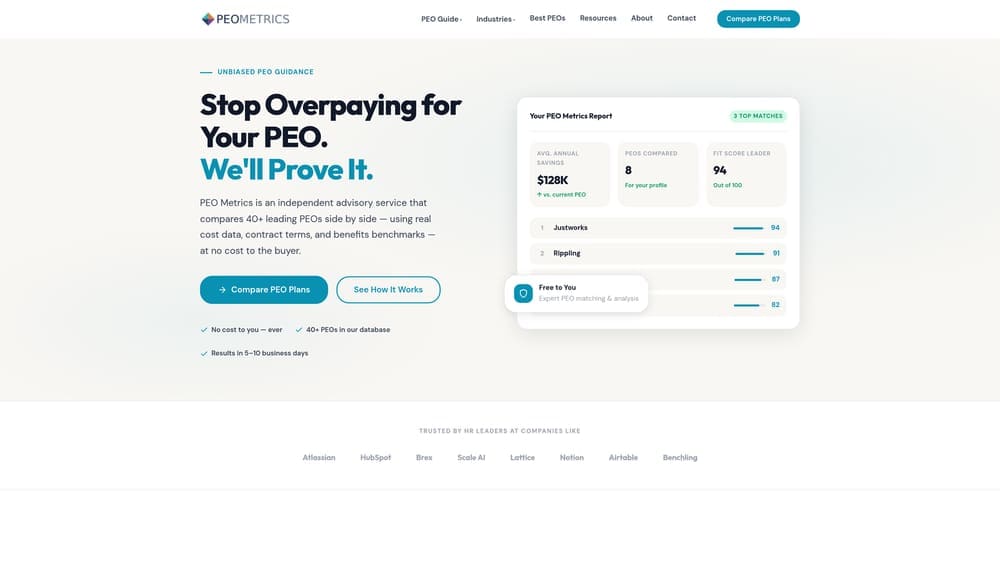
PEO Metrics is a PEO comparison and advisory service — not a PEO itself — that helps MSPs evaluate providers using real pricing data and unbiased analysis.
Where This Tool Shines
Most MSP owners sign PEO contracts without knowing what comparable companies in their space are actually paying. PEO Metrics closes that gap. Before you sit through a vendor sales call, you can see how providers compare on pricing structure, benefits quality, contract terms, and service model — without anyone trying to close you on a deal.
For an industry where HR decisions often get made reactively (you need benefits, you need payroll, someone hands you a contract), having an independent starting point changes the dynamic. It’s particularly useful if you’re renewing a contract and wondering whether you’ve drifted above market rate. You can also explore PEO HR technology services to understand what the right service model looks like for tech-forward businesses before you compare.
Key Features
Side-by-Side Provider Comparisons: Evaluate multiple PEOs on pricing, benefits, and service model differences in a single view.
Pricing Transparency: Helps you identify where you may be overpaying relative to market rates for your headcount range.
Unbiased Guidance: Not affiliated with any single PEO provider — no referral incentive to push you toward a specific vendor.
Contract and Terms Review: Covers contract structure and service model differences, not just headline pricing.
Pre-Quote Utility: Useful before initial vendor conversations, not just after you’ve already received proposals.
Best For
MSPs evaluating a PEO for the first time, switching providers, or approaching a renewal and unsure whether their current pricing is competitive. Especially useful for owners who don’t have an HR background and want a clear framework before vendor conversations start.
Pricing
Free comparison service — no cost to use. There’s no subscription or per-use fee to access comparisons and guidance.
2. Justworks
Best for: Growing MSPs that want pricing predictability and a clean, modern HR platform.
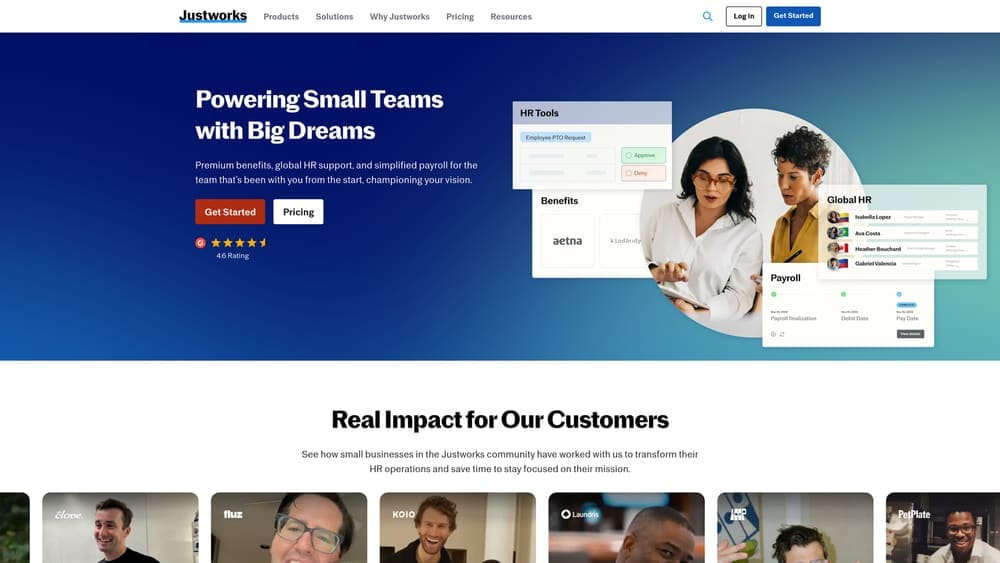
Justworks is a tech-friendly PEO with flat per-employee-per-month pricing, strong benefits access, and a platform built for companies that expect their software to actually work well.
Where This Tool Shines
The flat PEPM pricing model is genuinely unusual in the PEO industry. Most PEOs charge a percentage of payroll, which means your HR costs go up automatically as you give raises or hire more senior technicians. With Justworks, you know what you’re paying per head — which makes budgeting far more predictable for an MSP with variable project staffing.
The platform itself is clean and well-designed, which matters for an MSP audience that will immediately notice if the HR portal feels like it was built in 2009. Employee self-service is solid, onboarding is straightforward, and the benefits access through major carriers is genuinely competitive for companies trying to hire against larger tech employers.
Key Features
Flat PEPM Pricing: Predictable per-employee cost that doesn’t scale with salary increases — a real advantage as tech salaries rise.
Large-Group Health Insurance: Access to major carrier plans through PEO pooling, competitive with what larger employers offer.
Modern HR Platform: Intuitive interface with strong employee self-service — low friction for tech-savvy teams.
Multi-State Payroll: Handles payroll across multiple states, useful for MSPs with distributed remote teams.
401k and Benefits Options: Competitive retirement and benefits packages relevant for tech talent retention.
Best For
MSPs with 10 to 75 employees that want pricing they can actually forecast, a platform their team won’t complain about, and benefits access that helps them compete for engineering and help desk talent without a large-company HR budget.
Pricing
Starts around $59 to $99 per employee per month depending on plan tier. Verify current pricing directly with Justworks, as rates can change.
3. TriNet
Best for: MSPs in active hiring mode that need benefits packages capable of competing with larger tech employers.
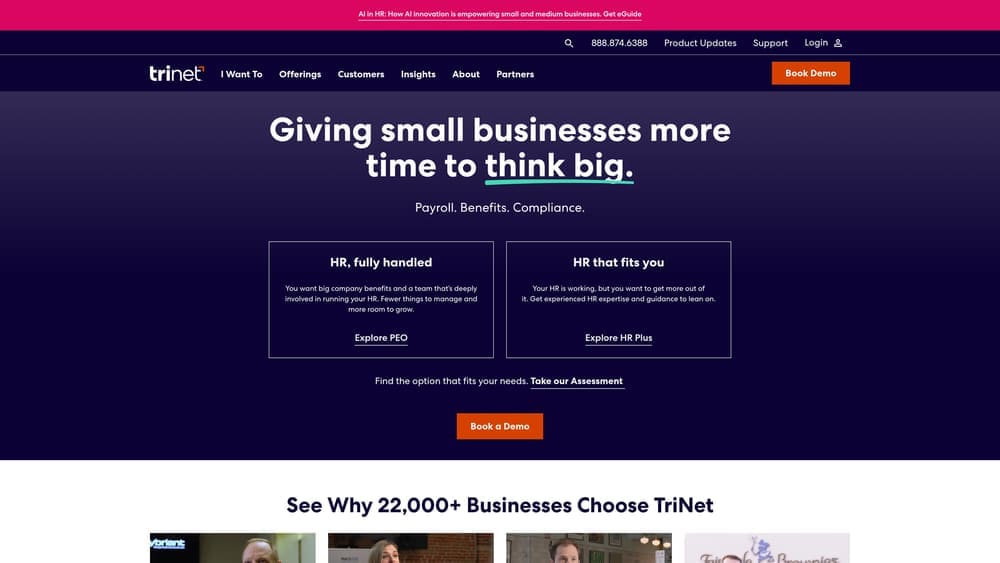
TriNet is a PEO with an explicit technology industry vertical, offering HR packages designed specifically for tech companies competing for skilled talent.
Where This Tool Shines
TriNet’s tech vertical isn’t just a marketing label. The benefits packages are structured with tech hiring in mind — health insurance options, dental and vision coverage, and 401k plans that a solutions architect or senior network engineer would actually find attractive. For an MSP trying to pull candidates away from larger SaaS companies or enterprise IT shops, benefits quality is a real lever, and TriNet invests there.
The benefits benchmarking tools are a useful differentiator. Being able to see how your benefits stack compares against tech industry norms helps you have a more informed conversation about what you’re actually offering candidates — and where you might be falling short.
Key Features
Technology Industry HR Packages: Purpose-built for tech companies, not a generic offering with a tech label applied.
Competitive Benefits for Tech Talent: Health, dental, and vision plans positioned to compete with what larger tech employers offer.
Benefits Benchmarking: Tools to compare your benefits against tech industry norms — useful for recruiting conversations.
Dedicated HR Support: HR professionals with industry context, not just generalist call center support.
Payroll and Compliance Infrastructure: Solid multi-state payroll and compliance handling for distributed teams.
Best For
MSPs that are actively hiring technical staff and losing candidates to larger companies on benefits. Also a reasonable fit for more established MSPs (typically 25+ employees) that want industry-specific HR support rather than a generic small-business PEO experience.
Pricing
Percentage-of-payroll model; pricing varies by company size and benefits selections. Get a direct quote — TriNet doesn’t publish standard pricing publicly.
4. Rippling
Best for: MSPs that want HR and IT operations managed in a single platform.
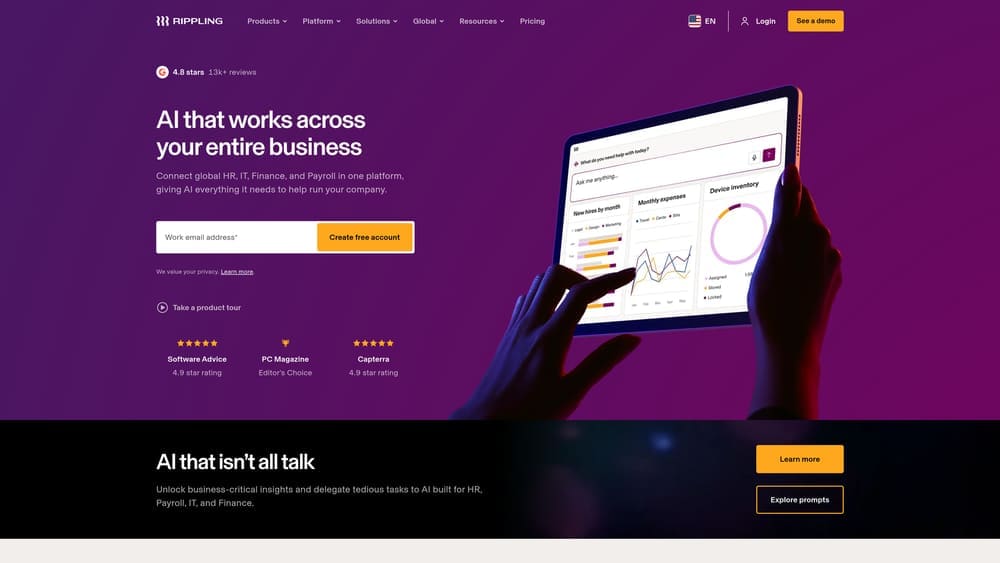
Rippling is an HR and IT management platform that combines payroll, benefits, compliance, and device management in one system — a combination that’s unusually relevant for companies in the managed services space.
Where This Tool Shines
The native IT device management alongside HR is the differentiator here. For an MSP that already manages client IT environments, having internal device provisioning, app access, and employee onboarding handled in the same system as payroll and benefits is genuinely useful. When you hire a new technician, Rippling can handle their HR paperwork and their laptop setup in the same workflow. That’s not something other PEOs come close to offering.
The software integration library is extensive — 500+ app connections. If your MSP runs ConnectWise, Autotask, QuickBooks, or other common tools, there’s a reasonable chance Rippling connects to them directly. Multi-state compliance automation is also built in, which reduces manual overhead for teams spread across several states.
Key Features
IT Device Management: Manage employee devices and software access alongside HR and payroll — rare in the PEO space.
500+ Software Integrations: Connects with PSA tools, accounting software, and IT management systems common in MSP environments.
Automated Onboarding: Covers HR paperwork and device provisioning in a single workflow — reduces manual setup time.
Multi-State Compliance Automation: Handles state-specific payroll, leave law, and tax requirements automatically.
PEO Option Available: PEO service layer available alongside the standard HR platform for companies that want co-employment benefits access.
Best For
MSPs that are technology-forward internally and want their HR platform to reflect that. Particularly strong for teams that are frustrated with disconnected systems for HR, IT provisioning, and payroll. Works well for companies with 15 to 100 employees.
Pricing
Modular pricing — core platform starts around $8 per employee per month; PEO pricing requires a direct quote. Costs scale based on which modules you add.
5. Insperity
Best for: Established MSPs that want high-touch HR support from dedicated specialists, not just a software portal.
Insperity is one of the largest full-service PEOs in the US, known for dedicated HR specialist support and comprehensive benefits packages suited for more mature businesses.
Where This Tool Shines
Most PEOs are primarily software platforms with HR support available when you ask for it. Insperity flips that emphasis. You get a dedicated HR specialist assigned to your account — someone who learns your business, your workforce structure, and your compliance situation over time. For an MSP owner who doesn’t want to become an HR expert, having a real person in your corner matters.
The benefits packages are strong and backed by major carrier relationships. Compliance and risk management support is deep, which is relevant for MSPs operating across multiple states where employment law complexity compounds quickly. The platform is functional but not the most modern in the category — Insperity’s value is in the human layer, not the interface.
Key Features
Dedicated HR Specialists: Assigned HR professionals who know your account — not a generic support queue.
Comprehensive Benefits Packages: Major carrier access with strong health, dental, vision, and retirement options.
Compliance and Risk Management: Proactive support across multi-state employment law, workers’ comp, and regulatory changes.
Integrated HR Tools: Payroll, time tracking, and performance management included in the service model.
Depth Over Speed: Better suited for companies that want thorough HR partnership rather than self-service speed.
Best For
MSPs with 50 or more employees that want a full-service HR partner rather than a platform to manage themselves. Less ideal for very small MSPs where the service model depth may exceed what you actually need at that stage.
Pricing
Percentage-of-payroll pricing; generally considered mid-to-premium range. Direct quote required — pricing is not publicly listed.
6. ADP TotalSource
Best for: MSPs with complex multi-state workforces that need deep compliance infrastructure across all 50 states.
ADP TotalSource is the largest PEO in the US by covered employees, with broad multi-state compliance capabilities and payroll infrastructure built at scale.
Where This Tool Shines
Scale matters here in a specific way. ADP TotalSource has compliance infrastructure across all 50 states — state income tax withholding, unemployment insurance, state-specific leave laws, workers’ comp. For an MSP that has technicians scattered across six or eight states (which is increasingly common for remote-first service teams), having a PEO that handles all of that without manual workarounds is genuinely valuable.
If your MSP already uses ADP payroll tools, TotalSource integrates with that ecosystem, which reduces migration friction. Workers’ comp coverage and risk management support is broad, and the audit and compliance support is well-regarded for complex workforce situations — including the kind of classification questions that come up when you have a mix of field techs and remote desk-based support staff.
Key Features
50-State Compliance Coverage: Multi-state payroll, tax, and employment law compliance across the full US — not just major markets.
Workers’ Comp and Risk Management: Broad coverage with support for complex classification situations.
ADP Ecosystem Integration: Works with existing ADP payroll tools if your MSP already uses them.
Large-Group Benefits Access: Major carrier relationships with competitive health and retirement options.
Audit and Compliance Support: Strong infrastructure for businesses facing employment law complexity or audit exposure.
Best For
MSPs operating across many states with distributed remote teams, or companies that already use ADP tools and want to consolidate under one provider. Also a reasonable fit for MSPs that have experienced workers’ comp classification issues and want a provider with deep risk management support.
Pricing
Percentage-of-payroll model; pricing is not publicly listed. Requires a direct quote. Generally considered negotiable at higher headcounts.
7. Oasis (a Paychex Company)
Best for: Small MSPs under 25 employees that want PEO-level benefits access without large-company minimums.
Oasis is a Paychex-backed PEO positioned for smaller businesses, offering PEO-level benefits access with lower entry requirements than most larger providers.
Where This Tool Shines
The practical challenge for a small MSP is that many of the best-known PEOs have minimum headcount requirements or pricing structures that make them less accessible below 25 employees. Oasis has historically served smaller businesses, which makes it a more realistic option for a 10-person MSP that wants health insurance access and payroll administration without being told they’re too small to qualify.
The Paychex backing provides solid payroll infrastructure and carrier relationships that give Oasis more buying power than a standalone small-business PEO would have. The platform is functional rather than flashy — don’t expect the interface sophistication of Rippling or Justworks — but the core services are reliable and the entry point is more accessible.
Key Features
Lower Headcount Minimums: Accessible for MSPs under 25 employees that can’t meet larger PEO requirements.
Paychex Infrastructure: Backed by Paychex payroll processing and carrier relationships — more stability than smaller standalone PEOs.
Benefits Pooling Access: Health, dental, vision, and 401k through PEO co-employment — competitive options for small teams.
Payroll and Tax Administration: Full payroll processing and tax filing handled through Paychex infrastructure.
Multi-State Compliance Support: Handles multi-state situations, though depth varies compared to larger providers.
Best For
Early-stage or smaller MSPs that need PEO access to compete on benefits but aren’t large enough to get serious attention from TriNet or Insperity. A practical starting point before you grow into a more feature-rich provider.
Pricing
Percentage-of-payroll or PEPM depending on configuration — requires a direct quote from Oasis to get accurate numbers for your situation.
8. Engage PEO
Best for: MSPs with significant multi-state employment law complexity who want attorneys on staff, not just HR generalists.
Engage PEO is built around an attorney-led compliance model — employment attorneys on staff rather than outsourced legal — designed for businesses navigating complex multi-state employment situations.
Where This Tool Shines
The core differentiator is meaningful. Most PEOs handle compliance through HR generalists who know the rules but aren’t attorneys. Engage puts employment lawyers in-house, which changes the quality of guidance you get on genuinely difficult questions — state-specific termination procedures, leave law interpretation, independent contractor classification, and the kind of nuanced multi-state situations that a growing MSP with remote staff across many states regularly faces.
This matters more than it might seem for MSPs. If you have technicians in California, New York, and Texas simultaneously, you’re dealing with three very different employment law environments. Getting proactive guidance from someone who actually understands the legal exposure — not just the checklist — is a different level of protection than most PEOs offer.
Key Features
In-House Employment Attorneys: Legal compliance expertise on staff, not outsourced — a meaningful distinction for complex situations.
Multi-State Employment Law Support: Strong guidance on leave laws, classification, and termination across jurisdictions.
Proactive Compliance Guidance: Flags issues before they become problems rather than just responding when you ask.
Competitive Benefits Packages: Major carrier access with health, dental, and vision options through PEO pooling.
Dedicated Service Model: Assigned HR professionals alongside the legal compliance layer — not just a portal.
Best For
MSPs operating across multiple states with meaningful employment law exposure, or companies that have had compliance issues in the past and want a PEO that takes a legal-first approach to HR risk. Less necessary for a single-state MSP with a straightforward workforce.
Pricing
Pricing is not publicly listed. Direct quote required. Generally considered competitive with mid-market PEO pricing — get a comparison before committing.
Which PEO Actually Fits Your MSP?
The right answer depends more on your specific situation than on which provider has the best marketing. Here’s a quick way to think through it.
If you’re a smaller MSP on a budget and need accessible entry: Justworks or Oasis are the most realistic starting points. Justworks gives you a better platform; Oasis gives you lower minimums. If you’re in an aggressive hiring phase and losing candidates to larger tech companies on benefits, TriNet’s tech-specific packages are worth a serious look. The benchmarking tools alone can sharpen your recruiting conversations.
If your internal operations and HR feel disconnected, Rippling is the one to evaluate. The HR-plus-IT combination isn’t a gimmick for an MSP — it’s genuinely useful when you’re provisioning devices and onboarding staff in the same week. For MSPs that have grown past 50 employees and want a real HR partner rather than a self-service platform, Insperity’s dedicated specialist model is worth the premium.
Multi-state complexity is the deciding factor for the last two. ADP TotalSource has the broadest 50-state compliance infrastructure. Engage PEO has the deepest legal expertise for situations where the compliance questions get genuinely complicated.
Before you talk to any of them, it’s worth knowing what comparable MSPs in your headcount range are actually paying. Most businesses sign PEO contracts without that context — and end up overpaying because of bundled fees, hidden administrative markups, and contracts designed to limit flexibility. PEO Metrics gives you a clear, side-by-side breakdown of pricing, services, and contract terms before you sit through a single sales call.
Don’t auto-renew. Make an informed, confident decision.
Before you sign that PEO renewal, make sure you’re not leaving money on the table.
Many businesses unknowingly overpay because of bundled fees, hidden administrative markups, and contracts designed to limit flexibility. We give you a clear, side-by-side breakdown of pricing, services, and contract terms—so you can see exactly what you’re paying for and choose the option that truly fits your business.
