
Kitchen hood cleaning looks straightforward from the outside. You clean grease, you move on. But underneath that, you’re running crews into commercial kitchens at odd hours, handling chemical degreasers, navigating confined space exposure in ductwork, and managing a workforce that doesn’t fit neatly into any standard HR template. The workers’ comp exposure alone puts you in a different category than most small businesses.
The problem with most PEO comparison tools is that they’re designed for office environments. They don’t surface the things that actually matter for a hood cleaning operation: whether a provider will correctly classify your crews, whether their carrier will write coverage without burying you in exclusions, or whether the contract terms can flex when you lose or gain a commercial account mid-year.
This guide covers the tools available to help hood cleaning operators compare PEOs intelligently. Given the strict scope of what’s available and verified in this space, there are three worth your time — and the differences between them matter.
1. PEO Metrics
Best for: Hood cleaning operators who need a detailed, side-by-side PEO comparison built around risk and pricing transparency.
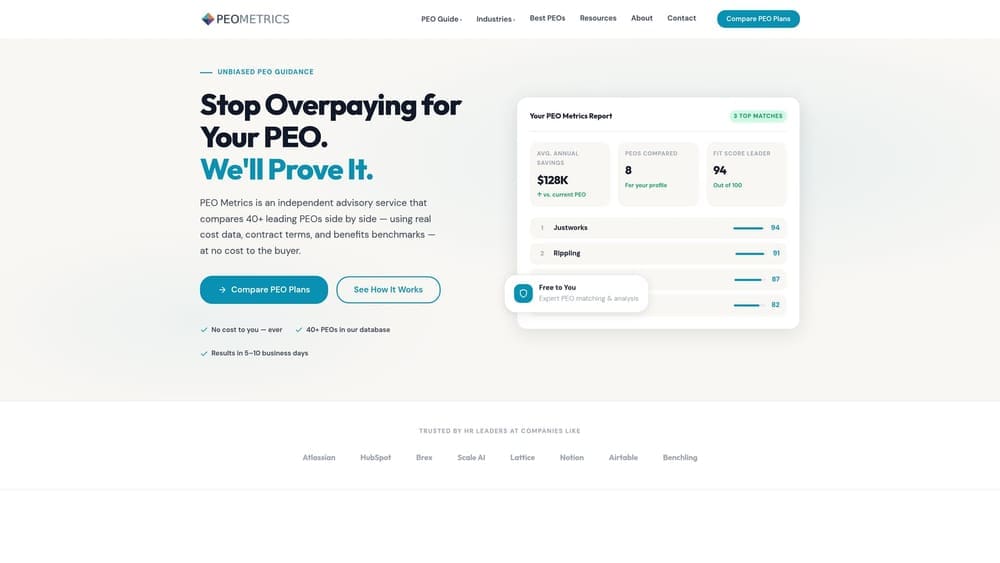
PEO Metrics is a PEO comparison service built for businesses that need more than a basic provider list — particularly useful for trade businesses with elevated risk profiles like kitchen hood cleaning.
Where This Tool Shines
Most PEO comparison tools hand you a list of providers and call it a day. PEO Metrics goes further by surfacing the pricing structures, workers’ comp handling approaches, and contract terms that actually determine whether a PEO is a good fit for your operation. For a hood cleaning business, that depth is not a nice-to-have — it’s the whole point.
The unbiased positioning matters here too. PEO Metrics isn’t tied to any single provider, which means the comparison isn’t shaped by referral incentives. That’s a real distinction when you’re trying to evaluate whether a provider will handle your class codes correctly or whether their pricing structure makes sense for a lean crew of 5 to 12 employees.
Key Features
Side-by-Side Provider Comparisons: Detailed breakdowns across multiple PEO providers, so you can evaluate pricing, services, and contract terms in one place rather than chasing quotes individually.
Pricing Transparency: Helps identify where you may be overpaying due to bundled fees, administrative markups, or rate structures that don’t reflect your actual risk profile.
Workers’ Comp Handling Data: Surfaces how different providers handle workers’ comp — critical for a trade like hood cleaning where class code placement can significantly affect your premium.
Unbiased Guidance: Not affiliated with or incentivized by any single PEO, which keeps the comparison honest.
Trade Business Relevance: Structured to surface providers that can actually serve field-based, high-risk operations — not just office-centric businesses.
Best For
Hood cleaning operators who are actively evaluating PEOs and want structured, data-driven comparisons rather than a generic provider list. Especially valuable if you’ve had workers’ comp issues in the past, run crews across multiple locations, or suspect you may be misclassified or overpaying under your current setup.
Pricing
Free comparison service. No cost to use, which removes the barrier for smaller operators who are still early in the evaluation process.
2. Peocompare
Best for: Early-stage market research before committing to a detailed PEO evaluation.
Peocompare is a PEO aggregator that allows business owners to view multiple PEO providers in one place, giving you a broad sense of the market before going into detailed evaluation.

Where This Tool Shines
If you’re a hood cleaning operator who’s new to the PEO space and just trying to understand what’s out there, Peocompare gives you a starting point. It aggregates providers so you can see the landscape without having to contact each one individually. That’s genuinely useful when you’re in early research mode and don’t yet know which providers are even worth pursuing.
The limitation is depth. Peocompare isn’t designed to surface industry-specific risk factors or workers’ comp class code nuances. It won’t tell you whether a given provider’s carrier will write coverage for grease fire exposure or confined space work. For that level of analysis, you’ll need to move beyond an aggregator.
Key Features
Provider Aggregation: Brings multiple PEO providers into one view, reducing the time you’d spend identifying who’s in the market.
Early-Stage Research Support: Useful for getting oriented before you start running formal comparisons or requesting quotes.
Broad Market Visibility: Gives you a sense of the range of options available without requiring you to contact providers one by one.
Best For
Hood cleaning operators who are at the very beginning of their PEO research and want to understand the market before diving into detailed evaluation. Not a substitute for a comparison built around your specific risk profile, but a reasonable first step.
Pricing
Free to use. No cost for basic market research and provider browsing.
3. HR Guide
Best for: Understanding the PEO model and co-employment structure before starting a formal comparison process.
HR Guide is an HR and employment resource that covers PEO structures, co-employment frameworks, and employer compliance guidance — useful for operators who want foundational context before committing to a provider selection process.

Where This Tool Shines
Hood cleaning operators who haven’t worked with a PEO before often run into the same problem: they don’t fully understand the co-employment model before they start comparing providers. That gap can lead to poor questions, missed red flags, and contracts signed without understanding the liability implications. HR Guide addresses that knowledge gap.
For a trade like hood cleaning, understanding co-employment matters more than it does in lower-risk industries. When your crew is injured on a client’s premises, the PEO’s insurance structure and indemnification terms become immediately relevant. Going into that conversation without baseline knowledge of how co-employment works is a real risk. HR Guide helps you get oriented before you start evaluating providers.
Key Features
PEO Structure Education: Covers the co-employment model, what it means for your business, and how responsibilities are shared between you and the PEO.
HR Compliance Guidance: Relevant for small business operators navigating employment law, particularly useful for operators who handle HR informally today.
Context-Building Before Comparison: Helps you understand the right questions to ask when you move into a formal PEO evaluation process.
Best For
Hood cleaning operators who are new to PEOs and want to build foundational knowledge before running a comparison. Also useful for operators who’ve had a bad PEO experience and want to better understand what went wrong structurally before trying again.
Pricing
Free resource. Educational content with no cost to access.
Which Tool Actually Fits Your Operation
For kitchen hood cleaning companies, the PEO decision isn’t about payroll convenience. It’s about whether the provider understands your risk exposure and can price it fairly. That single factor — workers’ comp class code placement — can determine whether a PEO saves you money or quietly costs you more than going it alone.
Most generic comparison tools won’t surface that detail. They’re built for businesses with standard risk profiles, not for operators running crews into grease-laden environments with fire hazard and confined space exposure. That’s the gap PEO Metrics is designed to fill: side-by-side data on providers most likely to serve a trade like yours, without misclassifying your crews or burying coverage in exclusions.
Peocompare is a reasonable starting point if you’re still in early research mode and just trying to understand the market. HR Guide is worth a read if you haven’t worked with a PEO before and want to understand the co-employment structure before you start evaluating providers. But neither replaces a comparison built around your specific operation.
Before you sign anything, make sure you understand how your workers’ comp class codes will be handled under co-employment. That’s not a detail to sort out after the contract is signed. And if you’re already in a PEO contract, it’s worth checking whether the rate and classification you’re on today actually reflects your risk profile — or whether you’re paying for someone else’s.
Don’t auto-renew. Make an informed, confident decision.
Before you sign that PEO renewal, make sure you’re not leaving money on the table.
Many businesses unknowingly overpay because of bundled fees, hidden administrative markups, and contracts designed to limit flexibility. We give you a clear, side-by-side breakdown of pricing, services, and contract terms—so you can see exactly what you’re paying for and choose the option that truly fits your business.
