
Manufacturing isn’t a forgiving industry when it comes to HR risk. Workers’ comp class codes run high, OSHA obligations are real, payroll gets complicated fast across multiple shifts, and you’re competing for hourly workers in a tight labor market — often against employers with bigger benefits budgets.
A general-purpose PEO that works fine for a 30-person software company can leave a manufacturer genuinely exposed. The wrong workers’ comp structure, a PEO that won’t touch your risk classification, or a payroll engine that can’t handle shift differentials — these aren’t minor inconveniences. They’re operational and liability problems.
This list focuses on PEOs that actually handle manufacturing well. Selection criteria: workers’ comp depth and loss control programs, OSHA compliance support, multi-shift payroll capability, benefits competitiveness for hourly workers, and pricing transparency. PEO Metrics leads the list because if you’re still in the comparison phase, it’s worth running providers side-by-side before you sign anything.
1. PEO Metrics
Best for: Manufacturing businesses comparing PEO providers before committing to a contract
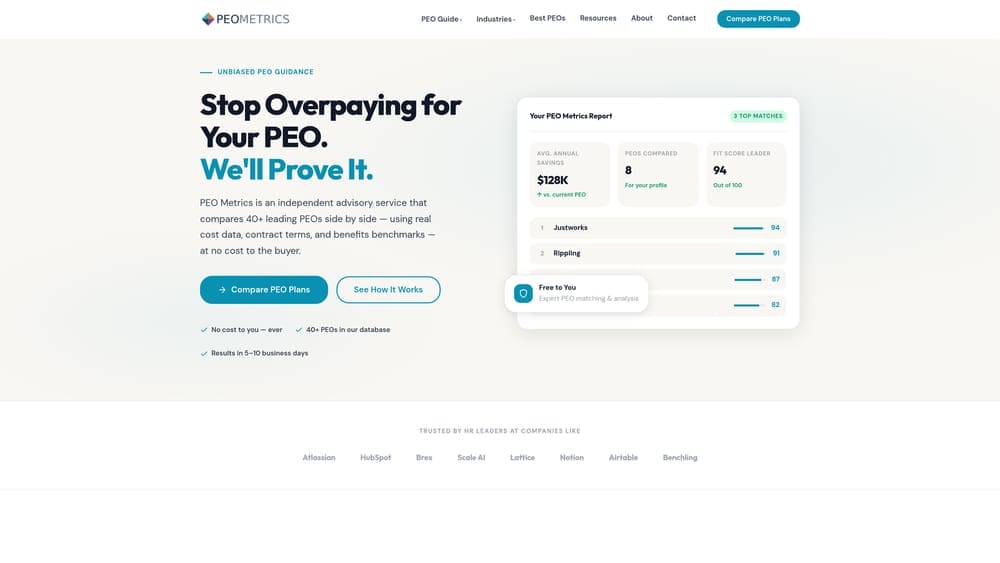
PEO Metrics is a PEO comparison platform that helps manufacturing businesses evaluate and compare providers side-by-side with detailed pricing analysis and unbiased guidance.
Where This Tool Shines
PEO pricing for manufacturers isn’t what it is for a typical office-based business. Workers’ comp classification codes vary dramatically depending on what your facility actually does — light assembly carries a very different rate than heavy fabrication or chemical processing. Most manufacturers don’t know what a fair price looks like until they’ve already signed a contract, which is exactly when that information stops being useful.
PEO Metrics gives you the comparison data before you commit. It’s not affiliated with any PEO provider, which matters: the guidance you get isn’t shaped by referral relationships or commission structures. For manufacturing specifically, where PEO pricing can vary significantly based on risk classification and workers’ comp structure, having a clear side-by-side view can be the difference between a good deal and an expensive one.
Key Features
Side-by-Side Provider Comparisons: Detailed metrics across multiple PEO providers so you can evaluate on the factors that matter for your operation.
Pricing Transparency: Helps identify where bundled fees and administrative markups are inflating costs — particularly relevant in high-risk manufacturing classifications where pricing opacity is common.
Unbiased Guidance: Not affiliated with any PEO, which means recommendations aren’t shaped by referral fees or preferred provider relationships.
Workers’ Comp Classification Relevance: Helps identify which PEOs are actually willing to quote and serve your specific manufacturing classification — not all are.
Contract Term Visibility: Surfaces differences in contract flexibility, exit terms, and service inclusions before you’re locked in.
Best For
Manufacturing businesses in the evaluation phase — especially those comparing multiple PEOs simultaneously or renewing a contract and wondering whether they’re still getting a competitive rate. Particularly useful if your operation falls into a higher-risk classification where PEO pricing varies widely.
Pricing
Free comparison service. No cost to use the platform or access provider comparisons.
2. Insperity
Best for: Mid-size manufacturers who want full-service HR infrastructure with strong OSHA and compliance depth
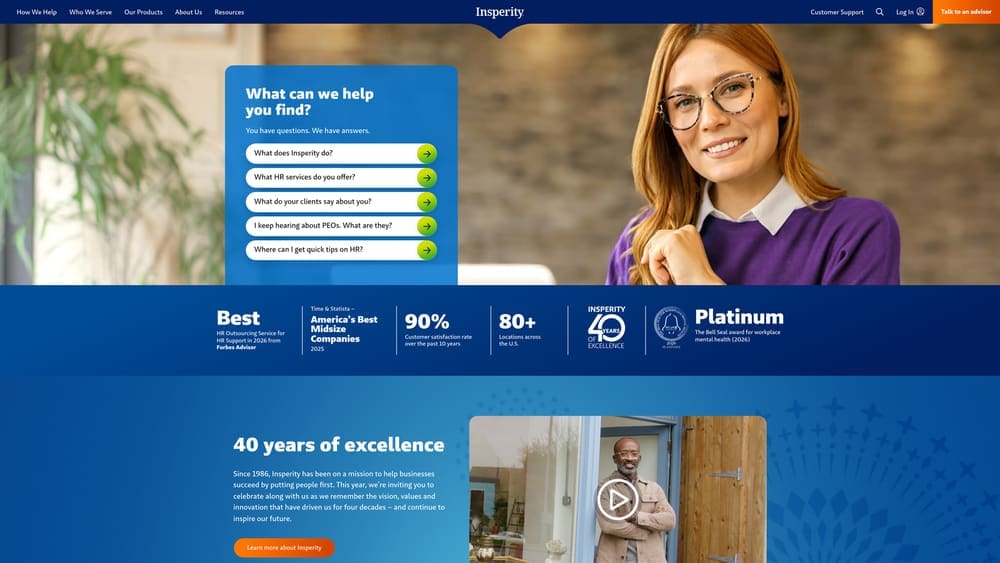
Insperity is one of the largest full-service PEOs in the U.S., with dedicated HR specialists, solid OSHA compliance support, and competitive benefits access suited to manufacturers with 50 or more employees.
Where This Tool Shines
Insperity’s strength is depth. Dedicated HR specialists who understand industry compliance obligations — not just generalist HR reps working from a script — make a real difference when you’re dealing with OSHA recordkeeping, incident response, or a workers’ comp claim that needs active management. That hands-on service model is what separates Insperity from more self-service-oriented PEOs.
For manufacturers with complex benefit needs, Insperity’s large group purchasing power translates to genuinely competitive health insurance options. Attracting and retaining hourly production workers is hard enough without being outcompeted on benefits by larger employers. Access to better benefit packages through a PEO can be a real recruiting lever.
Key Features
Dedicated HR Specialists: Assigned HR professionals with compliance knowledge, not just a general support queue.
OSHA Recordkeeping and Safety Support: Assistance with 300 log maintenance, safety program development, and incident response.
Large Group Benefits Access: Competitive health, dental, vision, and voluntary benefits through bulk purchasing.
Multi-Shift Payroll Infrastructure: Strong payroll processing capability for complex shift-based operations.
IRS-Certified PEO Status: Certified Professional Employer Organization (CPEO) designation, which carries specific tax and liability protections.
Best For
Mid-size manufacturers with 50 to several hundred employees who want comprehensive HR support, are willing to pay a premium for it, and need genuine OSHA compliance depth — not just a checkbox service.
Pricing
Custom pricing — typically structured as a percentage of payroll or per-employee monthly fee. Insperity is positioned at the premium end of the market; expect pricing to reflect that.
3. TriNet
Best for: Manufacturers with a mixed workforce of salaried engineers and hourly production staff
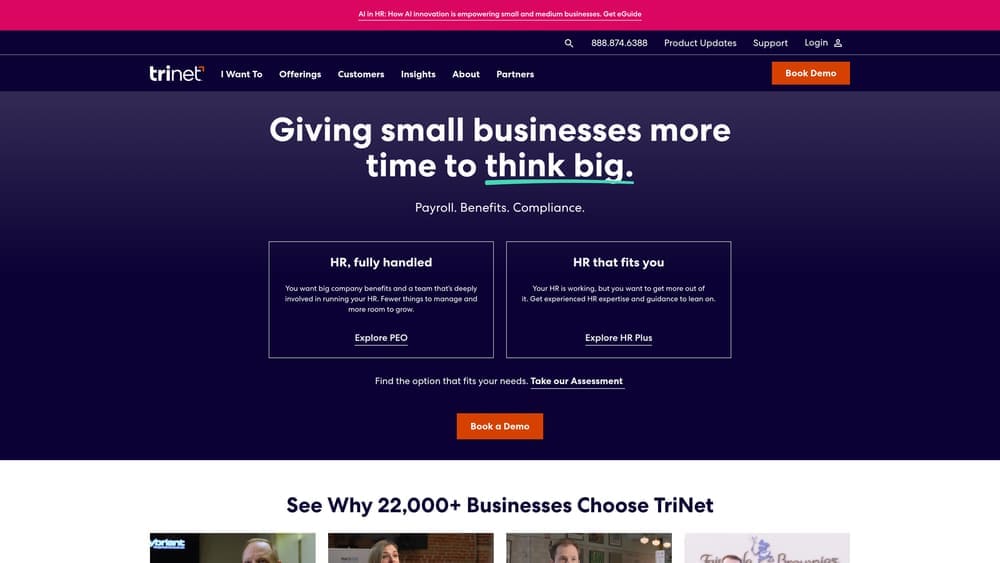
TriNet is a publicly traded PEO (NYSE: TNET) offering industry-specific HR bundles, strong benefits access, and solid payroll and compliance infrastructure.
Where This Tool Shines
TriNet is better known for tech and professional services than for heavy manufacturing, but that’s actually part of what makes it interesting for certain manufacturers. If your operation has a significant engineering, design, or administrative workforce alongside your production floor, TriNet’s industry-specific bundles can serve both populations reasonably well within one platform.
The publicly traded status is worth noting. Transparent financials and regulatory oversight add a layer of accountability that matters when you’re co-employing your workforce through a third party. TriNet’s technology platform also tends to be cleaner and more user-friendly than some of the older enterprise-tier PEOs, which reduces administrative friction for HR teams managing mixed employee types.
Key Features
Industry-Specific HR Bundles: Configurable service packages that can accommodate mixed workforce needs.
Benefits Access for Mixed Workforces: Competitive health and voluntary benefits for both hourly and salaried employees.
Payroll and Compliance Infrastructure: Solid multi-state payroll capability with built-in compliance support.
Publicly Traded Transparency: NYSE-listed with audited financials — useful for larger businesses with governance requirements.
Self-Service HR Technology: Clean platform with employee self-service tools that reduce administrative load.
Best For
Manufacturers with a meaningful white-collar or technical workforce alongside production staff, or operations that need a single PEO solution to serve genuinely different employee populations without separate systems.
Pricing
Per-employee monthly fee; varies by industry classification and headcount. Contact TriNet directly for manufacturing-specific quotes.
4. ADP TotalSource
Best for: Larger or multi-site manufacturers needing enterprise-grade payroll and multi-state compliance
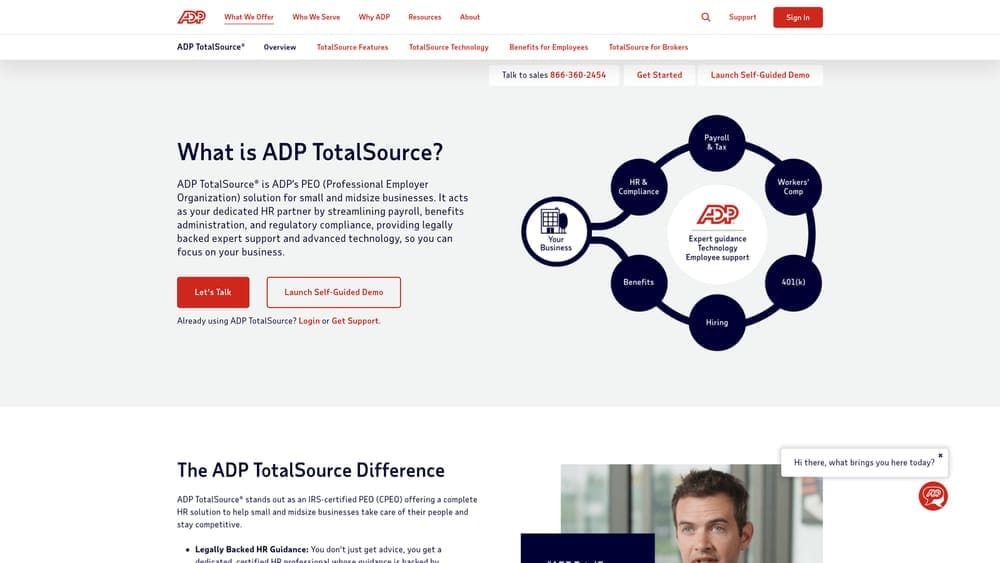
ADP TotalSource is the full-service PEO arm of ADP, offering enterprise payroll infrastructure, broad workers’ comp carrier access, and deep multi-state compliance capability for complex manufacturing operations.
Where This Tool Shines
If your manufacturing operation runs across multiple states or multiple facilities, the compliance complexity compounds quickly. Different workers’ comp regulations, varying state payroll tax requirements, and inconsistent labor law obligations across locations create real administrative exposure. ADP TotalSource’s infrastructure is built to handle that scale without breaking down — which is more than can be said for smaller PEOs that stretch to serve multi-state clients.
The workers’ comp carrier access is also worth calling out specifically. ADP TotalSource’s broad carrier relationships mean more flexibility in how coverage is structured for different manufacturing classifications. For operations that have struggled to find PEO coverage for higher-risk segments, that carrier breadth can open doors.
Key Features
Enterprise Multi-State Payroll: Handles complex multi-jurisdiction payroll, tax compliance, and reporting at scale.
Broad Workers’ Comp Carrier Access: Multiple carrier relationships provide more flexibility for varied manufacturing classifications.
Deep HRIS and Reporting: Robust HR information system with strong analytics and reporting capability.
Multi-Site Management Tools: Infrastructure designed for manufacturers operating across multiple locations.
IRS-Certified PEO Status: CPEO designation with associated tax and liability protections.
Best For
Larger manufacturers with 100-plus employees, multi-state operations, or complex facility structures that need an enterprise-grade payroll and compliance backbone rather than a boutique service model.
Pricing
Custom pricing, typically structured as a percentage of payroll. Pricing transparency upfront is limited — expect to go through a detailed sales process before getting numbers.
5. Oasis (a Paychex Company)
Best for: Smaller manufacturers not ready for enterprise-tier pricing but wanting solid PEO infrastructure
Oasis, now part of Paychex, offers PEO services with the backing of Paychex’s payroll and HR infrastructure — with historically more flexible entry points for smaller manufacturing businesses.
Where This Tool Shines
The challenge for smaller manufacturers — say, 10 to 75 employees — is that the enterprise-tier PEOs are often priced, structured, and operationally oriented toward larger clients. You end up paying for service infrastructure you can’t fully use. Oasis fills a different position: Paychex-backed reliability without the enterprise-tier complexity or pricing floor.
For manufacturers in that smaller headcount range who need workers’ comp options, payroll processing, and HR compliance support without committing to a premium-tier contract, Oasis is worth evaluating. The Paychex acquisition has added infrastructure depth while the core model has remained more accessible than ADP TotalSource or Insperity.
Key Features
Paychex-Backed Infrastructure: Solid payroll and HR systems supported by one of the largest payroll processors in the country.
Flexible Entry Points: More accessible minimum headcount and pricing structure for smaller operations.
Workers’ Comp Options for Smaller Operations: Coverage options available for manufacturing businesses below the threshold where larger PEOs become practical.
Benefits and Payroll Administration: Core PEO services without the enterprise overhead.
HR Compliance Support: Compliance assistance for smaller HR teams managing complex obligations.
Best For
Small to mid-size manufacturers in the 10 to 75 employee range who want PEO infrastructure without enterprise-tier pricing or complexity. A practical bridge option for growing operations.
Pricing
Custom pricing; generally more accessible for smaller headcounts than enterprise-tier alternatives. Contact Oasis directly for manufacturing-specific quotes.
6. Engage PEO
Best for: High-injury-rate manufacturing environments where workers’ comp management is the primary concern
Engage PEO is a specialized PEO with a strong reputation for hands-on workers’ comp management and proactive risk control programs — particularly relevant for physical, high-exposure manufacturing environments.
Where This Tool Shines
Most PEOs offer workers’ comp as a bundled service. Engage PEO treats it as a core competency. Hands-on claims management, return-to-work coordination, modified duty programs, and proactive loss control aren’t just listed features — they’re central to how the company operates. For manufacturers in segments with elevated injury frequency, that distinction matters more than it might seem.
Experience modification rates are directly tied to claims history, and claims history is directly tied to how aggressively injuries are managed after they occur. A PEO that actively advocates on your behalf during the claims process, coordinates return-to-work programs, and conducts safety audits before incidents happen can materially affect your mod rate over time. That has real dollar implications on your workers’ comp premiums. If you want to understand how risk management plays out across similar high-risk industries, PEO risk management for food processing covers parallel dynamics worth reviewing.
Key Features
Hands-On Claims Management: Active advocacy and management through the claims process, not passive administration.
Return-to-Work and Modified Duty Coordination: Programs designed to get injured workers back productively while managing claim costs.
Safety Audits and Risk Assessments: Proactive on-site safety evaluations to identify and address hazards before they become incidents.
Experience Modification Rate Management: Deliberate focus on managing EMR over time through loss control and claims advocacy.
Dedicated Risk Management Team: Specialists focused specifically on risk, not generalist HR staff handling everything.
Best For
Manufacturing operations with high injury frequency or elevated workers’ comp class codes where proactive risk management has direct financial impact. Particularly relevant for heavy fabrication, metalworking, or other physically demanding production environments.
Pricing
Custom pricing; contact Engage PEO directly for manufacturing-specific quotes, particularly if your classification falls into higher-risk categories.
7. Justworks
Best for: Smaller manufacturers who want transparent, predictable pricing without the custom-quote runaround
Justworks is a PEO known for flat-rate per-employee pricing — one of the few providers in the industry that publishes its rates — with strong benefits access suited to smaller manufacturing operations.
Where This Tool Shines
Pricing opacity is one of the most frustrating parts of buying a PEO. Most providers require a full sales process before you see a number, and even then the structure can be difficult to compare across vendors. Justworks is genuinely different here: flat-rate per-employee pricing that’s publicly listed. For a smaller manufacturer trying to model HR costs without going through three rounds of sales calls, that clarity is valuable.
The benefits access is also competitive for the segment Justworks serves. Smaller manufacturers often lose recruiting battles to larger employers simply because they can’t offer comparable health insurance. Access to large group benefits through Justworks levels that playing field to a meaningful degree without requiring 200 employees to qualify.
Key Features
Transparent Flat-Rate Pricing: Per-employee monthly fee with publicly listed tiers — no custom quote required to understand the cost structure.
Competitive Benefits Access: Large group health, dental, vision, and voluntary benefits for smaller employers.
Clean HR Platform: User-friendly technology with employee self-service that reduces administrative burden on small HR teams.
Payroll Processing with Compliance Support: Core payroll and compliance infrastructure without enterprise complexity.
No Hidden Fees: Straightforward pricing model without bundled administrative markups — unusual in the PEO market.
Best For
Small manufacturers under 50 employees who prioritize cost predictability and benefits competitiveness over deep OSHA support or specialized risk management programs. Less suited to high-risk classifications that need intensive workers’ comp management.
Pricing
Flat per-employee monthly fee with publicly listed pricing tiers. One of the few PEOs where you can get a realistic cost estimate without a sales call.
8. Vensure Employer Services
Best for: High-risk manufacturing classifications that larger PEOs decline to quote
Vensure Employer Services is one of the larger privately-held PEOs in the U.S., known for working with harder-to-place industries and elevated-risk manufacturing segments that many enterprise PEOs won’t touch.
Where This Tool Shines
Not every manufacturer can walk into Insperity or ADP TotalSource and get a quote. High-risk classifications — certain types of metal fabrication, chemical processing, or heavy industrial work — fall outside the risk appetite of larger PEOs that prefer cleaner client profiles. Vensure occupies a different position: willing to work with classifications that others decline, with flexible workers’ comp structures to match.
This isn’t a fallback option for manufacturers who couldn’t get approved elsewhere. It’s a deliberate choice for operations that need a PEO with broader risk tolerance and flexible coverage structures. The trade-off is less brand recognition and a less polished technology platform compared to the enterprise players — but for a manufacturer that’s been turned down elsewhere, those are secondary concerns. For a parallel example of how risk-focused PEO selection plays out in another high-risk industry, the approach to PEO workers’ comp for trucking companies shares some relevant dynamics.
Key Features
Flexible Workers’ Comp for High-Risk Classifications: Coverage structures designed to accommodate elevated-risk manufacturing segments.
Broad Industry Acceptance: Willing to quote and serve classifications that larger PEOs frequently decline.
Full-Service HR, Payroll, and Benefits: Complete PEO service offering across HR, payroll administration, and benefits access.
National Coverage: Operates across the U.S. without the regional limitations of smaller PEOs.
Risk Management and Compliance Support: Compliance infrastructure and risk management programs for complex manufacturing environments.
Best For
Manufacturers in elevated-risk classifications who have been declined by larger PEOs, or operations in segments with complex workers’ comp structures that require more flexible underwriting. Also relevant for manufacturers who’ve outgrown smaller regional PEOs but don’t fit the enterprise-tier risk profile.
Pricing
Custom pricing; contact Vensure directly, particularly if your classification falls into higher-risk categories where standard pricing models don’t apply.
9. CoAdvantage
Best for: Manufacturers in the Southeast and Sun Belt looking for regional expertise and dedicated account service
CoAdvantage is a regional PEO with strong presence across Florida, Texas, Georgia, and the Carolinas, offering dedicated account teams and competitive workers’ comp programs in states with significant manufacturing activity.
Where This Tool Shines
Regional PEOs get dismissed too quickly. For manufacturers operating in one or two states — particularly in the Southeast where manufacturing density is high — a PEO with genuine regional expertise and localized account teams often delivers better day-to-day service than a national enterprise provider where your account is one of thousands. CoAdvantage’s presence in key manufacturing states like Texas, Florida, Georgia, and the Carolinas isn’t incidental; it’s where their operational depth actually lives.
The personal service model is a real differentiator for manufacturers who’ve been burned by enterprise PEOs that assign a new account manager every six months. Dedicated, consistent account relationships matter when you’re dealing with a workers’ comp claim, an OSHA recordkeeping question, or a payroll issue that needs quick resolution. For manufacturers with electronics or precision manufacturing operations, the dynamics covered in PEO payroll for electronics manufacturing are worth reviewing alongside CoAdvantage’s regional capabilities.
Key Features
Strong Regional Presence: Deep operational footprint in FL, TX, GA, and the Carolinas — key manufacturing states.
Dedicated Account Teams: Consistent, named account relationships rather than rotating support queues.
Competitive Workers’ Comp Programs: Solid workers’ comp options in states where they have established carrier relationships.
Full HR, Payroll, and Benefits Administration: Complete PEO service offering without the enterprise-tier complexity.
Localized Service Model: Regional focus means account teams understand state-specific compliance nuances that national providers sometimes miss.
Best For
Small to mid-size manufacturers concentrated in the Southeast or Sun Belt who value consistent, personalized account service and regional compliance expertise over national scale. Less suited to manufacturers with significant multi-state operations outside CoAdvantage’s core geography.
Pricing
Custom pricing; regional focus may translate to competitive rates in key manufacturing states. Contact CoAdvantage directly for location-specific quotes.
Which PEO Actually Fits Your Manufacturing Operation
The right answer depends heavily on where your biggest exposure sits — and that varies more across manufacturing segments than most PEO salespeople will tell you.
If you’re still in the comparison phase and want to avoid signing a contract that doesn’t fit your risk classification or budget, start with PEO Metrics. Running providers side-by-side before you commit is genuinely worth the time, especially given how much workers’ comp classification affects PEO pricing in manufacturing. Don’t auto-renew. Make an informed, confident decision.
Before you sign that PEO renewal, make sure you’re not leaving money on the table.
Many businesses unknowingly overpay because of bundled fees, hidden administrative markups, and contracts designed to limit flexibility. We give you a clear, side-by-side breakdown of pricing, services, and contract terms—so you can see exactly what you’re paying for and choose the option that truly fits your business.
