

Choosing a PEO rarely happens on a leisurely timeline. A founder or first HR hire gets pulled into the decision after a broker pitch, a renewal deadline, or a hiring surge that exposes gaps in benefits or compliance coverage, and the research usually starts from zero. Fee structures differ by percentage-of-payroll versus flat per-employee pricing, co-employment terms vary in what they actually cover, and “PEO” gets used loosely alongside EOR, ASO, and payroll-only providers that solve different problems.
A PEO enters a co-employment relationship with your company, giving employees access to the PEO’s master benefits plans and workers’ comp policies while handling payroll, compliance, and HR administration. An EOR (employer of record) becomes the legal employer, typically used for hiring in states or countries where you have no entity. An ASO handles administrative HR tasks without co-employment or shared liability. Payroll-only providers just run payroll. This list sticks to PEOs with real experience serving venture-backed and fast-growing companies, since a provider built for stable, low-growth headcounts often handles funding-stage transitions and benefits competitiveness poorly.
The providers below were selected for relevance to startup and scale-up hiring patterns, not general market size. Pricing details are marked “see website” or “quote-based” throughout, since PEO pricing changes often and every vendor should be confirmed directly before you commit.
Quick Comparison
- PEO Metrics: best for startups comparing multiple PEO options before committing; pricing is quote-based for its guidance service; it’s the only entry here that compares other providers side by side instead of being a PEO itself.
- Justworks: best for early-stage startups without in-house HR; pricing is a flat monthly per-employee model; its predictability is unmatched by percentage-of-payroll competitors.
- TriNet: best for startups in tech or other specific sectors; pricing is quote-based and plan-dependent; its industry-tailored plan design sets it apart from generalist PEOs.
- Insperity: best for growing companies wanting dedicated HR support; pricing is quote-based; it assigns a dedicated HR service team rather than a purely self-serve model.
- ADP TotalSource: best for companies planning to scale into a larger, more complex organization; pricing is quote-based; it draws on ADP’s payroll infrastructure and client scale.
- Rippling PEO: best for companies wanting to unify HR and IT in one platform; pricing is quote-based; it’s the only option here bundling device and app management with PEO services.
- Sequoia One: best for VC-backed startups prioritizing competitive benefits; pricing is quote-based; its benefits strategy consulting is built specifically around venture-backed hiring competition.
- G&A Partners: best for growing companies outside pure tech; pricing is quote-based; it lets you bundle or unbundle specific HR services rather than committing to an all-or-nothing package.
1. PEO Metrics
PEO Metrics is not a PEO. It’s a comparison and guidance service built for HR leaders and founders who need to evaluate multiple PEO providers side by side before signing anything. Instead of taking one broker’s pitch or one provider’s proposal at face value, you get cost and service metrics laid out across providers so you can see how pricing structures, benefits access, and service models actually differ.
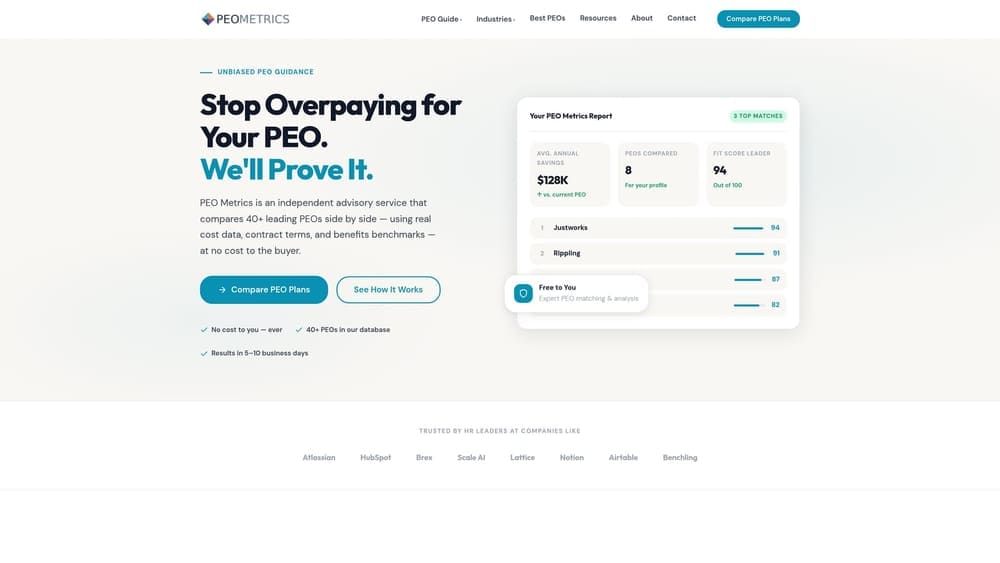
What sets it apart on this list is exactly that: every other entry here is a PEO trying to win your business, while PEO Metrics is the step you take before deciding which of them, if any, deserves it. That distinction matters most for growth-stage companies weighing several providers with different fee models and benefits tiers, where a side-by-side comparison surfaces cost differences that a single sales conversation won’t.
- Lays out PEO pricing structures and service models next to each other so you’re not comparing a percentage-of-payroll quote to a flat-fee quote blind.
- Gives you consultative guidance to narrow a broad market down to a shortlist that fits your headcount stage and industry.
- Maintains an independent view across PEO brands rather than pushing you toward a single preferred vendor.
Setup involves working directly with PEO Metrics’ team rather than logging into a self-serve dashboard, and it fits before your PEO decision rather than as an ongoing HR system. It integrates informationally with the vendor landscape it covers rather than plugging into your payroll or HRIS. The clear limitation: it doesn’t run payroll, administer benefits, or handle compliance filings itself, so you still need to select and onboard a PEO afterward. Pricing is quote-based, and PEO Metrics may receive placement fees from vendors as part of how the service is funded, which is worth knowing as you weigh its recommendations alongside your own research.
Best for: Startups that want to compare several PEO options before committing to one.
2. Justworks
Justworks built its reputation on a flat monthly per-employee fee and a self-serve platform, which appeals to early founders who don’t have time to manage a complex HR vendor relationship. Employees enroll in benefits and access payroll tools directly through the platform, with minimal hand-holding required from your side.
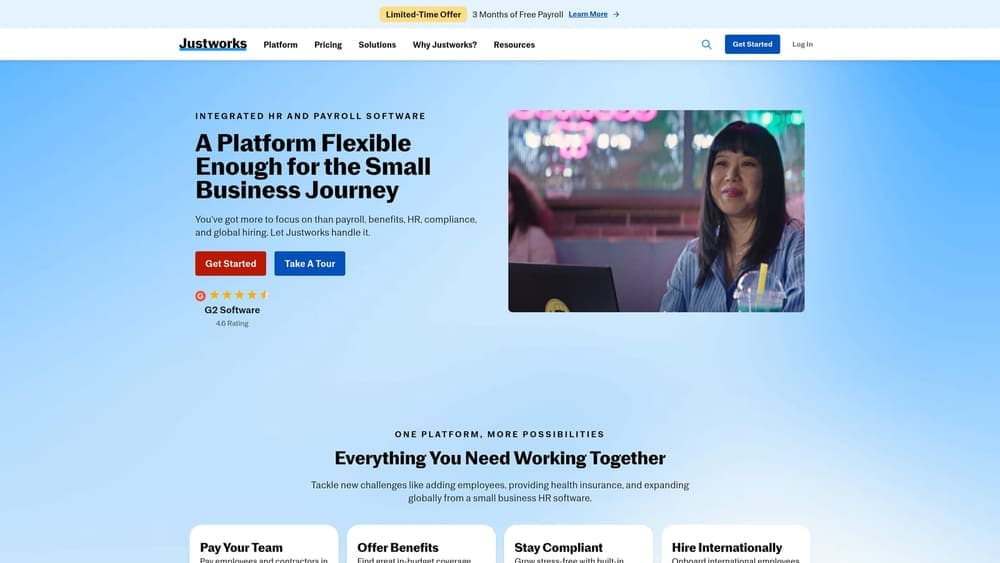
Its main distinction here is pricing predictability. Where several PEOs on this list price as a percentage of payroll that fluctuates with raises and hiring, Justworks’ flat-fee structure makes it easier to forecast HR costs into next year’s budget, a real advantage for a startup managing runway.
- Charges a flat per-employee monthly fee that doesn’t move with payroll increases, simplifying budget forecasting.
- Provides a self-serve platform so employees can handle much of their own onboarding and benefits enrollment without HR intervention.
- Gives access to group health insurance plans through the PEO’s master policies, useful for teams too small to negotiate their own rates.
Setup is largely self-directed, with a founder or early HR hire typically managing the account without needing a dedicated HR department. Integrations exist with common accounting and payroll-adjacent tools, though the platform is designed to be a hub rather than a connector to a wider tech stack.
The limitation shows up as companies scale past the earliest stage: multi-state compliance and industry-specific HR support become more demanding, and a flat-fee, self-serve model built for simplicity doesn’t always keep pace with that complexity. Pricing is quote-based around the flat monthly per-employee model, and you should confirm current rates directly given how frequently PEO pricing shifts.
Best for: Early-stage startups without in-house HR wanting predictable, simple pricing.
3. TriNet
TriNet takes a different approach from flat, generic PEO packages by building plans around specific industries, including options tailored for technology companies. That sector focus means compliance guidance and plan design reflect the realities of the industry you’re in rather than a one-size-fits-all template.
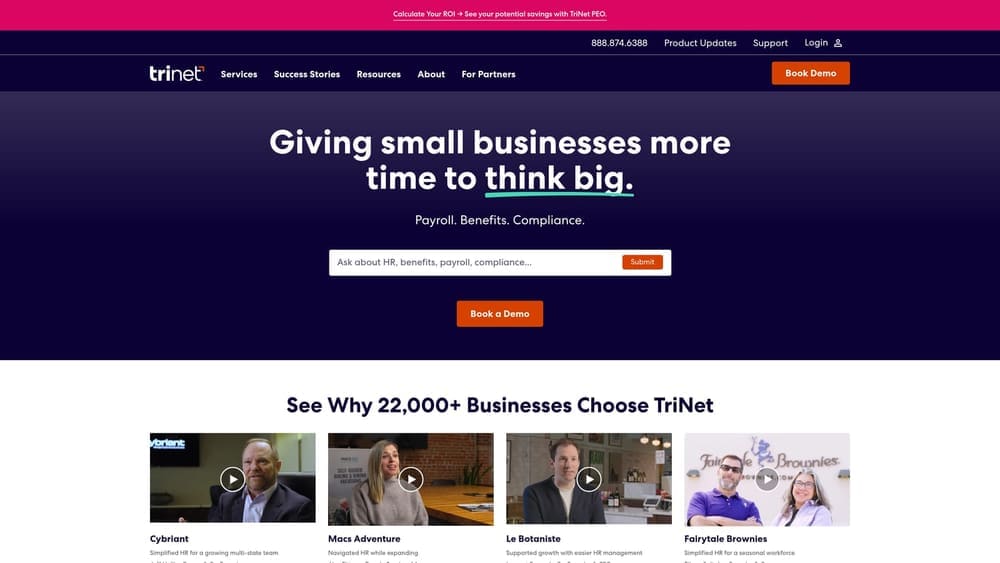
Compared with the rest of this list, TriNet’s industry-specific plan structure is its clearest differentiator. A biotech startup and a SaaS company have different compliance exposure and benefits expectations, and TriNet’s plan options are built to reflect that rather than treating every client the same.
- Offers plan options built around specific industries, so compliance support matches the regulatory realities of your sector.
- Pools clients under master benefits policies, giving smaller companies access to larger-group insurance rates than they could get alone.
- Provides HR compliance support shaped by sector-specific risk rather than generic HR policy templates.
A dedicated HR hire or founder typically manages the relationship, with payroll and benefits administration integrations varying depending on which plan you’re on. Because plan structure and pricing shift by industry, getting an accurate comparison requires a direct quote rather than relying on general published rates.
The tradeoff is that this variability makes apples-to-apples comparison harder without doing that legwork yourself, which is exactly where a side-by-side comparison across providers helps before you sign. Pricing is quote-based and plan-dependent, so confirm current terms directly with TriNet as of your evaluation date.
Best for: Startups in tech or other specific sectors wanting industry-tailored HR support.
4. Insperity
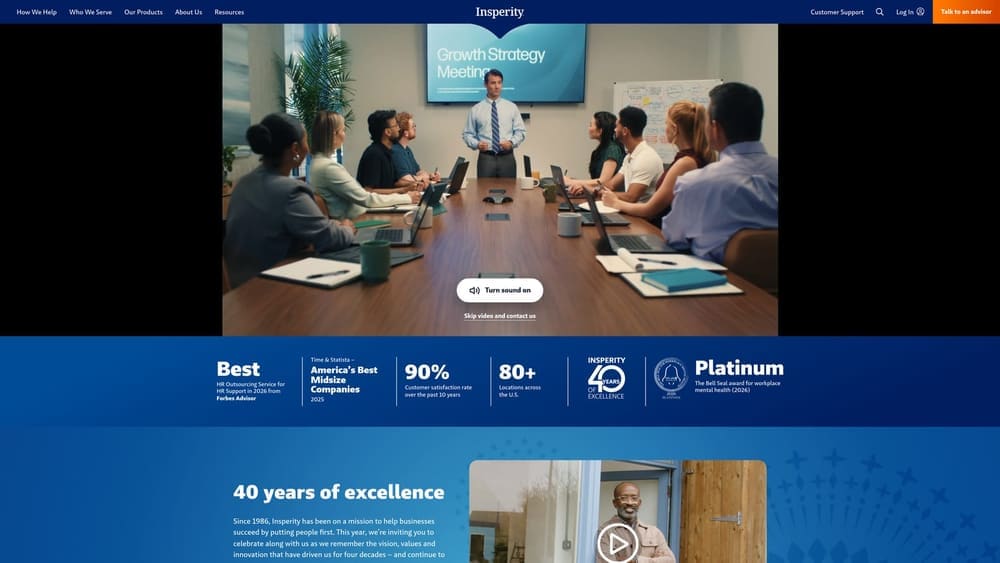
Growing headcount often means outgrowing a purely self-serve HR model, and that’s the gap Insperity is built to fill. Each client company gets a dedicated HR service team, rather than a support ticket queue, to handle payroll, benefits, and compliance as the organization scales.
Where it fits versus self-serve options
The dedicated-team model is Insperity’s clearest differentiator against Justworks and other self-serve platforms on this list. Instead of your HR lead troubleshooting issues alone through a dashboard, you have a named team that becomes familiar with your company’s specific structure and needs over time.
- Assigns a dedicated HR service team to your account instead of a rotating support queue.
- Administers payroll, benefits, and compliance as a full-service package rather than a set of disconnected tools.
- Structures HR processes to scale as headcount grows, reducing the need to overhaul systems at each growth stage.
Who it doesn’t fit
That structure can feel like more process than a five-person team needs. Very small companies without complex compliance needs may find the service model heavier and more formal than necessary, and the value proposition improves as headcount and complexity grow. Integrations for payroll and time tracking are available, and setup typically involves closer onboarding with the assigned team rather than a purely self-guided signup. Pricing is quote-based; confirm current terms directly with Insperity.
Best for: Growing companies that want dedicated HR support as headcount scales.
5. ADP TotalSource
ADP TotalSource is ADP’s PEO offering, built on top of the payroll and workforce management infrastructure ADP has run for decades. For a growing company, that scale translates into benefits purchasing power drawn from ADP’s large overall client base and compliance support that spans multiple states.
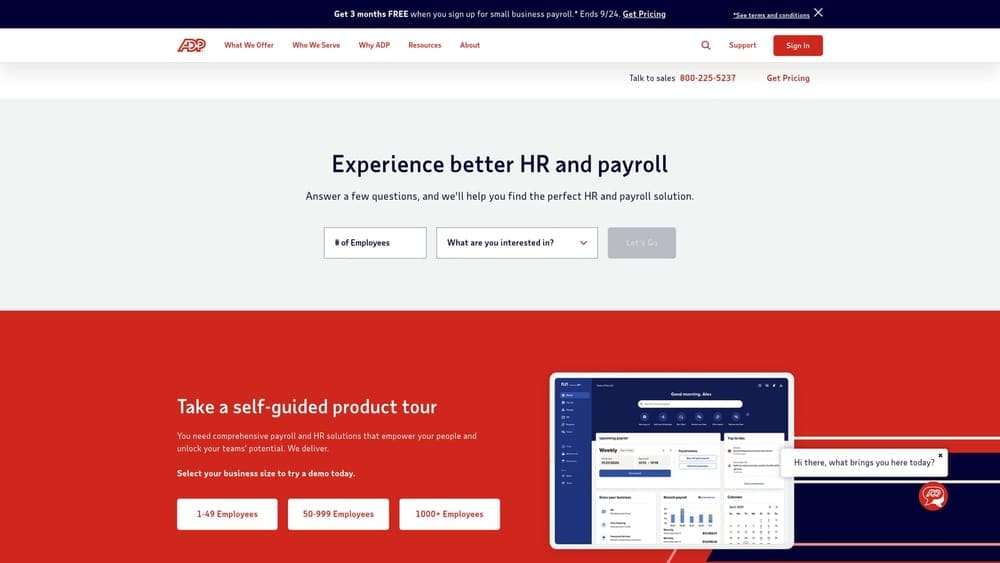
What separates ADP TotalSource from smaller PEOs on this list is that infrastructure backing. Companies anticipating rapid multi-state expansion may value the depth of an established payroll and compliance engine over a newer or more boutique provider.
- Runs on ADP’s established payroll and workforce management technology rather than a newer, smaller platform.
- Draws benefits purchasing power from ADP’s large client base, which can matter for benefits competitiveness at scale.
- Supports HR compliance needs across multiple states, relevant as a distributed or remote workforce grows.
Setup generally involves working with ADP’s onboarding and account teams, and the platform is typically managed by an HR lead or ops person familiar with ADP’s broader ecosystem. Integrations run through ADP’s own payroll and workforce management tools.
The tradeoff of that scale is that larger organizational structure can mean a less personalized, more standardized service experience than a boutique PEO offers. Founders who want a close, high-touch relationship with a small account team may find ADP’s model feels more corporate. Pricing is quote-based, and you should confirm current terms directly given how PEO fee structures shift.
Best for: Growing companies planning to scale into a larger, more complex organization.
6. Rippling PEO
Rippling PEO is offered alongside Rippling’s broader platform for HR, payroll, IT, and device management, which makes it a different kind of choice than a standalone PEO. Instead of adding a PEO on top of a separate stack of tools, Rippling positions the PEO as one module within a single system.
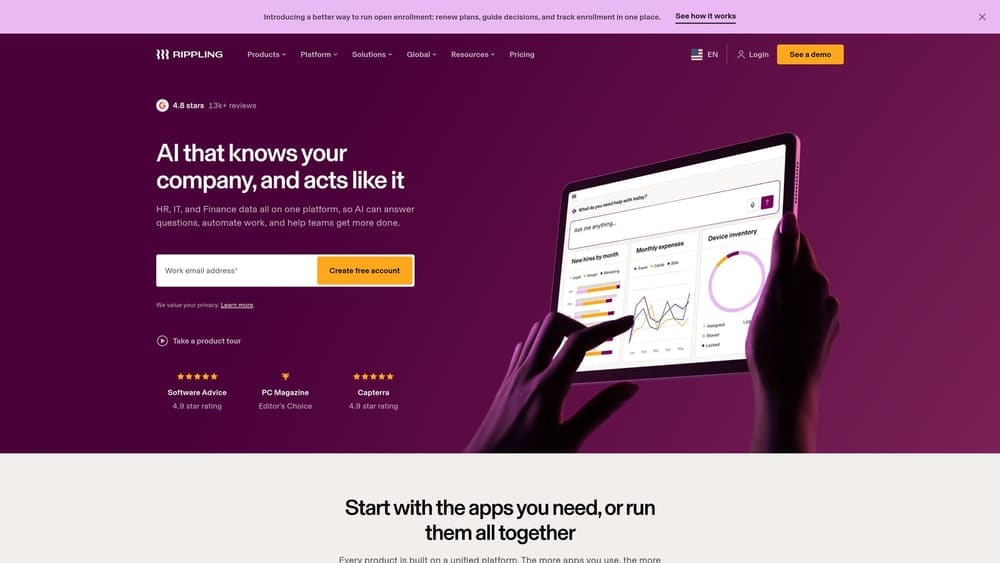
That unification is the standout feature versus every other provider on this list. No other PEO here manages employee laptops, software provisioning, and device security within the same platform as payroll and benefits.
- Combines PEO services with HR, payroll, and IT management so data doesn’t have to sync across separate systems.
- Uses a modular structure, letting you add or remove services as your needs change without switching platforms.
- Manages devices and software access alongside HR functions, useful for remote or hybrid teams issuing company hardware.
Setup is centered on the Rippling platform itself, typically run by an HR or ops lead who also oversees IT provisioning, and integrations are strongest within Rippling’s own native modules for HR, IT, and finance rather than external third-party tools.
The real value of this model shows up when you consolidate most of your HR and IT tooling into Rippling. Companies with an established, separate tech stack for IT management may not get the full benefit of the unified approach and could find themselves paying for overlap with tools they already use. Pricing is quote-based, and it’s worth mapping your current tool stack against Rippling’s modules before assuming cost savings.
Best for: Growing companies wanting to unify HR and IT management in one platform.
7. Sequoia One
Sequoia One orients its entire model around venture-backed startups, with benefits strategy as the centerpiece rather than an add-on to payroll administration. The pitch is less about processing HR paperwork and more about helping you compete for talent in tight hiring markets.
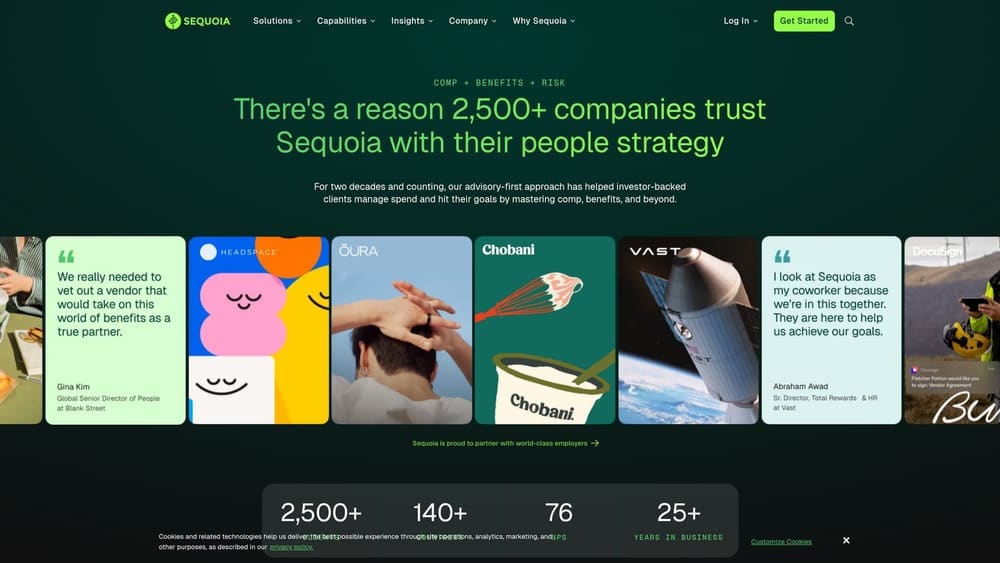
Its standout feature relative to the rest of this list is that benefits-first consultative approach built specifically for venture-backed hiring competition, rather than general small-business HR administration.
- Designs benefits packages meant to compete in tight talent markets, not just meet minimum compliance requirements.
- Provides compliance support shaped around the specific needs of venture-backed companies, including rapid headcount changes.
- Offers guidance through funding-stage transitions, when headcount, benefits needs, and compliance obligations can shift quickly.
Founders or HR leads typically work closely with a Sequoia team through onboarding, with payroll and benefits integrations varying by plan. The company is run by and for people who’ve seen the specific HR problems that come with rapid, funded growth.
The limitation is straightforward: this consultative, benefits-forward emphasis tends to cost more than a bare-bones administrative PEO built purely for compliance and payroll processing. If your priority is the lowest possible administrative fee rather than benefits competitiveness, this may not be the right fit. Pricing is quote-based, and confirming current terms directly is essential given how much plan design varies by client.
Best for: VC-backed startups prioritizing competitive benefits over the lowest administrative fee.
8. G&A Partners
G&A Partners takes a flexible approach to service delivery, letting clients bundle or unbundle specific HR, payroll, and benefits services rather than committing to a fixed all-in-one package. It also serves companies well beyond pure tech, which broadens its relevance for growing companies in other industries.
That flexibility is the clearest point of difference here. Where most PEOs on this list sell a defined package, G&A Partners lets you pick which services you actually want administered through the PEO relationship and which you’d rather keep in-house.
- Lets you bundle or unbundle HR, payroll, and benefits services instead of locking you into an all-or-nothing package.
- Serves companies across a range of industries, not just technology, which matters if your growth story doesn’t fit the typical startup mold.
- Provides local and regional service teams in addition to national support, useful if you value a more personal point of contact.
Setup and day-to-day management usually falls to an HR lead or operations manager who works directly with G&A’s regional team, and payroll and benefits administration integrations vary depending on which services you’ve chosen to bundle.
The tradeoff is brand recognition. G&A Partners doesn’t carry the same name recognition in startup circles as Justworks or Rippling, which can matter if investors or candidates expect to see a familiar PEO name attached to your HR stack. Pricing is quote-based and depends heavily on which services you bundle, so get a detailed breakdown before comparing it to a fixed-package competitor.
Best for: Growing companies outside pure tech wanting flexible, unbundled HR service options.
Matching the Provider to Your Growth Stage
The right fit depends less on brand recognition and more on where your company sits right now. Early-stage teams without dedicated HR staff generally do better with flat-fee, self-serve models like Justworks, where predictable costs matter more than white-glove service. VC-backed startups competing hard for engineering or product talent tend to get more value from benefits-consultative providers like Sequoia One, even at a higher price point, because the benefits package itself becomes a hiring tool.
Fast-scaling companies facing multi-state compliance or a growing tech stack often lean toward full-service providers like Insperity or ADP TotalSource, or platform-unified options like Rippling, depending on whether dedicated service or software consolidation matters more to you. Industry-specific needs point toward TriNet, and companies outside the typical tech mold that want flexibility in what’s bundled fit G&A Partners’ model well.
None of that matters if you’re comparing sticker fees without checking what’s actually included. Benefits markup, administrative fees, and contract terms vary enough between providers that the lowest quoted rate isn’t always the lowest total cost. Running actual quotes through a side-by-side comparison, rather than evaluating one proposal at a time, is the only reliable way to see that clearly before you sign.
Before you sign that PEO renewal, make sure you’re not leaving money on the table. Many businesses unknowingly overpay because of bundled fees, hidden administrative markups, and contracts designed to limit flexibility. We give you a clear, side-by-side breakdown of pricing, services, and contract terms, so you can see exactly what you’re paying for and choose the option that truly fits your business. Don’t auto-renew. Make an informed, confident decision.
