
Trucking is one of the hardest industries to place with a PEO. You’re dealing with DOT compliance, high-risk workers’ comp classifications, owner-operators who blur the employee/contractor line, and drivers spread across multiple states. Most PEOs aren’t built for any of that — and finding out after you’ve signed a 12-month contract is an expensive lesson.
This list focuses on PEOs that can actually handle the trucking environment: commercial auto exposure, FMCSA compliance support, multi-state payroll for drivers, and workers’ comp programs that won’t crater your budget. Whether you run a small fleet or a regional carrier with 100+ employees, the right PEO can meaningfully reduce your HR overhead and insurance costs — but only if they understand your risk profile.
Here’s what we evaluated: workers’ comp handling for high-risk codes, multi-state compliance capability, DOT/FMCSA awareness, pricing transparency, and whether the PEO has demonstrated experience with transportation clients.
1. PEO Metrics
Best for: Trucking companies comparing multiple PEO providers before signing anything
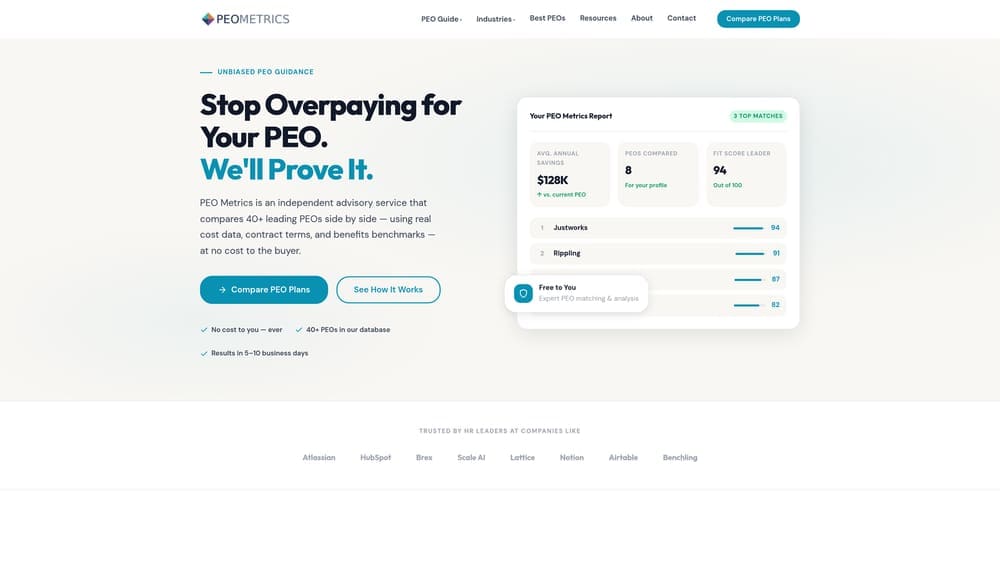
PEO Metrics is a PEO comparison and advisory service — not a PEO itself — that helps trucking companies evaluate providers side-by-side before committing to a contract.
Where This Tool Shines
For trucking companies, the biggest mistake in PEO selection isn’t picking the wrong provider — it’s picking without comparing. Workers’ comp structure, pricing methodology, and multi-state capability vary dramatically across PEOs, and those differences matter far more in high-risk industries than in low-risk ones.
PEO Metrics gives you a structured way to cut through the noise. Instead of taking five separate sales calls and trying to compare apples to oranges, you get a side-by-side breakdown of what each provider actually offers — pricing, comp handling, contract terms, and service depth. That’s particularly valuable in trucking, where the wrong comp program alone can cost you significantly more than the right one.
Key Features
Side-by-Side Comparisons: Evaluate multiple PEOs simultaneously on pricing, services, and contract terms without relying on each vendor’s own sales materials.
Unbiased Guidance: No vendor relationships that skew recommendations — the analysis is independent.
High-Risk Industry Filtering: Helps identify PEOs with experience handling elevated workers’ comp classifications, which is directly relevant to trucking.
Time Savings: Filters out providers that aren’t equipped for your risk profile before you waste time on discovery calls.
Multi-Provider Evaluation: Useful when comparing three to five PEOs simultaneously, which is the right approach for any serious evaluation.
Best For
Any trucking company that hasn’t yet signed with a PEO — or is approaching a renewal and wants to know if they’re overpaying. Also useful for carriers that have gotten burned by a PEO that wasn’t equipped for their risk profile and want a more structured process the second time around.
Pricing
Free to use. PEO Metrics is a comparison and advisory service, not a subscription product.
2. Employers PEO
Best for: Small to mid-size trucking companies focused on managing workers’ comp costs
Employers PEO is an insurance-backed PEO with deep roots in workers’ compensation — a meaningful distinction for an industry where comp costs are the primary financial lever.
Where This Tool Shines
Most PEOs treat workers’ comp as a line item. Employers built its business around it. That orientation matters for trucking companies, where driver classification codes carry some of the highest comp rates in any industry. An insurance-backed structure can provide more stability in how those costs are managed, particularly for smaller carriers that don’t have the volume to self-insure or access captive programs independently.
The tradeoff is that Employers PEO is a smaller operation. You won’t get the enterprise-level HR technology or the deep benefits bench that larger PEOs offer. But if your primary concern is comp cost control and you’re running a smaller fleet, that narrower focus can actually work in your favor.
Key Features
Insurance-Backed Workers’ Comp: Integrated comp coverage with experience managing higher-hazard classification codes.
Bundled HR Administration: Payroll, HR administration, and compliance packaged alongside comp coverage.
Small Business Focus: Service model oriented toward smaller employers rather than enterprise-scale operations.
Cost Control Orientation: The underlying business model is built around managing insurance exposure, which aligns with trucking’s primary cost concern.
Best For
Small trucking operations — think fleets under 50 employees — where workers’ comp is the dominant cost concern and the priority is finding a PEO that won’t price them out due to their risk profile. Less suited to carriers that need deep multi-state HR infrastructure or competitive benefits packages for driver recruiting.
Pricing
Custom pricing — contact for a quote based on headcount and risk profile. Expect the comp component to factor heavily into the overall cost structure.
3. Acrisure Workforce Solutions
Best for: Regional carriers with drivers operating across multiple states
Acrisure Workforce Solutions (formerly operating under the Oasis brand) brings multi-state payroll and HR infrastructure built for employers with distributed workforces — a direct fit for carriers whose drivers regularly cross state lines.
Where This Tool Shines
Multi-state payroll compliance is one of the most underestimated headaches in trucking HR. Drivers create nexus questions across state lines — payroll tax withholding, unemployment insurance, and state-specific employment law all come into play when your workforce is mobile. Acrisure’s infrastructure, inherited from Oasis’s years of multi-state operations, is built to handle this kind of complexity.
The platform is oriented toward mid-market employers, which makes it a reasonable fit for regional carriers that have outgrown basic payroll solutions but aren’t large enough to justify a fully custom enterprise HR setup. The benefits access for mid-size employers is also worth noting for carriers competing for CDL talent.
Key Features
Multi-State Payroll Infrastructure: Tax compliance and withholding management across multiple states — relevant for any carrier with routes crossing state lines.
HR Administration and Onboarding: Structured onboarding support useful for carriers that frequently hire drivers.
Benefits Access: Group health and ancillary benefits access for mid-market employers who wouldn’t qualify for competitive rates independently.
Workers’ Comp Administration: Risk management and comp administration included in the service bundle.
Best For
Regional carriers with 25 to 150 employees operating across multiple states who need solid multi-state compliance infrastructure. Less ideal for very small fleets or for carriers whose primary concern is comp cost control rather than payroll complexity.
Pricing
Custom pricing — varies by headcount and service tier. Contact Acrisure directly for a quote.
4. TriNet
Best for: Mid-size trucking companies prioritizing CDL driver recruitment and retention
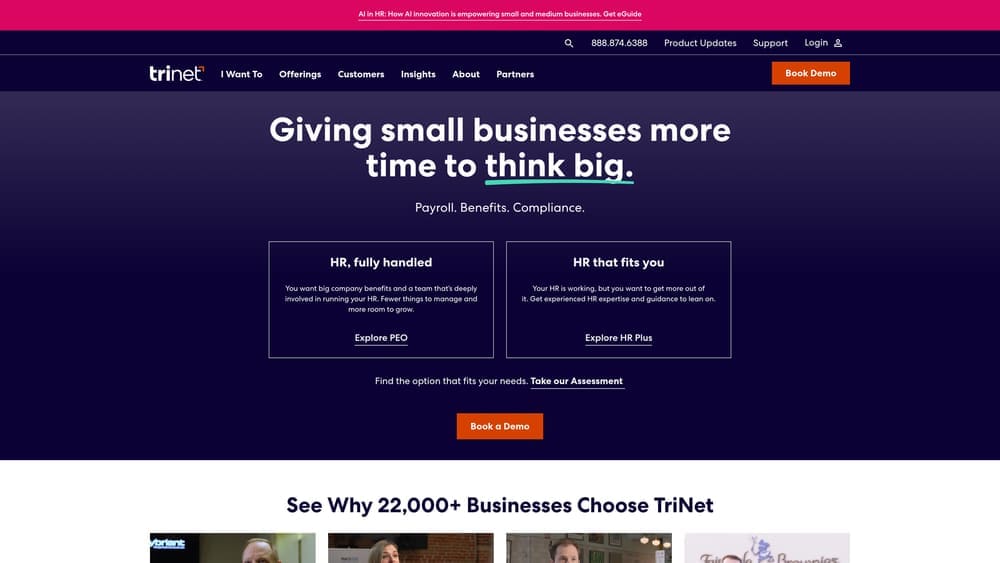
TriNet is one of the better-known PEOs for employers that compete on benefits quality — which matters more in trucking than most industries, given how difficult it is to recruit and retain qualified CDL drivers.
Where This Tool Shines
Small and mid-size carriers can’t independently access the same health insurance rates as large employers. TriNet’s co-employment model pools employees across its client base, giving smaller trucking companies access to Fortune 500-level benefits packages they couldn’t offer on their own. In a market where experienced CDL drivers have options, that gap in benefits quality is a real competitive disadvantage — and TriNet directly addresses it.
The multi-state compliance support is solid, and the HR platform is more polished than what you’d get from smaller PEOs. That said, TriNet is not a comp-specialist PEO. If workers’ comp cost control is your primary concern, you’ll want to evaluate carefully whether their comp program is structured competitively for high-risk classifications.
Key Features
Fortune 500-Level Benefits: Health, dental, and vision packages that small carriers couldn’t access independently — a genuine driver retention tool.
Multi-State Payroll and Compliance: Payroll processing and tax compliance across multiple states.
HR Technology Platform: Online HR tools with employee self-service capabilities.
Dedicated HR Support: Access to HR specialists for guidance on employment matters.
Industry-Specific Guidance: Some vertical-specific HR support available depending on account configuration.
Best For
Mid-size trucking companies with 20 to 100 employees where driver retention is a real operational problem and competitive benefits would make a meaningful difference. Less suited to very small fleets or operations where comp cost structure is the primary concern.
Pricing
Per-employee per-month pricing — typically ranges from $80 to $600 per employee depending on services and benefits selected. Contact TriNet for a specific quote based on your headcount and configuration.
5. Insperity
Best for: Growing trucking operations that need real HR guidance, not just a software portal
Insperity is one of the largest PEOs in the U.S., and its primary differentiator is service depth. You get a dedicated HR specialist assigned to your account — an actual person who knows your business — rather than a ticketing system and a chatbot.
Where This Tool Shines
Trucking companies scaling quickly face a specific HR challenge: the operational complexity grows faster than the internal HR capacity. Hiring decisions, compliance questions, and workers’ comp incidents pile up, and a software dashboard doesn’t solve that. Insperity’s high-touch model is designed for exactly this scenario — a dedicated specialist who can work through real HR problems rather than routing everything through a generic support queue.
The benefits administration is comprehensive, and the payroll infrastructure handles multi-state complexity well. Insperity isn’t the cheapest option, but for carriers that are growing and need substantive HR support rather than just administrative processing, the service depth tends to justify the cost.
Key Features
Dedicated HR Specialist: A named HR professional assigned to your account — not a call center rotation.
Comprehensive Benefits Administration: Health, retirement, and ancillary benefits with strong plan options.
Workers’ Comp and Risk Management: Comp administration and risk management support included.
HR Technology Tools: Performance management and HR platform access alongside the human support layer.
Best For
Trucking companies in a growth phase — typically 30 to 150 employees — that are adding headcount, dealing with complex HR situations, and need a PEO that acts more like an HR partner than a payroll processor. Not the right fit for price-sensitive small fleets looking for the lowest per-employee cost.
Pricing
Custom pricing — typically structured as a percentage of payroll or a per-employee fee. Contact Insperity directly for a quote. Generally positioned at the higher end of the market, reflecting the service depth.
6. ADP TotalSource
Best for: Larger trucking operations with complex multi-state payroll and compliance needs
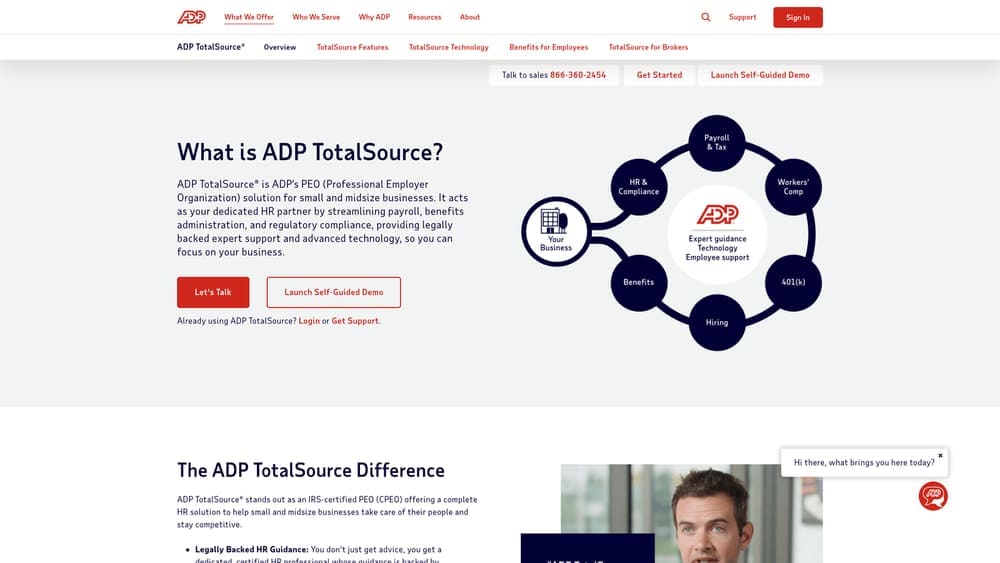
ADP TotalSource is ADP’s full-service PEO offering — enterprise-grade payroll infrastructure, broad multi-state compliance capability, and deep integration with ADP’s broader HR ecosystem. It’s built for scale, which means it’s better suited to mid-to-large carriers than to small fleets.
Where This Tool Shines
If you’re running a larger trucking operation with drivers across many states, complex payroll configurations, and a need for enterprise-level HR technology, ADP TotalSource brings the infrastructure to handle it. The multi-state compliance capability is among the strongest in the PEO market, and the integration with ADP’s existing payroll and HR tools means less friction if you’re already in their ecosystem.
The honest caveat: ADP TotalSource is a broad platform, not a trucking specialist. You won’t get industry-specific FMCSA guidance or specialized comp programs tailored to transportation. What you will get is reliable, enterprise-grade execution across payroll, compliance, and benefits — which matters a lot when your operations span multiple states and jurisdictions.
Key Features
Robust Multi-State Payroll: Tax compliance and payroll processing across all 50 states — a genuine strength for carriers with wide geographic footprints.
ADP Ecosystem Integration: Works within ADP’s broader HR and payroll infrastructure if you’re already using their tools.
Large-Group Benefits Access: Health and benefits administration with access to large-group insurance rates.
Workers’ Comp and Risk Management: Comp administration and risk services included in the PEO bundle.
Multi-State Compliance Support: Strong compliance infrastructure for employers operating across multiple jurisdictions.
Best For
Larger trucking and logistics operations — typically 75 employees and above — that need enterprise-grade payroll and compliance infrastructure and are less concerned with finding a trucking specialist than with finding a reliable, scalable platform.
Pricing
Custom pricing — generally competitive at higher headcounts. Contact ADP directly for a quote based on employee count and services required.
7. Justworks
Best for: Small fleets that want predictable HR costs without complicated contracts
Justworks is a PEO built around transparency and simplicity. Flat per-employee monthly pricing, no hidden fees, and a clean platform that doesn’t require a dedicated HR person to navigate. It’s not the deepest option for complex trucking operations, but for small fleets that want cost predictability, it’s worth considering.
Where This Tool Shines
Most PEO contracts are hard to fully price until you’re deep into the sales process. Justworks is different — the pricing is published and straightforward. For a small trucking company trying to budget HR costs without surprises, that transparency has real value. The no-long-term-contract policy also reduces the commitment risk, which matters when you’re evaluating a PEO for the first time.
The honest limitation: Justworks isn’t built for high-risk industries. If your workers’ comp classification codes are complex or your drivers are spread across many states with layered compliance requirements, you’ll likely outgrow Justworks quickly. It’s a solid entry point for simple operations, not a long-term platform for carriers with real complexity.
Key Features
Transparent Flat-Rate Pricing: Published per-employee monthly fees — no guessing what you’ll actually pay.
Benefits Access: Health, dental, vision, and 401(k) options available through the platform.
Payroll Processing: Basic multi-state payroll and compliance included.
Simple Platform: Low learning curve — manageable without a dedicated HR staff member.
No Long-Term Contracts: Lower commitment barrier compared to most PEO providers.
Best For
Small fleets — under 25 employees — with relatively straightforward operations, limited multi-state complexity, and a primary need for benefits access and payroll administration. Not the right fit for carriers with high-risk comp classifications or complex driver compliance requirements.
Pricing
Starts at approximately $59 per employee per month for the basic tier. Higher tiers available with benefits included. Check Justworks directly for current pricing, as rates are periodically updated.
8. Paychex PEO
Best for: Trucking companies already using Paychex for payroll who want to consolidate HR services
Paychex PEO is a natural consolidation play for carriers that are already running payroll through Paychex. The national footprint, familiar interface, and relatively smooth upgrade path make it a low-friction option for businesses that don’t want to migrate platforms.
Where This Tool Shines
If your drivers are already paid through Paychex, the transition to their PEO service is meaningfully simpler than switching to an entirely new provider. You keep the same interface, the same support contacts, and the same payroll data history. For a trucking company that’s growing and needs to add HR services without disrupting existing operations, that continuity has real practical value.
Paychex PEO is broad rather than specialized. It covers the fundamentals well — payroll, benefits, compliance, workers’ comp — but it doesn’t bring trucking-specific expertise. The national coverage across all 50 states is a genuine strength for carriers with wide geographic reach.
Key Features
Seamless Paychex Integration: Smooth upgrade path for existing Paychex payroll customers — minimal platform disruption.
National Coverage: Payroll and compliance support across all 50 states.
Benefits and Workers’ Comp: Benefits administration and comp support included in the PEO bundle.
HR Administration: Compliance assistance and HR administration services.
Dedicated Payroll Specialist: Assigned specialist support for payroll-related questions.
Best For
Trucking companies that are already Paychex customers and want to add PEO services without changing platforms. Also a reasonable fit for carriers that need broad national coverage and standard HR administration without requiring industry-specific depth.
Pricing
Custom pricing — contact Paychex directly for a quote based on employee count and services. Pricing is not published publicly.
9. Engage PEO
Best for: Carriers with multi-state employment law complexity and compliance-heavy operations
Engage PEO is a smaller PEO with an attorney-led compliance team — a meaningful structural difference from most providers. For trucking companies operating across multiple states and jurisdictions, that regulatory depth can reduce real legal exposure.
Where This Tool Shines
Most PEOs handle compliance through HR generalists. Engage built its model around attorneys. That distinction matters when you’re dealing with multi-state employment law questions, driver classification issues, or regulatory changes that carry legal risk. For carriers navigating complex jurisdictional questions — particularly around owner-operator classification or state-specific employment law — having attorneys in the compliance chain rather than just HR professionals is a meaningful advantage.
Engage is a smaller operation, so the technology platform and benefits depth won’t match what you’d get from TriNet or ADP TotalSource. But if compliance precision is your primary concern, the attorney-led model is genuinely differentiated.
Key Features
Attorney-Led Compliance Team: HR compliance backed by employment attorneys — not just HR generalists.
Multi-State Employment Law Support: Regulatory depth across multiple jurisdictions, relevant for carriers with drivers in many states.
Payroll and Tax Administration: Standard payroll processing and tax compliance included.
Benefits Access and Administration: Group benefits access and administration support.
Risk Management and Workers’ Comp: Comp administration and risk services included.
Best For
Trucking companies with genuine multi-state compliance complexity — particularly those dealing with classification questions, multi-jurisdiction employment law, or situations where legal exposure around HR decisions is a real concern. Not the best fit for carriers whose primary priority is benefits depth or enterprise-scale payroll technology.
Pricing
Custom pricing — contact Engage PEO directly for a quote. Pricing is not published publicly.
Owner-Operators and Employee Classification: What PEOs Can and Can’t Do
One of the most common points of confusion when trucking companies evaluate PEOs is the owner-operator question. If your operation uses 1099 owner-operators alongside W-2 employees, the PEO relationship only covers the W-2 side. Owner-operators are independent contractors — a PEO cannot employ them on your behalf without fundamentally changing the nature of that relationship, and doing so creates its own legal exposure.
That matters for a few reasons:
Workers’ comp coverage does not extend to 1099 contractors. Owner-operators you engage as independent contractors are outside the PEO’s master workers’ comp policy. If a misclassified contractor files a claim, you’re looking at coverage gaps and potential regulatory scrutiny at the same time.
Classification risk doesn’t disappear when you join a PEO. A PEO can help you manage your existing workforce compliantly, but it doesn’t audit your contractor relationships or certify that your 1099 driver arrangements meet IRS or DOL standards. If you have owner-operators whose working arrangements look a lot like employment — set schedules, exclusive arrangements, company-provided equipment — that classification exposure stays with you regardless of your PEO setup.
Some PEOs can flag the risk; few can resolve it. Engage PEO, with its attorney-led compliance team, is better positioned than most to identify classification vulnerabilities and advise on remediation. Most generalist PEOs will not proactively surface this issue. If classification risk is real in your operation, bring it up explicitly during the sales process and ask how the PEO handles it — not whether they’re aware of it.
The practical guidance: get a clear count of your W-2 employees versus 1099 owner-operators before approaching any PEO. Know which group you’re trying to cover and be explicit about your contractor arrangements early in the evaluation. A PEO that doesn’t ask about this during discovery is a PEO that won’t help you manage it after you sign.
Which PEO Actually Fits Your Trucking Operation
Trucking companies don’t have the luxury of picking a generic PEO and hoping it works out. The workers’ comp exposure alone — especially for long-haul drivers — can make or break your total cost. Add in multi-state compliance, DOT regulations, and the ongoing challenge of retaining CDL drivers, and you need a PEO that’s actually equipped for your operating environment.
Here’s a practical way to think about it by situation:
If you’re starting from scratch: Use PEO Metrics first. Get a side-by-side comparison before any sales calls. The differences in pricing structure and comp handling across providers are significant, and you won’t see them clearly until you compare them on the same criteria.
If workers’ comp costs are your primary concern: Employers PEO and Engage PEO deserve a close look. Both bring more regulatory and comp depth than generic platforms.
If you’re competing for CDL drivers: TriNet and Insperity are worth evaluating for benefits depth. Access to competitive health packages can be a real differentiator in a tight driver market.
If you’re a larger operation with complex payroll: ADP TotalSource and Acrisure Workforce Solutions are built for the scale and multi-state complexity that larger carriers face.
If you’re a small fleet that wants simplicity: Justworks or Paychex PEO (if you’re already a Paychex customer) offer lower-friction entry points.
Whatever direction you go, don’t sign without comparing at least three providers on the same criteria: pricing structure, workers’ comp handling, multi-state capability, and contract terms. The differences are significant, and the right fit can save you real money.
Before you sign that PEO renewal, make sure you’re not leaving money on the table. Many trucking companies unknowingly overpay because of bundled fees, hidden administrative markups, and contracts designed to limit flexibility. Don’t auto-renew. Make an informed, confident decision.
Before you sign that PEO renewal, make sure you’re not leaving money on the table.
Many businesses unknowingly overpay because of bundled fees, hidden administrative markups, and contracts designed to limit flexibility. We give you a clear, side-by-side breakdown of pricing, services, and contract terms—so you can see exactly what you’re paying for and choose the option that truly fits your business.
